Wines of ItalyWines of Italy
• Italy often called as “Vineyards of the
World”
• The Greeks called Italy Oenotria-tellus (The
land of vines), because of the great affinity
that the vines displayed for the sun & soil of
Italy.
• The Greeks first brought the vines to Italy
almost 5000 years ago.
Cont…Cont…
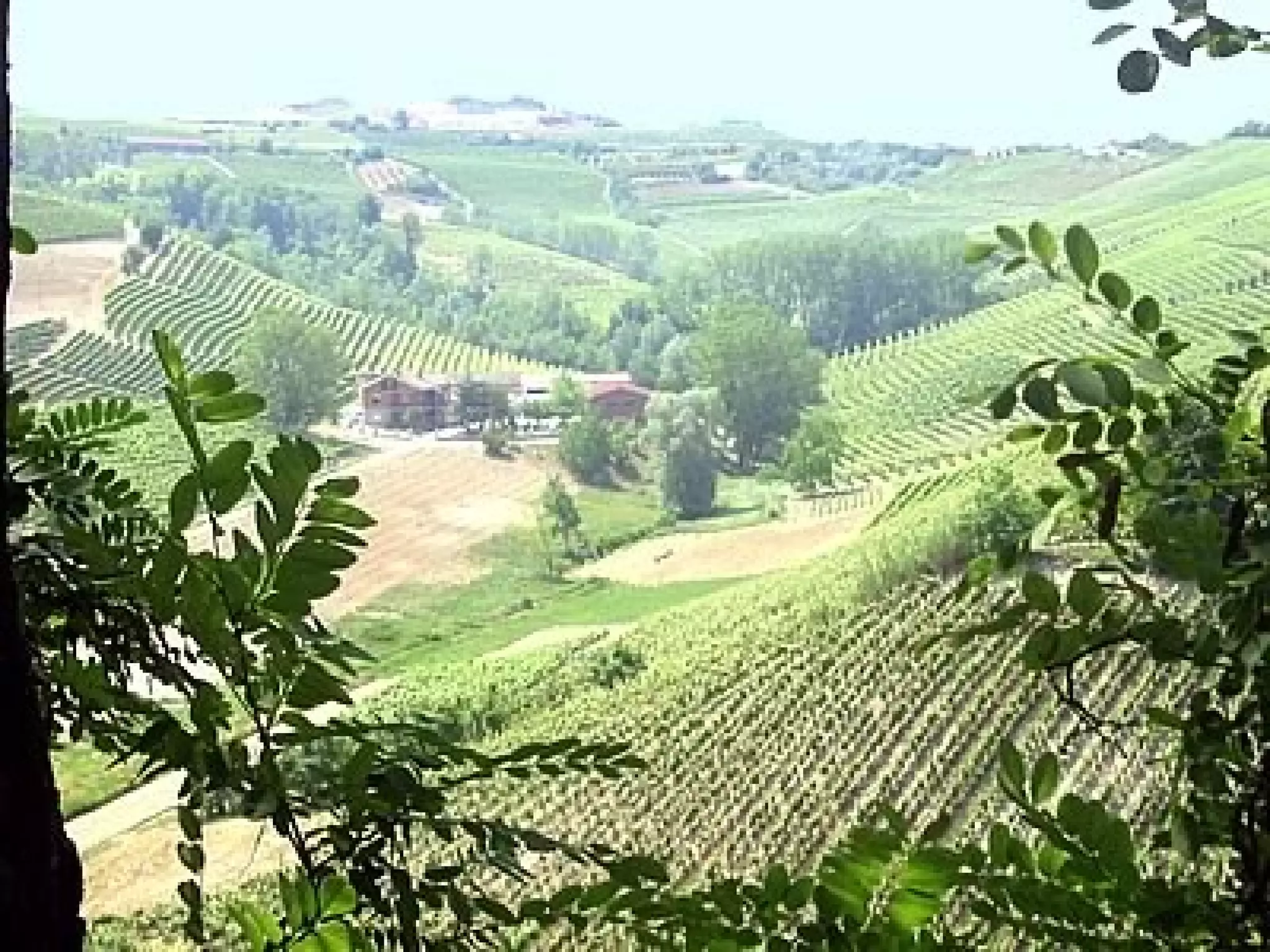
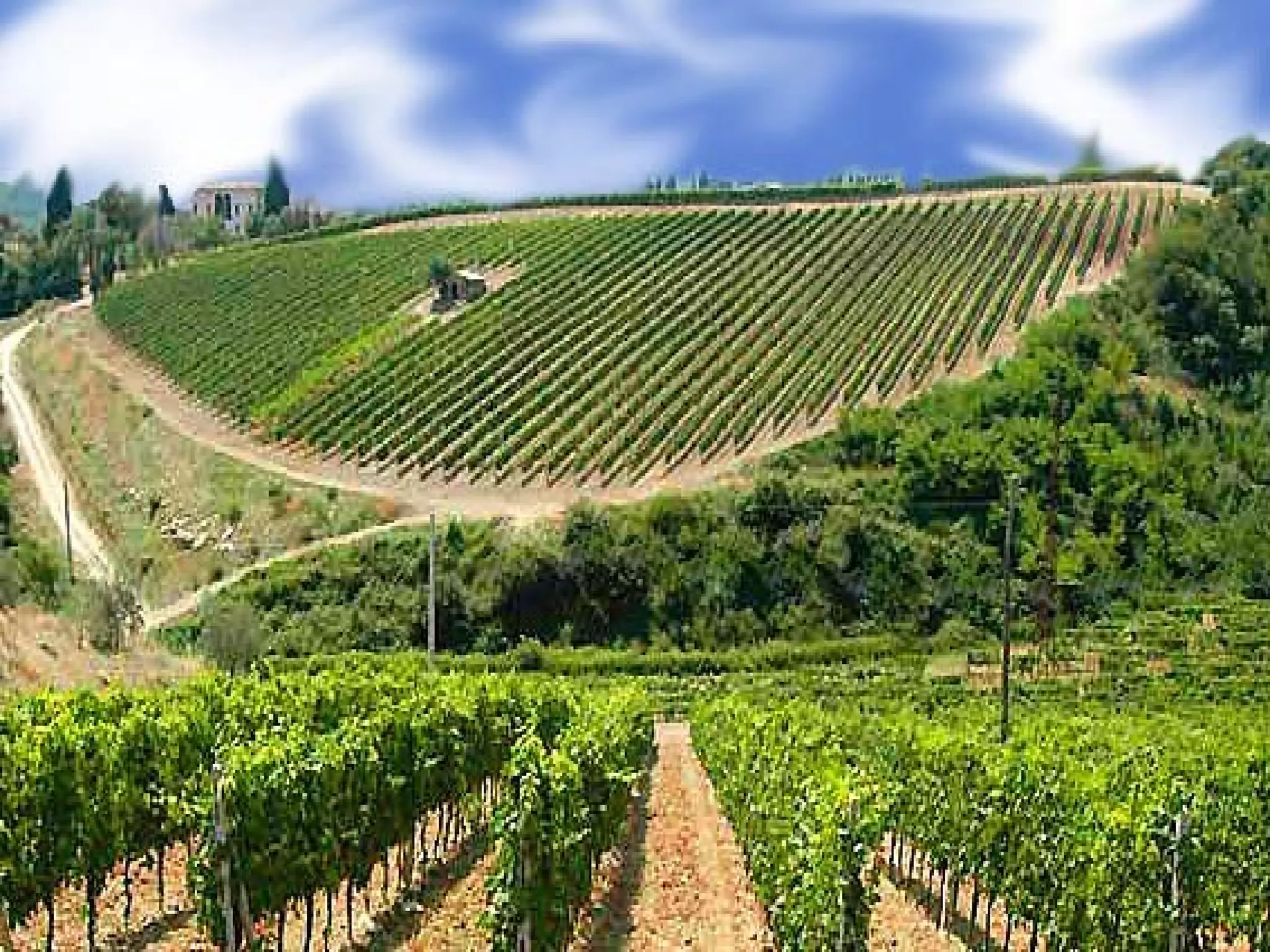
• The vines thrive on Italy’s mountainous
slopes, rich planes & gently rolling hills.
• It can probably claim to the longest unbroken,
tradition of viticulture in comparison to any
country.
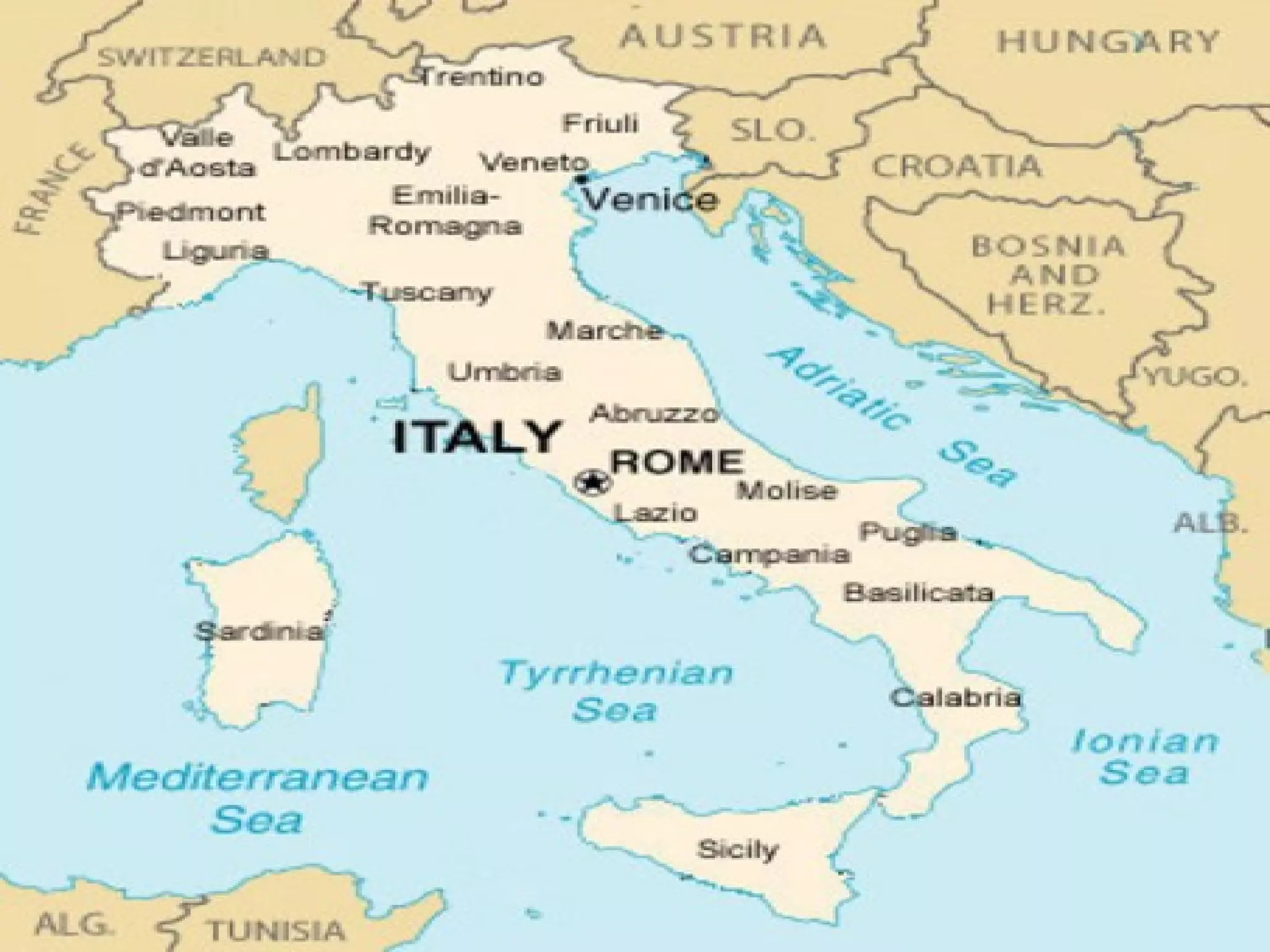
• Italy is divided into 6 areas, which are made
up of provinces.
Cont..Cont..
• The northern produces better wines than the south.
• Table wines in the ratio of 4:1 red: white, sparkling,
fortified& aromatized wines are produced.
• The per capita consumption of wines is 184 bottles
per year.
• Italy in last 30 odd years of this century has
undergone more changes than it had in the previous
1000 years.
Cont…Cont…
• In 1960 a widespread replanting took place in
Italy, where viticulture underwent a total
change. As opposed to the Greek influence the
vine in the north are now trained low & those
in south, which were traditionally, trained low
are now trained higher.
GeographyGeography
• Entire peninsula covered with mountains.
• In the west & north lies snow covered Alps and in the
east Venetian Alp.
• Winters are long & bitter
• Valley is fertile.
• Due to great length Italy has a varied climate.
• Soil is chalky and volcanic.
Italian VineyardsItalian Vineyards
GrapesGrapes
White Grapes
• Cortesse Bianco
• Malvasia Bianco
• Pinot Bianco
• Vernaccia
Red Grapes
• Aleatico Nero
• Barbera
• Brachello
• Sangiovese
ClassificationClassification
• DOCG - Denominazione di Origine Controllata Garantita-
Controlled & guaranteed. Guarantees of high quality of wine, which
have confirmed to the most demanding regulation.
• DOC - Denominazione di Origine Controllata. This is category of
Italian wine. The vine species used & where they may be grown,
maximum yields, minimum strength etc. are some factors that are
taken into consideration before granting this appellation to a wine.
• IGT- Indicazione Geografica Tipica is the second of four
classifications of wine recognized by the government of Italy. IGT
wines are labeled with the locality of their creation, but do not meet
the requirements of the stricter DOC or DOCG designations. It is
considered broadly equivalent to the French vin de pays designation.
• VDT- Vino Da Tavola - A table wine.
Wine producing RegionsWine producing Regions
Piedmont-
• Situated in North east.
• Main river Po
• Famous for Italian vermouths, which are sweet &
red.
• Asti spumante is made by Methode
Champenoise .
Barolo (Red)Barolo (Red)
• Highest rated Italian red wine.
• It is produced from 100%
nebbiolo grapes.
• Barolo must have a minimum
alcoholic strength of 13%,
• Aged for a minimum period of 3
years.
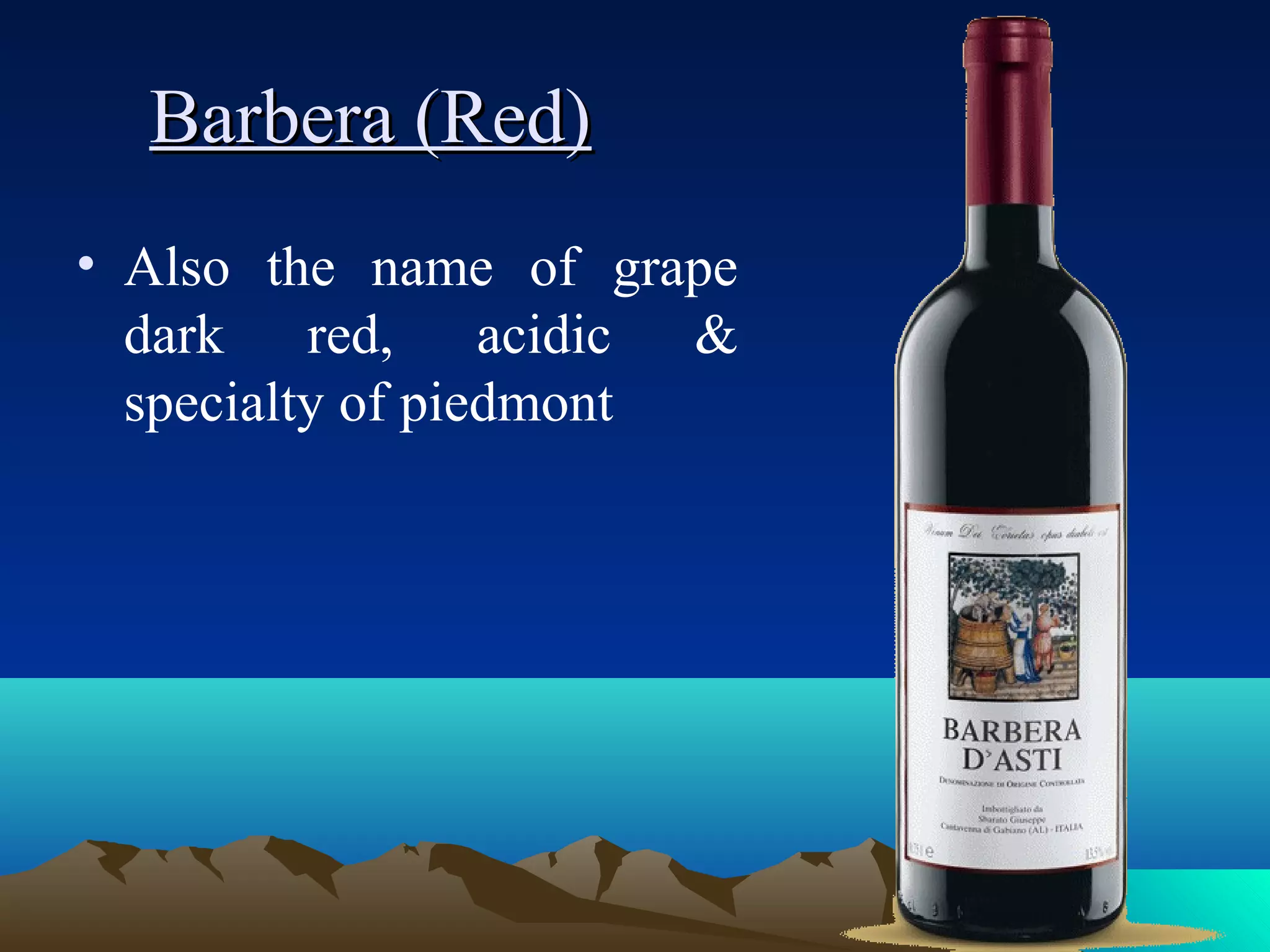
Barbera (Red)Barbera (Red)
• Also the name of grape
dark red, acidic &
specialty of piedmont
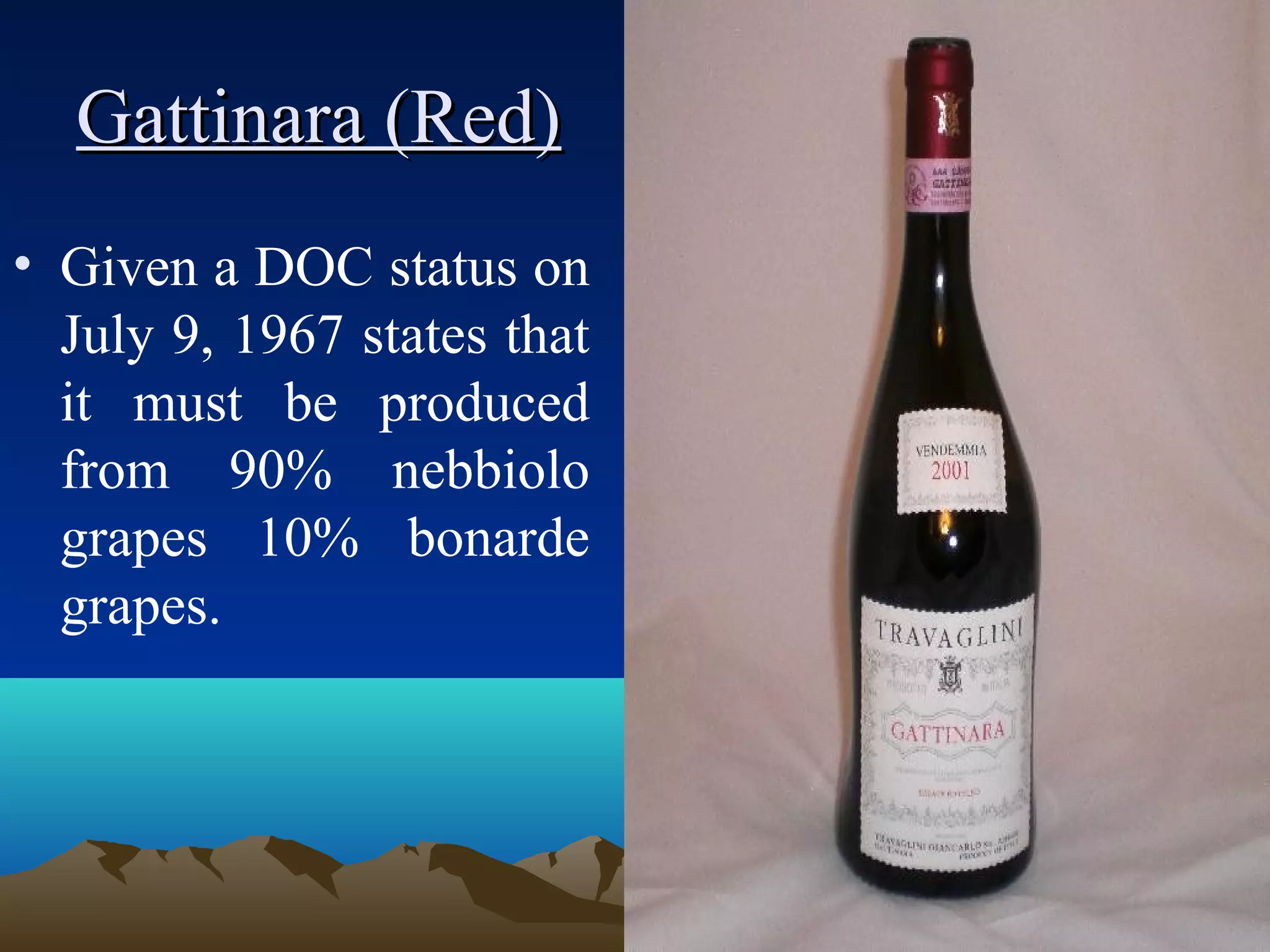
Gattinara (Red)Gattinara (Red)
• Given a DOC status on
July 9, 1967 states that
it must be produced
from 90% nebbiolo
grapes 10% bonarde
grapes.
Barbaresco (red)Barbaresco (red)
o This district lies north east
of river Alba and
produces dry, full bodied
ruby red wine.
Cont..Cont..
• Freisa (red) – Also a name of grape variety, grown
in piedmont, which produces 2 styles of wine
Asti spumante (sparkling)Asti spumante (sparkling)
• White sweet
sparkling wine
produced in the
town of Asti in
south
• Alcoholic strength
is 7%, having full
flavour of ripe green
grape. E.g.
– Fontanafredda
– Sandro
– Martini
Cortese (White)Cortese (White)
• The traditional white wine grape variety
of Piedmont that produces a white wine
of particular refinement.
• The wine made from cortese grapes can
be labeled as Cortese d’ gavi or simply
Gavi
LombardyLombardy
• Northwest zone east of piedmont. It is the fashion &
the financial capital of Italy. Campari is the most well
known aperitif.
• Barbacario (Red) – should have a minimum alcoholic
strength of 12% & is produced from a blend of
Barbera & Bonarda grapes
• Riesling (White) – minimum 11% alcohol also
produced as spumante. Made from a blend of Riesling
Renano or Riesling Italianco or a combination of
both.
VenetoVeneto
• Important city is Verona, but Venice is the
city, which is well known & is also a port for
merchant navy. It is famous for
• Waterways,
• Gondolas;
• St. marks Square,
• St. Marks cathedral.
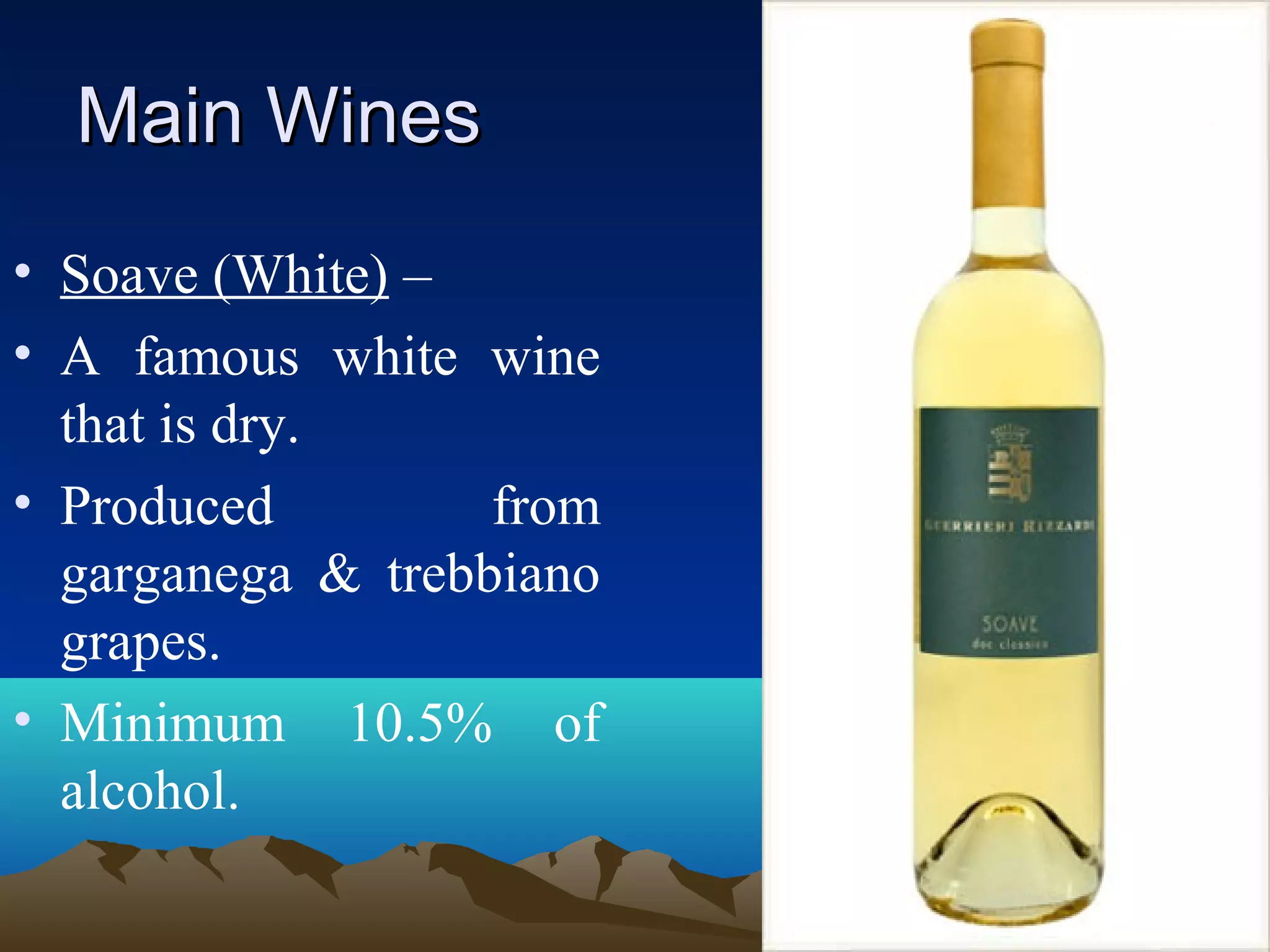
Main WinesMain Wines
• Soave (White) –
• A famous white wine
that is dry.
• Produced from
garganega & trebbiano
grapes.
• Minimum 10.5% of
alcohol.
Cont..Cont..
• Gambellara (White) –
Made from a
combination of
garganega & trebbiano
grapes. Should have
minimum 11% alcohol
Cont..Cont..
• Bianco di custoza (White)
Made from a combination of
trebbiano, toscano &
garganega grapes. Also
produced as a spumante
should have a minimum
alcoholic strength of 11%
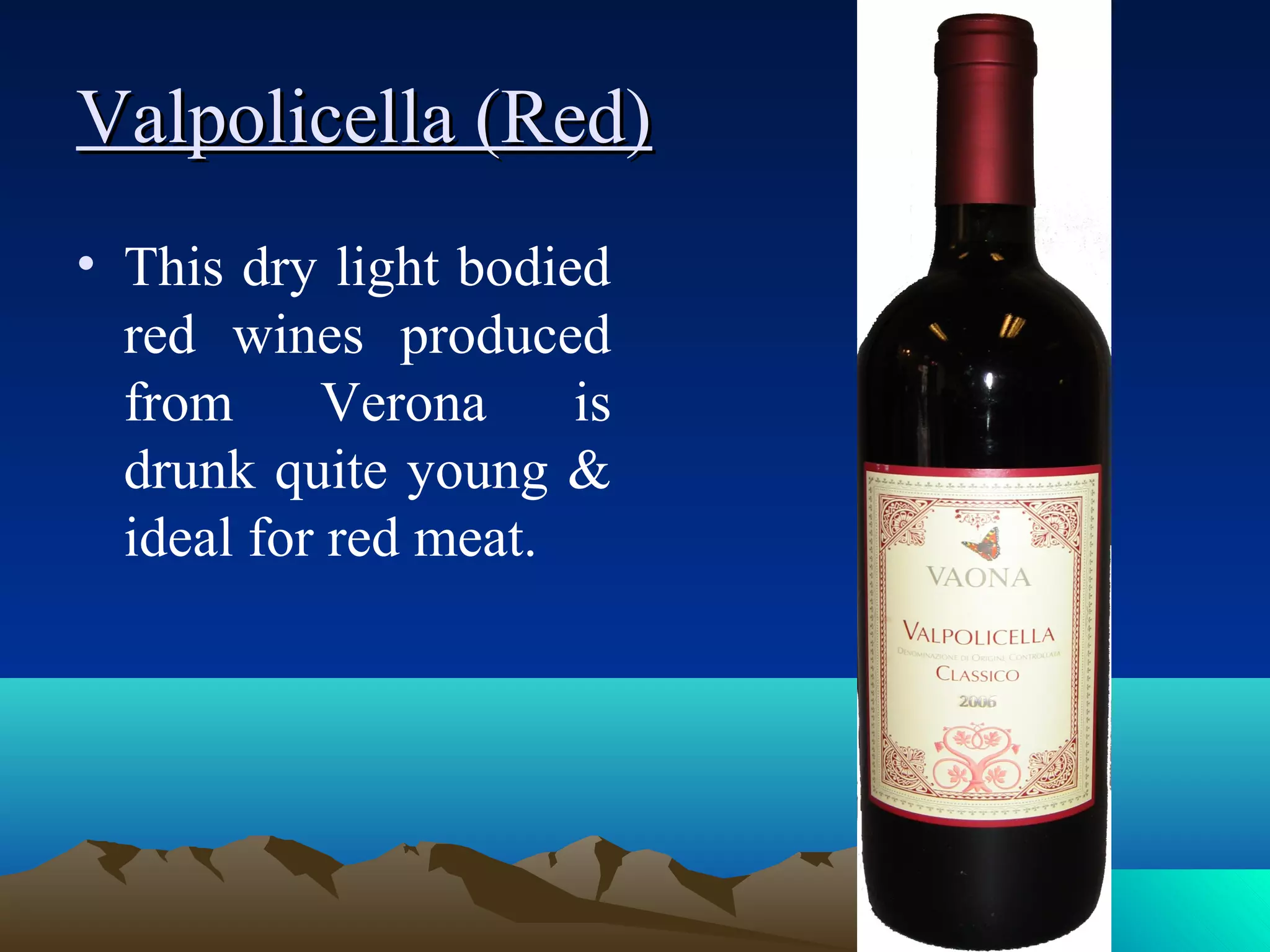
Valpolicella (Red)Valpolicella (Red)
• This dry light bodied
red wines produced
from Verona is
drunk quite young &
ideal for red meat.
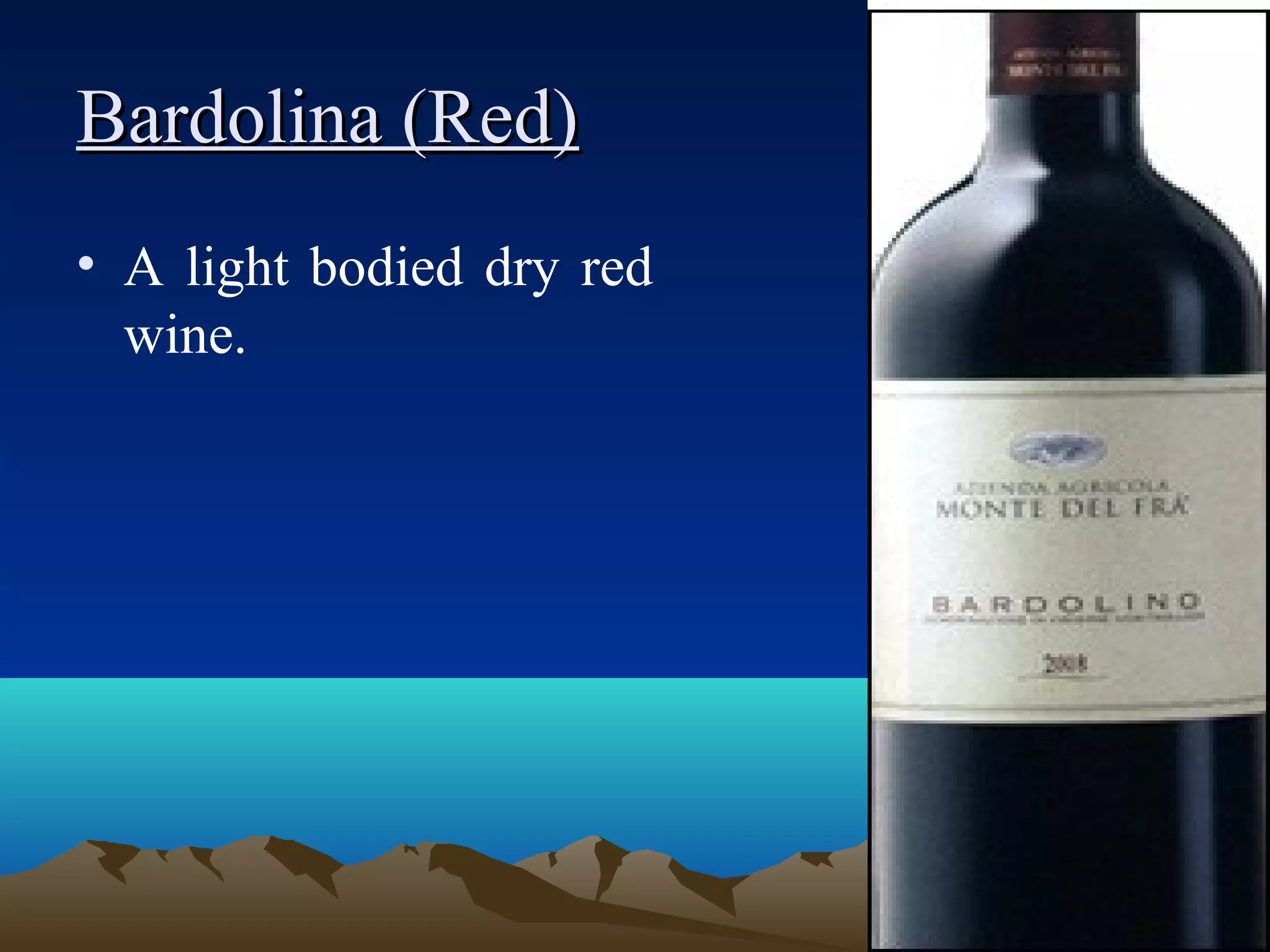
Bardolina (Red)Bardolina (Red)
• A light bodied dry red
wine.
TuscanyTuscany
• It is famous for the
leaning tower of Pisa &
architecture and aged
wines, which are probably
the most famous of all
Italian red table wines that
is the Chianti.
Main WinesMain Wines
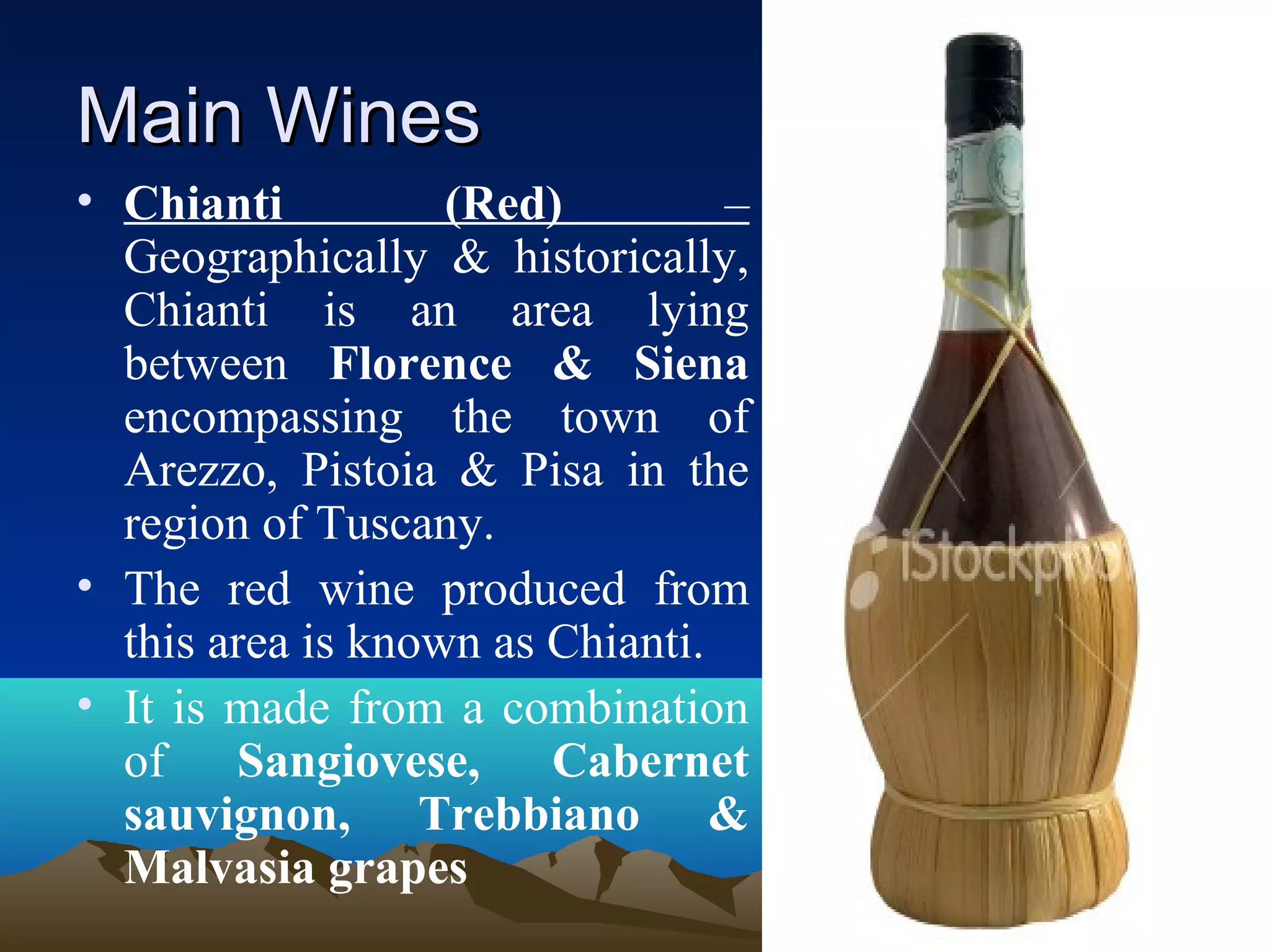
• Chianti (Red) –
Geographically & historically,
Chianti is an area lying
between Florence & Siena
encompassing the town of
Arezzo, Pistoia & Pisa in the
region of Tuscany.
• The red wine produced from
this area is known as Chianti.
• It is made from a combination
of Sangiovese, Cabernet
sauvignon, Trebbiano &
Malvasia grapes
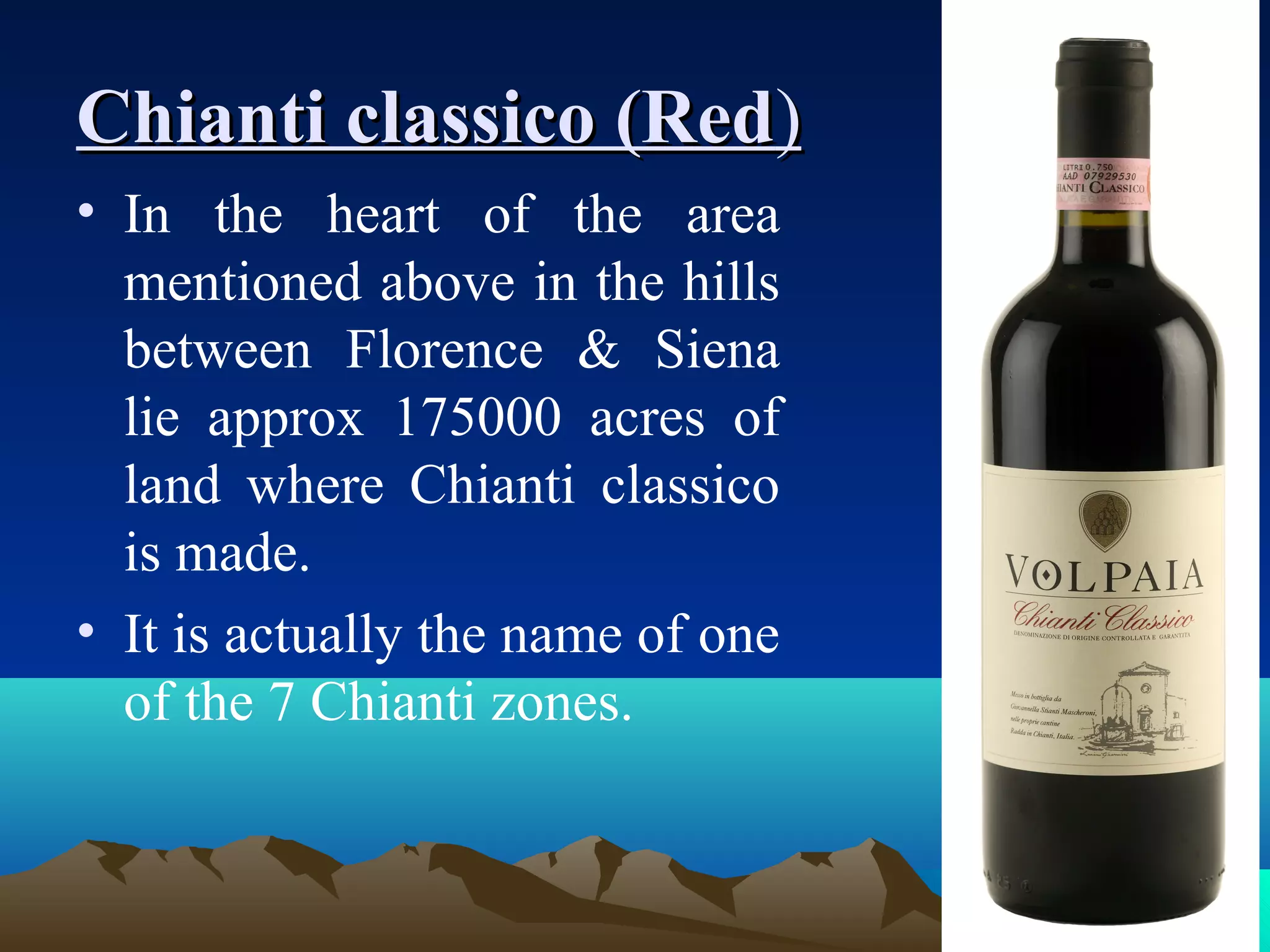
Chianti classico (RedChianti classico (Red))
• In the heart of the area
mentioned above in the hills
between Florence & Siena
lie approx 175000 acres of
land where Chianti classico
is made.
• It is actually the name of one
of the 7 Chianti zones.
Other winesOther wines
Brunello di Montalcino (Red)-
• An extremely full-bodied red wine
produced from the Tuscany region it
is Italy’s finest & longest-lived
wines.
Bianco di Pitigliano (White)Bianco di Pitigliano (White)
• A white wine
produced from
the Tuscany
region white dry,
fruity, & lively.
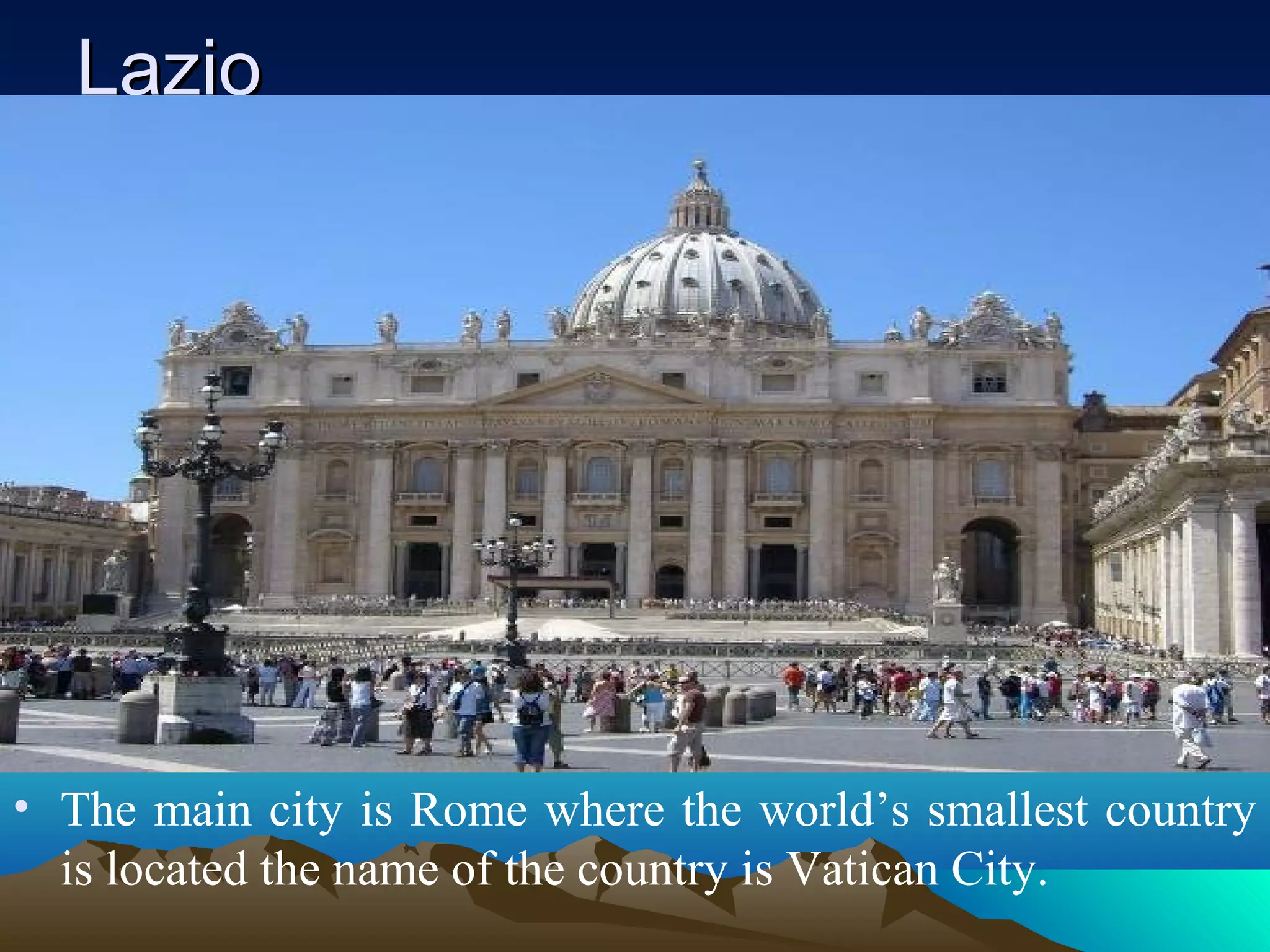
LazioLazio
• The main city is Rome where the world’s smallest country
is located the name of the country is Vatican City.
FrascatiFrascati
• It has around
11.5% of alcohol.
It can be a dry
white wine or a
semi white
sparkling wine.
Est! Est!! Est!!! (White)Est! Est!! Est!!! (White)
• Abbreviated form of
venum bonum est.
Est, est, est is made
from Muscat ,
Merlot & Cabernet
Sauvignon grapes.
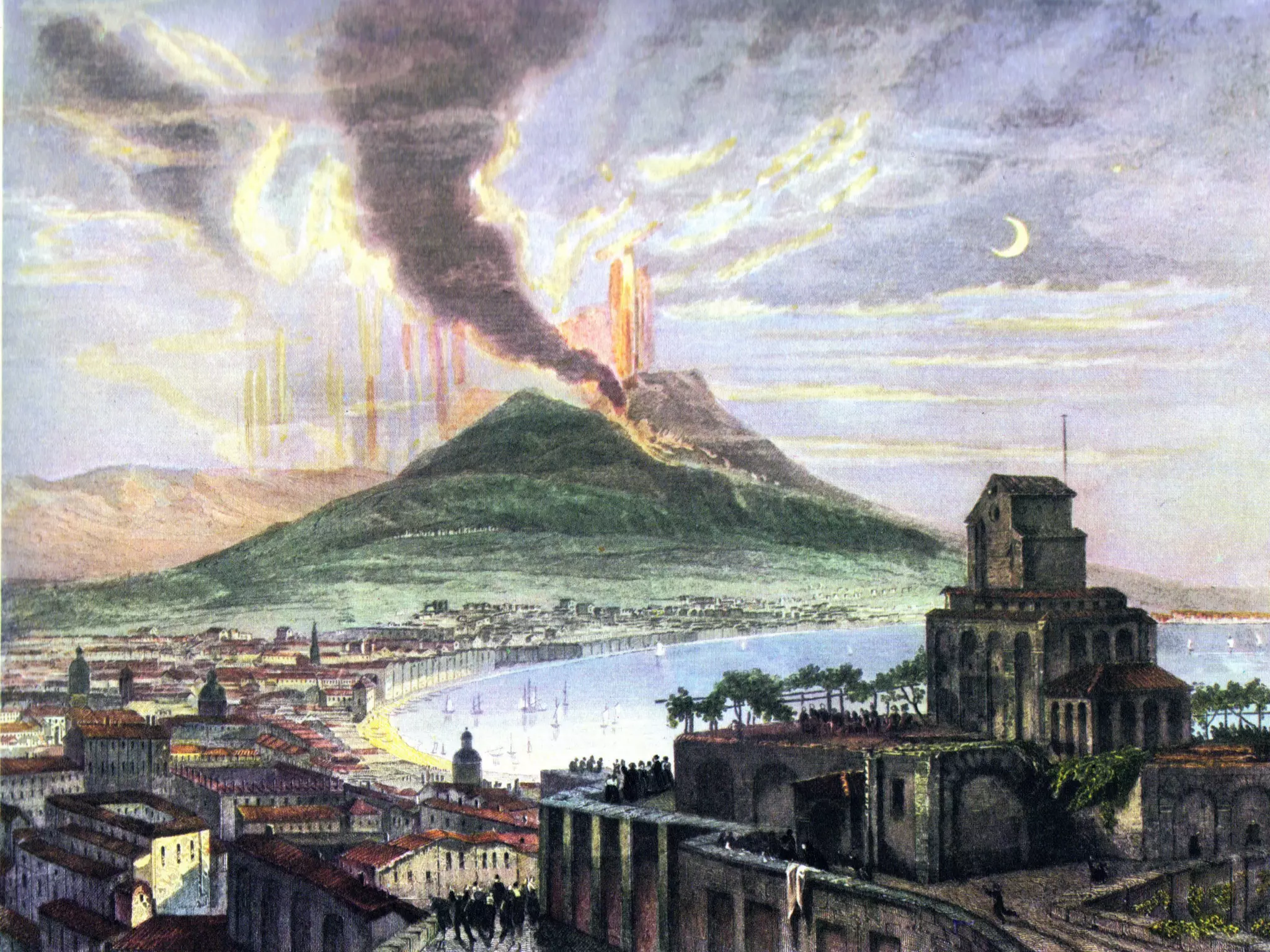
CampaniaCampania
• The area is more famous as a tourist attraction
rather than wine production.
• The main city is Naples.
• The most well known wine from this area is:
Lacryma Christi (Tear of Christ)Lacryma Christi (Tear of Christ)
• The white wine known as lacryma
Christi del vesuvio bianco, has a
minimum alcoholic strength of
11%.
• The red lacryma Christi del vesuvio
rosso has a minimum 12% alcohol.
• The grapes for the production of
wine is obtained from the slopes of
Mt. Vesuvius.
• A red, rose & a sparkling version is
also available.
SardiniaSardinia
• It is known for its dessert wines, both white &
red. It also produces table wines, which are
red, or white & which are considered good.
Examples are:
• Moscato del Templo- White dessert wine.
• Giro di Sardegan- Red dessert wine.
• Marlestella- A white table wine.
• Santa Marla la Palmo- Red table wine.
Italian Wine TermsItalian Wine Terms
• Cantina
• Azienda
• Riserva
• Rosso
• Blanco
• Rosato/ Chaiaretto
• Secco
• Dolce
• Abbocato
• Vinery
• an estate or farm
• a reserve wine
• Red
• White
• Rose
• Dry
• Sweet
• Medium Sweet
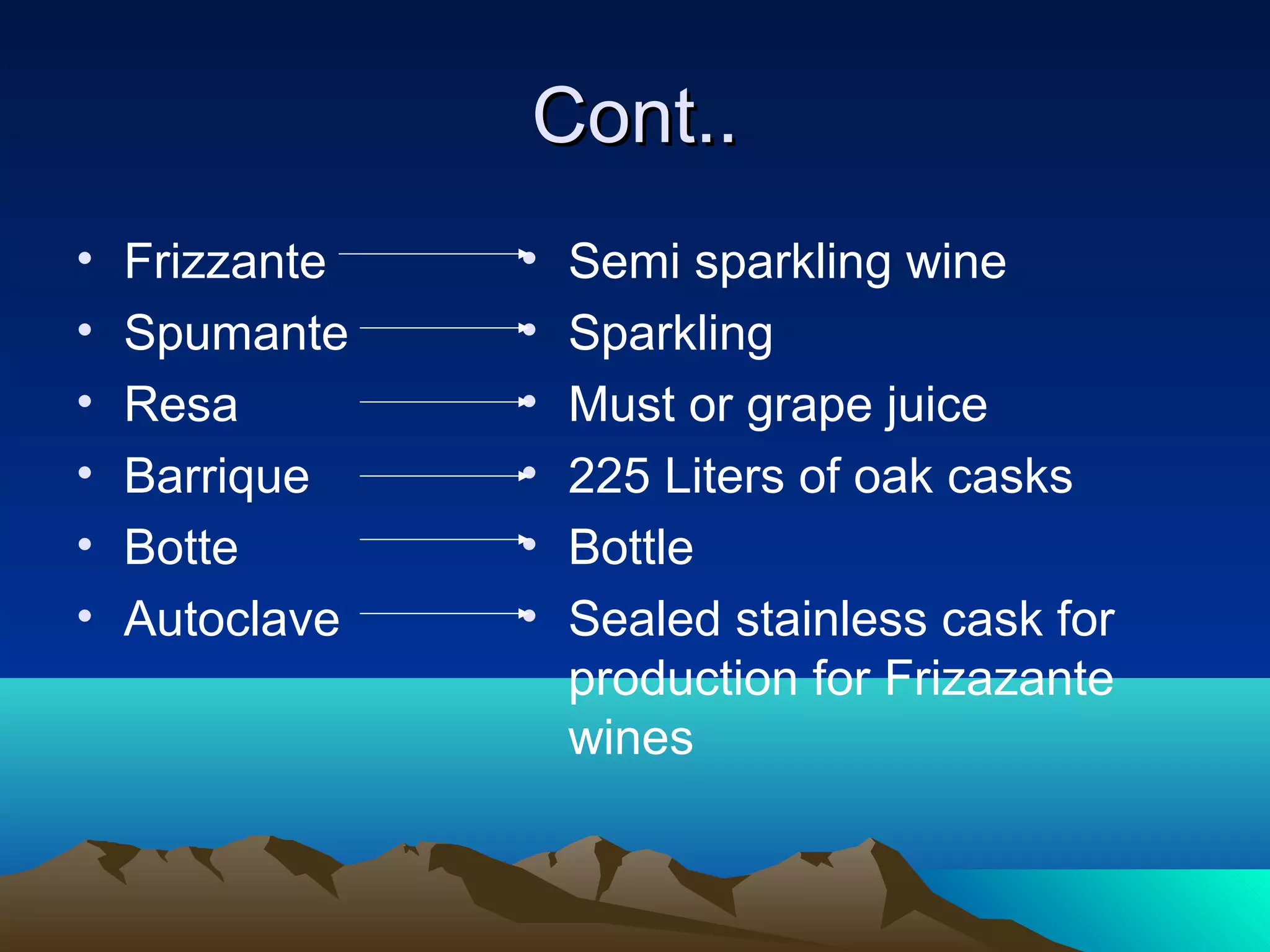
Cont..Cont..
• Frizzante
• Spumante
• Resa
• Barrique
• Botte
• Autoclave
• Semi sparkling wine
• Sparkling
• Must or grape juice
• 225 Liters of oak casks
• Bottle
• Sealed stainless cask for
production for Frizazante
wines
PRODUCTION OF MARSALAPRODUCTION OF MARSALA
• Marsala is both the name of the city in the north-west Sicily
and the name of a blend of grapes most notably the Citaratto
and or Grillo grapes with with a maximum of 15% of Inzolla
allowed.
• The white wines rich in extract and low in acidity are allowed
to ferment till dry.
• The blend is slowly heated for about 24 hours until it has been
reduced to one third of its original raw volume.
• During this time they must become sweet, thick and caramel
like. This cooked is wine is called Cotto .
Cont..Cont..
• This Cotto is then added to a base wine in the proportion
of six part of Cotto to six part of alcohol to 100 part
of base wine.
• The dry Marsala is also made in the same way except
that less of Cotto is used, sometimes to a tune of 1%.
• Marsala is aged in casks for a minimum period of four
months to as much as five years occasionally longer.
• During this time it takes on a dark brown colour with the
original white wine imparting a dry undertone to the
general sweetness, which slowly reduces with age.
TypesTypes
• Marsala Vergine (18%)-
This is considered as the
finest Marsala and is made
by the solera system
• Aged for at least five years
in oak casks.
• It is extremely dry.
Cont..Cont..
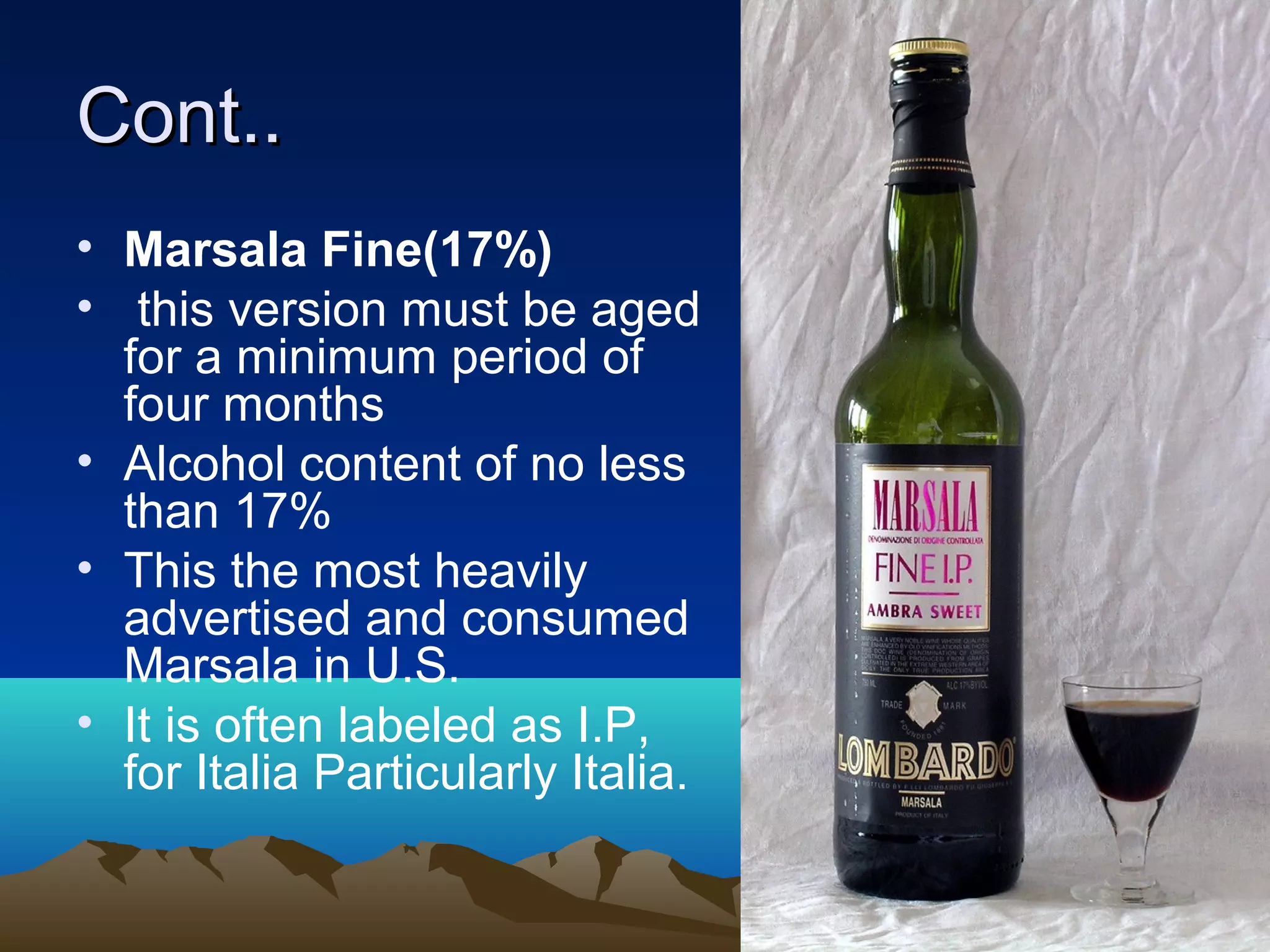
• Marsala Fine(17%)
• this version must be aged
for a minimum period of
four months
• Alcohol content of no less
than 17%
• This the most heavily
advertised and consumed
Marsala in U.S.
• It is often labeled as I.P,
for Italia Particularly Italia.
Cont..Cont..
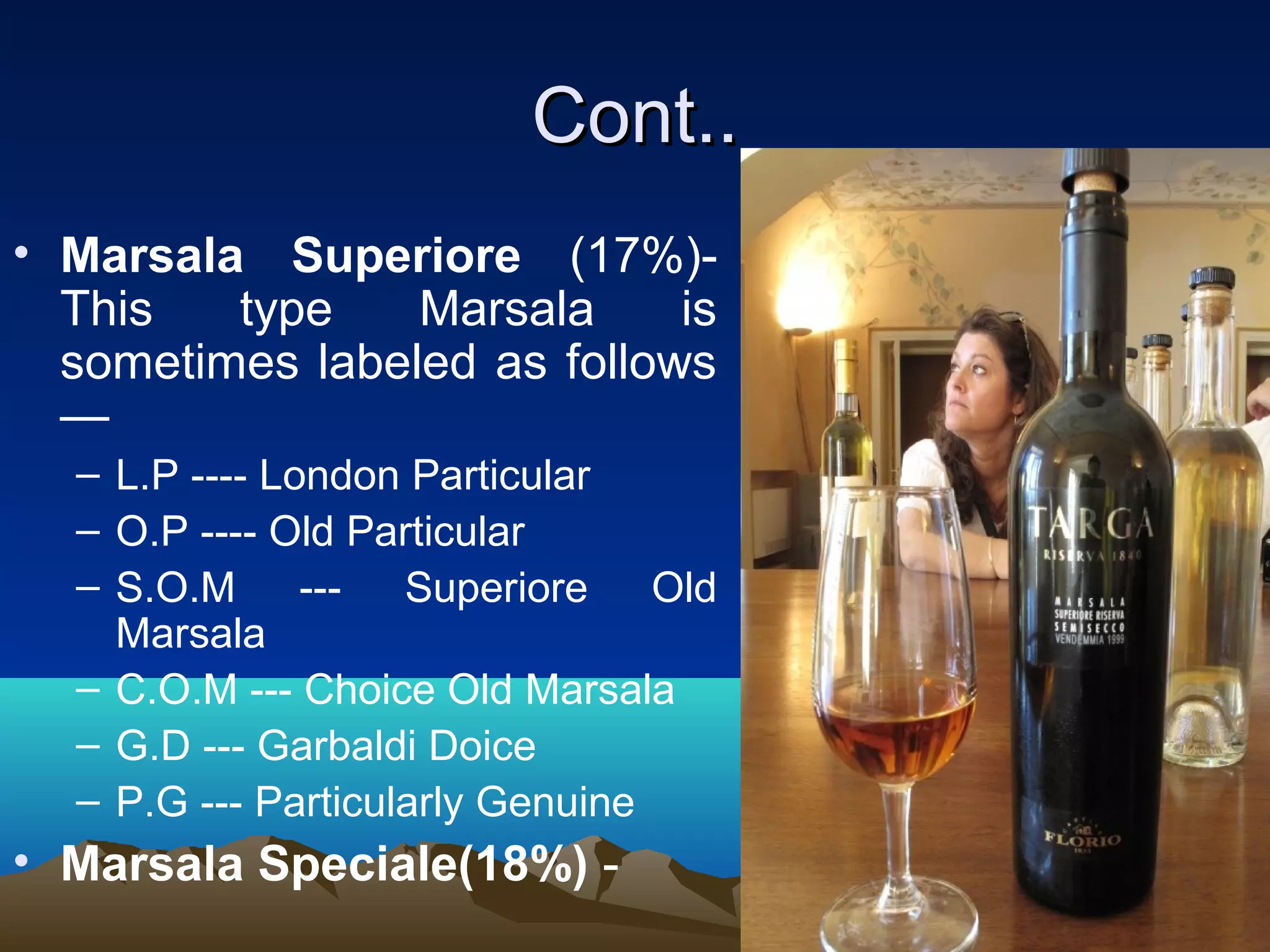
• Marsala Superiore (17%)-
This type Marsala is
sometimes labeled as follows
—
– L.P ---- London Particular
– O.P ---- Old Particular
– S.O.M --- Superiore Old
Marsala
– C.O.M --- Choice Old Marsala
– G.D --- Garbaldi Doice
– P.G --- Particularly Genuine
• Marsala Speciale(18%) -
COMMON SHIPPERS OF MARSALACOMMON SHIPPERS OF MARSALA
• Woodhouse and company
• Ingham wittaker and company
• Florio and company

Wine of italy

  • 1.
    Wines of ItalyWinesof Italy • Italy often called as “Vineyards of the World” • The Greeks called Italy Oenotria-tellus (The land of vines), because of the great affinity that the vines displayed for the sun & soil of Italy. • The Greeks first brought the vines to Italy almost 5000 years ago.
  • 2.
    Cont…Cont… • The vinesthrive on Italy’s mountainous slopes, rich planes & gently rolling hills. • It can probably claim to the longest unbroken, tradition of viticulture in comparison to any country. • Italy is divided into 6 areas, which are made up of provinces.
  • 3.
    Cont..Cont.. • The northernproduces better wines than the south. • Table wines in the ratio of 4:1 red: white, sparkling, fortified& aromatized wines are produced. • The per capita consumption of wines is 184 bottles per year. • Italy in last 30 odd years of this century has undergone more changes than it had in the previous 1000 years.
  • 4.
    Cont…Cont… • In 1960a widespread replanting took place in Italy, where viticulture underwent a total change. As opposed to the Greek influence the vine in the north are now trained low & those in south, which were traditionally, trained low are now trained higher.
  • 5.
    GeographyGeography • Entire peninsulacovered with mountains. • In the west & north lies snow covered Alps and in the east Venetian Alp. • Winters are long & bitter • Valley is fertile. • Due to great length Italy has a varied climate. • Soil is chalky and volcanic.
  • 8.
  • 12.
    GrapesGrapes White Grapes • CortesseBianco • Malvasia Bianco • Pinot Bianco • Vernaccia Red Grapes • Aleatico Nero • Barbera • Brachello • Sangiovese
  • 13.
    ClassificationClassification • DOCG -Denominazione di Origine Controllata Garantita- Controlled & guaranteed. Guarantees of high quality of wine, which have confirmed to the most demanding regulation. • DOC - Denominazione di Origine Controllata. This is category of Italian wine. The vine species used & where they may be grown, maximum yields, minimum strength etc. are some factors that are taken into consideration before granting this appellation to a wine. • IGT- Indicazione Geografica Tipica is the second of four classifications of wine recognized by the government of Italy. IGT wines are labeled with the locality of their creation, but do not meet the requirements of the stricter DOC or DOCG designations. It is considered broadly equivalent to the French vin de pays designation. • VDT- Vino Da Tavola - A table wine.
  • 14.
    Wine producing RegionsWineproducing Regions Piedmont- • Situated in North east. • Main river Po • Famous for Italian vermouths, which are sweet & red. • Asti spumante is made by Methode Champenoise .
  • 15.
    Barolo (Red)Barolo (Red) •Highest rated Italian red wine. • It is produced from 100% nebbiolo grapes. • Barolo must have a minimum alcoholic strength of 13%, • Aged for a minimum period of 3 years.
  • 16.
    Barbera (Red)Barbera (Red) •Also the name of grape dark red, acidic & specialty of piedmont
  • 17.
    Gattinara (Red)Gattinara (Red) •Given a DOC status on July 9, 1967 states that it must be produced from 90% nebbiolo grapes 10% bonarde grapes.
  • 18.
    Barbaresco (red)Barbaresco (red) oThis district lies north east of river Alba and produces dry, full bodied ruby red wine.
  • 19.
    Cont..Cont.. • Freisa (red)– Also a name of grape variety, grown in piedmont, which produces 2 styles of wine
  • 20.
    Asti spumante (sparkling)Astispumante (sparkling) • White sweet sparkling wine produced in the town of Asti in south • Alcoholic strength is 7%, having full flavour of ripe green grape. E.g. – Fontanafredda – Sandro – Martini
  • 21.
    Cortese (White)Cortese (White) •The traditional white wine grape variety of Piedmont that produces a white wine of particular refinement. • The wine made from cortese grapes can be labeled as Cortese d’ gavi or simply Gavi
  • 23.
    LombardyLombardy • Northwest zoneeast of piedmont. It is the fashion & the financial capital of Italy. Campari is the most well known aperitif. • Barbacario (Red) – should have a minimum alcoholic strength of 12% & is produced from a blend of Barbera & Bonarda grapes • Riesling (White) – minimum 11% alcohol also produced as spumante. Made from a blend of Riesling Renano or Riesling Italianco or a combination of both.
  • 25.
    VenetoVeneto • Important cityis Verona, but Venice is the city, which is well known & is also a port for merchant navy. It is famous for • Waterways, • Gondolas; • St. marks Square, • St. Marks cathedral.
  • 30.
    Main WinesMain Wines •Soave (White) – • A famous white wine that is dry. • Produced from garganega & trebbiano grapes. • Minimum 10.5% of alcohol.
  • 31.
    Cont..Cont.. • Gambellara (White)– Made from a combination of garganega & trebbiano grapes. Should have minimum 11% alcohol
  • 32.
    Cont..Cont.. • Bianco dicustoza (White) Made from a combination of trebbiano, toscano & garganega grapes. Also produced as a spumante should have a minimum alcoholic strength of 11%
  • 33.
    Valpolicella (Red)Valpolicella (Red) •This dry light bodied red wines produced from Verona is drunk quite young & ideal for red meat.
  • 34.
    Bardolina (Red)Bardolina (Red) •A light bodied dry red wine.
  • 35.
    TuscanyTuscany • It isfamous for the leaning tower of Pisa & architecture and aged wines, which are probably the most famous of all Italian red table wines that is the Chianti.
  • 36.
    Main WinesMain Wines •Chianti (Red) – Geographically & historically, Chianti is an area lying between Florence & Siena encompassing the town of Arezzo, Pistoia & Pisa in the region of Tuscany. • The red wine produced from this area is known as Chianti. • It is made from a combination of Sangiovese, Cabernet sauvignon, Trebbiano & Malvasia grapes
  • 37.
    Chianti classico (RedChianticlassico (Red)) • In the heart of the area mentioned above in the hills between Florence & Siena lie approx 175000 acres of land where Chianti classico is made. • It is actually the name of one of the 7 Chianti zones.
  • 38.
    Other winesOther wines Brunellodi Montalcino (Red)- • An extremely full-bodied red wine produced from the Tuscany region it is Italy’s finest & longest-lived wines.
  • 39.
    Bianco di Pitigliano(White)Bianco di Pitigliano (White) • A white wine produced from the Tuscany region white dry, fruity, & lively.
  • 40.
    LazioLazio • The maincity is Rome where the world’s smallest country is located the name of the country is Vatican City.
  • 41.
    FrascatiFrascati • It hasaround 11.5% of alcohol. It can be a dry white wine or a semi white sparkling wine.
  • 42.
    Est! Est!! Est!!!(White)Est! Est!! Est!!! (White) • Abbreviated form of venum bonum est. Est, est, est is made from Muscat , Merlot & Cabernet Sauvignon grapes.
  • 43.
    CampaniaCampania • The areais more famous as a tourist attraction rather than wine production. • The main city is Naples. • The most well known wine from this area is:
  • 44.
    Lacryma Christi (Tearof Christ)Lacryma Christi (Tear of Christ) • The white wine known as lacryma Christi del vesuvio bianco, has a minimum alcoholic strength of 11%. • The red lacryma Christi del vesuvio rosso has a minimum 12% alcohol. • The grapes for the production of wine is obtained from the slopes of Mt. Vesuvius. • A red, rose & a sparkling version is also available.
  • 47.
    SardiniaSardinia • It isknown for its dessert wines, both white & red. It also produces table wines, which are red, or white & which are considered good. Examples are: • Moscato del Templo- White dessert wine. • Giro di Sardegan- Red dessert wine. • Marlestella- A white table wine. • Santa Marla la Palmo- Red table wine.
  • 48.
    Italian Wine TermsItalianWine Terms • Cantina • Azienda • Riserva • Rosso • Blanco • Rosato/ Chaiaretto • Secco • Dolce • Abbocato • Vinery • an estate or farm • a reserve wine • Red • White • Rose • Dry • Sweet • Medium Sweet
  • 49.
    Cont..Cont.. • Frizzante • Spumante •Resa • Barrique • Botte • Autoclave • Semi sparkling wine • Sparkling • Must or grape juice • 225 Liters of oak casks • Bottle • Sealed stainless cask for production for Frizazante wines
  • 51.
    PRODUCTION OF MARSALAPRODUCTIONOF MARSALA • Marsala is both the name of the city in the north-west Sicily and the name of a blend of grapes most notably the Citaratto and or Grillo grapes with with a maximum of 15% of Inzolla allowed. • The white wines rich in extract and low in acidity are allowed to ferment till dry. • The blend is slowly heated for about 24 hours until it has been reduced to one third of its original raw volume. • During this time they must become sweet, thick and caramel like. This cooked is wine is called Cotto .
  • 52.
    Cont..Cont.. • This Cottois then added to a base wine in the proportion of six part of Cotto to six part of alcohol to 100 part of base wine. • The dry Marsala is also made in the same way except that less of Cotto is used, sometimes to a tune of 1%. • Marsala is aged in casks for a minimum period of four months to as much as five years occasionally longer. • During this time it takes on a dark brown colour with the original white wine imparting a dry undertone to the general sweetness, which slowly reduces with age.
  • 53.
    TypesTypes • Marsala Vergine(18%)- This is considered as the finest Marsala and is made by the solera system • Aged for at least five years in oak casks. • It is extremely dry.
  • 54.
    Cont..Cont.. • Marsala Fine(17%) •this version must be aged for a minimum period of four months • Alcohol content of no less than 17% • This the most heavily advertised and consumed Marsala in U.S. • It is often labeled as I.P, for Italia Particularly Italia.
  • 55.
    Cont..Cont.. • Marsala Superiore(17%)- This type Marsala is sometimes labeled as follows — – L.P ---- London Particular – O.P ---- Old Particular – S.O.M --- Superiore Old Marsala – C.O.M --- Choice Old Marsala – G.D --- Garbaldi Doice – P.G --- Particularly Genuine • Marsala Speciale(18%) -
  • 56.
    COMMON SHIPPERS OFMARSALACOMMON SHIPPERS OF MARSALA • Woodhouse and company • Ingham wittaker and company • Florio and company