LIQUEURS
www.hospitalitynu.blogspot.in
LIQUEURS
• These are flavoured, sweetened spirits,
characterised by their flavourings and not base
spirit.
• Latin word LIQUIFACERE meaning ‘To
dissolve’.
• Monks who experimented with liqueurs were
herbalists.
LIQUEURS
• Since these medicines were harsh tasting so
they were sweetened with honey.
• In the 17th Century the liqueurs became more
popular.
All liqueurs consist of the following three constituents:
•The spirit base
•The flavoring agent
•The sweetener
CONSTITUENTS
• Fruit liqueurs- Flavored with any fruit except citrus
fruits
• Citrus liqueurs- Flavored with peels of citrus fruits
• Herb Liqueurs
• Bean & Kernel liqueurs- Beans, nuts and Kernels
are used.
• Cream liqueurs
CATEGORIES OF LIQUEURS
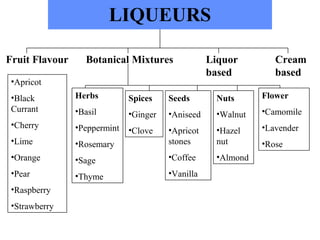
LIQUEURS
Fruit Flavour Botanical Mixtures Liquor
based
Cream
based
Herbs
•Basil
•Peppermint
•Rosemary
•Sage
•Thyme
Spices
•Ginger
•Clove
Seeds
•Aniseed
•Apricot
stones
•Coffee
•Vanilla
Nuts
•Walnut
•Hazel
nut
•Almond
Flower
•Camomile
•Lavender
•Rose
•Apricot
•Black
Currant
•Cherry
•Lime
•Orange
•Pear
•Raspberry
•Strawberry
FRUIT FLAVOURED
• Either the whole fruit or the part of the fruit is
used.
• Fruit liqueurs are labelled as Creme eg. Creme
de Cassis.
• These are fairly low in alcohol
BOTANICAL MIXTURE
• These were first used for the medicinal
purposes.
• These liqueurs are flavoured with a
combination of herbs with no one flavour
being predominant.
• These are fairly high on the alcohol content.
• Examples : Benedictine, Chartreuse
SEEDS AND NUTS
• A single flavour predominates
• Examples
– Anisette
– Pastis
– Pernod
Anise Seed
LIQUOR BASE
• The alcohol used as spirit base must be as pure as
possible.
• Manner of distillation and degree of rectification
determine purity of spirit.
• Most liqueurs have a neutral or a grain spirit base
though whisky, rum, grape brandy, cognac, fruit
spirit or rice spirit are often used.
CREAM BASED
• Main ingredients are fresh dairy cream and
spirit which are flavoured and sweetened.
• Most are 34 v/v
• Liqueurs are sweetened with sugar syrup after
blending is completed.
• Most liqueurs contain 35% -40% sweetener.
• Liqueurs containing 2.5% to 10% sugar come in the
dry range.
SWEETENER
• Liqueurs with large amount of sugar are often called
cremes.
• Honey particularly heather honey, is used in many
liqueurs like Drambuie.
SWEETENER
• The steps involved in the production of liqueurs are
 Extraction
 Distillation
 Compounding
 Maturing
 Fining
 Addition of sugar syrup
 Filtration
 Bottling
MANUFACTURE
• The flavoring agent must be extracted from the
natural substance, to use the essential oil as an
ingredient.
• There are four methods of extraction:
Pressure
Infusion
Maceration
Percolation
EXTRACTION
• Agents like citrus fruits are pressed to extract the
essential oils.
• This method is also used when the flavoring agents
are seeds, barks etc.
PRESSURE
• The fruit is crushed and steeped in hot water until
the water absorbs the flavour.
• The liquid is then drawn off and allowed to settle.
• It is then filtered.
INFUSION
• The crushed fruit is steeped in cold spirit.
• It is a high proof alcohol to extract flavours.
MACERATION
• The flavour material, usually leaves or herbs are
placed in the upper part of the percolation apparatus.
• A high proof spirit is pumped up and allowed to
drip down through it.
PERCOLATION
• The natural products are steeped in the alcohol until
it is well impregnated with flavour.
• It is then distilled to protect the delicate essences.
• Further purified by rectification to remove
impurities.
DISTILLATION
• Once the ingredients have been assembled the
compounder blends them in strict sequence.
• Most liqueur companies keep this sequence and the
recipes strictly guarded secrets.
COMPOUNDING
• The finest liqueurs are matured in oak casks which
aid in mellowing the liquid.
Finings
• Vegetable matter suspended in the liquid is removed
in a procedure similar to fining wines.
Addition of sugar syrups
• Sugar syrup is added to ensure desired level of
sweetness- sometimes the liqueur is topped with
spirit to bring it to correct alcoholic strength
FINAL PROCESS
• Original Absinthe was first created in 1792 as a
medicine to treat malaria.
• The essential flavouring came from the bitter root of
the “wormwood” plant however, manufacturers
substituted aniseed for the original flavouring due
to narcotic effect of wormwood.
• It is a very dry, bitter drink with high alcoholic
content.
• Anisette & Pernod are all well known substitutes.
ABSINTHE
• Made by a company founded in 1863 near the ruins
of Benedictine Abbey of Fecamp.
• Secret recipe includes cinnamon, cardamom,
angelica,and seventeen other ingredients.
• The liqueur golden, highly aromatized and very
sweet.
BENEDICTINE
• D.O.M. Stands for - Deo Optimo Maximo - To God,
Most Good Most Great.
• B&B developed in 1930’s is a rich dry blend of
benedictine and brandy.
BENEDICTINE
• Originally the name for an orange flavoured liqueur,
made from the dried peels of green oranges from
the Island Of Curacao off the coast of Venezuela.
• Sweet digestive liqueur now made from grape spirit,
sugar and orange peels.
• The name is now applies to all orange liqueurs.
• After infusion, spirit is distilled - if resulting liquor
undergoes rectification it becomes Triple Sec
Curacao which is then sweetened and coloured.
CURACAO
• Drambuie comes from the Gaelic phrase- “ An
Dram Buidheach” ‘A drink that satisfies’
• Original recipe was given by Bonnie Prince Charlie
- and the liqueur is still made by the Mackinnon
family of Edinburgh.
• Made from a base of fine single malt scotch to
which are added heather honey and herbs.
• It is the oldest whisky liqueur.
DRAMBUIE
• A golden yellow Herb liqueur packaged in a tall
fluted bottle.
• It is produced in Milan -Italy.
• Named after Captain Giuseppe Galliano who
distinguished himself during the Italian-
Abyssinian war in 1896.
• Liqueur is made in a modern plant and aged in glass
tanks for six months before being bottled.
GALLIANO
Thank you
www.hospitalitynu.blogspot.in

Liqueurs

  • 1.
  • 2.
    LIQUEURS • These areflavoured, sweetened spirits, characterised by their flavourings and not base spirit. • Latin word LIQUIFACERE meaning ‘To dissolve’. • Monks who experimented with liqueurs were herbalists.
  • 3.
    LIQUEURS • Since thesemedicines were harsh tasting so they were sweetened with honey. • In the 17th Century the liqueurs became more popular.
  • 4.
    All liqueurs consistof the following three constituents: •The spirit base •The flavoring agent •The sweetener CONSTITUENTS
  • 5.
    • Fruit liqueurs-Flavored with any fruit except citrus fruits • Citrus liqueurs- Flavored with peels of citrus fruits • Herb Liqueurs • Bean & Kernel liqueurs- Beans, nuts and Kernels are used. • Cream liqueurs CATEGORIES OF LIQUEURS
  • 6.
    LIQUEURS Fruit Flavour BotanicalMixtures Liquor based Cream based Herbs •Basil •Peppermint •Rosemary •Sage •Thyme Spices •Ginger •Clove Seeds •Aniseed •Apricot stones •Coffee •Vanilla Nuts •Walnut •Hazel nut •Almond Flower •Camomile •Lavender •Rose •Apricot •Black Currant •Cherry •Lime •Orange •Pear •Raspberry •Strawberry
  • 7.
    FRUIT FLAVOURED • Eitherthe whole fruit or the part of the fruit is used. • Fruit liqueurs are labelled as Creme eg. Creme de Cassis. • These are fairly low in alcohol
  • 8.
    BOTANICAL MIXTURE • Thesewere first used for the medicinal purposes. • These liqueurs are flavoured with a combination of herbs with no one flavour being predominant. • These are fairly high on the alcohol content. • Examples : Benedictine, Chartreuse
  • 9.
    SEEDS AND NUTS •A single flavour predominates • Examples – Anisette – Pastis – Pernod Anise Seed
  • 10.
    LIQUOR BASE • Thealcohol used as spirit base must be as pure as possible. • Manner of distillation and degree of rectification determine purity of spirit. • Most liqueurs have a neutral or a grain spirit base though whisky, rum, grape brandy, cognac, fruit spirit or rice spirit are often used.
  • 11.
    CREAM BASED • Mainingredients are fresh dairy cream and spirit which are flavoured and sweetened. • Most are 34 v/v
  • 12.
    • Liqueurs aresweetened with sugar syrup after blending is completed. • Most liqueurs contain 35% -40% sweetener. • Liqueurs containing 2.5% to 10% sugar come in the dry range. SWEETENER
  • 13.
    • Liqueurs withlarge amount of sugar are often called cremes. • Honey particularly heather honey, is used in many liqueurs like Drambuie. SWEETENER
  • 14.
    • The stepsinvolved in the production of liqueurs are  Extraction  Distillation  Compounding  Maturing  Fining  Addition of sugar syrup  Filtration  Bottling MANUFACTURE
  • 15.
    • The flavoringagent must be extracted from the natural substance, to use the essential oil as an ingredient. • There are four methods of extraction: Pressure Infusion Maceration Percolation EXTRACTION
  • 16.
    • Agents likecitrus fruits are pressed to extract the essential oils. • This method is also used when the flavoring agents are seeds, barks etc. PRESSURE
  • 17.
    • The fruitis crushed and steeped in hot water until the water absorbs the flavour. • The liquid is then drawn off and allowed to settle. • It is then filtered. INFUSION
  • 18.
    • The crushedfruit is steeped in cold spirit. • It is a high proof alcohol to extract flavours. MACERATION
  • 19.
    • The flavourmaterial, usually leaves or herbs are placed in the upper part of the percolation apparatus. • A high proof spirit is pumped up and allowed to drip down through it. PERCOLATION
  • 20.
    • The naturalproducts are steeped in the alcohol until it is well impregnated with flavour. • It is then distilled to protect the delicate essences. • Further purified by rectification to remove impurities. DISTILLATION
  • 21.
    • Once theingredients have been assembled the compounder blends them in strict sequence. • Most liqueur companies keep this sequence and the recipes strictly guarded secrets. COMPOUNDING
  • 22.
    • The finestliqueurs are matured in oak casks which aid in mellowing the liquid. Finings • Vegetable matter suspended in the liquid is removed in a procedure similar to fining wines. Addition of sugar syrups • Sugar syrup is added to ensure desired level of sweetness- sometimes the liqueur is topped with spirit to bring it to correct alcoholic strength FINAL PROCESS
  • 23.
    • Original Absinthewas first created in 1792 as a medicine to treat malaria. • The essential flavouring came from the bitter root of the “wormwood” plant however, manufacturers substituted aniseed for the original flavouring due to narcotic effect of wormwood. • It is a very dry, bitter drink with high alcoholic content. • Anisette & Pernod are all well known substitutes. ABSINTHE
  • 24.
    • Made bya company founded in 1863 near the ruins of Benedictine Abbey of Fecamp. • Secret recipe includes cinnamon, cardamom, angelica,and seventeen other ingredients. • The liqueur golden, highly aromatized and very sweet. BENEDICTINE
  • 25.
    • D.O.M. Standsfor - Deo Optimo Maximo - To God, Most Good Most Great. • B&B developed in 1930’s is a rich dry blend of benedictine and brandy. BENEDICTINE
  • 26.
    • Originally thename for an orange flavoured liqueur, made from the dried peels of green oranges from the Island Of Curacao off the coast of Venezuela. • Sweet digestive liqueur now made from grape spirit, sugar and orange peels. • The name is now applies to all orange liqueurs. • After infusion, spirit is distilled - if resulting liquor undergoes rectification it becomes Triple Sec Curacao which is then sweetened and coloured. CURACAO
  • 27.
    • Drambuie comesfrom the Gaelic phrase- “ An Dram Buidheach” ‘A drink that satisfies’ • Original recipe was given by Bonnie Prince Charlie - and the liqueur is still made by the Mackinnon family of Edinburgh. • Made from a base of fine single malt scotch to which are added heather honey and herbs. • It is the oldest whisky liqueur. DRAMBUIE
  • 28.
    • A goldenyellow Herb liqueur packaged in a tall fluted bottle. • It is produced in Milan -Italy. • Named after Captain Giuseppe Galliano who distinguished himself during the Italian- Abyssinian war in 1896. • Liqueur is made in a modern plant and aged in glass tanks for six months before being bottled. GALLIANO
  • 29.