THE TRUTH ABOUT
VERMOUTH
By
GIUSEPPE GALLO
.
#THETRUTHABOUTVERMOUTH
www.slideshare.net/peppegallo
@MrGiuseppeGallo
facebook/mixologistsociety
giuseppemrgallo
MORE INFO : salute@italspirits.com
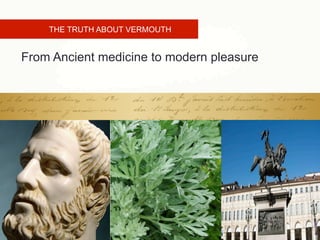
THE TRUTH ABOUT VERMOUTH
From Ancient medicine to modern pleasure
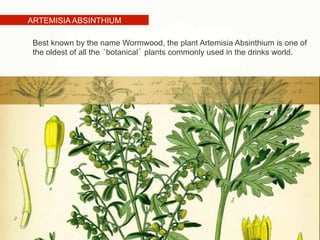
ARTEMISIA ABSINTHIUM
Best known by the name Wormwood, the plant Artemisia Absinthium is one of
the oldest of all the ‘botanical’ plants commonly used in the drinks world.
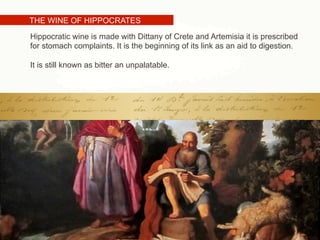
THE WINE OF HIPPOCRATES
Hippocratic wine is made with Dittany of Crete and Artemisia it is prescribed
for stomach complaints. It is the beginning of its link as an aid to digestion.
It is still known as bitter an unpalatable.
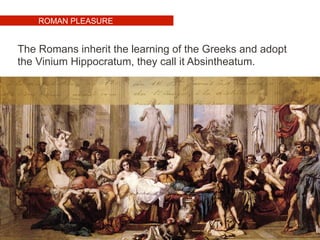
ROMAN PLEASURE
The Romans inherit the learning of the Greeks and adopt
the Vinium Hippocratum, they call it Absintheatum.
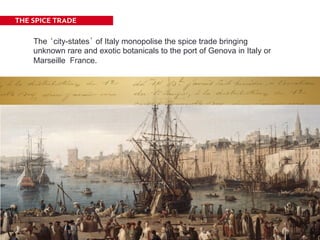
The ‘city-states’ of Italy monopolise the spice trade bringing
unknown rare and exotic botanicals to the port of Genova in Italy or
Marseille France.
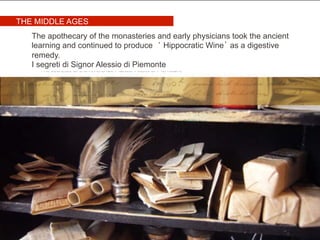
The apothecary of the monasteries and early physicians took the ancient
learning and continued to produce ‘ Hippocratic Wine’ as a digestive
remedy.
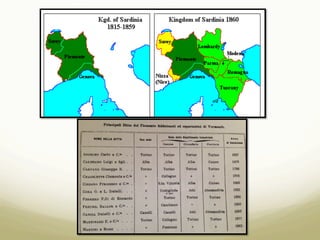
I segreti di Signor Alessio di Piemonte
THE MIDDLE AGES
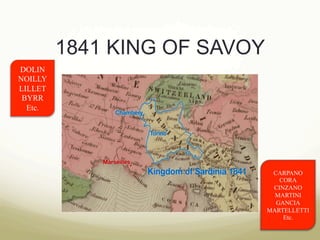
1841 KING OF SAVOY
CARPANO
CORA
CINZANO
MARTINI
GANCIA
MARTELLETTI
Etc.
DOLIN
NOILLY
LILLET
BYRR
Etc.
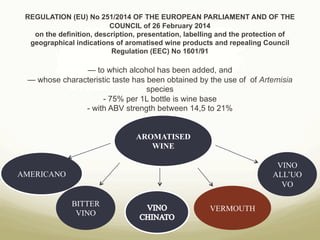
REGULATION (EU) No 251/2014 OF THE EUROPEAN PARLIAMENT AND OF THE
COUNCIL of 26 February 2014
on the definition, description, presentation, labelling and the protection of
geographical indications of aromatised wine products and repealing Council
Regulation (EEC) No 1601/91
— to which alcohol has been added, and
— whose characteristic taste has been obtained by the use of of Artemisia
species
- 75% per 1L bottle is wine base
- with ABV strength between 14,5 to 21%
AROMATISED
WINE
AMERICANO
VERMOUTH
VINO
ALL’UO
VO
BITTER
VINO
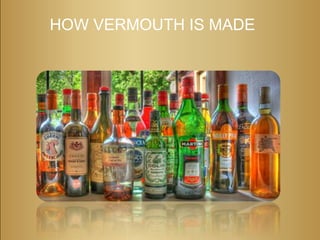
HOW VERMOUTH IS MADE
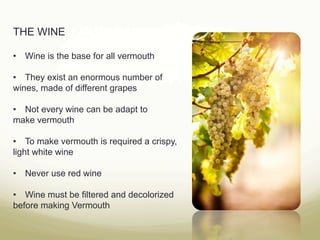
THE WINE
•  Wine is the base for all vermouth
•  They exist an enormous number of
wines, made of different grapes
•  Not every wine can be adapt to
make vermouth
•  To make vermouth is required a crispy,
light white wine
•  Never use red wine
•  Wine must be filtered and decolorized
before making Vermouth
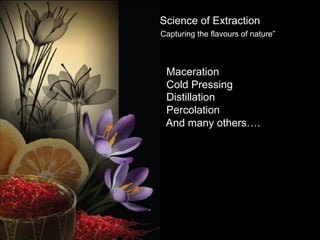
Science of Extraction
“Capturing the flavours of nature”
•  Maceration
•  Cold Pressing
•  Distillation
•  Percolation
•  And many others….
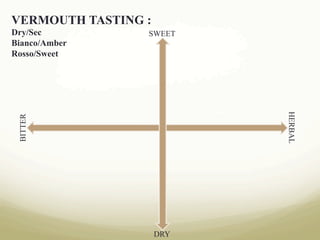
VERMOUTH TASTING :
Dry/Sec
Bianco/Amber
Rosso/Sweet
SWEET
HERBAL
DRY
BITTER

Vermouth.101.TOTC

  • 1.
  • 2.
  • 3.
    THE TRUTH ABOUTVERMOUTH From Ancient medicine to modern pleasure
  • 4.
    ARTEMISIA ABSINTHIUM Best knownby the name Wormwood, the plant Artemisia Absinthium is one of the oldest of all the ‘botanical’ plants commonly used in the drinks world.
  • 5.
    THE WINE OFHIPPOCRATES Hippocratic wine is made with Dittany of Crete and Artemisia it is prescribed for stomach complaints. It is the beginning of its link as an aid to digestion. It is still known as bitter an unpalatable.
  • 6.
    ROMAN PLEASURE The Romansinherit the learning of the Greeks and adopt the Vinium Hippocratum, they call it Absintheatum.
  • 7.
    The ‘city-states’ ofItaly monopolise the spice trade bringing unknown rare and exotic botanicals to the port of Genova in Italy or Marseille France.
  • 8.
    The apothecary ofthe monasteries and early physicians took the ancient learning and continued to produce ‘ Hippocratic Wine’ as a digestive remedy. I segreti di Signor Alessio di Piemonte THE MIDDLE AGES
  • 10.
    1841 KING OFSAVOY CARPANO CORA CINZANO MARTINI GANCIA MARTELLETTI Etc. DOLIN NOILLY LILLET BYRR Etc.
  • 11.
    REGULATION (EU) No251/2014 OF THE EUROPEAN PARLIAMENT AND OF THE COUNCIL of 26 February 2014 on the definition, description, presentation, labelling and the protection of geographical indications of aromatised wine products and repealing Council Regulation (EEC) No 1601/91 — to which alcohol has been added, and — whose characteristic taste has been obtained by the use of of Artemisia species - 75% per 1L bottle is wine base - with ABV strength between 14,5 to 21% AROMATISED WINE AMERICANO VERMOUTH VINO ALL’UO VO BITTER VINO
  • 12.
  • 13.
    THE WINE •  Wineis the base for all vermouth •  They exist an enormous number of wines, made of different grapes •  Not every wine can be adapt to make vermouth •  To make vermouth is required a crispy, light white wine •  Never use red wine •  Wine must be filtered and decolorized before making Vermouth
  • 15.
    Science of Extraction “Capturingthe flavours of nature” •  Maceration •  Cold Pressing •  Distillation •  Percolation •  And many others….
  • 16.