Presentation
On
Vodka
Brief History
 The first documented production of vodka in Russia
was at the end of the 9th century, but the first
known distillery at, Khylnovsk, was about two
hundred years later as reported in the Vyatka
Chronicle of 1174.
 Poland lays claim to having distilled vodka even
earlier in the 8th century, but as this was a
distillation of wine it might be more appropriate to
consider it a crude brandy.
 The first identifiable Polish vodkas appeared in the
11th century when they were called 'gorzalka',
originally used as medicines.
Ingredients
 Vegetables or Grains - Although original vodka was
made from potatoes, this versatile drink can be
produced from virtually any fermentable ingredients
that are filled with starch or sugar.
 The most popular source for fermentation is wheat,
rye or corn.
 Water - Water can have significant effect to the final
flavor of vodka, especially if distiller decides not to
make "neutral tasting" drink.
 Underground natural water is often filled with
various minerals collected from the rocks and
ground.
Ingredients
 Malt meal - To enable transformation of starch into
sugar, some grains and vegetables require presence
of this ingredient.
 Yeast - This very important ingredient is essential for
the process of fermentation. It transforms present
sugar into alcohol. This process can however create
liquid with only 14% alcohol volume.
 Flavor Additives - At the end of the production
process, distiller can choose to put any number of
flavor additives in his drink. Most popular flavors
range from herbs, grasses, spices to fruit essences.
Manufacturing
 Preparation of mash - After deciding what type of
grain or fruit is to be used, distiller must insert it into
automated mash tub.
 If grain consists mostly from starch, malt meal must
be introduced to transform it into sugar.
Manufacturing
 Sterilization - Prevention of appearance of bacteria
during fermentation process is very essential.
 For this purpose, entire mash must be boiled and
thus sterilized.
 As another technique of prevention, mash is
injected with lactic-acid bacteria which raise acidity
level of entire mash and prepares it for better
fermentation.
Manufacturing
 Fermentation - Fermentation is done by pouring
prepared mash into sterilized large stainless steel
vats.
 For the next two to four days yeast transforms
sugars in the mash into ethyl alcohol.
Manufacturing
 Distillation and rectification - Liquid ethyl alcohol
that was produced in fermentation needs to be
poured in stainless steel stills, which collect
vaporized alcohol and transfer it into sterilized
chamber.
 During this process water and impurities remain in
first chamber, enabling the produced liquid to have
higher alcohol content.
Manufacturing
 Adding water and flavor additives - After
distillation, produced liquid have between 95-100%
alcohol content.
 To became drinkable, water must be added to
weaken the alcohol to the standardized 40% level
(some countries have varying laws about the
required alcohol content).
 If distiller wants, at this point he can add flavor
additives.
Manufacturing
 Bottling - Vodka does not have aging process like
wine or whisky.
 It can immediately be transferred into non-reactive
glass bottles.
 Automated distilleries use machines to sometimes
process 400 bottles per minute.
Types of Vodka
 Neutral Vodka
 Neutral vodka refers to the drink that is made from
traditional Russian or Polish recipe.
 Russians separate their natural vodkas into high
quality, strong (with over 55% alcohol by volume)
and export-worthy.
 Polish define their vodka into standard, premium
and deluxe.
 United States used classic or regular types, and all of
their vodkas are completely devoid of specific
aromas.
 To distinguish themselves, manufacturers of neutral
vodka in US use varying amounts of alcohol content,
brand recognition and price.
Types of Vodka
 Flavored Vodka
 As the techniques for creating vodka became more
advanced, brewers from all around the world
started devising the ways to introduce many new
flavors.
 Some of the best known flavored vodkas come from
Russia and Poland - Limonnaya Vodka (lemon),
Kubanskaya Vodka (lemon and orange), Pertsovka
Vodka (peppercorns and chili peppers), Okhotnichya
or Hunter Vodka (coffee, lemon, ginger, brandy and
more).
 In recent years, fruit flavored vodkas started
receiving much more popularity than before
(oranges, apples, berries, and more).
Types of Vodka
 Regional Vodka
 Many countries around the world have accepted
vodka as their national drinks (especially in Eastern
Europe) and started changing the recipe of this drink
to better suit their region.
 Poland likes to use potato and grain based vodkas,
Russia, Belarus and Ukraine focus mostly on wheat
and rye.
Types of Vodka
 Other Eastern European countries focus on other
grains (same as UK and Germany), while France,
Italy and Balkan region like to produce vodkas form
fermented grapes and fruits (most notably Serbian
plum based vodka "šljivovica", which is famous in
entire Europe).
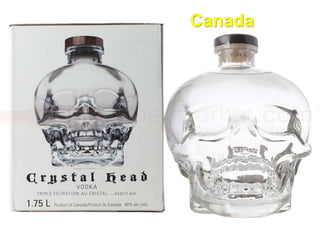
 Non-European countries also like to make their
vodkas from molasses (that is case for US, Canada,
Caribbean and Australia).
Top Ten Brands
France
Canada
Finland
Russia
Sweden
Russia
Poland
USA
France
Russia
Amazing Facts
 Fact one:
 Since vodka is distilled from water ethanol and
fermented potatoes or grains, it contains very little
fusel oils--much less than other alcoholic beverages.
 This coupled with the fact that it is carbon filtered,
makes it one of the purest drinks in the world!
Amazing Facts
 Fact two:
 A litre of vodka weighs only 953 g and not 1 kg as
one might imagine!
 Fact three:
 As opposed to popular belief, vodka does go bad if
stored for longer periods of time.
 Ideally, vodka has to be consumed within 12 months
of the manufacturing date!
Amazing Facts
 Fact four:
 Up until 1885, vodka was only sold in 12.3 litre
buckets--and even still, it was a very popular drink.
 Thankfully, smaller bottles were introduced so that
we don't spend the early part of our work week
coping with a massive hangover!
Amazing Facts
 Fact five:
 While traditional vodka has exactly 38 percent
alcohol, the European Union recognizes any such
drink with more than 37.5 percent alcohol content
as vodka.
 On the other hand, all vodka sold in the United
States has to have 40 percent or more alcohol
content.
Amazing Facts
 Fact six:
 Due to the high production and consumption of
vodka in America, countries like Russia, Ukraine,
Belarus, all Nordic and Baltic countries, Poland
and areas of Slovakia and Hungary, these regions
constitute the Vodka Belt!
Amazing Facts
 Fact seven:
 Apart from getting you drunk, vodka can also be
used for other purposes.
 For example, soaking your razor blade in vodka after
a shave disinfects it and prevents rusting!
 Vodka can also be used for cleaning glasses and
bathrooms because the alcohol tends to kill, mould
and mildew!
 Of course, this is assuming you have enough money
to switch from Harpic to vodka!
Amazing Facts
 Fact eight:
 While there are varied accounts of where vodka
originated--either in Russia or Poland--the first
variations of Russian vodka were meant for
medicinal purposes.
 It is also reported that Polish vodka was scented and
used as aftershave!
Amazing Facts
 Fact nine:
 According to some historic accounts, vodka was
used to make gunpowder in Sweden in the 15th
century!
 Fact ten:
 While clear vodka is very popular, its flavored
versions are also widely available.
 Some of the best vodka flavors are red pepper,
ginger, varying fruit flavors, vanilla, chocolate
(unsweetened), and cinnamon.
Vodka

Vodka

  • 1.
  • 2.
    Brief History  Thefirst documented production of vodka in Russia was at the end of the 9th century, but the first known distillery at, Khylnovsk, was about two hundred years later as reported in the Vyatka Chronicle of 1174.  Poland lays claim to having distilled vodka even earlier in the 8th century, but as this was a distillation of wine it might be more appropriate to consider it a crude brandy.  The first identifiable Polish vodkas appeared in the 11th century when they were called 'gorzalka', originally used as medicines.
  • 3.
    Ingredients  Vegetables orGrains - Although original vodka was made from potatoes, this versatile drink can be produced from virtually any fermentable ingredients that are filled with starch or sugar.  The most popular source for fermentation is wheat, rye or corn.  Water - Water can have significant effect to the final flavor of vodka, especially if distiller decides not to make "neutral tasting" drink.  Underground natural water is often filled with various minerals collected from the rocks and ground.
  • 4.
    Ingredients  Malt meal- To enable transformation of starch into sugar, some grains and vegetables require presence of this ingredient.  Yeast - This very important ingredient is essential for the process of fermentation. It transforms present sugar into alcohol. This process can however create liquid with only 14% alcohol volume.  Flavor Additives - At the end of the production process, distiller can choose to put any number of flavor additives in his drink. Most popular flavors range from herbs, grasses, spices to fruit essences.
  • 5.
    Manufacturing  Preparation ofmash - After deciding what type of grain or fruit is to be used, distiller must insert it into automated mash tub.  If grain consists mostly from starch, malt meal must be introduced to transform it into sugar.
  • 6.
    Manufacturing  Sterilization -Prevention of appearance of bacteria during fermentation process is very essential.  For this purpose, entire mash must be boiled and thus sterilized.  As another technique of prevention, mash is injected with lactic-acid bacteria which raise acidity level of entire mash and prepares it for better fermentation.
  • 7.
    Manufacturing  Fermentation -Fermentation is done by pouring prepared mash into sterilized large stainless steel vats.  For the next two to four days yeast transforms sugars in the mash into ethyl alcohol.
  • 8.
    Manufacturing  Distillation andrectification - Liquid ethyl alcohol that was produced in fermentation needs to be poured in stainless steel stills, which collect vaporized alcohol and transfer it into sterilized chamber.  During this process water and impurities remain in first chamber, enabling the produced liquid to have higher alcohol content.
  • 9.
    Manufacturing  Adding waterand flavor additives - After distillation, produced liquid have between 95-100% alcohol content.  To became drinkable, water must be added to weaken the alcohol to the standardized 40% level (some countries have varying laws about the required alcohol content).  If distiller wants, at this point he can add flavor additives.
  • 10.
    Manufacturing  Bottling -Vodka does not have aging process like wine or whisky.  It can immediately be transferred into non-reactive glass bottles.  Automated distilleries use machines to sometimes process 400 bottles per minute.
  • 11.
    Types of Vodka Neutral Vodka  Neutral vodka refers to the drink that is made from traditional Russian or Polish recipe.  Russians separate their natural vodkas into high quality, strong (with over 55% alcohol by volume) and export-worthy.  Polish define their vodka into standard, premium and deluxe.  United States used classic or regular types, and all of their vodkas are completely devoid of specific aromas.  To distinguish themselves, manufacturers of neutral vodka in US use varying amounts of alcohol content, brand recognition and price.
  • 12.
    Types of Vodka Flavored Vodka  As the techniques for creating vodka became more advanced, brewers from all around the world started devising the ways to introduce many new flavors.  Some of the best known flavored vodkas come from Russia and Poland - Limonnaya Vodka (lemon), Kubanskaya Vodka (lemon and orange), Pertsovka Vodka (peppercorns and chili peppers), Okhotnichya or Hunter Vodka (coffee, lemon, ginger, brandy and more).  In recent years, fruit flavored vodkas started receiving much more popularity than before (oranges, apples, berries, and more).
  • 13.
    Types of Vodka Regional Vodka  Many countries around the world have accepted vodka as their national drinks (especially in Eastern Europe) and started changing the recipe of this drink to better suit their region.  Poland likes to use potato and grain based vodkas, Russia, Belarus and Ukraine focus mostly on wheat and rye.
  • 14.
    Types of Vodka Other Eastern European countries focus on other grains (same as UK and Germany), while France, Italy and Balkan region like to produce vodkas form fermented grapes and fruits (most notably Serbian plum based vodka "šljivovica", which is famous in entire Europe).  Non-European countries also like to make their vodkas from molasses (that is case for US, Canada, Caribbean and Australia).
  • 15.
  • 16.
  • 17.
  • 18.
  • 19.
  • 20.
  • 21.
  • 22.
  • 23.
  • 24.
  • 25.
  • 26.
    Amazing Facts  Factone:  Since vodka is distilled from water ethanol and fermented potatoes or grains, it contains very little fusel oils--much less than other alcoholic beverages.  This coupled with the fact that it is carbon filtered, makes it one of the purest drinks in the world!
  • 27.
    Amazing Facts  Facttwo:  A litre of vodka weighs only 953 g and not 1 kg as one might imagine!  Fact three:  As opposed to popular belief, vodka does go bad if stored for longer periods of time.  Ideally, vodka has to be consumed within 12 months of the manufacturing date!
  • 28.
    Amazing Facts  Factfour:  Up until 1885, vodka was only sold in 12.3 litre buckets--and even still, it was a very popular drink.  Thankfully, smaller bottles were introduced so that we don't spend the early part of our work week coping with a massive hangover!
  • 29.
    Amazing Facts  Factfive:  While traditional vodka has exactly 38 percent alcohol, the European Union recognizes any such drink with more than 37.5 percent alcohol content as vodka.  On the other hand, all vodka sold in the United States has to have 40 percent or more alcohol content.
  • 30.
    Amazing Facts  Factsix:  Due to the high production and consumption of vodka in America, countries like Russia, Ukraine, Belarus, all Nordic and Baltic countries, Poland and areas of Slovakia and Hungary, these regions constitute the Vodka Belt!
  • 31.
    Amazing Facts  Factseven:  Apart from getting you drunk, vodka can also be used for other purposes.  For example, soaking your razor blade in vodka after a shave disinfects it and prevents rusting!  Vodka can also be used for cleaning glasses and bathrooms because the alcohol tends to kill, mould and mildew!  Of course, this is assuming you have enough money to switch from Harpic to vodka!
  • 32.
    Amazing Facts  Facteight:  While there are varied accounts of where vodka originated--either in Russia or Poland--the first variations of Russian vodka were meant for medicinal purposes.  It is also reported that Polish vodka was scented and used as aftershave!
  • 33.
    Amazing Facts  Factnine:  According to some historic accounts, vodka was used to make gunpowder in Sweden in the 15th century!  Fact ten:  While clear vodka is very popular, its flavored versions are also widely available.  Some of the best vodka flavors are red pepper, ginger, varying fruit flavors, vanilla, chocolate (unsweetened), and cinnamon.