index
1.   Introduction
2.   History of whiskey
3.   Preparation of the whiskey
4.   Types of whiskey
5.   The whiskeys most expensive of world
6.   Tips for drinking whiskey
7.   Effects of whiskey
• The Scotch whiskey is an alcoholic beverage obtained
  by the distillation of a fermented mash of grains such as
  barley, wheat, malt, rye and corn, and further aging in
  wooden barrels, traditionally white oak. The term derives
  from the whiskey or whiskey Scottish Gaelic "uisge
  beatha" and the Irish Gaelic "uisce beathadh" which
  means, in both cases, "water of life" from the Latin aqua
  vitae aquavit.
History of whiskey
• The whiskey was first distilled in Scotland in 1494 when
  Friar John Cor was about 6 bushels of malt, this
  amounted to 1500 bottles of whiskey. The first records of
  a distillery dating back to 1690 when the distillery
  mentioned "Ferintoch" Forbes of Culloden. In the mid-
  nineteenth century the Scots began to blend their malt
  whiskey with grain whiskey lighter and cheaper. It was
  Andrew Usher and Co.. who in 1850 produced the first
  whiskey mixture.
Preparation of the whiskey
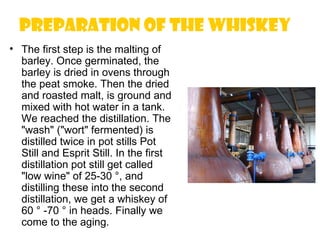
• The first step is the malting of
  barley. Once germinated, the
  barley is dried in ovens through
  the peat smoke. Then the dried
  and roasted malt, is ground and
  mixed with hot water in a tank.
  We reached the distillation. The
  "wash" ("wort" fermented) is
  distilled twice in pot stills Pot
  Still and Esprit Still. In the first
  distillation pot still get called
  "low wine" of 25-30 °, and
  distilling these into the second
  distillation, we get a whiskey of
  60 ° -70 ° in heads. Finally we
  come to the aging.
Types of whiskey
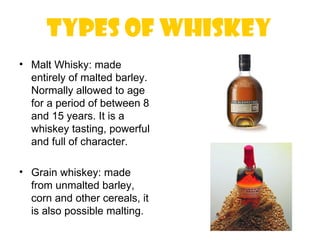
• Malt Whisky: made
  entirely of malted barley.
  Normally allowed to age
  for a period of between 8
  and 15 years. It is a
  whiskey tasting, powerful
  and full of character.

• Grain whiskey: made
  from unmalted barley,
  corn and other cereals, it
  is also possible malting.
Whisky of Scotland 
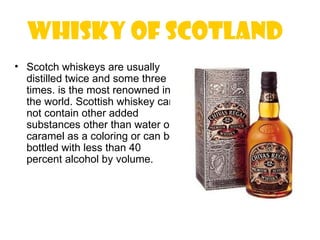
• Scotch whiskeys are usually
  distilled twice and some three
  times. is the most renowned in
  the world. Scottish whiskey can
  not contain other added
  substances other than water or
  caramel as a coloring or can be
  bottled with less than 40
  percent alcohol by volume.
Irish whiskey 
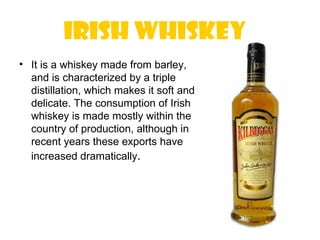
• It is a whiskey made from barley,
  and is characterized by a triple
  distillation, which makes it soft and
  delicate. The consumption of Irish
  whiskey is made mostly within the
  country of production, although in
  recent years these exports have
  increased dramatically.
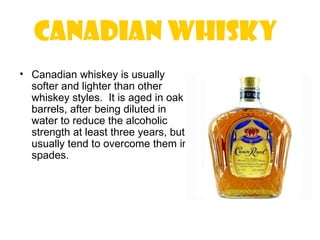
Canadian Whisky
• Canadian whiskey is usually
  softer and lighter than other
  whiskey styles. It is aged in oak
  barrels, after being diluted in
  water to reduce the alcoholic
  strength at least three years, but
  usually tend to overcome them in
  spades.
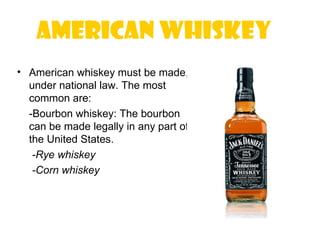
American Whiskey
• American whiskey must be made,
  under national law. The most
  common are:
  -Bourbon whiskey: The bourbon
  can be made legally in any part of
  the United States.
   -Rye whiskey
   -Corn whiskey
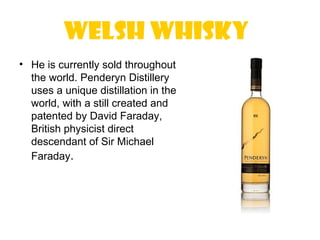
Welsh Whisky
• He is currently sold throughout
  the world. Penderyn Distillery
  uses a unique distillation in the
  world, with a still created and
  patented by David Faraday,
  British physicist direct
  descendant of Sir Michael
  Faraday.
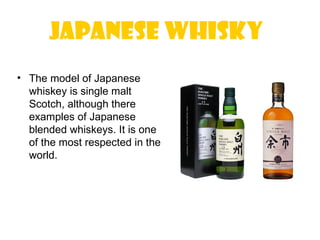
Japanese Whisky
• The model of Japanese
  whiskey is single malt
  Scotch, although there
  examples of Japanese
  blended whiskeys. It is one
  of the most respected in the
  world.
Indian Whisky
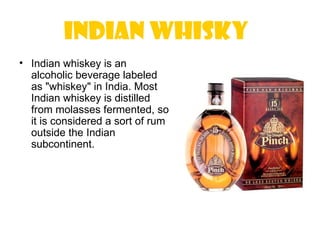
• Indian whiskey is an
  alcoholic beverage labeled
  as "whiskey" in India. Most
  Indian whiskey is distilled
  from molasses fermented, so
  it is considered a sort of rum
  outside the Indian
  subcontinent.
The whiskeys most expensive
            of world
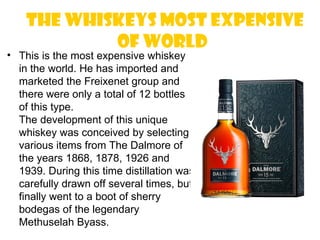
• This is the most expensive whiskey
  in the world. He has imported and
  marketed the Freixenet group and
  there were only a total of 12 bottles
  of this type.
  The development of this unique
  whiskey was conceived by selecting
  various items from The Dalmore of
  the years 1868, 1878, 1926 and
  1939. During this time distillation was
  carefully drawn off several times, but
  finally went to a boot of sherry
  bodegas of the legendary
  Methuselah Byass.
Tips for drinking whiskey
 In whiskey, like a good alcoholic beverage that is, has its
own mode of operation allows us to follow a few simple
things, make the best of him.
    -The glass or glass: The glass that you drink whiskey is
very important, in fact there is a glass and a glass specially
designed to consume this drink. The style glass shade,
broad at the base and narrow at the mouth is the ideal to
taste the whiskey as it allows to move freely in whiskey
inside without spilling a single drop, allowing the aromas
are released into the neck of the cup.
•  -Adding water: Just add or not add a touch of water is
  entirely personal. Many people believe that adding water
  ruins the taste of whiskey, on the other hand others say
  that a touch of fresh water enhances the aroma and
  flavor bringing to light the hidden features of the whiskey.
• -Added Ice: Put ice in a good whiskey is like wasting it, it
  sounds a bit crazy, but the ice will not only reduce the
  temperature of the whiskey but also freeze its aroma and
  taste properties decreasing. If you take whiskey with ice
  always try it without him, I assure you it looks like you're
  drinking a whiskey altogether.
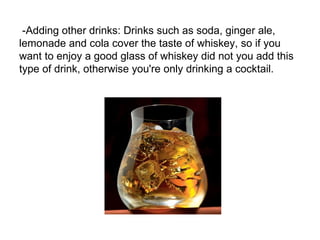
-Adding other drinks: Drinks such as soda, ginger ale,
lemonade and cola cover the taste of whiskey, so if you
want to enjoy a good glass of whiskey did not you add this
type of drink, otherwise you're only drinking a cocktail.
effects of whiskey 
  The effects of the whiskey depends on the amount
  consumed, but there are other circumstances that may
  accelerate or exacerbate.
• Age: Young people are more sensitive to the effects of
  alcohol on activities that deal with planning, memory and
  learning, and are more resistant than adults to the
  sedative and motor incoordination.

•    The weight and sex: Alcohol affects more serious for
    people with lower body mass. In general, women weigh
    less and the size of your internal organs are proportionally
    smaller, therefore, smaller amounts of alcohol can quickly
    generate more psycho-organic damage and develop
    alcohol problems more easily than men.
• The amount and speed of intake: depending on the amount
  of alcohol consumed, irrigation can be considered low, high
  or dangerous. A higher intake of alcohol in less time,
  greater possibility of poisoning.

• The combination with carbonated drinks (tonic, tails, etc.)
  accelerates the poisoning.
• The simultaneous ingestion of food, especially fatty food,
  poisoning slows but does not prevent or reduce damage to
  the body.
• The combination with other substances, such as
  tranquilizers, muscle relaxants and analgesics, potentiates
  the sedative effects of alcohol. When combined with
  cannabis increases the sedative effects of both
  substances. In the case of cocaine, a stimulant effects are
  counteracted, but the toxicity of both substances is greater
  than if consumed separately.
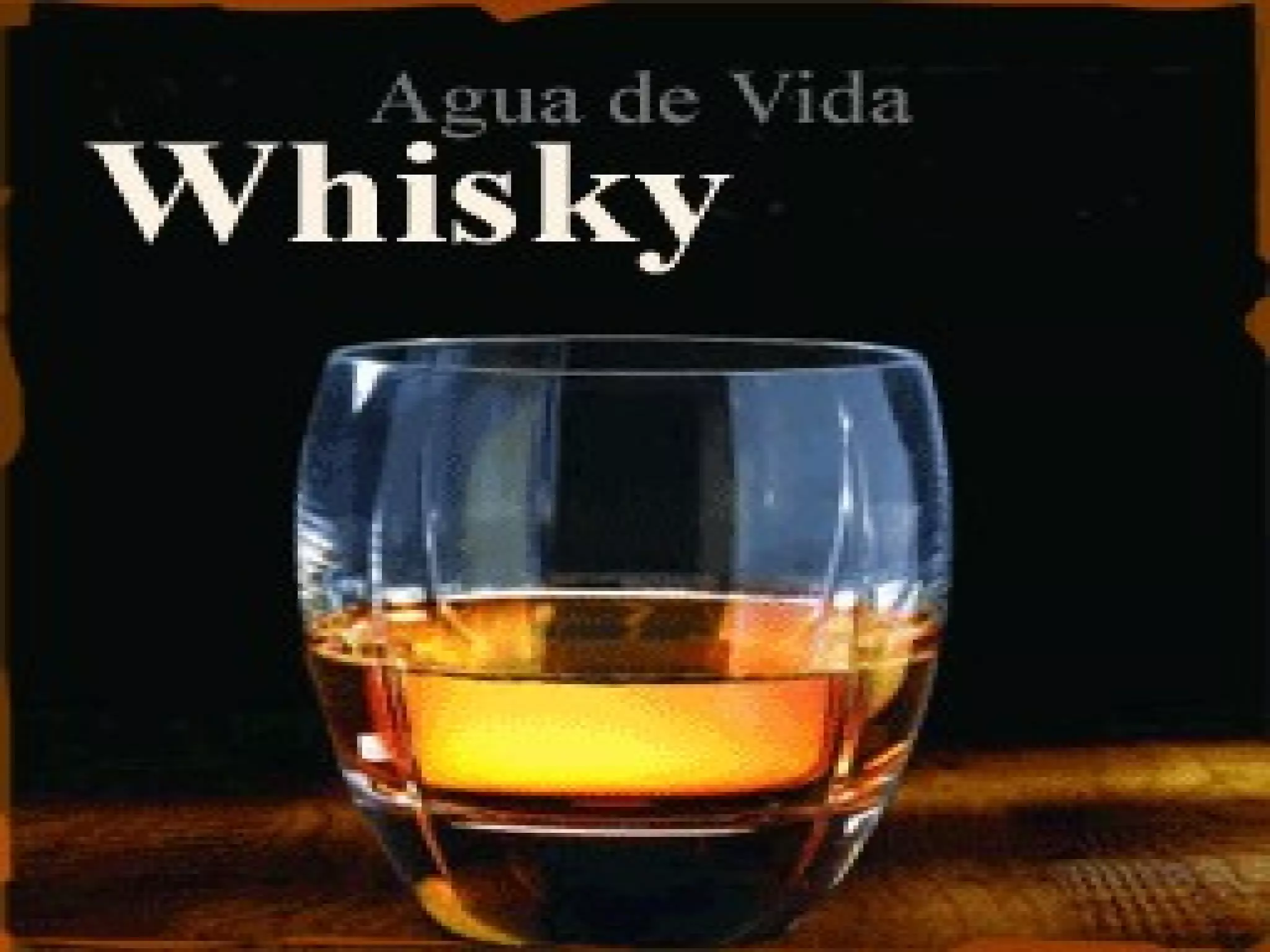
WHISKY

WHISKY

  • 2.
    index 1. Introduction 2. History of whiskey 3. Preparation of the whiskey 4. Types of whiskey 5. The whiskeys most expensive of world 6. Tips for drinking whiskey 7. Effects of whiskey
  • 3.
    • The Scotchwhiskey is an alcoholic beverage obtained by the distillation of a fermented mash of grains such as barley, wheat, malt, rye and corn, and further aging in wooden barrels, traditionally white oak. The term derives from the whiskey or whiskey Scottish Gaelic "uisge beatha" and the Irish Gaelic "uisce beathadh" which means, in both cases, "water of life" from the Latin aqua vitae aquavit.
  • 4.
    History of whiskey •The whiskey was first distilled in Scotland in 1494 when Friar John Cor was about 6 bushels of malt, this amounted to 1500 bottles of whiskey. The first records of a distillery dating back to 1690 when the distillery mentioned "Ferintoch" Forbes of Culloden. In the mid- nineteenth century the Scots began to blend their malt whiskey with grain whiskey lighter and cheaper. It was Andrew Usher and Co.. who in 1850 produced the first whiskey mixture.
  • 5.
    Preparation of thewhiskey • The first step is the malting of barley. Once germinated, the barley is dried in ovens through the peat smoke. Then the dried and roasted malt, is ground and mixed with hot water in a tank. We reached the distillation. The "wash" ("wort" fermented) is distilled twice in pot stills Pot Still and Esprit Still. In the first distillation pot still get called "low wine" of 25-30 °, and distilling these into the second distillation, we get a whiskey of 60 ° -70 ° in heads. Finally we come to the aging.
  • 6.
    Types of whiskey •Malt Whisky: made entirely of malted barley. Normally allowed to age for a period of between 8 and 15 years. It is a whiskey tasting, powerful and full of character. • Grain whiskey: made from unmalted barley, corn and other cereals, it is also possible malting.
  • 7.
    Whisky of Scotland  •Scotch whiskeys are usually distilled twice and some three times. is the most renowned in the world. Scottish whiskey can not contain other added substances other than water or caramel as a coloring or can be bottled with less than 40 percent alcohol by volume.
  • 8.
    Irish whiskey  • Itis a whiskey made from barley, and is characterized by a triple distillation, which makes it soft and delicate. The consumption of Irish whiskey is made mostly within the country of production, although in recent years these exports have increased dramatically.
  • 9.
    Canadian Whisky • Canadianwhiskey is usually softer and lighter than other whiskey styles. It is aged in oak barrels, after being diluted in water to reduce the alcoholic strength at least three years, but usually tend to overcome them in spades.
  • 10.
    American Whiskey • Americanwhiskey must be made, under national law. The most common are: -Bourbon whiskey: The bourbon can be made legally in any part of the United States. -Rye whiskey -Corn whiskey
  • 11.
    Welsh Whisky • Heis currently sold throughout the world. Penderyn Distillery uses a unique distillation in the world, with a still created and patented by David Faraday, British physicist direct descendant of Sir Michael Faraday.
  • 12.
    Japanese Whisky • Themodel of Japanese whiskey is single malt Scotch, although there examples of Japanese blended whiskeys. It is one of the most respected in the world.
  • 13.
    Indian Whisky • Indianwhiskey is an alcoholic beverage labeled as "whiskey" in India. Most Indian whiskey is distilled from molasses fermented, so it is considered a sort of rum outside the Indian subcontinent.
  • 14.
    The whiskeys mostexpensive of world • This is the most expensive whiskey in the world. He has imported and marketed the Freixenet group and there were only a total of 12 bottles of this type. The development of this unique whiskey was conceived by selecting various items from The Dalmore of the years 1868, 1878, 1926 and 1939. During this time distillation was carefully drawn off several times, but finally went to a boot of sherry bodegas of the legendary Methuselah Byass.
  • 15.
    Tips for drinkingwhiskey In whiskey, like a good alcoholic beverage that is, has its own mode of operation allows us to follow a few simple things, make the best of him. -The glass or glass: The glass that you drink whiskey is very important, in fact there is a glass and a glass specially designed to consume this drink. The style glass shade, broad at the base and narrow at the mouth is the ideal to taste the whiskey as it allows to move freely in whiskey inside without spilling a single drop, allowing the aromas are released into the neck of the cup.
  • 16.
    • -Addingwater: Just add or not add a touch of water is entirely personal. Many people believe that adding water ruins the taste of whiskey, on the other hand others say that a touch of fresh water enhances the aroma and flavor bringing to light the hidden features of the whiskey. • -Added Ice: Put ice in a good whiskey is like wasting it, it sounds a bit crazy, but the ice will not only reduce the temperature of the whiskey but also freeze its aroma and taste properties decreasing. If you take whiskey with ice always try it without him, I assure you it looks like you're drinking a whiskey altogether.
  • 17.
    -Adding other drinks:Drinks such as soda, ginger ale, lemonade and cola cover the taste of whiskey, so if you want to enjoy a good glass of whiskey did not you add this type of drink, otherwise you're only drinking a cocktail.
  • 18.
    effects of whiskey  The effects of the whiskey depends on the amount consumed, but there are other circumstances that may accelerate or exacerbate. • Age: Young people are more sensitive to the effects of alcohol on activities that deal with planning, memory and learning, and are more resistant than adults to the sedative and motor incoordination. • The weight and sex: Alcohol affects more serious for people with lower body mass. In general, women weigh less and the size of your internal organs are proportionally smaller, therefore, smaller amounts of alcohol can quickly generate more psycho-organic damage and develop alcohol problems more easily than men.
  • 19.
    • The amountand speed of intake: depending on the amount of alcohol consumed, irrigation can be considered low, high or dangerous. A higher intake of alcohol in less time, greater possibility of poisoning. • The combination with carbonated drinks (tonic, tails, etc.) accelerates the poisoning. • The simultaneous ingestion of food, especially fatty food, poisoning slows but does not prevent or reduce damage to the body. • The combination with other substances, such as tranquilizers, muscle relaxants and analgesics, potentiates the sedative effects of alcohol. When combined with cannabis increases the sedative effects of both substances. In the case of cocaine, a stimulant effects are counteracted, but the toxicity of both substances is greater than if consumed separately.