Meringue
Making of Meringues
Factors affecting the stability
Cooking Meringues
Types of Meringues
Uses of Meringue Presented by:-
Pankaj Chaudhary,
Lecturer,
Institute of Hotel
Management,
Bhopal.
Meringue
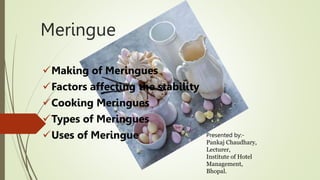
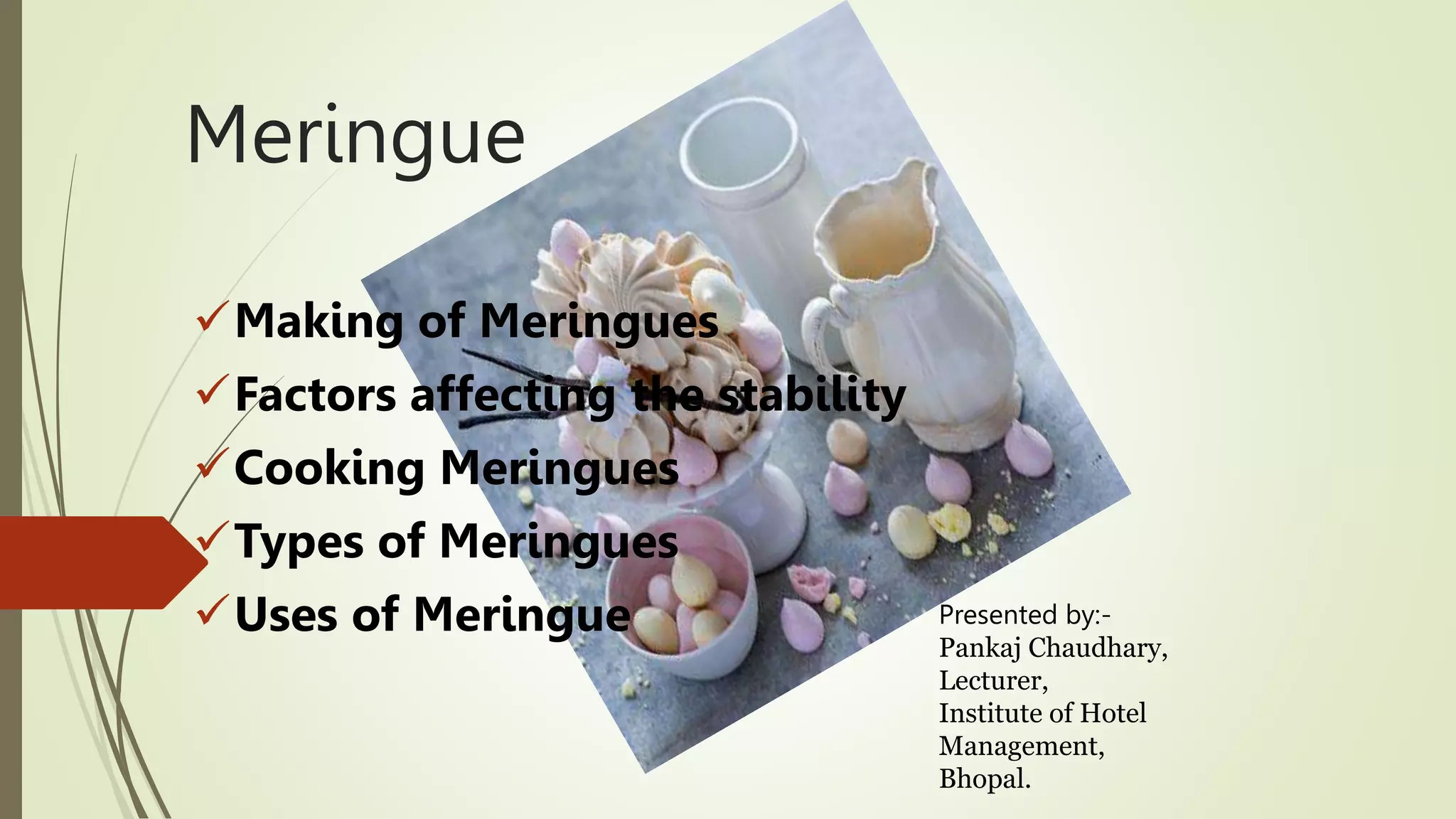
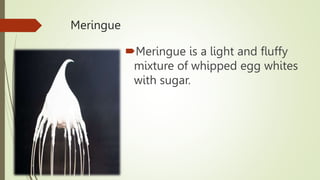
Meringue is a light and fluffy
mixture of whipped egg whites
with sugar.
Factors/The science behind meringues
 When egg whites are beaten, some of the hydrogen bonds in the protein
break, causing the proteins to unfold ("denature") and to aggregate non-
specifically. This change in structure leads to the stiff consistency required
for meringues.
 The use of a copper bowl, or the addition of cream of tartar is required to
additionally denature the proteins to create the firm peaks, otherwise the
whites will not be firm.
 Plastic bowls, wet or greasy bowls will likely result in the meringue mix
being prevented from becoming peaky. Wiping the bowl with a wedge of
lemon to remove any traces of grease can often help the process.
 When beating egg whites, they are classified in three stages according to
the peaks they form when the beater is lifted: soft, firm, and stiff peaks.
Storage
Egg whites and sugar are both hygroscopic (water-attracting) chemicals.
Consequently, meringue becomes soggy when refrigerated or stored in a high-
humidity environment.
This quality also explains the problem called "weeping" or "sweating", in which beads
of moisture form on all surfaces of the meringue. Sweating is a particular problem for
French meringues in which the granulated sugar is inadequately dissolved in the egg
whites, and for high-moisture pie fillings.
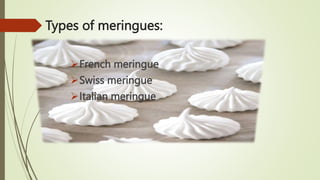
Types of meringues:
French meringue
Swiss meringue
Italian meringue
French meringue
It is also known as cold meringue.
Egg whites are whipped until frothy and sugar is added in
small amounts while whipping continuously.
Should be used instantly as it separates easily if left out.
Swiss Meringue Vs Italian Meringue
Italian Meringue
 It is most stable of all meringues.
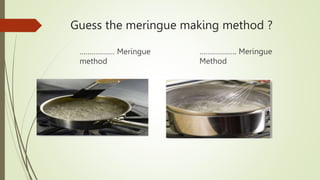
 The egg whites are whipped with small
amount of sugar until frothy and then hot
melted sugar boiled to 118 degree Celsius is
added while whisking continuously until a
thick meringue is formed.
Swiss Meringue
 This is hot meringue.
 The egg whites are whipped on a warm water
bath until frothy, sugar is added in smaller
amounts, and the mixture is whipped over hot
water bath until creamy and forms peaks.
Guess the meringue making method ?
……………… Meringue
method
………………. Meringue
Method
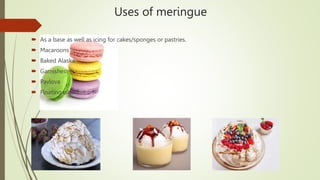
Uses of meringue
 As a base as well as icing for cakes/sponges or pastries.
 Macaroons
 Baked Alaska
 Garnishes
 Pavlova
 Floating island

Meringues.pptx

  • 1.
    Meringue Making of Meringues Factorsaffecting the stability Cooking Meringues Types of Meringues Uses of Meringue Presented by:- Pankaj Chaudhary, Lecturer, Institute of Hotel Management, Bhopal.
  • 2.
    Meringue Meringue is alight and fluffy mixture of whipped egg whites with sugar.
  • 3.
    Factors/The science behindmeringues  When egg whites are beaten, some of the hydrogen bonds in the protein break, causing the proteins to unfold ("denature") and to aggregate non- specifically. This change in structure leads to the stiff consistency required for meringues.  The use of a copper bowl, or the addition of cream of tartar is required to additionally denature the proteins to create the firm peaks, otherwise the whites will not be firm.  Plastic bowls, wet or greasy bowls will likely result in the meringue mix being prevented from becoming peaky. Wiping the bowl with a wedge of lemon to remove any traces of grease can often help the process.  When beating egg whites, they are classified in three stages according to the peaks they form when the beater is lifted: soft, firm, and stiff peaks.
  • 4.
    Storage Egg whites andsugar are both hygroscopic (water-attracting) chemicals. Consequently, meringue becomes soggy when refrigerated or stored in a high- humidity environment. This quality also explains the problem called "weeping" or "sweating", in which beads of moisture form on all surfaces of the meringue. Sweating is a particular problem for French meringues in which the granulated sugar is inadequately dissolved in the egg whites, and for high-moisture pie fillings.
  • 5.
    Types of meringues: Frenchmeringue Swiss meringue Italian meringue
  • 6.
    French meringue It isalso known as cold meringue. Egg whites are whipped until frothy and sugar is added in small amounts while whipping continuously. Should be used instantly as it separates easily if left out.
  • 7.
    Swiss Meringue VsItalian Meringue Italian Meringue  It is most stable of all meringues.  The egg whites are whipped with small amount of sugar until frothy and then hot melted sugar boiled to 118 degree Celsius is added while whisking continuously until a thick meringue is formed. Swiss Meringue  This is hot meringue.  The egg whites are whipped on a warm water bath until frothy, sugar is added in smaller amounts, and the mixture is whipped over hot water bath until creamy and forms peaks.
  • 8.
    Guess the meringuemaking method ? ……………… Meringue method ………………. Meringue Method
  • 9.
    Uses of meringue As a base as well as icing for cakes/sponges or pastries.  Macaroons  Baked Alaska  Garnishes  Pavlova  Floating island