All About Rum
Ritesh Pathania
HISTORY The history of Rum is the history of sugar. Sugar is a
sweet crystalline carbohydrate that occurs naturally in a
variety of plants. One of those is the sugar cane
(Saccharum officinarum), a tall, thick grass that has its
origins in the islands of present-day Indonesia in the East
Indies. Chinese traders spread its cultivation to Asia and
on to India. Arabs in turn brought it to the Middle East and
North Africa where it came to the attention of Europeans
during the Crusades in the 11th century.
As the Spanish and Portuguese began to venture out into
the Atlantic Ocean, they planted sugar cane in the Canary
and Azore Islands.
In 1493 Christopher Columbus picked up cane cuttings
from the Canaries while on his second voyage to the
Americas and transplanted them to Hispaniola, the island
in the Caribbean that is now shared by Haiti and the
Dominican Republic. Portuguese explorers soon did
likewise in Brazil.
Ritesh Pathania
HISTORY The Caribbean basin proved to have an ideal climate for
growing sugar cane, and sugar production quickly spread
around the islands. The insatiable demand in Europe for
sugar soon led to the establishment of hundreds of sugar
cane plantations and mills in the various English,
Spanish, French, Portuguese, and Dutch colonies. These
mills crushed the harvested cane and extracted the juice.
Boiling this juice caused chunks of crystallized sugar to
form. The remaining unsolidified juice was called melazas
and in English this became molasses.
Molasses is a sticky syrup that still contains a significant
amount of sugar. Sugar mill operators soon noticed that
when it was mixed with water and left out in the sun it
would ferment. In the English colonies it was called Kill
Devil (from its tendency to cause a nasty hangover or its
perceived medicinal power, take your choice) or
rumbullion (origins uncertain), which was shortened over
the years to our modern word Rum. The French render
this word as rhum, while the Spanish call it ron.
Ritesh Pathania
HISTORY Rum, and its fraternal twin, cane spirit, are made by
distilling fermented sugar and water. This sugar comes
from the sugar cane and is fermented from cane juice,
concentrated cane juice, or molasses. Molasses is the
sweet, sticky residue that remains after sugar cane
juice is boiled and the crystallized sugar is extracted.
Most Rum is made from molasses. Molasses is over
50% sugar, but it also contains significant amounts of
minerals and other trace elements, which can
contribute to the final flavor. Rums made from cane
juice, primarily on Haiti and Martinique, have a
naturally smooth palate.
Depending on the recipe, the "wash" (the cane juice,
or molasses and water) is fermented, using either
cultured yeast or airborne wild yeasts, for a period
ranging from 24 hours for light Rums up to several
weeks for heavy, full varieties.
Ritesh Pathania
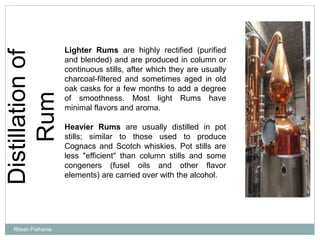
Distillationof
Rum Lighter Rums are highly rectified (purified
and blended) and are produced in column or
continuous stills, after which they are usually
charcoal-filtered and sometimes aged in old
oak casks for a few months to add a degree
of smoothness. Most light Rums have
minimal flavors and aroma.
Heavier Rums are usually distilled in pot
stills; similar to those used to produce
Cognacs and Scotch whiskies. Pot stills are
less "efficient" than column stills and some
congeners (fusel oils and other flavor
elements) are carried over with the alcohol.
Ritesh Pathania
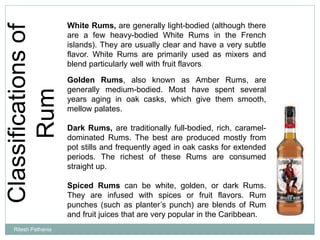
Classificationsof
Rum
White Rums, are generally light-bodied (although there
are a few heavy-bodied White Rums in the French
islands). They are usually clear and have a very subtle
flavor. White Rums are primarily used as mixers and
blend particularly well with fruit flavors.
Golden Rums, also known as Amber Rums, are
generally medium-bodied. Most have spent several
years aging in oak casks, which give them smooth,
mellow palates.
Dark Rums, are traditionally full-bodied, rich, caramel-
dominated Rums. The best are produced mostly from
pot stills and frequently aged in oak casks for extended
periods. The richest of these Rums are consumed
straight up.
Spiced Rums can be white, golden, or dark Rums.
They are infused with spices or fruit flavors. Rum
punches (such as planter’s punch) are blends of Rum
and fruit juices that are very popular in the Caribbean.
Ritesh Pathania
RumRegions The Caribbean is the epicenter of world Rum production. Virtually
every major island group produces its own distinct Rum style.
Barbados produces light, sweetish Rums from both pot and column
stills. Rum distillation began here and the Mount Gay Distillery, dating
from 1663, is probably the oldest operating Rum producer in the world.
Cuba produces light-bodied, crisp, clean Rums from column stills. It is
currently illegal to ship Cuban Rums into the United States.
The Dominican Republic is notable for its full-bodied, aged Rums
from column stills.
Guyana is justly famous for its rich, heavy Demerara Rums, named for
a local river, which are produced from both pot and column stills.
Ritesh Pathania
RumRegions Haiti follows the French tradition of heavier Rums that are double-
distilled in pot stills and aged in oak casks for three or more years to
produce full-flavored, exceptionally smooth- tasting Rums.
Jamaica is well known for its rich, aromatic Rums, most of which are
produced in pot stills. Jamaica has official classifications of Rum,
ranging from light to very full-flavored.
Martinique is a French island with the largest number of distilleries in
the Eastern Caribbean. Both pot and column stills are used. As on
other French islands such as Guadeloupe, both rhum agricole (made
from sugar cane juice) and rhum industriel (made from molasses) are
produced. These Rums are frequently aged in used French brandy
casks for a minimum of three years.
Puerto Rico is known primarily for light, very dry Rums from column
stills. All white Puerto Rican Rums must, by law, be aged a minimum of
one year while dark Rums must be aged three years.
Trinidad produces mainly light Rums from column stills and has an
extensive export trade.
Ritesh Pathania
RumRegions Guatemala and Nicaragua are noteworthy in Central America where a
variety of primarily medium-bodied Rums from column stills that lend
themselves well to aging.
Brazil produces vast quantities of mostly light Rums from column stills
with un-aged cane spirit called Cachaça (ca·sha·sa) the best-known
example.
Venezuela makes a number of well-respected barrel-aged golden and
dark Rums.
Asia rums tend to follow regional sugar cane production, with white
and golden Rums from column stills being produced primarily in the
Philippines and Thailand.
Ritesh Pathania
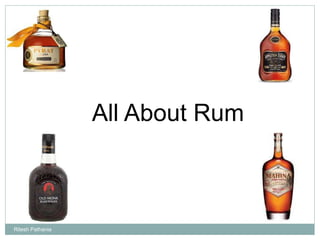
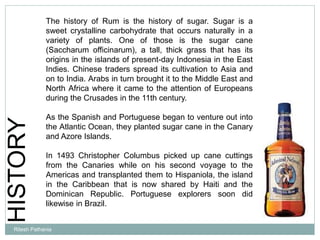
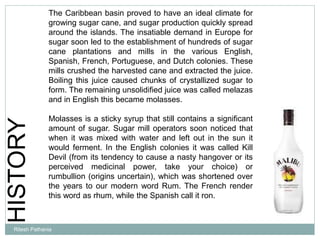
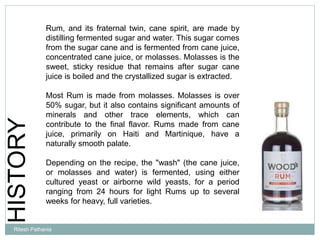
BrandsofRum Rhum Clement V.S.O.P. Rum
Rhum Clement Premiere Canne
Cachaca Gold, Silver
Sagatiba Vehla Gold
Havana Club
Captain Morgan
Bacardi Gold, Black, Superior
Bacardi Carda Blanca, Green Apple, Limon
Old Monk
Ritesh Pathania
RumCocktails Cuba Libre
Rum, Coke and Lemon Juice
Daiquiri
White Rum, Cointreau, Lemon Juice
Mai Tai
Rum, Amaretto, Cointreau, Lemon Juice,
Pineapple and Orange Juice
Mojito
Rum, Lemon Chunks, Mint Leaves and
Sparkling Water
Pina Colada
White Rum, Malibu, Pineapple Juice, Vanilla
Ice Cream
Caipirinha
Rum, Lemon Chunks, Sugar
Ritesh Pathania

ALL ABOUT RUM

  • 1.
  • 2.
    HISTORY The historyof Rum is the history of sugar. Sugar is a sweet crystalline carbohydrate that occurs naturally in a variety of plants. One of those is the sugar cane (Saccharum officinarum), a tall, thick grass that has its origins in the islands of present-day Indonesia in the East Indies. Chinese traders spread its cultivation to Asia and on to India. Arabs in turn brought it to the Middle East and North Africa where it came to the attention of Europeans during the Crusades in the 11th century. As the Spanish and Portuguese began to venture out into the Atlantic Ocean, they planted sugar cane in the Canary and Azore Islands. In 1493 Christopher Columbus picked up cane cuttings from the Canaries while on his second voyage to the Americas and transplanted them to Hispaniola, the island in the Caribbean that is now shared by Haiti and the Dominican Republic. Portuguese explorers soon did likewise in Brazil. Ritesh Pathania
  • 3.
    HISTORY The Caribbeanbasin proved to have an ideal climate for growing sugar cane, and sugar production quickly spread around the islands. The insatiable demand in Europe for sugar soon led to the establishment of hundreds of sugar cane plantations and mills in the various English, Spanish, French, Portuguese, and Dutch colonies. These mills crushed the harvested cane and extracted the juice. Boiling this juice caused chunks of crystallized sugar to form. The remaining unsolidified juice was called melazas and in English this became molasses. Molasses is a sticky syrup that still contains a significant amount of sugar. Sugar mill operators soon noticed that when it was mixed with water and left out in the sun it would ferment. In the English colonies it was called Kill Devil (from its tendency to cause a nasty hangover or its perceived medicinal power, take your choice) or rumbullion (origins uncertain), which was shortened over the years to our modern word Rum. The French render this word as rhum, while the Spanish call it ron. Ritesh Pathania
  • 4.
    HISTORY Rum, andits fraternal twin, cane spirit, are made by distilling fermented sugar and water. This sugar comes from the sugar cane and is fermented from cane juice, concentrated cane juice, or molasses. Molasses is the sweet, sticky residue that remains after sugar cane juice is boiled and the crystallized sugar is extracted. Most Rum is made from molasses. Molasses is over 50% sugar, but it also contains significant amounts of minerals and other trace elements, which can contribute to the final flavor. Rums made from cane juice, primarily on Haiti and Martinique, have a naturally smooth palate. Depending on the recipe, the "wash" (the cane juice, or molasses and water) is fermented, using either cultured yeast or airborne wild yeasts, for a period ranging from 24 hours for light Rums up to several weeks for heavy, full varieties. Ritesh Pathania
  • 5.
    Distillationof Rum Lighter Rumsare highly rectified (purified and blended) and are produced in column or continuous stills, after which they are usually charcoal-filtered and sometimes aged in old oak casks for a few months to add a degree of smoothness. Most light Rums have minimal flavors and aroma. Heavier Rums are usually distilled in pot stills; similar to those used to produce Cognacs and Scotch whiskies. Pot stills are less "efficient" than column stills and some congeners (fusel oils and other flavor elements) are carried over with the alcohol. Ritesh Pathania
  • 6.
    Classificationsof Rum White Rums, aregenerally light-bodied (although there are a few heavy-bodied White Rums in the French islands). They are usually clear and have a very subtle flavor. White Rums are primarily used as mixers and blend particularly well with fruit flavors. Golden Rums, also known as Amber Rums, are generally medium-bodied. Most have spent several years aging in oak casks, which give them smooth, mellow palates. Dark Rums, are traditionally full-bodied, rich, caramel- dominated Rums. The best are produced mostly from pot stills and frequently aged in oak casks for extended periods. The richest of these Rums are consumed straight up. Spiced Rums can be white, golden, or dark Rums. They are infused with spices or fruit flavors. Rum punches (such as planter’s punch) are blends of Rum and fruit juices that are very popular in the Caribbean. Ritesh Pathania
  • 7.
    RumRegions The Caribbeanis the epicenter of world Rum production. Virtually every major island group produces its own distinct Rum style. Barbados produces light, sweetish Rums from both pot and column stills. Rum distillation began here and the Mount Gay Distillery, dating from 1663, is probably the oldest operating Rum producer in the world. Cuba produces light-bodied, crisp, clean Rums from column stills. It is currently illegal to ship Cuban Rums into the United States. The Dominican Republic is notable for its full-bodied, aged Rums from column stills. Guyana is justly famous for its rich, heavy Demerara Rums, named for a local river, which are produced from both pot and column stills. Ritesh Pathania
  • 8.
    RumRegions Haiti followsthe French tradition of heavier Rums that are double- distilled in pot stills and aged in oak casks for three or more years to produce full-flavored, exceptionally smooth- tasting Rums. Jamaica is well known for its rich, aromatic Rums, most of which are produced in pot stills. Jamaica has official classifications of Rum, ranging from light to very full-flavored. Martinique is a French island with the largest number of distilleries in the Eastern Caribbean. Both pot and column stills are used. As on other French islands such as Guadeloupe, both rhum agricole (made from sugar cane juice) and rhum industriel (made from molasses) are produced. These Rums are frequently aged in used French brandy casks for a minimum of three years. Puerto Rico is known primarily for light, very dry Rums from column stills. All white Puerto Rican Rums must, by law, be aged a minimum of one year while dark Rums must be aged three years. Trinidad produces mainly light Rums from column stills and has an extensive export trade. Ritesh Pathania
  • 9.
    RumRegions Guatemala andNicaragua are noteworthy in Central America where a variety of primarily medium-bodied Rums from column stills that lend themselves well to aging. Brazil produces vast quantities of mostly light Rums from column stills with un-aged cane spirit called Cachaça (ca·sha·sa) the best-known example. Venezuela makes a number of well-respected barrel-aged golden and dark Rums. Asia rums tend to follow regional sugar cane production, with white and golden Rums from column stills being produced primarily in the Philippines and Thailand. Ritesh Pathania
  • 10.
    BrandsofRum Rhum ClementV.S.O.P. Rum Rhum Clement Premiere Canne Cachaca Gold, Silver Sagatiba Vehla Gold Havana Club Captain Morgan Bacardi Gold, Black, Superior Bacardi Carda Blanca, Green Apple, Limon Old Monk Ritesh Pathania
  • 11.
    RumCocktails Cuba Libre Rum,Coke and Lemon Juice Daiquiri White Rum, Cointreau, Lemon Juice Mai Tai Rum, Amaretto, Cointreau, Lemon Juice, Pineapple and Orange Juice Mojito Rum, Lemon Chunks, Mint Leaves and Sparkling Water Pina Colada White Rum, Malibu, Pineapple Juice, Vanilla Ice Cream Caipirinha Rum, Lemon Chunks, Sugar Ritesh Pathania