OFFENDER PROFILING AND
LINKING CRIME
Desmond Ayim-Aboagye, Ph.D.
Criminal Psychology
Overview
• The term ‘offender profiling’ is one with which most of us are
• familiar. Its recent appearances in the media have certainly raised
• the profile of criminal psychology and a number of students are
• keen to work in this area. Unfortunately, the media portrayal of
• offender profiling has often been far from accurate. As a result of
• its general popularity, much has been written on this topic and a
• comprehensive review of the literature is beyond the scope of this
• chapter: rather we aim to give you a more accurate introduction to
• the topic of offender profiling. It will also introduce you to the
• equally fascinating but relatively unpublicized practice of linking
• crimes, which has at times been considered a type of offender pro-
• filing. However, the aims of the two processes are quite different
• and therefore they are discussed separately within this chapter
offender profiling and
linking crime
• ‘offender profiling’
• Offender profiling is the inferring of an of
ender’s characteristics from his or her cr
ime scene behaviour.
What are involved
• For example, a profiler might
• try to infer a criminal’s age, gender or employment history from the
• way he or she has behaved during a crime. This practice has been refe
rred to by other names including criminal profiling, psychological profilin
g and specific profile analysis. Offender profiling is
• typically used with crimes where the offender’s identity is unknown
• and with serious types of crime, such as murder or rape. Profilers are
• also likely to work on crime series, which are collections of crimes
• that are thought to have been committed by the same offender.
The different types of offender profiling
• 1) geographical profiling and
• 2) the profiling of an offender’s personal
characteristics.
Geographical profiling and the profiling of
an offender’s personal characteristics.
• This is the one people most commonly associate with th
e term offender profiling.
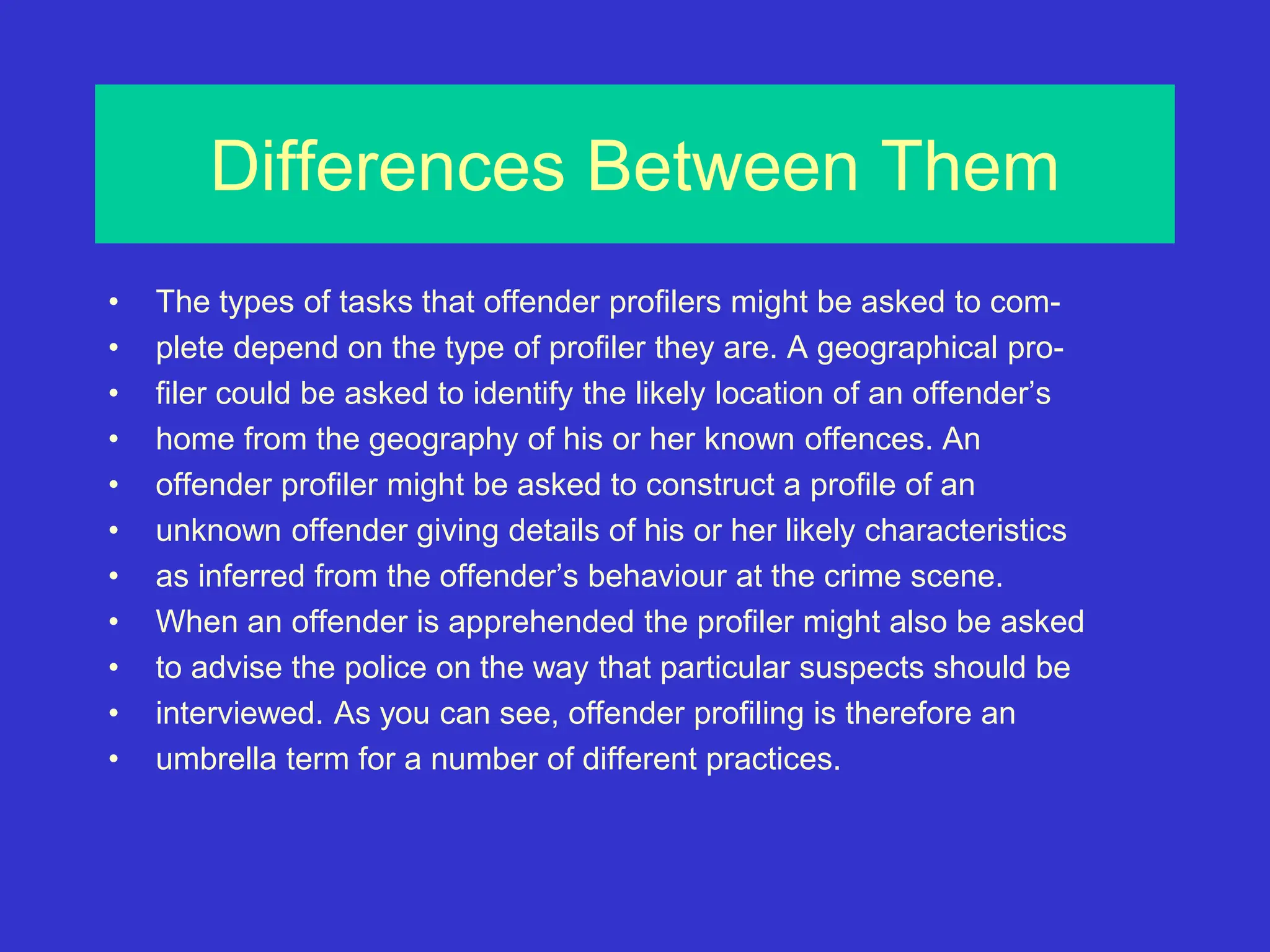
Differences Between Them
• The types of tasks that offender profilers might be asked to com-
• plete depend on the type of profiler they are. A geographical pro-
• filer could be asked to identify the likely location of an offender’s
• home from the geography of his or her known offences. An
• offender profiler might be asked to construct a profile of an
• unknown offender giving details of his or her likely characteristics
• as inferred from the offender’s behaviour at the crime scene.
• When an offender is apprehended the profiler might also be asked
• to advise the police on the way that particular suspects should be
• interviewed. As you can see, offender profiling is therefore an
• umbrella term for a number of different practices.
‘Who are offender profilers?’
• 1. Criminal psychologists.
• 2. Psychiatrists,
• 3. Police officers and police civilian staff were
also represented within his sample of offende
r profilers
A number of different materials can be used by an offen
der
profiler
• A) One of the most important sources of
• information for constructing a profile would be the victims’ or
• witnesses’ accounts of the crime. In some types of crime it is po
ssible that a victim’s account may not be available, for example i
n the case of murder.
• B) In such cases, an offender profiler might
• instead have to rely on post-mortem reports,
• C) Sketches of the crime scene and
• D) Accounts from others about the victim. Regardless of
• the documentation used in constructing the profile, an offender
• profiler has a lot of information to absorb and process when
• trying to profile the offenders or their location.
Geographical profiling
• Geographical profiling is typically used to identify the likely area
• of an offender’s residence from the location of the crime. Such a
n approach can be very useful in narrowing down a pool of susp
ects or enabling the police to prioritize an area for investigation
or DNA sampling.
•
• Geographical profiling has its history in environmental criminolo
gy.
Circle Theory of
Environmental Range
• Circle Theory of
• Environmental Range which predicts that all things being equal,
• the shape of an offender’s criminal and home range will be circul
ar, with the home itself being located in the centre of the circle.
• When the home location is unknown, which is the case for geo-
• graphical profilers, its approximate location can be predicted by
• drawing a circle through the two most geographically distant
• offences.
Profiling personal characteristics
• The profiling of someone’s personal characteristics is more com-
• monly associated with offender profiling and is the practice most
•
• often portrayed in the media. The types of characteristics profiled
• (as shown in the media and in published reports of profiling)
• include demographic characteristics such as an offender’s gender,
• age, ethnicity, educational and employment history. This
• approach assumes that the way a crime is committed is related to
• the characteristics of the person, which enables the profiler to
• draw inferences about the characteristics of a criminal from the
• way in which he or she behaved during the crime.
Different approaches to this type of profiling can be
broadly broken down into three categories.
1. Statistical Profiling
2. Clinical profiling
3. The Federal Bureau of
• Investigation (FBI) in the United States. (On the basis
of interviews
• with serial offenders)
empirical evidence for the theoretical
assumptions of offender profiling
– Three Assumptions of Offender Profiling
– 1) Cross-Situational Consistency
– 2) The offender consistency hypothesis
– 3) The homology assumption
Cross-Situational Consistency
• The study of behavioural consistency, including cross-situational
• consistency, has been a focus for personality and social psycholo-
• gists for decades.
• Some recent research has found that the more psychologically similar t
he situations being compared, the greater the behavioural consistency
observed.
• This
• has been demonstrated with aggressive behaviour, which could be
• considered closer to criminal behaviour than other types of
• behaviour psychologists have investigated.
Cross-Situational Consistency
• Researchers of personality psychology have explained that
• psychological similarity relates to what a situation means to us
• and what feelings, thoughts, expectations or goals it triggers.
• The
• psychological similarity of situations is increasingly recognized
• as an important factor in determining the likely degree of
• behavioural consistency. However, how someone interprets a
• situation is likely to be quite idiosyncratic, depending on their
• own cognitive abilities and past experiences.
The offender consistency hypothesis
• Behaviours are hypothesized as relating to the psychology of the individual.
• Psychologists studying non-
• criminal behaviour have suggested that some types of behaviour
• show more consistency than others.
• Essentially, research has sug-
• gested that behaviour generated by the individual shows greater
• Consistency than behaviour elicited by the environment.
• Behaviour generated by the individual -- is viewed as self-generated, reflecting p
ersonal goals and
• desires, and involves acting on the environment.
The offender consistency hypothesis
• Findings seems quite logical to hypothesize that
• criminal behaviour, which could be considered need- or desire-driven, would sho
w consistency.
• It could also be hypothesized that
• more interpersonal types of crime would show less consistency,
• because the additional environmental stimulus of victims or wit-
• nesses introduces more potential for variability.
The homology assumption
• The question of whether offenders who behave in a similar manner
• during their crimes also share similar demographic characteristics
• has been examined using a sample of stranger rapists, but the study
• found no evidence to support this.
• NOTE!!!!
• In the practice of offender profiling, it is clearly of concern that thus
• far it is only the offender consistency hypothesis that shows evi-
• dence of sound empirical support.
Evaluations of offender profiling in practice
• While it is very positive that profiling has been succes
sful in specific cases it is important for the acceptanc
e of profiling as a scientific practice that its effectiven
ess is demonstrated through empirical research.
Recommended Reading
• Ainsworth, P. B. (2000) Psychology and crime: Myths and reality.
• Harlow, Essex: Longman.
•
• Alison, L. (2005) The Forensic Psychologist’s casebook: psychological
• profiling and criminal investigation. Cullompton, UK:
• Willan.
•
• Carson, D. and Bull, R. (2003) Handbook of psychology in legal
• contexts, 2nd edn. Chichester: Wiley.

Offender Profiling and Linking Crime.ppt

  • 1.
    OFFENDER PROFILING AND LINKINGCRIME Desmond Ayim-Aboagye, Ph.D. Criminal Psychology
  • 2.
    Overview • The term‘offender profiling’ is one with which most of us are • familiar. Its recent appearances in the media have certainly raised • the profile of criminal psychology and a number of students are • keen to work in this area. Unfortunately, the media portrayal of • offender profiling has often been far from accurate. As a result of • its general popularity, much has been written on this topic and a • comprehensive review of the literature is beyond the scope of this • chapter: rather we aim to give you a more accurate introduction to • the topic of offender profiling. It will also introduce you to the • equally fascinating but relatively unpublicized practice of linking • crimes, which has at times been considered a type of offender pro- • filing. However, the aims of the two processes are quite different • and therefore they are discussed separately within this chapter
  • 3.
    offender profiling and linkingcrime • ‘offender profiling’ • Offender profiling is the inferring of an of ender’s characteristics from his or her cr ime scene behaviour.
  • 4.
    What are involved •For example, a profiler might • try to infer a criminal’s age, gender or employment history from the • way he or she has behaved during a crime. This practice has been refe rred to by other names including criminal profiling, psychological profilin g and specific profile analysis. Offender profiling is • typically used with crimes where the offender’s identity is unknown • and with serious types of crime, such as murder or rape. Profilers are • also likely to work on crime series, which are collections of crimes • that are thought to have been committed by the same offender.
  • 5.
    The different typesof offender profiling • 1) geographical profiling and • 2) the profiling of an offender’s personal characteristics.
  • 6.
    Geographical profiling andthe profiling of an offender’s personal characteristics. • This is the one people most commonly associate with th e term offender profiling.
  • 7.
    Differences Between Them •The types of tasks that offender profilers might be asked to com- • plete depend on the type of profiler they are. A geographical pro- • filer could be asked to identify the likely location of an offender’s • home from the geography of his or her known offences. An • offender profiler might be asked to construct a profile of an • unknown offender giving details of his or her likely characteristics • as inferred from the offender’s behaviour at the crime scene. • When an offender is apprehended the profiler might also be asked • to advise the police on the way that particular suspects should be • interviewed. As you can see, offender profiling is therefore an • umbrella term for a number of different practices.
  • 8.
    ‘Who are offenderprofilers?’ • 1. Criminal psychologists. • 2. Psychiatrists, • 3. Police officers and police civilian staff were also represented within his sample of offende r profilers
  • 9.
    A number ofdifferent materials can be used by an offen der profiler • A) One of the most important sources of • information for constructing a profile would be the victims’ or • witnesses’ accounts of the crime. In some types of crime it is po ssible that a victim’s account may not be available, for example i n the case of murder. • B) In such cases, an offender profiler might • instead have to rely on post-mortem reports, • C) Sketches of the crime scene and • D) Accounts from others about the victim. Regardless of • the documentation used in constructing the profile, an offender • profiler has a lot of information to absorb and process when • trying to profile the offenders or their location.
  • 10.
    Geographical profiling • Geographicalprofiling is typically used to identify the likely area • of an offender’s residence from the location of the crime. Such a n approach can be very useful in narrowing down a pool of susp ects or enabling the police to prioritize an area for investigation or DNA sampling. • • Geographical profiling has its history in environmental criminolo gy.
  • 11.
    Circle Theory of EnvironmentalRange • Circle Theory of • Environmental Range which predicts that all things being equal, • the shape of an offender’s criminal and home range will be circul ar, with the home itself being located in the centre of the circle. • When the home location is unknown, which is the case for geo- • graphical profilers, its approximate location can be predicted by • drawing a circle through the two most geographically distant • offences.
  • 12.
    Profiling personal characteristics •The profiling of someone’s personal characteristics is more com- • monly associated with offender profiling and is the practice most • • often portrayed in the media. The types of characteristics profiled • (as shown in the media and in published reports of profiling) • include demographic characteristics such as an offender’s gender, • age, ethnicity, educational and employment history. This • approach assumes that the way a crime is committed is related to • the characteristics of the person, which enables the profiler to • draw inferences about the characteristics of a criminal from the • way in which he or she behaved during the crime.
  • 13.
    Different approaches tothis type of profiling can be broadly broken down into three categories. 1. Statistical Profiling 2. Clinical profiling 3. The Federal Bureau of • Investigation (FBI) in the United States. (On the basis of interviews • with serial offenders)
  • 14.
    empirical evidence forthe theoretical assumptions of offender profiling – Three Assumptions of Offender Profiling – 1) Cross-Situational Consistency – 2) The offender consistency hypothesis – 3) The homology assumption
  • 15.
    Cross-Situational Consistency • Thestudy of behavioural consistency, including cross-situational • consistency, has been a focus for personality and social psycholo- • gists for decades. • Some recent research has found that the more psychologically similar t he situations being compared, the greater the behavioural consistency observed. • This • has been demonstrated with aggressive behaviour, which could be • considered closer to criminal behaviour than other types of • behaviour psychologists have investigated.
  • 16.
    Cross-Situational Consistency • Researchersof personality psychology have explained that • psychological similarity relates to what a situation means to us • and what feelings, thoughts, expectations or goals it triggers. • The • psychological similarity of situations is increasingly recognized • as an important factor in determining the likely degree of • behavioural consistency. However, how someone interprets a • situation is likely to be quite idiosyncratic, depending on their • own cognitive abilities and past experiences.
  • 17.
    The offender consistencyhypothesis • Behaviours are hypothesized as relating to the psychology of the individual. • Psychologists studying non- • criminal behaviour have suggested that some types of behaviour • show more consistency than others. • Essentially, research has sug- • gested that behaviour generated by the individual shows greater • Consistency than behaviour elicited by the environment. • Behaviour generated by the individual -- is viewed as self-generated, reflecting p ersonal goals and • desires, and involves acting on the environment.
  • 18.
    The offender consistencyhypothesis • Findings seems quite logical to hypothesize that • criminal behaviour, which could be considered need- or desire-driven, would sho w consistency. • It could also be hypothesized that • more interpersonal types of crime would show less consistency, • because the additional environmental stimulus of victims or wit- • nesses introduces more potential for variability.
  • 19.
    The homology assumption •The question of whether offenders who behave in a similar manner • during their crimes also share similar demographic characteristics • has been examined using a sample of stranger rapists, but the study • found no evidence to support this. • NOTE!!!! • In the practice of offender profiling, it is clearly of concern that thus • far it is only the offender consistency hypothesis that shows evi- • dence of sound empirical support.
  • 20.
    Evaluations of offenderprofiling in practice • While it is very positive that profiling has been succes sful in specific cases it is important for the acceptanc e of profiling as a scientific practice that its effectiven ess is demonstrated through empirical research.
  • 21.
    Recommended Reading • Ainsworth,P. B. (2000) Psychology and crime: Myths and reality. • Harlow, Essex: Longman. • • Alison, L. (2005) The Forensic Psychologist’s casebook: psychological • profiling and criminal investigation. Cullompton, UK: • Willan. • • Carson, D. and Bull, R. (2003) Handbook of psychology in legal • contexts, 2nd edn. Chichester: Wiley.