The Self Understanding “Who am I?”
Thinking about the Self: Personal verses Social Identity Personal-Social Identity Continuum The two distinct ways that the self can be categorized. At the personal level, the self can be thought of as a unique individual, whereas at the social identity level, the self is thought of as a member of a group.
Intragroup Comparisons Judgments that result from comparisons between individuals who are members of the same group.
Intergroup Comparisons Judgments that result from comparisons between our group and another group.
Who I Am Depends On the Situation Typically reference social identities, interpersonal relationships and a variety of traits. Describe self differently depending on situational specificity:  “ I am a _______ person.” “ I am a(n) _______ person when a professor provides me with a challenge.” Tendency to describe self according to context and relationships increases with age
Self-Complexity How the self-concept is organized. For those whose self-concepts are organized complexly, important aspects of the self are distinct from one another. For those whose self-concept is low in complexity, there is a greater overlap in different components of the self. Consequences for how we view the self when we experience stress
Identity Interference When two important social identities are perceived as being in conflict, such that acting on the basis of one identity interferes with performing well based on the other identity. Example- woman scientists
Independent Self-Concept In individualistic cultures, the expectation is that people will develop a self-concept as separate from or independent of others. Men are expected to have an independent self-concept more so than women.
Interdependent Self-Concept In collectivist cultures, the expectation is that people will develop a self-concept in terms of their connections or relationships with others. Women are expected to have an interdependent self-concept more than men.
Who I Am Depends on Others' Treatment We would change an aspect of the self to avoid rejection by others (don't ask, don't tell), or make  even more  self-defining (rebel against establishment). Identity dilemmas
Subjective Self-Awareness The first level of self to emerge. It is the recognition that the self is separate from other objects in one's physical environment. Objective Self-Awareness/seeing the self Symbolic Self-Awareness/ability to form abstract representations of the self through language
Possible Selves: The Self over Time Images of how the self might be in the future—either “dreaded” possible selves to avoid or “desired” potential selves to strive  for.  Role Models and New Year's Resolutions Self-Efficacy: The belief that one can achieve a goal as a result of one's own actions (also Collective Self-Efficacy related to groups)
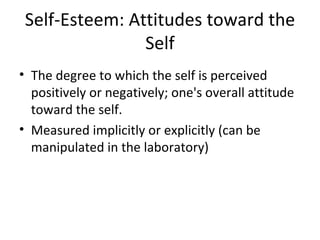
Self-Esteem: Attitudes toward the Self The degree to which the self is perceived positively or negatively; one's overall attitude toward the self. Measured implicitly or explicitly (can be manipulated in the laboratory)
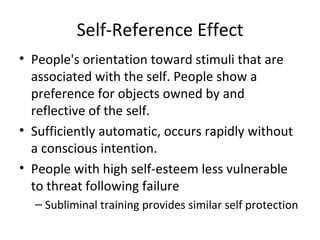
Self-Reference Effect People's orientation toward stimuli that are associated with the self. People show a preference for objects owned by and reflective of the self. Sufficiently automatic, occurs rapidly without a conscious intention. People with high self-esteem less vulnerable to threat following failure Subliminal training provides similar self protection
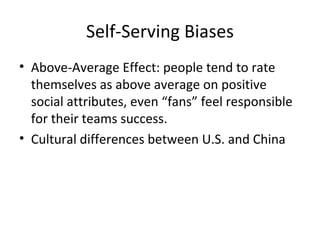
Self-Serving Biases Above-Average Effect: people tend to rate themselves as above average on positive social attributes, even “fans” feel responsible for their teams success. Cultural differences between U.S. and China
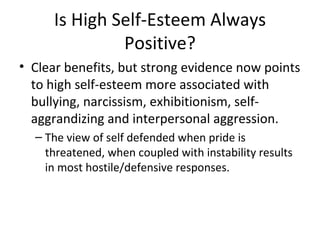
Is High Self-Esteem Always Positive? Clear benefits, but strong evidence now points to high self-esteem more associated with bullying, narcissism, exhibitionism, self-aggrandizing and interpersonal aggression. The view of self defended when pride is threatened, when coupled with instability results in most hostile/defensive responses.
Do Women and Men differ in Levels of Self-Esteem? To the extent that woman are viewed as less competent than men in the larger social world, their self-esteem is lower. Indian and Malaysian women lowest. England and Finland perceive themselves equally favorably as men. Women in jobs with frequent gender discrimination lower emotional/physical health over time
Self-Comparison: Knowing the Self Perhaps  all  human judgment is related to  some  comparison Downward Social Comparison: compare self to someone who does less well  Upward Social Comparison: compare to someone who does better than the self
Self-Evaluation Maintenance Model In order to maintain a positive view of the self, we distance ourselves from others who perform better than we do on valued dimensions, but move closer to others who perform worse, to protect our self-esteem. Applies with comparisons at the personal level and as individual to individual
Social Comparison Theory Festinger (1954) suggested that people compare themselves to others because, for many domains and attributes, there is no objective yardstick with which to evaluate the self, so other people are highly informative. -desire to see self positively appears more powerful that desire to see self accurately In-group comparisons “my salary is pretty good for a woman.”
Social Identity Theory Suggests that we will move closer to positive others with whom we share an identity, but distance ourselves from other ingroup members who perform poorly or otherwise make our social identity negative. Applies to comparing self at group level, with person sharing same category. Positive evaluations when make  group  look good (men vs women) Black-Sheep Effect
Self-Presentation and Self-Regulation Self-Promotion Ingratiation: attempts to make others like us by praising them (cultural differences)
Self-Monitoring Monitoring behavior in response to others expectancies. Low self-monitors are not very effective and act according to personal views, high self-monitors very good at adapting behavior according to expectancies and/or the situation. Politicians, actors, salespeople (use pronouns like they, them, and tend to have higher self-esteem)
Introspection Attempts to understand the self by self-examination, turning inward to assess one's motives Always good? We don't always know or have conscious access to the reasons for our actions Thinking about the future Beneficial when thinking about conscious choices
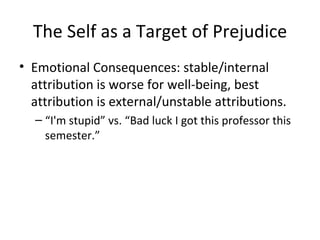
The Self as a Target of Prejudice Emotional Consequences: stable/internal attribution is worse for well-being, best attribution is external/unstable attributions. “ I'm stupid” vs. “Bad luck I got this professor this semester.”
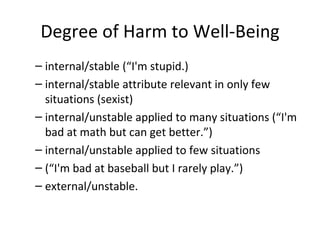
Degree of Harm to Well-Being internal/stable (“I'm stupid.) internal/stable attribute relevant in only few situations (sexist) internal/unstable applied to many situations (“I'm bad at math but can get better.”) internal/unstable applied to few situations  (“I'm bad at baseball but I rarely play.”) external/unstable.
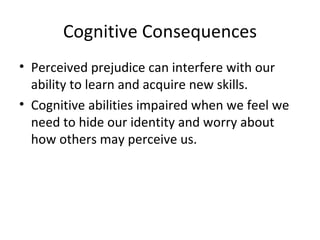
Cognitive Consequences Perceived prejudice can interfere with our ability to learn and acquire new skills. Cognitive abilities impaired when we feel we need to hide our identity and worry about how others may perceive us.
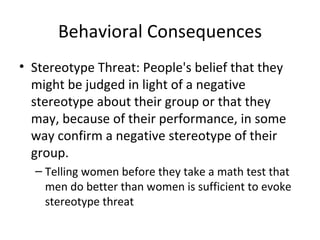
Behavioral Consequences Stereotype Threat: People's belief that they might be judged in light of a negative stereotype about their group or that they may, because of their performance, in some way confirm a negative stereotype of their group. Telling women before they take a math test that men do better than women is sufficient to evoke stereotype threat


The Self: Understanding "Who Am I?"

  • 1.
    The Self Understanding“Who am I?”
  • 2.
    Thinking about theSelf: Personal verses Social Identity Personal-Social Identity Continuum The two distinct ways that the self can be categorized. At the personal level, the self can be thought of as a unique individual, whereas at the social identity level, the self is thought of as a member of a group.
  • 3.
    Intragroup Comparisons Judgmentsthat result from comparisons between individuals who are members of the same group.
  • 4.
    Intergroup Comparisons Judgmentsthat result from comparisons between our group and another group.
  • 5.
    Who I AmDepends On the Situation Typically reference social identities, interpersonal relationships and a variety of traits. Describe self differently depending on situational specificity: “ I am a _______ person.” “ I am a(n) _______ person when a professor provides me with a challenge.” Tendency to describe self according to context and relationships increases with age
  • 6.
    Self-Complexity How theself-concept is organized. For those whose self-concepts are organized complexly, important aspects of the self are distinct from one another. For those whose self-concept is low in complexity, there is a greater overlap in different components of the self. Consequences for how we view the self when we experience stress
  • 7.
    Identity Interference Whentwo important social identities are perceived as being in conflict, such that acting on the basis of one identity interferes with performing well based on the other identity. Example- woman scientists
  • 8.
    Independent Self-Concept Inindividualistic cultures, the expectation is that people will develop a self-concept as separate from or independent of others. Men are expected to have an independent self-concept more so than women.
  • 9.
    Interdependent Self-Concept Incollectivist cultures, the expectation is that people will develop a self-concept in terms of their connections or relationships with others. Women are expected to have an interdependent self-concept more than men.
  • 10.
    Who I AmDepends on Others' Treatment We would change an aspect of the self to avoid rejection by others (don't ask, don't tell), or make even more self-defining (rebel against establishment). Identity dilemmas
  • 11.
    Subjective Self-Awareness Thefirst level of self to emerge. It is the recognition that the self is separate from other objects in one's physical environment. Objective Self-Awareness/seeing the self Symbolic Self-Awareness/ability to form abstract representations of the self through language
  • 12.
    Possible Selves: TheSelf over Time Images of how the self might be in the future—either “dreaded” possible selves to avoid or “desired” potential selves to strive for. Role Models and New Year's Resolutions Self-Efficacy: The belief that one can achieve a goal as a result of one's own actions (also Collective Self-Efficacy related to groups)
  • 13.
    Self-Esteem: Attitudes towardthe Self The degree to which the self is perceived positively or negatively; one's overall attitude toward the self. Measured implicitly or explicitly (can be manipulated in the laboratory)
  • 14.
    Self-Reference Effect People'sorientation toward stimuli that are associated with the self. People show a preference for objects owned by and reflective of the self. Sufficiently automatic, occurs rapidly without a conscious intention. People with high self-esteem less vulnerable to threat following failure Subliminal training provides similar self protection
  • 15.
    Self-Serving Biases Above-AverageEffect: people tend to rate themselves as above average on positive social attributes, even “fans” feel responsible for their teams success. Cultural differences between U.S. and China
  • 16.
    Is High Self-EsteemAlways Positive? Clear benefits, but strong evidence now points to high self-esteem more associated with bullying, narcissism, exhibitionism, self-aggrandizing and interpersonal aggression. The view of self defended when pride is threatened, when coupled with instability results in most hostile/defensive responses.
  • 17.
    Do Women andMen differ in Levels of Self-Esteem? To the extent that woman are viewed as less competent than men in the larger social world, their self-esteem is lower. Indian and Malaysian women lowest. England and Finland perceive themselves equally favorably as men. Women in jobs with frequent gender discrimination lower emotional/physical health over time
  • 18.
    Self-Comparison: Knowing theSelf Perhaps all human judgment is related to some comparison Downward Social Comparison: compare self to someone who does less well Upward Social Comparison: compare to someone who does better than the self
  • 19.
    Self-Evaluation Maintenance ModelIn order to maintain a positive view of the self, we distance ourselves from others who perform better than we do on valued dimensions, but move closer to others who perform worse, to protect our self-esteem. Applies with comparisons at the personal level and as individual to individual
  • 20.
    Social Comparison TheoryFestinger (1954) suggested that people compare themselves to others because, for many domains and attributes, there is no objective yardstick with which to evaluate the self, so other people are highly informative. -desire to see self positively appears more powerful that desire to see self accurately In-group comparisons “my salary is pretty good for a woman.”
  • 21.
    Social Identity TheorySuggests that we will move closer to positive others with whom we share an identity, but distance ourselves from other ingroup members who perform poorly or otherwise make our social identity negative. Applies to comparing self at group level, with person sharing same category. Positive evaluations when make group look good (men vs women) Black-Sheep Effect
  • 22.
    Self-Presentation and Self-RegulationSelf-Promotion Ingratiation: attempts to make others like us by praising them (cultural differences)
  • 23.
    Self-Monitoring Monitoring behaviorin response to others expectancies. Low self-monitors are not very effective and act according to personal views, high self-monitors very good at adapting behavior according to expectancies and/or the situation. Politicians, actors, salespeople (use pronouns like they, them, and tend to have higher self-esteem)
  • 24.
    Introspection Attempts tounderstand the self by self-examination, turning inward to assess one's motives Always good? We don't always know or have conscious access to the reasons for our actions Thinking about the future Beneficial when thinking about conscious choices
  • 25.
    The Self asa Target of Prejudice Emotional Consequences: stable/internal attribution is worse for well-being, best attribution is external/unstable attributions. “ I'm stupid” vs. “Bad luck I got this professor this semester.”
  • 26.
    Degree of Harmto Well-Being internal/stable (“I'm stupid.) internal/stable attribute relevant in only few situations (sexist) internal/unstable applied to many situations (“I'm bad at math but can get better.”) internal/unstable applied to few situations (“I'm bad at baseball but I rarely play.”) external/unstable.
  • 27.
    Cognitive Consequences Perceivedprejudice can interfere with our ability to learn and acquire new skills. Cognitive abilities impaired when we feel we need to hide our identity and worry about how others may perceive us.
  • 28.
    Behavioral Consequences StereotypeThreat: People's belief that they might be judged in light of a negative stereotype about their group or that they may, because of their performance, in some way confirm a negative stereotype of their group. Telling women before they take a math test that men do better than women is sufficient to evoke stereotype threat
  • 29.
  • 30.