RelationshipsRelationships
andand
Body ImageBody Image
Identity and self
Consider these two points of view –Consider these two points of view –
which approach do you find yourself inwhich approach do you find yourself in
most agreement with?most agreement with?
 “I am who I am because of the time and place I was
born and the culture I was raised in. My family gave me
a set of values and so has my town, my religion, my
community and my country. Add these all up and
that’s who I am”
 “I have got an identity – at least my friends seem to
think so, but I’m not really sure who I am. I know that
I’m more like some people than others, but this
changes as I try out new identities. I don’t really want
to take on an identity if it means I can’t be different
when I want to be”
First ApproachFirst Approach
“I am who I am because of the time and place I
was born and the culture I was raised in. My
family gave me a set of values and so has my
town, my religion, my community and my
country. Add these all up and that’s who I am”
This view sees identity as a product of culture –
we are fashioned by social and cultural forces
together with a sort of genetic blueprint which
moulds us into the individuals we are.
Second ApproachSecond Approach
 “I have got an identity – at least my friends seem to
think so, but I’m not really sure who I am. I know that
I’m more like some people than others, but this
changes as I try out new identities. I don’t really want
to take on an identity if it means I can’t be different
when I want to be”
 This view has a different take on the relationship
between culture and the individual. Here, culture
provides a set of resources which we are free to use in
the construction of our own identity. Rather than
being fixed into place by powerful forces, identity is
more like a butterfly.
The DebateThe Debate
Neither is right or wrong
They represent two sides of a debate
over the nature of identity
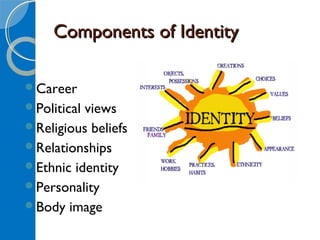
Components of IdentityComponents of Identity
Career
Political views
Religious beliefs
Relationships
Ethnic identity
Personality
Body image
SELFSELF
All the Characteristics of the Person
Self-concept: everything the person believes to be
true about him/herself
Includes traits, preferences, social roles, values,
beliefs, interests, self-categorization
Self-understanding develops throughout the
lifespan
Self-Awareness in InfancySelf-Awareness in Infancy
Dot-of-rouge experiment
Recognize selves in mirror at 15-18
months
15-23 months
◦ Personal pronoun use
◦ Picture recognition
◦ Self-referencing, ownership, self-monitoring
Self in Early ChildhoodSelf in Early Childhood
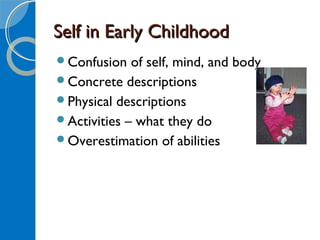
Confusion of self, mind, and body
Concrete descriptions
Physical descriptions
Activities – what they do
Overestimation of abilities
Self – Middle & Late ChildhoodSelf – Middle & Late Childhood
Shift to internal traits and abilities
Social role descriptions
Real and ideal selves
More realistic about abilities
Perspective TakingPerspective Taking
Opposite of egocentrism – the ability to
assume another’s perspective
Children who are good at this are
popular
Development progresses through stages
(Selman)
Self in AdolescenceSelf in Adolescence
Abstract-idealistic
Self-conscious/ preoccupied
Contradictions within self
Fluctuating picture across time/situations
Possible selves
Self-integrations as they get older
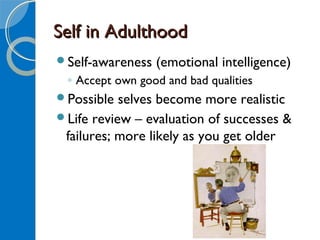
Self in AdulthoodSelf in Adulthood
Self-awareness (emotional intelligence)
◦ Accept own good and bad qualities
Possible selves become more realistic
Life review – evaluation of successes &
failures; more likely as you get older
Self-ConceptSelf-Concept
This is the idea we have of ourselves as
individuals
Consists of 3 elements
- SELF IMAGE
- IDEAL SELF
- SELF-ESTEEM
The Ideal SelfThe Ideal Self
An easier concept in theory
that is in in practice
Trying to probe the Ideal Self in any kind of
public context results in gatekeeping: we
filter out information that could cause negative
perceptions
Usually get role models and the ideal self
confused

Identity and self

  • 1.
  • 2.
    Consider these twopoints of view –Consider these two points of view – which approach do you find yourself inwhich approach do you find yourself in most agreement with?most agreement with?  “I am who I am because of the time and place I was born and the culture I was raised in. My family gave me a set of values and so has my town, my religion, my community and my country. Add these all up and that’s who I am”  “I have got an identity – at least my friends seem to think so, but I’m not really sure who I am. I know that I’m more like some people than others, but this changes as I try out new identities. I don’t really want to take on an identity if it means I can’t be different when I want to be”
  • 3.
    First ApproachFirst Approach “Iam who I am because of the time and place I was born and the culture I was raised in. My family gave me a set of values and so has my town, my religion, my community and my country. Add these all up and that’s who I am” This view sees identity as a product of culture – we are fashioned by social and cultural forces together with a sort of genetic blueprint which moulds us into the individuals we are.
  • 4.
    Second ApproachSecond Approach “I have got an identity – at least my friends seem to think so, but I’m not really sure who I am. I know that I’m more like some people than others, but this changes as I try out new identities. I don’t really want to take on an identity if it means I can’t be different when I want to be”  This view has a different take on the relationship between culture and the individual. Here, culture provides a set of resources which we are free to use in the construction of our own identity. Rather than being fixed into place by powerful forces, identity is more like a butterfly.
  • 5.
    The DebateThe Debate Neitheris right or wrong They represent two sides of a debate over the nature of identity
  • 6.
    Components of IdentityComponentsof Identity Career Political views Religious beliefs Relationships Ethnic identity Personality Body image
  • 7.
    SELFSELF All the Characteristicsof the Person Self-concept: everything the person believes to be true about him/herself Includes traits, preferences, social roles, values, beliefs, interests, self-categorization Self-understanding develops throughout the lifespan
  • 8.
    Self-Awareness in InfancySelf-Awarenessin Infancy Dot-of-rouge experiment Recognize selves in mirror at 15-18 months 15-23 months ◦ Personal pronoun use ◦ Picture recognition ◦ Self-referencing, ownership, self-monitoring
  • 9.
    Self in EarlyChildhoodSelf in Early Childhood Confusion of self, mind, and body Concrete descriptions Physical descriptions Activities – what they do Overestimation of abilities
  • 10.
    Self – Middle& Late ChildhoodSelf – Middle & Late Childhood Shift to internal traits and abilities Social role descriptions Real and ideal selves More realistic about abilities
  • 11.
    Perspective TakingPerspective Taking Oppositeof egocentrism – the ability to assume another’s perspective Children who are good at this are popular Development progresses through stages (Selman)
  • 12.
    Self in AdolescenceSelfin Adolescence Abstract-idealistic Self-conscious/ preoccupied Contradictions within self Fluctuating picture across time/situations Possible selves Self-integrations as they get older
  • 13.
    Self in AdulthoodSelfin Adulthood Self-awareness (emotional intelligence) ◦ Accept own good and bad qualities Possible selves become more realistic Life review – evaluation of successes & failures; more likely as you get older
  • 14.
    Self-ConceptSelf-Concept This is theidea we have of ourselves as individuals Consists of 3 elements - SELF IMAGE - IDEAL SELF - SELF-ESTEEM
  • 15.
    The Ideal SelfTheIdeal Self An easier concept in theory that is in in practice Trying to probe the Ideal Self in any kind of public context results in gatekeeping: we filter out information that could cause negative perceptions Usually get role models and the ideal self confused