Alfred Adler
Individual psychology
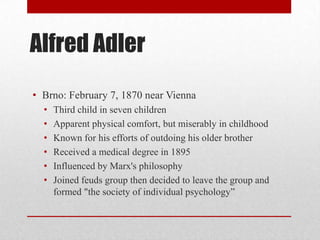
Alfred Adler
• Brno: February 7, 1870 near Vienna
• Third child in seven children
• Apparent physical comfort, but miserably in childhood
• Known for his efforts of outdoing his older brother
• Received a medical degree in 1895
• Influenced by Marx's philosophy
• Joined feuds group then decided to leave the group and
formed "the society of individual psychology‖
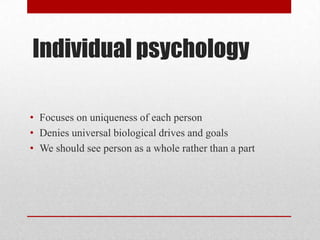
Individual psychology
• Focuses on uniqueness of each person
• Denies universal biological drives and goals
• We should see person as a whole rather than a part
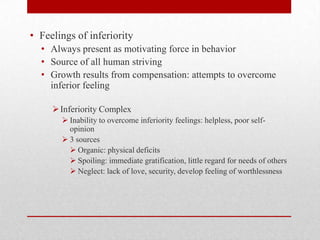
• Feelings of inferiority
• Always present as motivating force in behavior
• Source of all human striving
• Growth results from compensation: attempts to overcome
inferior feeling
Inferiority Complex
 Inability to overcome inferiority feelings: helpless, poor self-
opinion
 3 sources
 Organic: physical deficits
 Spoiling: immediate gratification, little regard for needs of others
 Neglect: lack of love, security, develop feeling of worthlessness
• Striving for Superiority
• Ultimate goal in life
• Drive to perfection
• Not an attempted to be better than others
• Fictional finalism: reach goals set in the future to be
complete, whole potential and guide behavior
Superior complex
 Overcompensate for feelings of inferiority
 Exaggerated and opinion of ones ability and accomplishments
Style of life
• Expression of striving superiority to attain goals
• Learned from early social interactions
• Guiding frameworks for all later behaviors
• how people live life, how they handle problems and
interpersonal relation
Universal Problems and styles of life
dealing with problems
• Problems:
• Involving behavior towards others
• Occupational
• Relationship/love
• Styles of life:
• Dominant – little self-awareness
• Getting- Expect to receive satisfactions from others, becomes
dependent
• Avoiding- avoids life problems
• Socially useful- cooperates with others, shows social interests
Social interests
• Innate potential to cooperate with others to reach personal
and societal goals
• Individual must cooperate with and contribute to society
to achieve goals
• Babies and small children often show sympathy for
others without having been taught to do so.
• Being useful to others
• lacking in social interest including neurotics, psychotics
,criminals ,drunkards ,problem, children ,perverts are
SOCAIL FAILURES
Neurosis
• All neurosis is a matter of insufficient social interest.
• Three types:
• Ruling type
• Getting type
• Avoiding type
The rulling type
• From childhood, they are characterized by a tendenct to
be rather aggressive and dominant ver others
• The strength of their striving after personal power is so
great that they tend to push over anything or anybody
who gets in their way.
• These are BUULLIES and SADIST
The getting type
• They relatively passive: make little effort to solve their
own problems
• Instead, they rely on others to take care of them
• Frequently use charm to persuade others to help them
The avoiding type
• These have the lowest level of energy and only survive by
essentially avoiding life
• When pushed to the limits, they tend to become
psychotic, retreating finally into their own personal words
Childhood
• Like Freud, Adler saw personality or lifestyle s something established
quite early in life
• There were three basic childhood situations that most contribute to
faulty lifestyle.
1. Feeling of inferiority: if someone's does not come along to draw
their attention to others, these children will remain focused on
themselves.
2. Pampering: many children are taught by the actions of others that
they can take without giving.
• They do not learn to do for themselves
• They don’t know of dealing with others than giving of commands
3. neglect: the child who neglected or abused learns what the
pampered child learns, but learns it in a far direct manner
• They learn selfishness because they are taught to trust no one
Birth orders
• Alder considered birth order, as another one of those
heuristic ideas—useful fictions, that contribute to
understanding people but must be not taken too seriously.
• Adler must be credited as the first theorist to include the
child's brothers and sisters as an early influence on the
child
Only child
• Family situation
• Birth is miracle
• Parents have no previous experience
• Retains 20% percent attention from the parents
• Can be over protected and spoiled
• Child’s Characteristic
• Likes being the center of attraction
• Often has difficulty sharing with siblings and peers
• Prefers adult company and uses adult language
Oldest child
• Family situation
• Dethroned by next child
• Parents expectations are usually high
• Often given responsibility and expected to set an example
• Childs characteristics
• May become authoritarian or strict
• Feels power in his hand
• Can become helpful; if encouraged
Second child
• Family situation
• He is the peacemaker
• There is always someone ahead
• Childs characteristics
• Is more competitive, wants to overtake older child
• May become a rebel or try to outdo everyone
• Competition can deteriorate into rivalry
Middle child
• Family situation
• Is ―sandwiched‖
• May feel squeezed out of a position of privilege and
significance
• Childs Characteristics
• May be even tempered, ―take it or leave it‖ attitude
Youngest child
• Family situation
• Has many fathers and mothers
• Never dethroned
• Childs Characteristics
• Wants to be bigger than others
• May have huge plans that never work out
• Frequently spoiled
Assessments: Early recollection and
dream analysis
• Early recollection
• Personality created in the first 4-5 years
• Earliest memories reveals primary interests in life
• Ex: attitudes towards achievements to future situations
• Dream analysis
• Reveals feelings about current problem and intended
solutions
• Oriented to present and future not past
• Ex: school exams: unexpected situations

Alfred Adler with example

  • 1.
  • 2.
    Alfred Adler • Brno:February 7, 1870 near Vienna • Third child in seven children • Apparent physical comfort, but miserably in childhood • Known for his efforts of outdoing his older brother • Received a medical degree in 1895 • Influenced by Marx's philosophy • Joined feuds group then decided to leave the group and formed "the society of individual psychology‖
  • 3.
    Individual psychology • Focuseson uniqueness of each person • Denies universal biological drives and goals • We should see person as a whole rather than a part
  • 4.
    • Feelings ofinferiority • Always present as motivating force in behavior • Source of all human striving • Growth results from compensation: attempts to overcome inferior feeling Inferiority Complex  Inability to overcome inferiority feelings: helpless, poor self- opinion  3 sources  Organic: physical deficits  Spoiling: immediate gratification, little regard for needs of others  Neglect: lack of love, security, develop feeling of worthlessness
  • 5.
    • Striving forSuperiority • Ultimate goal in life • Drive to perfection • Not an attempted to be better than others • Fictional finalism: reach goals set in the future to be complete, whole potential and guide behavior Superior complex  Overcompensate for feelings of inferiority  Exaggerated and opinion of ones ability and accomplishments
  • 6.
    Style of life •Expression of striving superiority to attain goals • Learned from early social interactions • Guiding frameworks for all later behaviors • how people live life, how they handle problems and interpersonal relation
  • 7.
    Universal Problems andstyles of life dealing with problems • Problems: • Involving behavior towards others • Occupational • Relationship/love • Styles of life: • Dominant – little self-awareness • Getting- Expect to receive satisfactions from others, becomes dependent • Avoiding- avoids life problems • Socially useful- cooperates with others, shows social interests
  • 8.
    Social interests • Innatepotential to cooperate with others to reach personal and societal goals • Individual must cooperate with and contribute to society to achieve goals • Babies and small children often show sympathy for others without having been taught to do so. • Being useful to others • lacking in social interest including neurotics, psychotics ,criminals ,drunkards ,problem, children ,perverts are SOCAIL FAILURES
  • 9.
    Neurosis • All neurosisis a matter of insufficient social interest. • Three types: • Ruling type • Getting type • Avoiding type
  • 10.
    The rulling type •From childhood, they are characterized by a tendenct to be rather aggressive and dominant ver others • The strength of their striving after personal power is so great that they tend to push over anything or anybody who gets in their way. • These are BUULLIES and SADIST
  • 11.
    The getting type •They relatively passive: make little effort to solve their own problems • Instead, they rely on others to take care of them • Frequently use charm to persuade others to help them
  • 12.
    The avoiding type •These have the lowest level of energy and only survive by essentially avoiding life • When pushed to the limits, they tend to become psychotic, retreating finally into their own personal words
  • 13.
    Childhood • Like Freud,Adler saw personality or lifestyle s something established quite early in life • There were three basic childhood situations that most contribute to faulty lifestyle. 1. Feeling of inferiority: if someone's does not come along to draw their attention to others, these children will remain focused on themselves. 2. Pampering: many children are taught by the actions of others that they can take without giving. • They do not learn to do for themselves • They don’t know of dealing with others than giving of commands 3. neglect: the child who neglected or abused learns what the pampered child learns, but learns it in a far direct manner • They learn selfishness because they are taught to trust no one
  • 14.
    Birth orders • Alderconsidered birth order, as another one of those heuristic ideas—useful fictions, that contribute to understanding people but must be not taken too seriously. • Adler must be credited as the first theorist to include the child's brothers and sisters as an early influence on the child
  • 15.
    Only child • Familysituation • Birth is miracle • Parents have no previous experience • Retains 20% percent attention from the parents • Can be over protected and spoiled • Child’s Characteristic • Likes being the center of attraction • Often has difficulty sharing with siblings and peers • Prefers adult company and uses adult language
  • 16.
    Oldest child • Familysituation • Dethroned by next child • Parents expectations are usually high • Often given responsibility and expected to set an example • Childs characteristics • May become authoritarian or strict • Feels power in his hand • Can become helpful; if encouraged
  • 17.
    Second child • Familysituation • He is the peacemaker • There is always someone ahead • Childs characteristics • Is more competitive, wants to overtake older child • May become a rebel or try to outdo everyone • Competition can deteriorate into rivalry
  • 18.
    Middle child • Familysituation • Is ―sandwiched‖ • May feel squeezed out of a position of privilege and significance • Childs Characteristics • May be even tempered, ―take it or leave it‖ attitude
  • 19.
    Youngest child • Familysituation • Has many fathers and mothers • Never dethroned • Childs Characteristics • Wants to be bigger than others • May have huge plans that never work out • Frequently spoiled
  • 20.
    Assessments: Early recollectionand dream analysis • Early recollection • Personality created in the first 4-5 years • Earliest memories reveals primary interests in life • Ex: attitudes towards achievements to future situations • Dream analysis • Reveals feelings about current problem and intended solutions • Oriented to present and future not past • Ex: school exams: unexpected situations