
The Self
in a
Social
World
— Benjamin Franklin
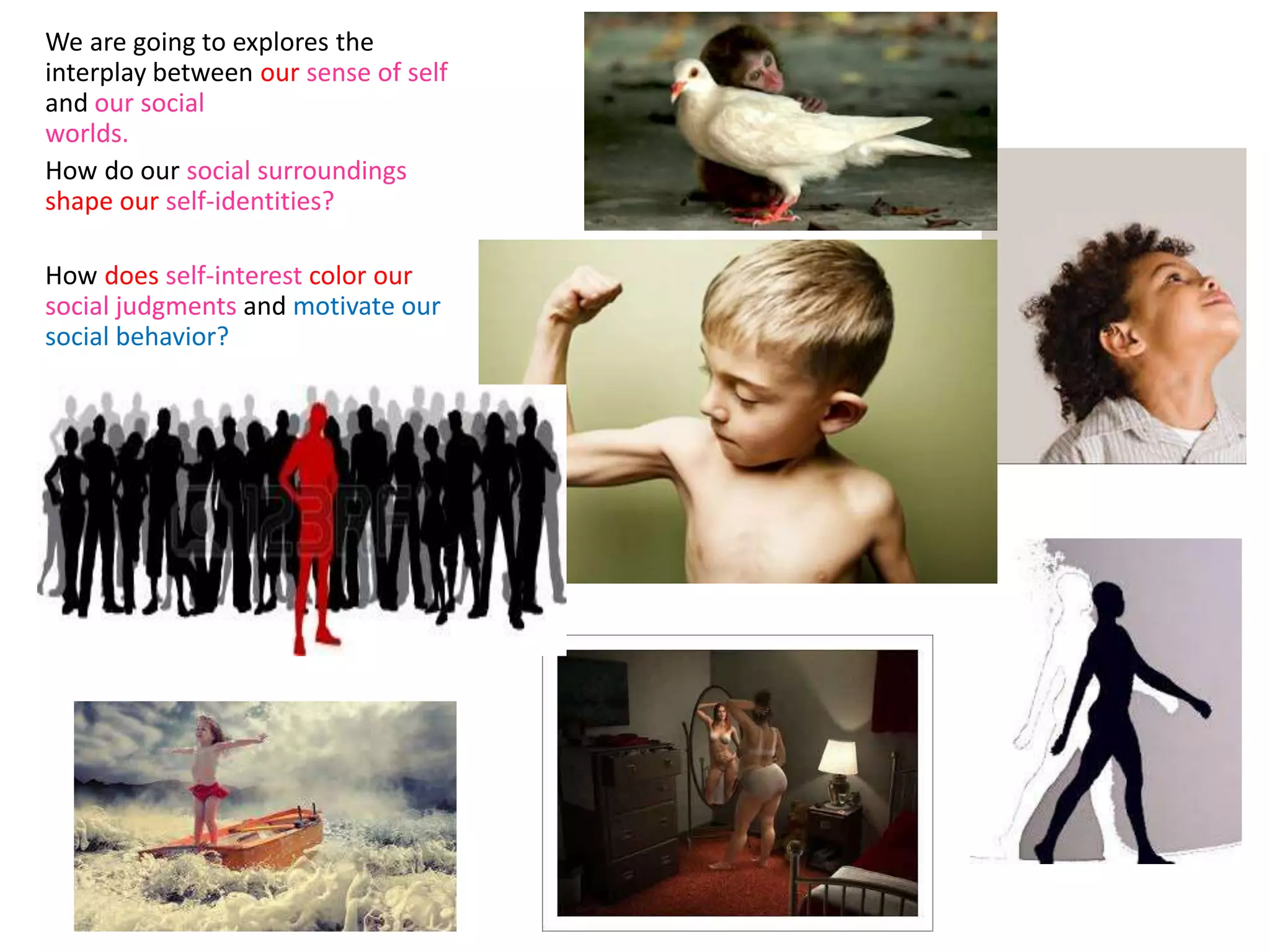
We are going to explores the
interplay between our sense of self
and our social
worlds.
How do our social surroundings
shape our self-identities?
How does self-interest color our
social judgments and motivate our
social behavior?
• From our self-focused perspective, we
overestimate our conspicuousness
positive or negative (Noticeability) .
• Positive or effect; (red carpet effect)
• This spotlight effect means that we
tend to see ourselves at center stage,
• so we intuitively overestimate the
extent to which others’ attention is
aimed at us.
• spotlight effect The belief that others
are paying more attention to one’s
appearance and behavior than they
really are.
On Being Nervous about Looking Nervous
• Negative; (Presentation anxiety/ effect)
we often suffer an illusion of transparency.
If we’re happy and we know it, then our
face will surely show it.
And we presume that others will notice.
• We also overestimate the visibility of our
social blunders and public mental
slips.
• Example: When we accidentally insult
someone, we may be mortified
/ashamed
(“Everyone thinks I’m a jerk”).
• But what we agonize over, others may
hardly notice and soon forget.
• Experiment:
• Savitsky and Gilovich (2003) knew that people
overestimate the extent to which their internal
states “leak out.”
• People who are asked to tell lies presume that
others will detect their deceit, which feels so
obvious.
• Many people who find themselves having to
make a presentation report being
not only nervous but also anxious that they will
seem so.
• And if they feel their knees shaking and hands
trembling during their presentation, their
presumption that others are noticing will
continue their anxiety more.
• To find out, they invited 40 students to their laboratory in pairs. Savitsky
assigned a topic, such as “The Best and Worst Things About Life Today,”
and asked the person to speak for three minutes and the other person
gave a three-minute impromptu/ unprepared talk on a different topic.
• Afterward, each rated how nervous they thought they appeared while
speaking (from 0, not at all, to 10, very) and how nervous the other
person seemed.
The results?
• People rated themselves as appearing relatively nervous (6.65, on
average). But to their partner they appeared not so nervous (5.25), a
difference great enough to be statistically significant .
• Twenty-seven of the 40 participants (68 percent) believed that they
appeared more nervous than did their partner.
• Class activity: Tell us a very ugly secrets
•
The spotlight effect and the related illusion of transparency are but
two of many examples of the interplay between our sense of self and
our social worlds.
• Here are more examples:
• Social surroundings affect our self-awareness. When we are the only
member of our race, gender, or nationality in a group, we notice how we
differ and how others are reacting to our difference.
• Self-interest colors our social judgment. When problems arise in a close
relationship such as marriage,
we usually attribute more responsibility to our partners than to
ourselves.
When things go well at home or work or play, we see ourselves as more
responsible.
• Self-concern motivates our social
behavior.
In hopes of making a positive
impression, we agonize about our
appearance.
• Social relationships help define our
self.
In our varied relationships, we have
varying selves,
We may be one self with Mom,
another with friends, another with
teachers.
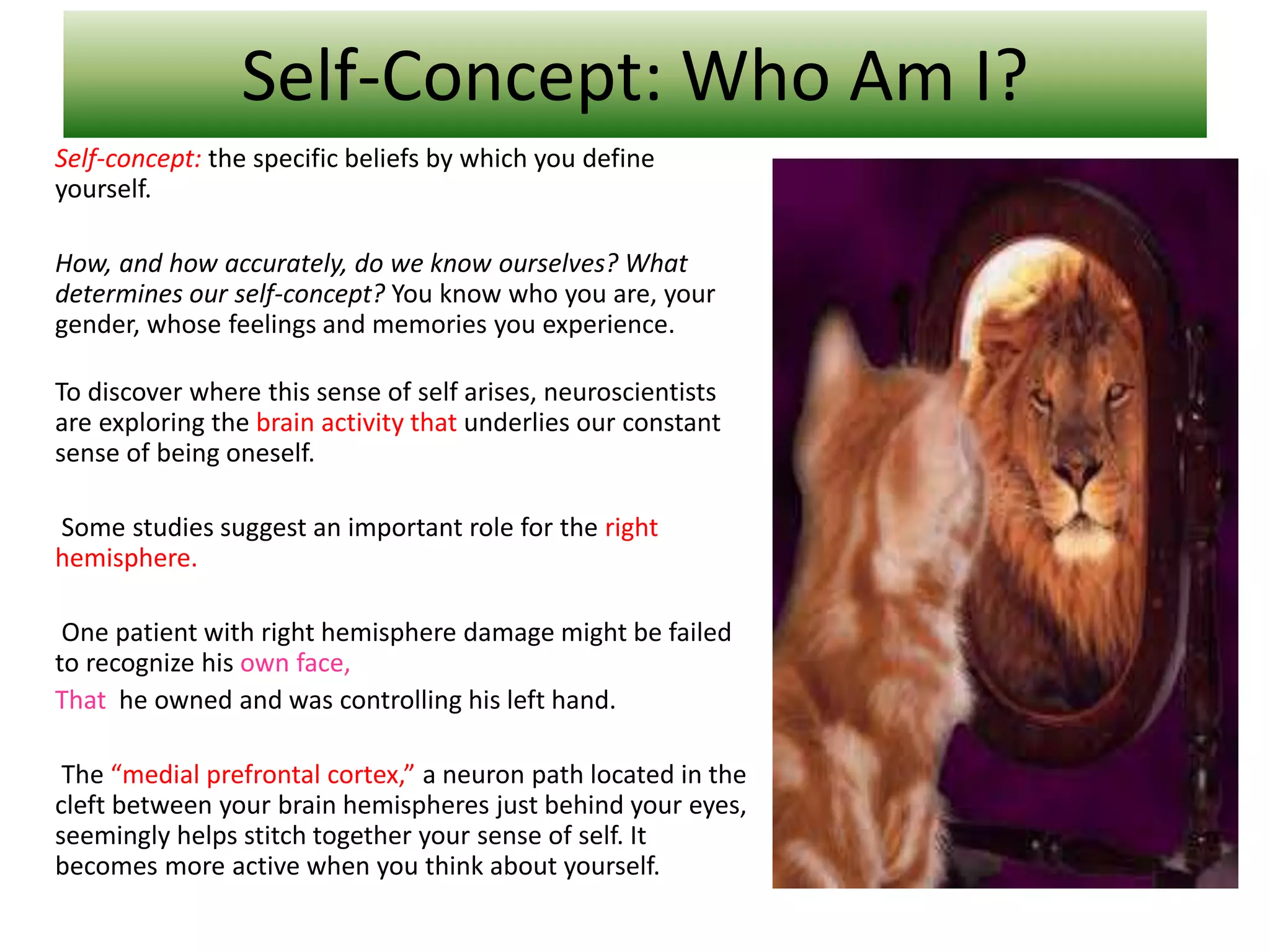
Self-Concept: Who Am I?
Self-concept: the specific beliefs by which you define
yourself.
How, and how accurately, do we know ourselves? What
determines our self-concept? You know who you are, your
gender, whose feelings and memories you experience.
To discover where this sense of self arises, neuroscientists
are exploring the brain activity that underlies our constant
sense of being oneself.
Some studies suggest an important role for the right
hemisphere.
One patient with right hemisphere damage might be failed
to recognize his own face,
That he owned and was controlling his left hand.
The “medial prefrontal cortex,” a neuron path located in the
cleft between your brain hemispheres just behind your eyes,
seemingly helps stitch together your sense of self. It
becomes more active when you think about yourself.
The elements of self-concept
The elements of your self-concept, are your self-schemas and possible
selves.
Schemas are mental templates by which we organize our worlds.
our perceiving ourselves —powerfully affect how we perceive, remember,
and evaluate other people and ourselves.
The self-schemas that make up our self-concepts help us organize and
retrieve our experiences.
Possible Selves
possible selves include our visions of the self we dream of becoming—
the rich self, the thin self, the passionately loved and loving self. They
also include the self we fear
Development of the Social Self
The self-concept has become a major social-psychological
focus because it helps organize our thinking and guide
our social behavior.
But what determines our self-concepts?
Studies of twins point to genetic influences on personality
and self-concept, but social experience also plays a part.
Among these influences are the following:
• the roles we play
• the social identities we form
• the comparisons we make with others
• our successes and failures
• how other people judge us
• the surrounding culture
THE ROLES WE PLAY
•
As we enact a new role—college student,
parent, salesperson—we initially feel self-
conscious.
• For example, while playing our roles we may
support something we haven’t really thought
much about.
•
• Having made a pitch on behalf of our
organization, we then justify our words by
believing more strongly in it. Role playing
becomes reality.
• Example : prisoner and guard
• Guards and prisoners in the Stanford prison
simulation quickly absorbed the roles
they played.
social comparisons (Festinger, 1954)
• The “big fish” is no longer in a small pond.
• Others around us help to define the standard by
which we define ourselves as rich or poor, smart or
dumb, tall or short:
• We compare ourselves with them and consider how
we differ.
• Social comparison explains why students tend to
have a higher academic self-concept if they attend a
high school with mostly average students (Marsh &
others, 2000),
• and how that self-concept can be threatened after
graduation when a student who excelled (outshined)
in an average high school goes on to an academically
selective university.
Types of comparison
• Downward comparison;
• We compare ourselves with others doing as inferior. Much of life revolves around social
comparisons.
• Example: We feel handsome when others seem homely, smart when others seem dull.
• When we witness a peer’s performance, we may, privately
take some pleasure in a peer’s failure, especially when it happens to someone we envy and when
we don’t feel vulnerable to such misfortune ourselves (Lockwood, 2002; Smith & others, 1996).
• Upward comparison;
• Social comparisons can also diminish our satisfaction. When we experience an
increase in affluence, status, or achievement, we “compare upward”—we raise
the standards by which we evaluate our attainments.
• Example: When climbing the ladder of success, we tend to look up, not down; we compare
ourselves with others doing even better.
• When facing competition, we often protect our shaky self-concept by perceiving the competitor as
advantaged. For example, college swimmers believed that their competitors had better coaching
and more practice time .
SUCCESS AND FAILURE
• Self-concept is also fed by our daily experiences.
To undertake challenging yet realistic tasks and to succeed is to feel more
competent.
Example: why female body builders or practice marshal arts
• After mastering the physical skills needed to repel a sexual assault, women
feel less vulnerable, less anxious, and more in control.
• Application: Why what we pleases us teaches us.
• After experiencing academic success, students believe they are better at
school, which often stimulates them to work harder and achieve more
(Felson, 1984; Marsh & Young, 1997).
people with a sense of self-worth ; are happier, less neurotic, less troubled
by insomnia, less prone to drug and alcohol addictions, and more
persistent after failure, more resilient.
or plays the other way around.
OTHER PEOPLE’S JUDGMENTS
• When people think well of us, it helps us think well of ourselves.
• Example: Children whom others label as gifted, hardworking, or helpful tend to
incorporate such ideas into their self-concepts and behavior.
• “Disidentify”: If minority groups feel threatened by negative stereotypes, they may
“disidentify” with those realms.
• Example: poor students by teachers or parents/ women if women feel threatened
by low expectations for their driving/ wont fight such prejudgment they may
identify their interest elsewhere. ( having affair)
The looking-glass self ; how we think others perceive us as a mirror for
perceiving ourselves. What matters for our self-concepts is not how others actually
see us but the way we imagine they see us.
• Example: People generally feel freer to praise than to criticize; they voice their
compliments and restrain their gibes. We may, therefore, overestimate others’
appraisal, inflating our self-images.
Self and Culture
Sense of the self in the world

Sense of the self in the world

  • 1.
  • 2.
  • 3.
    We are goingto explores the interplay between our sense of self and our social worlds. How do our social surroundings shape our self-identities? How does self-interest color our social judgments and motivate our social behavior?
  • 4.
    • From ourself-focused perspective, we overestimate our conspicuousness positive or negative (Noticeability) . • Positive or effect; (red carpet effect) • This spotlight effect means that we tend to see ourselves at center stage, • so we intuitively overestimate the extent to which others’ attention is aimed at us. • spotlight effect The belief that others are paying more attention to one’s appearance and behavior than they really are.
  • 5.
    On Being Nervousabout Looking Nervous • Negative; (Presentation anxiety/ effect) we often suffer an illusion of transparency. If we’re happy and we know it, then our face will surely show it. And we presume that others will notice. • We also overestimate the visibility of our social blunders and public mental slips. • Example: When we accidentally insult someone, we may be mortified /ashamed (“Everyone thinks I’m a jerk”). • But what we agonize over, others may hardly notice and soon forget.
  • 6.
    • Experiment: • Savitskyand Gilovich (2003) knew that people overestimate the extent to which their internal states “leak out.” • People who are asked to tell lies presume that others will detect their deceit, which feels so obvious. • Many people who find themselves having to make a presentation report being not only nervous but also anxious that they will seem so. • And if they feel their knees shaking and hands trembling during their presentation, their presumption that others are noticing will continue their anxiety more.
  • 7.
    • To findout, they invited 40 students to their laboratory in pairs. Savitsky assigned a topic, such as “The Best and Worst Things About Life Today,” and asked the person to speak for three minutes and the other person gave a three-minute impromptu/ unprepared talk on a different topic. • Afterward, each rated how nervous they thought they appeared while speaking (from 0, not at all, to 10, very) and how nervous the other person seemed. The results? • People rated themselves as appearing relatively nervous (6.65, on average). But to their partner they appeared not so nervous (5.25), a difference great enough to be statistically significant . • Twenty-seven of the 40 participants (68 percent) believed that they appeared more nervous than did their partner. • Class activity: Tell us a very ugly secrets
  • 8.
    • The spotlight effectand the related illusion of transparency are but two of many examples of the interplay between our sense of self and our social worlds. • Here are more examples: • Social surroundings affect our self-awareness. When we are the only member of our race, gender, or nationality in a group, we notice how we differ and how others are reacting to our difference. • Self-interest colors our social judgment. When problems arise in a close relationship such as marriage, we usually attribute more responsibility to our partners than to ourselves. When things go well at home or work or play, we see ourselves as more responsible.
  • 9.
    • Self-concern motivatesour social behavior. In hopes of making a positive impression, we agonize about our appearance. • Social relationships help define our self. In our varied relationships, we have varying selves, We may be one self with Mom, another with friends, another with teachers.
  • 11.
    Self-Concept: Who AmI? Self-concept: the specific beliefs by which you define yourself. How, and how accurately, do we know ourselves? What determines our self-concept? You know who you are, your gender, whose feelings and memories you experience. To discover where this sense of self arises, neuroscientists are exploring the brain activity that underlies our constant sense of being oneself. Some studies suggest an important role for the right hemisphere. One patient with right hemisphere damage might be failed to recognize his own face, That he owned and was controlling his left hand. The “medial prefrontal cortex,” a neuron path located in the cleft between your brain hemispheres just behind your eyes, seemingly helps stitch together your sense of self. It becomes more active when you think about yourself.
  • 12.
    The elements ofself-concept The elements of your self-concept, are your self-schemas and possible selves. Schemas are mental templates by which we organize our worlds. our perceiving ourselves —powerfully affect how we perceive, remember, and evaluate other people and ourselves. The self-schemas that make up our self-concepts help us organize and retrieve our experiences. Possible Selves possible selves include our visions of the self we dream of becoming— the rich self, the thin self, the passionately loved and loving self. They also include the self we fear
  • 13.
    Development of theSocial Self The self-concept has become a major social-psychological focus because it helps organize our thinking and guide our social behavior. But what determines our self-concepts? Studies of twins point to genetic influences on personality and self-concept, but social experience also plays a part. Among these influences are the following: • the roles we play • the social identities we form • the comparisons we make with others • our successes and failures • how other people judge us • the surrounding culture
  • 14.
    THE ROLES WEPLAY • As we enact a new role—college student, parent, salesperson—we initially feel self- conscious. • For example, while playing our roles we may support something we haven’t really thought much about. • • Having made a pitch on behalf of our organization, we then justify our words by believing more strongly in it. Role playing becomes reality. • Example : prisoner and guard • Guards and prisoners in the Stanford prison simulation quickly absorbed the roles they played.
  • 15.
    social comparisons (Festinger,1954) • The “big fish” is no longer in a small pond. • Others around us help to define the standard by which we define ourselves as rich or poor, smart or dumb, tall or short: • We compare ourselves with them and consider how we differ. • Social comparison explains why students tend to have a higher academic self-concept if they attend a high school with mostly average students (Marsh & others, 2000), • and how that self-concept can be threatened after graduation when a student who excelled (outshined) in an average high school goes on to an academically selective university.
  • 16.
    Types of comparison •Downward comparison; • We compare ourselves with others doing as inferior. Much of life revolves around social comparisons. • Example: We feel handsome when others seem homely, smart when others seem dull. • When we witness a peer’s performance, we may, privately take some pleasure in a peer’s failure, especially when it happens to someone we envy and when we don’t feel vulnerable to such misfortune ourselves (Lockwood, 2002; Smith & others, 1996). • Upward comparison; • Social comparisons can also diminish our satisfaction. When we experience an increase in affluence, status, or achievement, we “compare upward”—we raise the standards by which we evaluate our attainments. • Example: When climbing the ladder of success, we tend to look up, not down; we compare ourselves with others doing even better. • When facing competition, we often protect our shaky self-concept by perceiving the competitor as advantaged. For example, college swimmers believed that their competitors had better coaching and more practice time .
  • 17.
    SUCCESS AND FAILURE •Self-concept is also fed by our daily experiences. To undertake challenging yet realistic tasks and to succeed is to feel more competent. Example: why female body builders or practice marshal arts • After mastering the physical skills needed to repel a sexual assault, women feel less vulnerable, less anxious, and more in control. • Application: Why what we pleases us teaches us. • After experiencing academic success, students believe they are better at school, which often stimulates them to work harder and achieve more (Felson, 1984; Marsh & Young, 1997). people with a sense of self-worth ; are happier, less neurotic, less troubled by insomnia, less prone to drug and alcohol addictions, and more persistent after failure, more resilient. or plays the other way around.
  • 18.
    OTHER PEOPLE’S JUDGMENTS •When people think well of us, it helps us think well of ourselves. • Example: Children whom others label as gifted, hardworking, or helpful tend to incorporate such ideas into their self-concepts and behavior. • “Disidentify”: If minority groups feel threatened by negative stereotypes, they may “disidentify” with those realms. • Example: poor students by teachers or parents/ women if women feel threatened by low expectations for their driving/ wont fight such prejudgment they may identify their interest elsewhere. ( having affair) The looking-glass self ; how we think others perceive us as a mirror for perceiving ourselves. What matters for our self-concepts is not how others actually see us but the way we imagine they see us. • Example: People generally feel freer to praise than to criticize; they voice their compliments and restrain their gibes. We may, therefore, overestimate others’ appraisal, inflating our self-images.
  • 19.