• Self-concept isthe image we have of ourselves. It is influenced by
many forces, including our interaction with the important people
in our lives. It is how we perceive our behaviors, abilities, and
unique characteristics
• For example, beliefs such as "I am a good friend" or "I am a kind
person" are part of an overall self-concept
• Our self-perception is important because it affects our motivations,
attitudes, and behaviors.
3.
• is aknowledge representation that contains knowledge
about us, including our beliefs about our personality traits,
physical characteristics, abilities, values, goals, and roles,
as well as the knowledge that we exist as individuals.
4.
CARL ROGER'S DEFINESSELF-CONCEPT
• Ideal self: The ideal self is the person you want to be.
• Self-image: Self-image refers to how you see yourself at
this moment in time
• Self-esteem: How much you like, accept, and
value yourself contributes to your self-concept.
5.
Self-concept is notalways aligned with reality.
• Congruent – Self Concept is aligned
• Incongruent - If there is a mismatch between how you see yourself
(your self-image) and who you wish you were (your ideal self),
your self-concept
ACTIVITY: APRIL 24,2025; THE INTERVIEW
INSTRUCTIONS: KINDLY HAVE A PARTNER AND ASK THESE QUESTIONS
YOU TAKE TURNS TO ANSWERS THOSE QUESTIONS
Guide Questions
• What are your core values?
• What are your strengths and weaknesses?
• How do you see yourself?
• What do you like/dislike about yourself?
8.
ACTIVITY: APRIL 24,2025; THE INTERVIEW
1. When sharing to your partner what did you learn about your
self?
2. Reflecting on your sharing , did the feelings of self-worth and
overall satisfaction with one’s self increase or decrease?
File name: Last Name, First Name_April 24, 2025_The INTERVIEW
Upload at: https://drive.google.com/drive/folders/1-
lL3q1SIuIpFYDBY5zoW1ktTtb3fhR1f?usp=sharing
9.
SELF-AWARENESS
• Refers tothe extent to which we are currently fixing our attention
on our own self-concept. When our self-concept becomes highly
accessible because of our concerns about being observed and
potentially judged by others, we experience the publicly induced
self-awareness known as self-consciousness (Duval & Wicklund,
1972; Rochat, 2009)
• Private self-consciousnessrefers to the tendency to introspect
about our inner thoughts and feelings.
• Public self-consciousness, in contrast, refers to the tendency to
focus on our outer public image and to be particularly aware of
the extent to which we are meeting the standards set by others.
Example: “I’m concerned about what other people think of me,”
“Before I leave my house, I check how I look,”
“I care a lot about how I present myself to others.”
12.
• According toself-awareness theory(Duval & Wicklund,
1972), when we focus our attention on ourselves, we tend to
compare our current behavior against our internal standards.
• self-discrepancy theory states that when we perceive a
discrepancy between our actual and ideal selves, this is
distressing to us (Higgins, Klein, & Strauman, 1987)
• cognitive dissonance, which is the discomfort that occurs
when we respond in ways that we see as inconsistent.
13.
THE FEELING SELF:SELF-ESTEEM
• Self-esteem refers to the positive (high self-esteem) or negative
(low self-esteem) feelings that we have about ourselves.
• Our self-esteem is determined by many factors, including how well
we view our own performance and appearance, and how satisfied
we are with our relationships with other people (Tafarodi & Swann,
1995).
14.
FOUR KEY CHARACTERISTICSOF HEALTHY SELF-
ESTEEM ARE:
• A firm understanding of one's skills
• The ability to maintain healthy relationships with others as
a result of having a healthy relationship with oneself
• Realistic and appropriate personal expectations
• An understanding of one's needs and the ability to express
those needs
15.
FACTORS THAT AFFECTSELF-ESTEEM
• Age
• Disability
• Genetics
• Illness
• Physical abilities
• Socioeconomic status
• Thought patterns
16.
HEALTHY SELF-ESTEEM
• Avoiddwelling on past negative experiences
• Believe you are equal to everyone else, no better and no
worse
• Express your needs
• Feel confident
• Have a positive outlook on life
• Say no when you want to
• See your overall strengths and weaknesses and accept them
17.
• Overly highself-esteem is often mislabeled as narcissism,
• Narcissism is a personality trait characterized by overly high
self-esteem, self-admiration, and self-centeredness. Narcissists
tend to agree with statements such as the following:
• “I know that I am good because everybody keeps telling me so.”
• “I can usually talk my way out of anything.”
• Individuals with narcissistic traits may appear to have high self-
esteem, but their self-esteem may be high or low and is
unstable, constantly shifting depending on the given situation.
18.
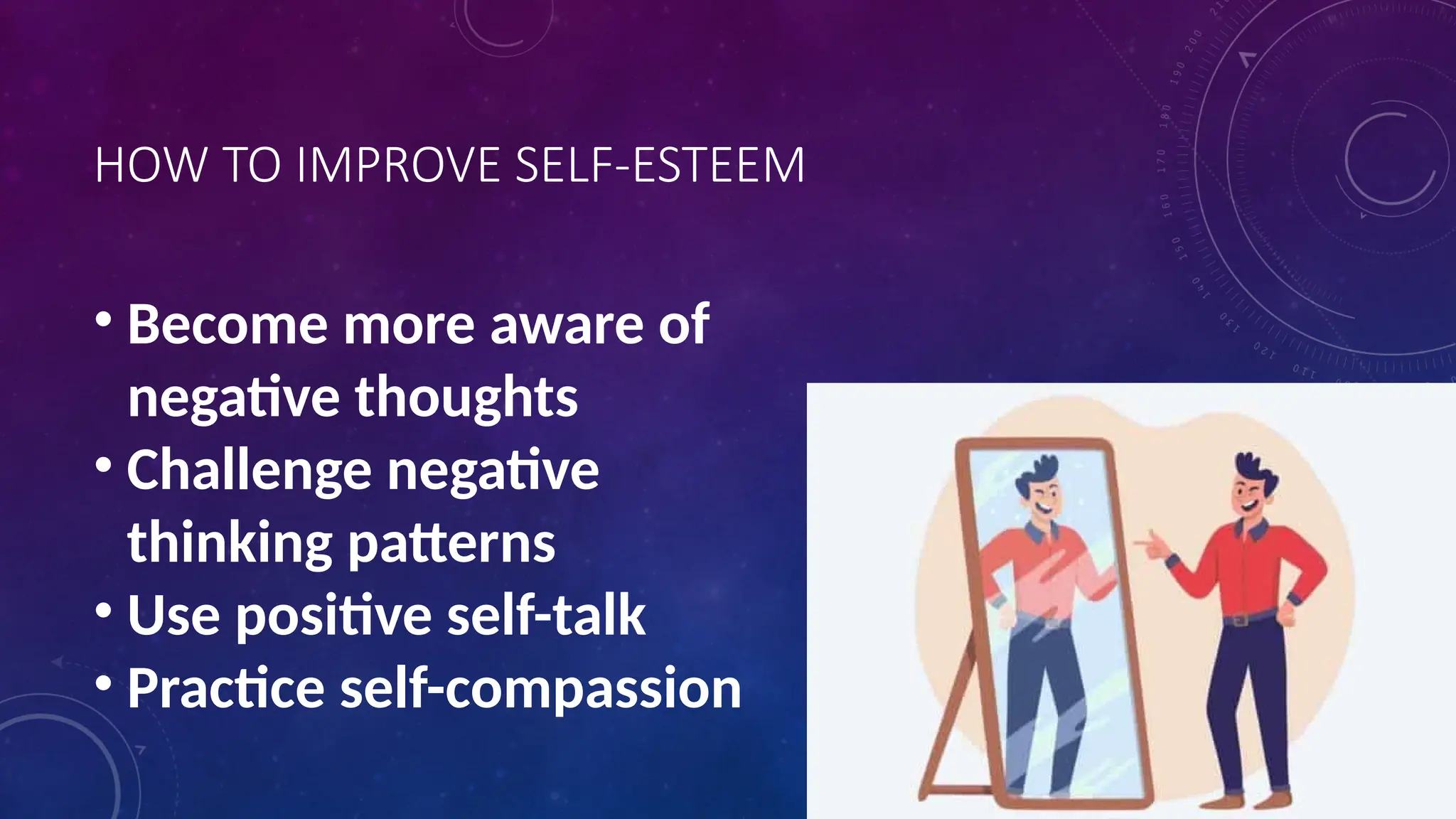
HOW TO IMPROVESELF-ESTEEM
• Become more aware of
negative thoughts
• Challenge negative
thinking patterns
• Use positive self-talk
• Practice self-compassion
19.
ACTIVITY APRIL 24,2025
INSTRUCTIONS KINDLY ANSWER THE FOLLOWING:
1. In what ways do you attempt to boost your own self-esteem? Which strategies
do you feel have been particularly effective and ineffective and why?
2. “It is relatively easy to succeed in life with low self-esteem, but very difficult to
succeed without self-control, self-discipline, or emotional resilience in the face
of setbacks” (Twenge & Campbell, 2009, p. 295). To what extent do you agree
with this quote and why?
File name: Last Name, First Name_Self Esteem_ April 24, 2025
Upload at: https://drive.google.com/drive/folders/1Elx_xQ93jjFfspPUr-
xYliQTlsVSBPTr?usp=sharing
20.
THE SOCIAL SELF
•The American Psychological Association has three definitions of
the social self. The first definition is:
• “Those aspects of one’s identity or self-concept that are
important to or influenced by interpersonal relationships and the
reactions of other people.”[
• A person’s characteristic behavior in social situations.
• “The facade that an individual may exhibit when in contact with
other people, as contrasted with his or her real self.”
21.
THE SOCIAL SELFAND COMPARISONS
• Upward social comparisons involve comparing ourselves to people
who appear to be better or more successful than us in some way,
e.g., “She earns three times as much as I do. She’s way more
ambitious than I am!”
• Downwards social comparisons involve comparing ourselves to
people who appear to be worse off, e.g., “Compared with his kids,
my children are much more obedient!! I’m probably a better
parent.”
22.
ACTIVITY APRIL 24,2025
1. Describe times when you have engaged in downward and
upward social comparison and the effects these comparisons
have had on your self-esteem. To what extent do your
experiences fit with the research evidence here?
2. What are your most salient social identities? How do they create
positive feelings for you?
23.
• Your socialself can adapt, depending on who is around.
You may show a particular set of behaviours or traits
• Most people adapt their behavior (whether consciously or
unconsciously) to make a good impression on others. This
is called self-presentation
• High self-monitors are willing and able to fit in with other
people; they will put on a mask or act if they think it will
earn approval.
• Low self-monitors are less likely to do this. Instead, they
use their personal standards to decide how they will act.
• Close relationshipswith other people can also give you access to
more knowledge, social status, possessions, wealth, or
membership in a community. For example, if you make friends
with someone who is well-respected in your local business
community, they could help you make valuable professional
connections.
26.
THE LABELING BIAS
•Your social self is affected by labels—both the labels others
give you and the labels you give yourself. These labels can
have a direct effect on your behavior in social situations.
Labels can be informal (e.g., “bad at math” or “emotional”)
Formal (e.g., “someone diagnosed with depression”)
The labels other people give us can also become self-
fulfilling prophecies.
27.
SELF-DISCREPANCY THEORY
• Theactual self is your idea of who you are right now
• The ought self is the version of yourself that you think
other people want or expect.
• The ideal self is the version of yourself that you’d like to
be.
28.
THE LOOKING-GLASS SELF
•According to the looking-glass self theory, our self-image is partly based on
how we think other people see us.
• example: Let’s say your friend introduces you to a couple of their other
friends. You believe that you are capable of making a good first impression
because several people have said things like “You always come across well
when you meet new people” in the past.
• As you make conversation, you’ll probably take note of how everyone is
responding to you. If they appear friendly and happy to be in your company,
your image of yourself as a person who can make a positive first impression
will be confirmed. But if your new acquaintances look awkward, you may start
to wonder, “Do I actually come across well when I talk to new people?”
Editor's Notes
#4 Carl R. Rogers is widely regarded as one of the most eminent thinkers in psychology. He is best known for developing the psychotherapy method called client-centered therapy and for being one of the founders of humanistic psychology.
Ideal self. This person has the attributes or qualities you are either working toward or want to possess. It's who you envision yourself to be if you were exactly the person you wanted to be.
Self-image: Physical characteristics, personality traits, and social roles affect your self-image.
Self-esteem: can be affected by a number of factors, including how others see you, how you think you compare to others, and your role in society.3
#5 Rogers believed that incongruence has its earliest roots in childhood. When parents place conditions on their affection for their children (e.g., only expressing love if children "earn it" through certain behaviors and living up to the parents' expectations), children begin to distort their memories of experiences that leave them feeling unworthy of their parents' love
Unconditional love, on the other hand, helps to foster congruence. Children who experience such love—also referred to as family love—feel no need to continually distort their memories in order to believe that other people will love and accept them as they are.
#11 Private self-consciousness . People who are high in private self-consciousness tend to think about themselves a lot and agree with statements such as “I’m always trying to figure myself out” and “I am generally attentive to my inner feelings.” People who are high on private self-consciousness are likely to base their behavior on their own inner beliefs and values—they let their inner thoughts and feelings guide their actions—and they may be particularly likely to strive to succeed on dimensions that allow them to demonstrate their own personal accomplishments (Lalwani et al., 2009)
#12 cognitive dissonance, In these cases, we may realign our current state to be closer to our ideals, or shift our ideals to be closer to our current state, both of which will help reduce our sense of dissonance. Another potential response to feelings of self-discrepancy is to try to reduce the state of self-awareness that gave rise to these feelings by focusing on other things
#15 People with low self-esteem tend to feel less sure of their abilities and may doubt their decision-making process. They may not feel motivated to try novel things because they don’t believe they can reach their goals. Those with low self-esteem may have issues with relationships and expressing their needs. They may also experience low levels of confidence and feel unlovable and unworthy.
#19 Become more aware of negative thoughts. Learn to identify the distorted thoughts that are impacting your self-worth.
Challenge negative thinking patterns. When you find yourself engaging in negative thinking, try countering those thoughts with more realistic and/or positive ones.
Use positive self-talk. Practice reciting positive affirmations to yourself.7
Practice self-compassion. Practice forgiving yourself for past mistakes and move forward by accepting all parts of yourself.
#21 For example, you may identify as a supporter of a particular sports team. This identity is part of your social self because it is important to your relationships and affects how you interact socially with other people. Maybe you like to make friends or hang out with people who support the same team, or dislike people who support a rival side, even if you don’t know them very well.
For example, your social self might be an outgoing, extroverted personality or a reserved introvert. But the social self is not completely consistent; you can change your behavior to suit different social situations.
This definition acknowledges that your social self might not always be authentic. Most of us have had the experience of putting on a mask in a social situation or trying to fit in by hiding who we truly are or how we are feeling. For example, you may feel low or worried one day but hide your anxiety and pretend to be happy when you’re out with a group of friends
#22 Your social self is partly based on labels and identities, such as “intelligent” or “funny.” But these labels aren’t meaningful if we don’t know how we compare to everyone else. To help us decide whether we really do have a certain trait or truly fit into a certain category, we can use social comparisons
#24 Some people are comfortable changing their behaviors to suit a social situation. In other words, their social self is more flexible.
For example, when you go for a job interview, you probably want to make the interviewer think that you are professional, intelligent, and conscientious. You might make a special effort to show up on time, introduce yourself by your first and second name, shake the interviewer’s hand, and speak in a formal way (e.g., without slang or profanity).
#25 When we get to know someone, either platonically or romantically, we have the opportunity to share their identities and experiences.[7] These new identities and experiences can change the ideas you hold about yourself. When your self-image changes, your social self may change as well.
For example, you might start dating someone who loves to ski, and you may develop your own passion for the sport. In time, you might start to think of yourself as “a keen skier.” In social situations, you may be keen to talk about skiing, introduce yourself as a skiing enthusiast, and find other people to ski with.
#26 The psychologists who proposed this theory don’t think that we have relationships because we want to take advantage of other people. When we get to know someone, we aren’t always aware of our own motivations.[7] We also tend to help people who help us; most friendships are based on a balance between giving and taking.
#27 These labels can influence what other people expect from us. In psychology, this effect is known as the labeling bias.
Sometimes, we can internalize a label and make it part of our identity. This is called “self-labeling.”
#28 The actual self is your idea of who you are right now. (For example, you might think you are a hardworking employee, a reasonably good friend, and an average partner. This self includes the qualities you believe that other people see in you.)
The ought self is the version of yourself that you think other people want or expect. (For example, you might think your parents want you to have a very high-paying job.)
The ideal self is the version of yourself that you’d like to be. (For example, you might want to be much more extroverted, or you might wish you were smarter.)
#29 When we base our self-image on what we believe other people think about us, we might change how we behave towards others and how we respond to social situations. In other words, our social self shifts. We may start looking for evidence that supports or disproves the ideas we have about ourselves. Depending on how others respond to us, we may adjust our self-image.