Self Concept After Carl Rogers By Soboleva Tatiana
“ Self concept” has three different components: Self image Self esteem or self-worth Ideal self
Self image (what you see in yourself ) A person’s self image is affected by many factors, such as parental influences, friends, the media etc. Kuhn (1960) investigated the self-image by using  The Twenty Statements Test.
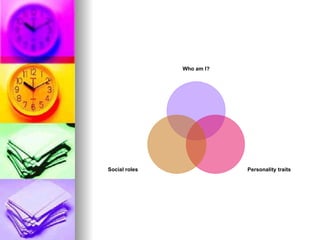
Who am I? Personality traits Social roles
The list of answers to the question “Who am I?” include examples of each of the following four types of responses: Physical description Social roles Personal traits Existential statements
Self Esteem and Self Worth Self esteem always involves a degree of evaluation and we may have either positive or a negative view of ourselves. *High self esteem *Low self esteem Even though self-esteem might fluctuate, there are times when we continue to believe good things about ourselves even when evidence to the contrary exists. This is known as the  perseverance effect .
There are 4 major facts that influences self-esteem 1)The reaction of others 2)Comparison with others 3)Social roles 4)Identification
Ideal Self A person’s ideal self may not be consistent with what actually happens in life and experiences of the person. Hence, a difference may exist between a person’s ideal-self and actual experience. This is called  incongruence.
In conclusion To understand better a person, it is important to analyze every of the three “self-sides” that interact inside him/her. Summing up Self image,  Self esteem and Ideal self, zou will visualise the entire image and skills of the analzsed person.

Self concept

  • 1.
    Self Concept AfterCarl Rogers By Soboleva Tatiana
  • 2.
    “ Self concept”has three different components: Self image Self esteem or self-worth Ideal self
  • 3.
    Self image (whatyou see in yourself ) A person’s self image is affected by many factors, such as parental influences, friends, the media etc. Kuhn (1960) investigated the self-image by using The Twenty Statements Test.
  • 4.
    Who am I?Personality traits Social roles
  • 5.
    The list ofanswers to the question “Who am I?” include examples of each of the following four types of responses: Physical description Social roles Personal traits Existential statements
  • 6.
    Self Esteem andSelf Worth Self esteem always involves a degree of evaluation and we may have either positive or a negative view of ourselves. *High self esteem *Low self esteem Even though self-esteem might fluctuate, there are times when we continue to believe good things about ourselves even when evidence to the contrary exists. This is known as the perseverance effect .
  • 7.
    There are 4major facts that influences self-esteem 1)The reaction of others 2)Comparison with others 3)Social roles 4)Identification
  • 8.
    Ideal Self Aperson’s ideal self may not be consistent with what actually happens in life and experiences of the person. Hence, a difference may exist between a person’s ideal-self and actual experience. This is called incongruence.
  • 9.
    In conclusion Tounderstand better a person, it is important to analyze every of the three “self-sides” that interact inside him/her. Summing up Self image, Self esteem and Ideal self, zou will visualise the entire image and skills of the analzsed person.