


The Real Truth about
Lies
Brought to you by
Warming up activities
Background information
Global study of Text I
Structural analysis
Detailed study of Text I
Comprehension questions of Text I
Exercises
Grammatical items
Warming up activities
 1.If your good friend buys a new MP3 or a new
mobile phone which you dislike intensely, and asks
for your opinion about it, what will you say?
 2.When do you think people lie?
 3. Why do people lie?
 4.To whom do people most likely to lie?
 5. How would you feel if somebody lied to you for
your own good?
 6. What’s your view of white lies?
 7. Have you ever lied? examples
Open discussion
1.What topics are husbands, wives, boyfriends
and girlfriends likely to lie about?
2. If once a cheater, always a cheater?
3. If you have done something wrong, should you
confess or tell a lie or keep it a secret?
4. How do you rebuild, restore or regain trust
after it has been destroyed?
The real truth about lying
 Reports on the psychology of lying :
 Community members lied in one-fifth of
their social interactions; students, one-third.
 Lying was more common in phone calls
than in face-to-face chats.
 One lie in seven was discovered--as far as
the liars could tell.
 A tenth of the lies were merely
exaggerations, while 60 percent were
outright deceptions. Most of the rest were
subtle lies. More than 70 percent of liars
would tell their lies again.
 Everyday lies are really part of the fabric of
social life.
 While some lies damage relationships and
destroy trust, other fibs fulfill important
interpersonal functions, like smoothing over
awkward situations or protecting fragile
egos.
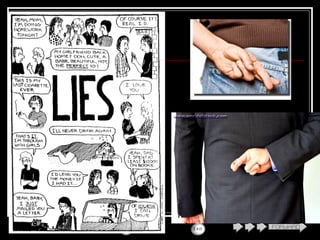
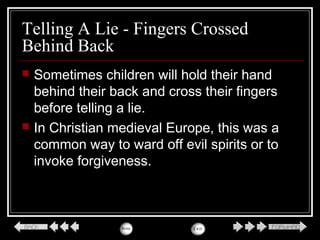
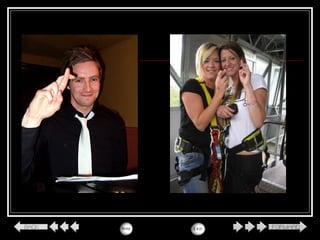
 1. To say 'fingers crossed!' (and sometimes hold
up your crossed fingers) means 'I hope this
succeeds!'.
 2. To keep your fingers crossed secretly when
you tell a lie absolves you from any responsibility
for that lie. If your lie is discovered, you can claim
to have had your fingers crossed at the time. (If
you're unable to cross your fingers while telling
the lie, you can cross any other part of your body
– legs, feet, etc.)
Telling A Lie - Fingers Crossed
Behind Back
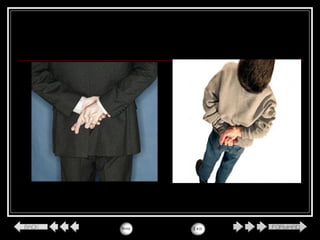
 Sometimes children will hold their hand
behind their back and cross their fingers
before telling a lie.
 In Christian medieval Europe, this was a
common way to ward off evil spirits or to
invoke forgiveness.
Fingers crossed for you
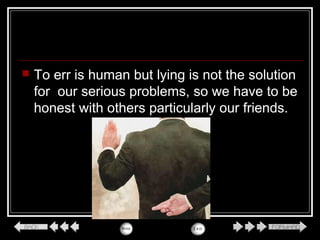
 To err is human but lying is not the solution
for our serious problems, so we have to be
honest with others particularly our friends.
Quotes reading—lie & truth
 Let sleeping dogs lie.
Truth is beautiful, without doubt; but so are lies.
- - - Ralph Waldo Emerson
 A lie stands on one leg, truth on two.
- - - Benjamin Franklin
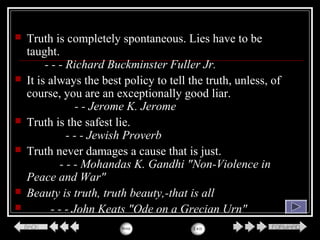
 Truth is completely spontaneous. Lies have to be
taught.
- - - Richard Buckminster Fuller Jr.
 Truth is completely spontaneous. Lies have to be
taught.
- - - Richard Buckminster Fuller Jr.
 It is always the best policy to tell the truth, unless, of
course, you are an exceptionally good liar.
- - Jerome K. Jerome
 Truth is the safest lie.
- - - Jewish Proverb
 Truth never damages a cause that is just.
- - - Mohandas K. Gandhi "Non-Violence in
Peace and War"
 Beauty is truth, truth beauty,-that is all
 - - - John Keats "Ode on a Grecian Urn"
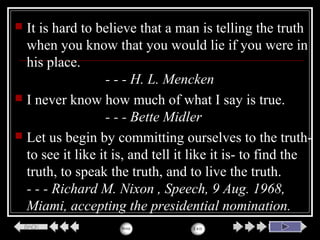
 It is hard to believe that a man is telling the truth
when you know that you would lie if you were in
his place.
- - - H. L. Mencken
 I never know how much of what I say is true.
- - - Bette Midler
 Let us begin by committing ourselves to the truth-
to see it like it is, and tell it like it is- to find the
truth, to speak the truth, and to live the truth.
- - - Richard M. Nixon , Speech, 9 Aug. 1968,
Miami, accepting the presidential nomination.
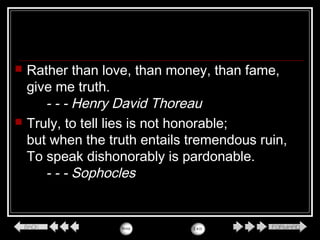
 Rather than love, than money, than fame,
give me truth.
- - - Henry David Thoreau
 Truly, to tell lies is not honorable;
but when the truth entails tremendous ruin,
To speak dishonorably is pardonable.
- - - Sophocles
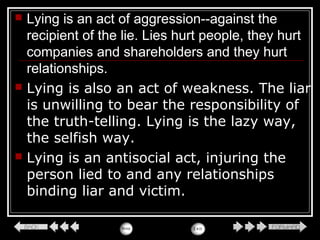
 Lying is an act of aggression--against the
recipient of the lie. Lies hurt people, they hurt
companies and shareholders and they hurt
relationships.
 Lying is also an act of weakness. The liar
is unwilling to bear the responsibility of
the truth-telling. Lying is the lazy way,
the selfish way.
 Lying is an antisocial act, injuring the
person lied to and any relationships
binding liar and victim.
About text I
 Topic –The Real Truth about Lies—white lies
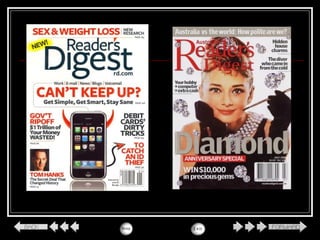
 Selected from Reader's Digest in the
November, 1999
 Journalistic style
 Short paragraphs---18 paras
 Argumentative writing
The University of Virginia
The University of Virginia is distinctive among
institutions of higher education. Founded by
Thomas Jefferson in 1819, the University is
public and remains the No. 2 best , according to
the 2005 US News & World Report. Numerous
distinguished alumni graduated from the
university and now dominate various areas, a few
of whom are the 28th president Wilson, Senator
Robert Kennedy and Edward Kennedy; and
world-famous director Mark Johnson.
Bella DePaulo
Professor Bella M. DePaulo is specialized in
Social Psychology. For more than 20 years,
She has studied the communication of deception. More
recently, she has also been studying the social
psychology of singles. She received her Ph. D. from
Harvard University in 1979. She is the author of more
than 100 publications, and her work has been funded by
NSF( 国家科学基金会 ), NIMH( 国家精神卫生研究
院 ), and the National Academy of Education.
Josephson Institute of Ethics
The Joseph & Edna Josephson Institute of Ethics
is a public-benefit, nonprofit, nonpartisan 无党
派 and nonsectarian 无宗派 membership
organization founded by Michael Josephson in
honor of his parents.
While-reading questions
 How does the writer begin with the topic?
 How does he convince the readers “the real
truth ” of lies?
 Find out words, phrases, expressions or
sentences to indicate the consequences of lies?
After-reading questions
 What is the tone of the author in the text?
 What is the author’s attitude towards lies?
 What is the author’s viewpoint in the text?
 What are the features of the text?
 What is your viewpoint of the topic?
Text comprehension
 Tone : objective
 View: negative
 Way of convincing: scientific research;
example; scholarly quotation
 1. What does Professor Bella DePaulo's
study indicate about lying? What do most
people think about lying?
 A: The study suggests that lying is a common
phenomenon and most of the lies we tell are
small, insignificant. She also points out that
different sexes lie for different reasons, but
nobody that lies suffers from a guilty
conscience.
Answer the following questions (page161)
 2. Why do people tell white lies? Do you think the
lies will be well received once they are exposed?
 A: According to the passage, the nature of white lies
is to seek self-interest: People tell white lies basically
for self-promoting purposes. White lies may have
different receptions in different cultures. In western
cultures as is illustrated by the example, white lies
may not be well received as the people value
honesty and integrity more than caring and face
value; but in the eastern cultures, they may be
received as a sign of concern and respect for each
other’s face.
 3. What, according to the author, would
be the consequences of lying?
 A: The consequences of lying fall into three
aspects: The deceived may feel cheated and
won't trust the liar any more; the liar will lose trust
from the deceived and get entangled in the lies he
fabricates; and the society as a whole would falter
and collapse as its members do not trust each
other any more.
 4. Are all white lies unacceptable? What is
the yardstick of acceptable lies?
 A: Not all white lies are unacceptable. Some
falsehoods like setting somebody up for a
surprise party or telling children about the tooth
fairy can be justified. However, you have to
consider the attitude of the deceived towards
lying and the consequences, i.e. whether your
act will undermine his trust in you.
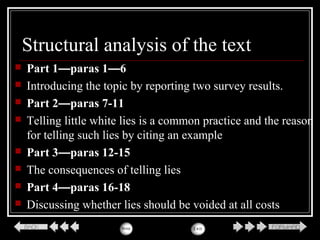
Structural analysis of the text
 Part 1—paras 1—6
 Introducing the topic by reporting two survey results.
 Part 2—paras 7-11
 Telling little white lies is a common practice and the reason
for telling such lies by citing an example
 Part 3—paras 12-15
 The consequences of telling lies
 Part 4—paras 16-18
 Discussing whether lies should be voided at all costs
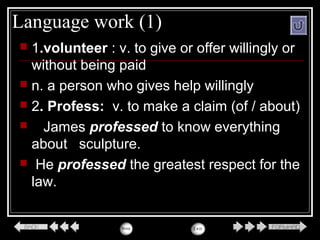
Language work (1)
 1.volunteer : v. to give or offer willingly or
without being paid
 n. a person who gives help willingly
 2. Profess: v. to make a claim (of / about)
 James professed to know everything
about sculpture.
 He professed the greatest respect for the
law.
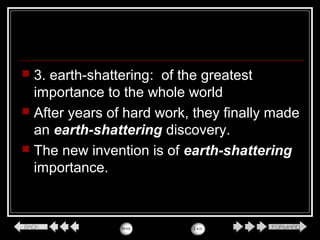
 3. earth-shattering: of the greatest
importance to the whole world
 After years of hard work, they finally made
an earth-shattering discovery.
 The new invention is of earth-shattering
importance.
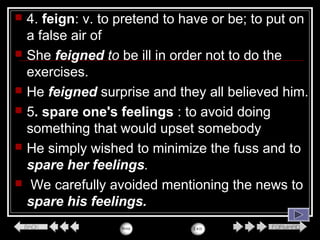
 4. feign: v. to pretend to have or be; to put on
a false air of
 She feigned to be ill in order not to do the
exercises.
 He feigned surprise and they all believed him.
 5. spare one's feelings : to avoid doing
something that would upset somebody
 He simply wished to minimize the fuss and to
spare her feelings.
 We carefully avoided mentioning the news to
spare his feelings.
 6. preoccupation: n.the state of constantly
thinking or worrying about something
 Because of his preoccupation with his
books, he didn't realize we were already back.
 Such preoccupation with your work isn't
healthy.
 7. Might that, too, be a lie? Is it possible to
consider that a lie?
 "Might" here means "possibility. " Note that
"may," when used to mean "possibility," is
normally not used in a question.
 8. prevarication: n. the state of avoiding giving a
direct answer or making a firm decision
 After months of prevarication, a decision was
finally made.
 When we questioned the authorities on the
subject, we were met by prevarication.
 9.ethics: n. moral correctness; moral principles
 10.consultant: n. a person who gives specialist
professional advice to others
 11. devote ... to: to give all or a large part of one's
time or resources to (a person, activity, or cause)
 I want to devote more time to my family.
 He devotes himself to philanthropy.
 12. profession: n.a form of employment, especially
one that is possible only for an educated person and
that is respected in society as honorable
 She intends to make teacher her profession.
According to the report, forty percent of the lawyers
entering the profession are women.
 13. pundit : n. a person who is an authority
on a particular subject; an expert
 Mr. Johnson is a well-known political pundit.
 We've invited a foreign-policy pundit to give
us a lecture.
 14. shape or spin the truth: to modify the truth
 15. client: n. somebody who pays for services
or advice from a person or organization
 eg. a solicitor and his client
 Cf: a shopkeeper and his customer
 16. Specialize in 17. Step out
Language work (2)
 18. Ubiquitous: a. seeming to be everywhere
 By the end of last century, the computer had
become ubiquitous.
 We are now confronted with the ubiquitous
spread of English.
 19. Fib: n. a small unimportant lie
 Have you ever told fibs!
 She told innocent fibs like anyone else.
 20. Invariably: ad. always
 It's invariably wet when I take my holidays.
 She invariably forgets to take her keys.
 21. blurt out : to say something suddenly
and without thinking, usually because one is
nervous or excited
 To our surprise,he blurted his secret out at
table.
 John blurted out that he dreamed of
becoming a computer programmer.
 22. lubricant :n. a substance such as oil
which causes a machine to operate more
easily
 23. tangled: a. complicated or made up of
many confusing parts
After listening to his speech I thought his ideas
and opinions were so tangled that I could.
not vote for him.
 The floor of the forest was covered with tangled
growth.
Language work (3)
 24. wear down: v.to reduce or become
weaker until useless
 Eg: Heavy traffic and variable weather can
wear down the surface of the road.
 Your back tyres are badly worn down; you
should fit new ones.
 25. Perception: n. the ability to see, hear
and understand
 perceive : v.
 26. warp : v. to (cause to) turn or twist out of shape
 Eg: Left in the garage where it was damp, the
wooden frame had warped.
 The door must be warped. It won't close properly.
 27. think highly of : to have a good opinion of
 We think highly of your suggestion.
 I can assure you that the management thinks very
highly of you.
 28. proliferation : n. a rapid increase in the amount
or number of something
 Smoking triggers off cell proliferation.
 Over the past two years, we have witnessed the
proliferation of TV channels.
 29. cynicism: n. the belief that people
always act selfishly
 30. falter: v. lose power or strength in an
uneven way, thus no longer making much
progress
Language work (4)
 31. at all costs : under any circumstances
 32. associate : n. somebody whom you
work or do business with
 He is not a friend, but a business associate.
 33. undermine: v. to gradually make sb.
Or sth. less strong or effective
 She jealously tried to undermine our
friendship. Lack of food has undermined
his health.
 34. rule of thumb : a rough method of
calculation, based on practical experience
 I never weigh anything when I'm cooking
— I just do it by rule of thumb.
 As a rule of thumb, a cup of filter coffee
contains about 89mg caffeine.
 35. confound : v. to confuse and surprise
people, causing them to be unable to
explain or deal with a situation
 His choice may confound us all.
 The dancer confounded the critics who
said she was finished by giving the best
performance of her life.
 36. astound : v. to make somebody very
surprised or shocked
 It astounds me that anyone could ever
consider declaring war.
 He used to astound his friends with feats of
physical endurance.
Explain the sentences in your own words
 1. “Psychological barriers wear down; the ability
to make more distinctions can coarsen; the liar’s
perception of his chances of being caught may
warp.” (para12)
 One is less inhibited from lying; his ability to tell
the truth from the falsehood is dulled;
 He may become less cautious against being
caught.
 2. Once they’ve become common enough,
even the small untruths that are not meant
to hurt encourage a certain cynicism and
loss of trust. (para.15)
 When it becomes common enough to tell
small lies, even the small unharmful ones
will induce doubt and distrust.
 3.The most understandable and forgivable
lies are an exchange of what ethicists refer
to as the principle of trust for the principle of
caring. (para. 16)
 Those lies that are most understandable
and acceptable are based on what
moralists call the principle of love and care
rather than that of trust.
Vocabulary exercises
 I. Explain the underlined part in each sentence
in your own words.
 1. The lies were most often not what most of us
would call earth-shattering.
-- of the greatest importance to the whole world
 2. According to DePaulo, women in their
interactions with other women lied mostly to spare
the other's feelings.
 ---to avoid hurting the other's feelings / to avoid
doing something that would upset the other
person
 3. And then there are professions — lawyers,
pundits, PR consultants — whose members seem
to specialize in shaping or spinning the truth to
suit clients' needs.
 ---telling the truth with a favourable emphasis or
slant / modifying the truth
 4. Philosopher Sissela Bok warns us that they can
put us on a slippery slope.
 -- a course of action which can easily lead to
something unacceptable, wrong, or disastrous
 5. Are all white lies to be avoided at all costs?
 ---under any circumstances / whatever might
happen (at any cost, whatever the cost)
 6. And if you are not sure,Mark Twain has
given us a good rule of thumb. (经验法
则)
 --- a broadly accurate guide or principle,
based on past experience rather than
theory / a rough method of assessing or
measuring sth., based on practical
experience
Translation
 1. 当哈姆雷特拿不定主意该采取什么行动时,他就装
疯。 (feign)
 Hamlet feigned madness when he was hesitating
what to do.
 2. 搪塞是这个商人喜欢使用的技巧之一。
(prevarication)
 Prevarication is one of the techniques this
businessman likes to employ.
 3. 真理之光有时令人目眩,因此,善意的谎言随处
可见。 (ubiquitous)
 Sometimes the light of the truth is just too dazzling,
so white lies are ubiquitous.
 4. 美国许多妇女声称她们对自己二等公民的地位感
到不满。 (profess)
 Many women in America profess that they are
unhappy with their status of second-class citizens.
 5. 一时冲动之下,他脱口说出了秘密。 (blurt out)
 On the impulse of the moment, he blurted out the
secret.
 6. 你应该摆脱偏见,抵制诱惑,不让任何东西扭曲你
的判断。 (warp)
 You should get rid of any prejudice, resist
temptations and let nothing warp your judgment.
 7. 他是一个过于敏感和富于想象力的人,经常在
头脑里编织依仗一张复杂的网络。 (a tangled
web)
 Being over-sensitive and imaginative, he often
weaves a tangled web in mind.
 8. 他在伙伴中很受欢迎,因为他总是设法不去麻烦
别人。 (spare)
 He is very popular among his peers as he always
tries to spare others any trouble.
Dictation
 Childhood is less clear to me than to many people: /
When it ended I turned my face away from it / for no
reason that I know about, / certainly without the
usual reason of un-happy memories. / For many
years that worried me, / but then I discovered / that
the tales of former children are seldom to be
trusted. / Some people supply too many past
victories or pleasures / with which to comfort
themselves, / and other people cling to pains, real
and imagined, / to excuse what they have become. /
I think I have always known about my memory. / I
know when it is to be trusted / and when some
dream or fantasy entered on the life, / and the
dream, the need of dream, / led to distortion of what
happened. (Source: Lilian Hellman, Julia. )
Text II
To Lie or Not to Lie?
 ------The Doctor’s Dilemma
 by Sissela Bok
Memorable Quote
 While all deception requires secrecy, all
secrecy is not meant to deceive.
 ---Sissela Bok
How do you understand it?
Sissela Bok
 Swedish writer, philosopher, and educator.
Among her works are: Lying: Moral Choice
in Public and Private Life (1978), Secrets:
On the Ethics of Concealment and
Revelation (1983), and Alva Myrdal: A
Daughter's Memoir (1991).
To Lie or Not to Lie
 Parody: v. to copy someone’s style or
attitude
 n. a piece of writing or music that copies a
particular well-known style in an amusing
way
 The title is a parody of the famous soliloquy
of Hamlet—’ To be or not to be, that is the
question.”
Questions for discussion
 1. According to the author, in what line of work is
honesty sacrificed for “ greater needs”?
 In medicine, law, politics, journalism, etc., is
deception practiced for “ greater needs.”
 2. What according to some doctors, is the
fundamental principle of the medical profession?
 “ As far as possible do no harm.”
 3. What are the negative effects of “ benevolent
deception” on patients?
 The patients may feel betrayed, and their autonomy
is intruded. And they cannot make informed
decisions about their health and life; and it can also
prolong recovery and affect treatment.
 4. How will the medical profession and its staff be
affected by “ benevolent deception”?
 It may cause the erosion of integrity of the medical
profession and affect those that do not tell lies to
their patients. It may even induce lawsuits and the
endless process of litigation.
 5.If you were a patient, would you like to know
the truth that you would have only a few
months to live? And if you were a doctor, how
would you break the news to your patient?
 This is an open question. Ask students to
Role play it in pairs.
Oral activities
 Group discussion---who do you think is in the wrong, the officer
of the Foreign Affairs Office or the American professor?
 An American exchange professor is now teaching in a
university in Southern China. The flat he is accommodated in by
the school authority faces an open-air market and every
morning he is woken up by the noise outside. He decides to
move to the other end of the building and goes to the Foreign
Affairs Office of the university. The reply he receives is “ We
must give it more thought.” he returns to his home and waits for
two weeks, but no reply is given. He waits another two weeks,
still without any answer. He feels cheated and decides to leave
China the next semester.
Writing practice
 Write an essay of about 300 words on the
following topic:
 My View of Telling Lies
This platform has been started by
Parveen Kumar Chadha with the
vision that nobody should suffer the
way he has suffered because of lack
and improper healthcare facilities in
India. We need lots of funds
manpower etc. to make this vision a
reality please contact us. Join us as a
member for a noble cause.
Our views have increased the mark
of the 20,000
 Thank you viewers
 Looking forward for franchise,
collaboration, partners.
Brought to you by
011-25464531,011-41425180,011-
66217387
+91-9818308353+,91-
9818569476
othermotherindia@gmail.com
www.other-mother.in
https://www.facebook.com/pages/Other-Mother-Nursing-Crusade/224235031114989?
ref=hl
http://www.linkedin.com/profile/view?
id=326103341&trk=nav_responsive_tab_profile
https://twitter.com/othermotherind
i
https://cparveen.wix.com/other-mother
A WORLDWIDE MISSITION
Contact Us:-
JOIN US
Saxbee Consultants Details :-www.parveenchadha.com
Brought to you by
THANKS FOR YOUR
ATTENTION!
Brought to you by

The real truth about lies

  • 1.
    The Real Truthabout Lies Brought to you by
  • 2.
    Warming up activities Backgroundinformation Global study of Text I Structural analysis Detailed study of Text I Comprehension questions of Text I Exercises Grammatical items
  • 4.
    Warming up activities 1.If your good friend buys a new MP3 or a new mobile phone which you dislike intensely, and asks for your opinion about it, what will you say?  2.When do you think people lie?  3. Why do people lie?  4.To whom do people most likely to lie?  5. How would you feel if somebody lied to you for your own good?  6. What’s your view of white lies?  7. Have you ever lied? examples
  • 5.
    Open discussion 1.What topicsare husbands, wives, boyfriends and girlfriends likely to lie about? 2. If once a cheater, always a cheater? 3. If you have done something wrong, should you confess or tell a lie or keep it a secret? 4. How do you rebuild, restore or regain trust after it has been destroyed?
  • 7.
    The real truthabout lying  Reports on the psychology of lying :  Community members lied in one-fifth of their social interactions; students, one-third.  Lying was more common in phone calls than in face-to-face chats.  One lie in seven was discovered--as far as the liars could tell.
  • 8.
     A tenthof the lies were merely exaggerations, while 60 percent were outright deceptions. Most of the rest were subtle lies. More than 70 percent of liars would tell their lies again.
  • 9.
     Everyday liesare really part of the fabric of social life.  While some lies damage relationships and destroy trust, other fibs fulfill important interpersonal functions, like smoothing over awkward situations or protecting fragile egos.
  • 12.
     1. Tosay 'fingers crossed!' (and sometimes hold up your crossed fingers) means 'I hope this succeeds!'.  2. To keep your fingers crossed secretly when you tell a lie absolves you from any responsibility for that lie. If your lie is discovered, you can claim to have had your fingers crossed at the time. (If you're unable to cross your fingers while telling the lie, you can cross any other part of your body – legs, feet, etc.)
  • 13.
    Telling A Lie- Fingers Crossed Behind Back  Sometimes children will hold their hand behind their back and cross their fingers before telling a lie.  In Christian medieval Europe, this was a common way to ward off evil spirits or to invoke forgiveness.
  • 14.
  • 17.
     To erris human but lying is not the solution for our serious problems, so we have to be honest with others particularly our friends.
  • 18.
    Quotes reading—lie &truth  Let sleeping dogs lie. Truth is beautiful, without doubt; but so are lies. - - - Ralph Waldo Emerson  A lie stands on one leg, truth on two. - - - Benjamin Franklin  Truth is completely spontaneous. Lies have to be taught. - - - Richard Buckminster Fuller Jr.
  • 19.
     Truth iscompletely spontaneous. Lies have to be taught. - - - Richard Buckminster Fuller Jr.  It is always the best policy to tell the truth, unless, of course, you are an exceptionally good liar. - - Jerome K. Jerome  Truth is the safest lie. - - - Jewish Proverb  Truth never damages a cause that is just. - - - Mohandas K. Gandhi "Non-Violence in Peace and War"  Beauty is truth, truth beauty,-that is all  - - - John Keats "Ode on a Grecian Urn"
  • 20.
     It ishard to believe that a man is telling the truth when you know that you would lie if you were in his place. - - - H. L. Mencken  I never know how much of what I say is true. - - - Bette Midler  Let us begin by committing ourselves to the truth- to see it like it is, and tell it like it is- to find the truth, to speak the truth, and to live the truth. - - - Richard M. Nixon , Speech, 9 Aug. 1968, Miami, accepting the presidential nomination.
  • 21.
     Rather thanlove, than money, than fame, give me truth. - - - Henry David Thoreau  Truly, to tell lies is not honorable; but when the truth entails tremendous ruin, To speak dishonorably is pardonable. - - - Sophocles
  • 22.
     Lying isan act of aggression--against the recipient of the lie. Lies hurt people, they hurt companies and shareholders and they hurt relationships.  Lying is also an act of weakness. The liar is unwilling to bear the responsibility of the truth-telling. Lying is the lazy way, the selfish way.  Lying is an antisocial act, injuring the person lied to and any relationships binding liar and victim.
  • 23.
    About text I Topic –The Real Truth about Lies—white lies  Selected from Reader's Digest in the November, 1999  Journalistic style  Short paragraphs---18 paras  Argumentative writing
  • 25.
    The University ofVirginia The University of Virginia is distinctive among institutions of higher education. Founded by Thomas Jefferson in 1819, the University is public and remains the No. 2 best , according to the 2005 US News & World Report. Numerous distinguished alumni graduated from the university and now dominate various areas, a few of whom are the 28th president Wilson, Senator Robert Kennedy and Edward Kennedy; and world-famous director Mark Johnson.
  • 27.
    Bella DePaulo Professor BellaM. DePaulo is specialized in Social Psychology. For more than 20 years, She has studied the communication of deception. More recently, she has also been studying the social psychology of singles. She received her Ph. D. from Harvard University in 1979. She is the author of more than 100 publications, and her work has been funded by NSF( 国家科学基金会 ), NIMH( 国家精神卫生研究 院 ), and the National Academy of Education.
  • 29.
    Josephson Institute ofEthics The Joseph & Edna Josephson Institute of Ethics is a public-benefit, nonprofit, nonpartisan 无党 派 and nonsectarian 无宗派 membership organization founded by Michael Josephson in honor of his parents.
  • 30.
    While-reading questions  Howdoes the writer begin with the topic?  How does he convince the readers “the real truth ” of lies?  Find out words, phrases, expressions or sentences to indicate the consequences of lies?
  • 31.
    After-reading questions  Whatis the tone of the author in the text?  What is the author’s attitude towards lies?  What is the author’s viewpoint in the text?  What are the features of the text?  What is your viewpoint of the topic?
  • 32.
    Text comprehension  Tone: objective  View: negative  Way of convincing: scientific research; example; scholarly quotation
  • 33.
     1. Whatdoes Professor Bella DePaulo's study indicate about lying? What do most people think about lying?  A: The study suggests that lying is a common phenomenon and most of the lies we tell are small, insignificant. She also points out that different sexes lie for different reasons, but nobody that lies suffers from a guilty conscience. Answer the following questions (page161)
  • 34.
     2. Whydo people tell white lies? Do you think the lies will be well received once they are exposed?  A: According to the passage, the nature of white lies is to seek self-interest: People tell white lies basically for self-promoting purposes. White lies may have different receptions in different cultures. In western cultures as is illustrated by the example, white lies may not be well received as the people value honesty and integrity more than caring and face value; but in the eastern cultures, they may be received as a sign of concern and respect for each other’s face.
  • 35.
     3. What,according to the author, would be the consequences of lying?  A: The consequences of lying fall into three aspects: The deceived may feel cheated and won't trust the liar any more; the liar will lose trust from the deceived and get entangled in the lies he fabricates; and the society as a whole would falter and collapse as its members do not trust each other any more.
  • 36.
     4. Areall white lies unacceptable? What is the yardstick of acceptable lies?  A: Not all white lies are unacceptable. Some falsehoods like setting somebody up for a surprise party or telling children about the tooth fairy can be justified. However, you have to consider the attitude of the deceived towards lying and the consequences, i.e. whether your act will undermine his trust in you.
  • 37.
    Structural analysis ofthe text  Part 1—paras 1—6  Introducing the topic by reporting two survey results.  Part 2—paras 7-11  Telling little white lies is a common practice and the reason for telling such lies by citing an example  Part 3—paras 12-15  The consequences of telling lies  Part 4—paras 16-18  Discussing whether lies should be voided at all costs
  • 38.
    Language work (1) 1.volunteer : v. to give or offer willingly or without being paid  n. a person who gives help willingly  2. Profess: v. to make a claim (of / about)  James professed to know everything about sculpture.  He professed the greatest respect for the law.
  • 39.
     3. earth-shattering:of the greatest importance to the whole world  After years of hard work, they finally made an earth-shattering discovery.  The new invention is of earth-shattering importance.
  • 40.
     4. feign:v. to pretend to have or be; to put on a false air of  She feigned to be ill in order not to do the exercises.  He feigned surprise and they all believed him.  5. spare one's feelings : to avoid doing something that would upset somebody  He simply wished to minimize the fuss and to spare her feelings.  We carefully avoided mentioning the news to spare his feelings.
  • 41.
     6. preoccupation:n.the state of constantly thinking or worrying about something  Because of his preoccupation with his books, he didn't realize we were already back.  Such preoccupation with your work isn't healthy.  7. Might that, too, be a lie? Is it possible to consider that a lie?  "Might" here means "possibility. " Note that "may," when used to mean "possibility," is normally not used in a question.
  • 42.
     8. prevarication:n. the state of avoiding giving a direct answer or making a firm decision  After months of prevarication, a decision was finally made.  When we questioned the authorities on the subject, we were met by prevarication.  9.ethics: n. moral correctness; moral principles  10.consultant: n. a person who gives specialist professional advice to others
  • 43.
     11. devote... to: to give all or a large part of one's time or resources to (a person, activity, or cause)  I want to devote more time to my family.  He devotes himself to philanthropy.  12. profession: n.a form of employment, especially one that is possible only for an educated person and that is respected in society as honorable  She intends to make teacher her profession. According to the report, forty percent of the lawyers entering the profession are women.
  • 44.
     13. pundit: n. a person who is an authority on a particular subject; an expert  Mr. Johnson is a well-known political pundit.  We've invited a foreign-policy pundit to give us a lecture.  14. shape or spin the truth: to modify the truth  15. client: n. somebody who pays for services or advice from a person or organization  eg. a solicitor and his client  Cf: a shopkeeper and his customer  16. Specialize in 17. Step out
  • 45.
    Language work (2) 18. Ubiquitous: a. seeming to be everywhere  By the end of last century, the computer had become ubiquitous.  We are now confronted with the ubiquitous spread of English.  19. Fib: n. a small unimportant lie  Have you ever told fibs!  She told innocent fibs like anyone else.  20. Invariably: ad. always  It's invariably wet when I take my holidays.  She invariably forgets to take her keys.
  • 46.
     21. blurtout : to say something suddenly and without thinking, usually because one is nervous or excited  To our surprise,he blurted his secret out at table.  John blurted out that he dreamed of becoming a computer programmer.  22. lubricant :n. a substance such as oil which causes a machine to operate more easily
  • 47.
     23. tangled:a. complicated or made up of many confusing parts After listening to his speech I thought his ideas and opinions were so tangled that I could. not vote for him.  The floor of the forest was covered with tangled growth.
  • 48.
    Language work (3) 24. wear down: v.to reduce or become weaker until useless  Eg: Heavy traffic and variable weather can wear down the surface of the road.  Your back tyres are badly worn down; you should fit new ones.  25. Perception: n. the ability to see, hear and understand  perceive : v.
  • 49.
     26. warp: v. to (cause to) turn or twist out of shape  Eg: Left in the garage where it was damp, the wooden frame had warped.  The door must be warped. It won't close properly.  27. think highly of : to have a good opinion of  We think highly of your suggestion.  I can assure you that the management thinks very highly of you.  28. proliferation : n. a rapid increase in the amount or number of something  Smoking triggers off cell proliferation.  Over the past two years, we have witnessed the proliferation of TV channels.
  • 50.
     29. cynicism:n. the belief that people always act selfishly  30. falter: v. lose power or strength in an uneven way, thus no longer making much progress
  • 51.
    Language work (4) 31. at all costs : under any circumstances  32. associate : n. somebody whom you work or do business with  He is not a friend, but a business associate.
  • 52.
     33. undermine:v. to gradually make sb. Or sth. less strong or effective  She jealously tried to undermine our friendship. Lack of food has undermined his health.  34. rule of thumb : a rough method of calculation, based on practical experience  I never weigh anything when I'm cooking — I just do it by rule of thumb.  As a rule of thumb, a cup of filter coffee contains about 89mg caffeine.
  • 53.
     35. confound: v. to confuse and surprise people, causing them to be unable to explain or deal with a situation  His choice may confound us all.  The dancer confounded the critics who said she was finished by giving the best performance of her life.
  • 54.
     36. astound: v. to make somebody very surprised or shocked  It astounds me that anyone could ever consider declaring war.  He used to astound his friends with feats of physical endurance.
  • 55.
    Explain the sentencesin your own words  1. “Psychological barriers wear down; the ability to make more distinctions can coarsen; the liar’s perception of his chances of being caught may warp.” (para12)  One is less inhibited from lying; his ability to tell the truth from the falsehood is dulled;  He may become less cautious against being caught.
  • 56.
     2. Oncethey’ve become common enough, even the small untruths that are not meant to hurt encourage a certain cynicism and loss of trust. (para.15)  When it becomes common enough to tell small lies, even the small unharmful ones will induce doubt and distrust.
  • 57.
     3.The mostunderstandable and forgivable lies are an exchange of what ethicists refer to as the principle of trust for the principle of caring. (para. 16)  Those lies that are most understandable and acceptable are based on what moralists call the principle of love and care rather than that of trust.
  • 58.
    Vocabulary exercises  I.Explain the underlined part in each sentence in your own words.  1. The lies were most often not what most of us would call earth-shattering. -- of the greatest importance to the whole world  2. According to DePaulo, women in their interactions with other women lied mostly to spare the other's feelings.  ---to avoid hurting the other's feelings / to avoid doing something that would upset the other person
  • 59.
     3. Andthen there are professions — lawyers, pundits, PR consultants — whose members seem to specialize in shaping or spinning the truth to suit clients' needs.  ---telling the truth with a favourable emphasis or slant / modifying the truth  4. Philosopher Sissela Bok warns us that they can put us on a slippery slope.  -- a course of action which can easily lead to something unacceptable, wrong, or disastrous  5. Are all white lies to be avoided at all costs?  ---under any circumstances / whatever might happen (at any cost, whatever the cost)
  • 60.
     6. Andif you are not sure,Mark Twain has given us a good rule of thumb. (经验法 则)  --- a broadly accurate guide or principle, based on past experience rather than theory / a rough method of assessing or measuring sth., based on practical experience
  • 61.
    Translation  1. 当哈姆雷特拿不定主意该采取什么行动时,他就装 疯。(feign)  Hamlet feigned madness when he was hesitating what to do.  2. 搪塞是这个商人喜欢使用的技巧之一。 (prevarication)  Prevarication is one of the techniques this businessman likes to employ.  3. 真理之光有时令人目眩,因此,善意的谎言随处 可见。 (ubiquitous)  Sometimes the light of the truth is just too dazzling, so white lies are ubiquitous.
  • 62.
     4. 美国许多妇女声称她们对自己二等公民的地位感 到不满。(profess)  Many women in America profess that they are unhappy with their status of second-class citizens.  5. 一时冲动之下,他脱口说出了秘密。 (blurt out)  On the impulse of the moment, he blurted out the secret.  6. 你应该摆脱偏见,抵制诱惑,不让任何东西扭曲你 的判断。 (warp)  You should get rid of any prejudice, resist temptations and let nothing warp your judgment.
  • 63.
     7. 他是一个过于敏感和富于想象力的人,经常在 头脑里编织依仗一张复杂的网络。(a tangled web)  Being over-sensitive and imaginative, he often weaves a tangled web in mind.  8. 他在伙伴中很受欢迎,因为他总是设法不去麻烦 别人。 (spare)  He is very popular among his peers as he always tries to spare others any trouble.
  • 64.
    Dictation  Childhood isless clear to me than to many people: / When it ended I turned my face away from it / for no reason that I know about, / certainly without the usual reason of un-happy memories. / For many years that worried me, / but then I discovered / that the tales of former children are seldom to be trusted. / Some people supply too many past victories or pleasures / with which to comfort themselves, / and other people cling to pains, real and imagined, / to excuse what they have become. / I think I have always known about my memory. / I know when it is to be trusted / and when some dream or fantasy entered on the life, / and the dream, the need of dream, / led to distortion of what happened. (Source: Lilian Hellman, Julia. )
  • 65.
    Text II To Lieor Not to Lie?  ------The Doctor’s Dilemma  by Sissela Bok
  • 66.
    Memorable Quote  Whileall deception requires secrecy, all secrecy is not meant to deceive.  ---Sissela Bok How do you understand it?
  • 67.
    Sissela Bok  Swedishwriter, philosopher, and educator. Among her works are: Lying: Moral Choice in Public and Private Life (1978), Secrets: On the Ethics of Concealment and Revelation (1983), and Alva Myrdal: A Daughter's Memoir (1991).
  • 68.
    To Lie orNot to Lie  Parody: v. to copy someone’s style or attitude  n. a piece of writing or music that copies a particular well-known style in an amusing way  The title is a parody of the famous soliloquy of Hamlet—’ To be or not to be, that is the question.”
  • 69.
    Questions for discussion 1. According to the author, in what line of work is honesty sacrificed for “ greater needs”?  In medicine, law, politics, journalism, etc., is deception practiced for “ greater needs.”  2. What according to some doctors, is the fundamental principle of the medical profession?  “ As far as possible do no harm.”
  • 70.
     3. Whatare the negative effects of “ benevolent deception” on patients?  The patients may feel betrayed, and their autonomy is intruded. And they cannot make informed decisions about their health and life; and it can also prolong recovery and affect treatment.  4. How will the medical profession and its staff be affected by “ benevolent deception”?  It may cause the erosion of integrity of the medical profession and affect those that do not tell lies to their patients. It may even induce lawsuits and the endless process of litigation.
  • 71.
     5.If youwere a patient, would you like to know the truth that you would have only a few months to live? And if you were a doctor, how would you break the news to your patient?  This is an open question. Ask students to Role play it in pairs.
  • 72.
    Oral activities  Groupdiscussion---who do you think is in the wrong, the officer of the Foreign Affairs Office or the American professor?  An American exchange professor is now teaching in a university in Southern China. The flat he is accommodated in by the school authority faces an open-air market and every morning he is woken up by the noise outside. He decides to move to the other end of the building and goes to the Foreign Affairs Office of the university. The reply he receives is “ We must give it more thought.” he returns to his home and waits for two weeks, but no reply is given. He waits another two weeks, still without any answer. He feels cheated and decides to leave China the next semester.
  • 73.
    Writing practice  Writean essay of about 300 words on the following topic:  My View of Telling Lies
  • 74.
    This platform hasbeen started by Parveen Kumar Chadha with the vision that nobody should suffer the way he has suffered because of lack and improper healthcare facilities in India. We need lots of funds manpower etc. to make this vision a reality please contact us. Join us as a member for a noble cause.
  • 75.
    Our views haveincreased the mark of the 20,000  Thank you viewers  Looking forward for franchise, collaboration, partners. Brought to you by
  • 76.
  • 77.