QUESTIONS ABOUT THE
TRUTH
G L E N N M A R T I N
J U L Y 2 0 1 6
WHY
This slide set is intended to give a brief overview of ideas about what truth is.
It seeks to share, to clarify and to raise questions.
Painting by Rene Magritte
TRUTH IN THE HEADLINES
Here are the headlines of some news articles concerning
truth:
• Ten years on: how Al Gore’s An Inconvenient Truth made its
mark
• The truth about for-profit colleges and Trump University
• Gorillas in zoos – the unpalatable truth
• Hillsborough: at last, the shameful truth is out
• The deadly truth about loneliness
• Revealed: the truth about ethnic diversity of
neighbourhoods
• Culloden: why the truth about the battle for Britain lay
hidden for three centuries
Is the word “truth” being
used in the same way in
each case?
What kind of “thing” is it
referring to?
WHAT IS TRUTH?
STATEMENTS
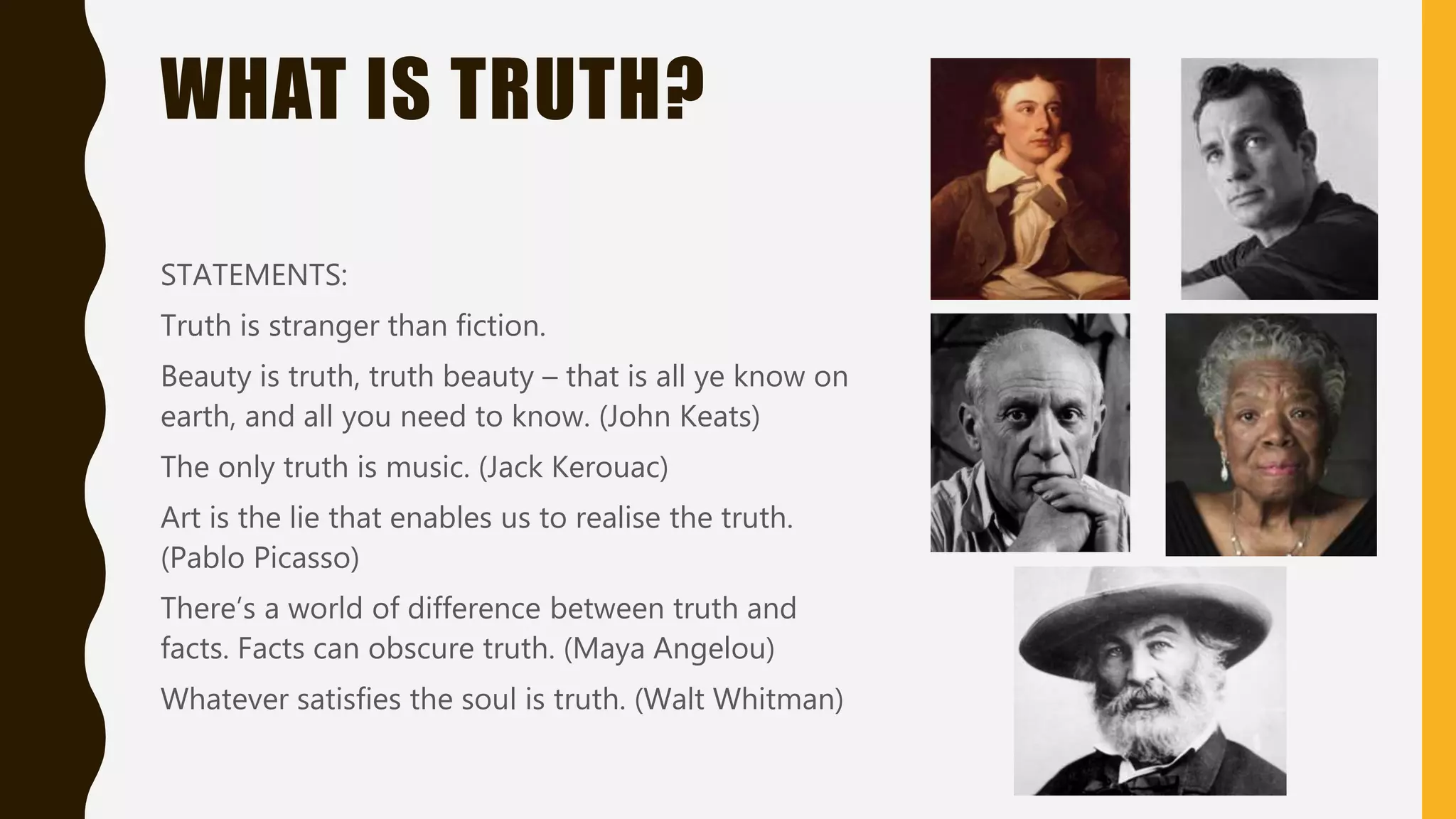
Truth is stranger than fiction.
Beauty is truth, truth beauty – that is all ye know on
earth, and all you need to know. (John Keats)
The only truth is music. (Jack Kerouac)
Art is the lie that enables us to realise the truth.
(Pablo Picasso)
There’s a world of difference between truth and
facts. Facts can obscure truth. (Maya Angelou)
Whatever satisfies the soul is truth. (Walt Whitman)
MORE PERSPECTIVES ON TRUTH
All truths are easy to understand once they are discovered; the
point is to discover them. (Galileo Galilei)
Anyone who doesn’t take truth seriously in small matters cannot
be trusted in large ones either. (Albert Einstein)
When in doubt, tell the truth. (Mark Twain)
There are only two mistakes one can make along the road to
truth: not going all the way and not starting. (Buddha)
A STORY ABOUT TRUTH
In 2015 a movie called “Truth” was released
(starring Robert Redford and Cate Blanchett).
It examines a team of journalists who uncover
a story about the US President that brings his
past into question. Or did they? What was the
truth?
The movie is of interest because it looks at
the difficulties of determining the truth, but
also at the influence of power over the story
that is given to us as the truth.
Watch the trailer for the movie.
What conceptions of truth
are at play here?
THE CONTEST FOR TRUTH
Somewhere in the middle of the twentieth century,
fundamentalism and postmodernism, the religious right and
the academic left, met up: either the only truth is the truth of
the divine or there is no truth; for both, empiricism is an error.
That epistemological havoc has never ended: much of
contemporary discourse and pretty much all of American
politics is a dispute over evidence. An American Presidential
debate has a lot more in common with trial by combat1 than
with trial by jury2.
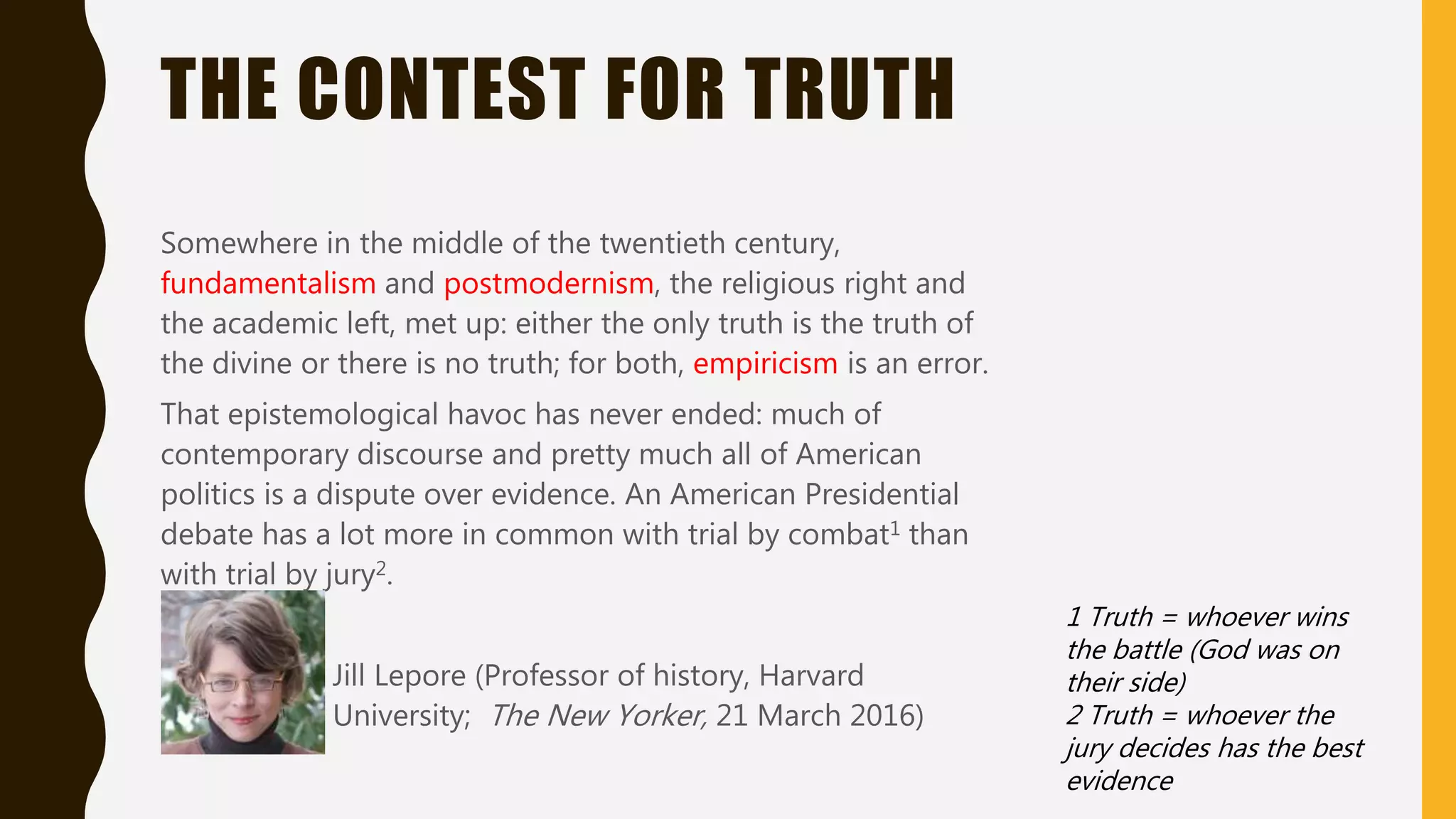
Jill Lepore (Professor of history, Harvard
University; The New Yorker, 21 March 2016)
1 Truth = whoever wins
the battle (God was on
their side)
2 Truth = whoever the
jury decides has the best
evidence
THE PROBLEM WITH TRUTH
We have conflicting beliefs about truth; we sometimes
think it is discovered, sometimes created, sometimes
knowable, sometimes mysterious.
- Michael P. Lynch, True to Life, MIT Press, 2004;
professor of philosophy.
CAN WE PUT UP PERSUASIVE
PROPOSITIONS ABOUT TRUTH?
Truth is not necessarily what works
(pragmatism) – lies can “work”.
Truth is not necessarily what makes us
feel good – bad news can be true.
Truth is not necessarily what the majority
thinks – the majority can be wrong.
What we believe is not necessarily the
truth.
The truth corresponds with facts, or
reality.
Truth means being true to something (to
a standard, or true to oneself).
Examples of statements
that are true or false
The chair is red.
There is $1,000 in my bank account.
You lied about where you were last
night.
The earth is not flat.
2 + 2 = 4
BUT…..
The meaning of truth depends on the context.
For example:
2 + 2 = 4 is true (that is, not false) in a mathematical context. But even here, it
depends. In a base 4 system, 2 + 2 = 10. And, the statement has no correspondence
in physical reality, except as particular examples (2 apples + 2 apples = 4 apples)
“It is Tuesday” is only true on Tuesdays, and only in cultures that have a calendar
containing Tuesdays.
Clearly, “Beauty is truth” is not the same kind of statement as “The chair is red”. So
how do we explain the difference?
What does it mean “to be true to oneself”?
AND WHAT ABOUT THESE STATEMENTS….
The truth about depression is….
The truth about climate change is….
The truth about God is….
The truth about beauty is….
The truth about kindness is….
The truth about being healthy is….
HAVING CONSIDERED THE VARIETY OF
EXAMPLES….
THEORIES
Correspondence: True beliefs and true statements correspond to the
actual state of affairs (“reality”).
Pragmatism: Truth is verified and confirmed by the results of putting
one's concepts into practice. (If it’s true it will work. It implies that
understanding of the truth is self-corrective over time.)
Consensus: Truth is what we agree is the truth. (This could be “trial by
jury” or “History is what is written by the victors”).
Performative: To say a statement is true is to perform the act of
agreeing, or accepting, that it is true (that is, making it true).
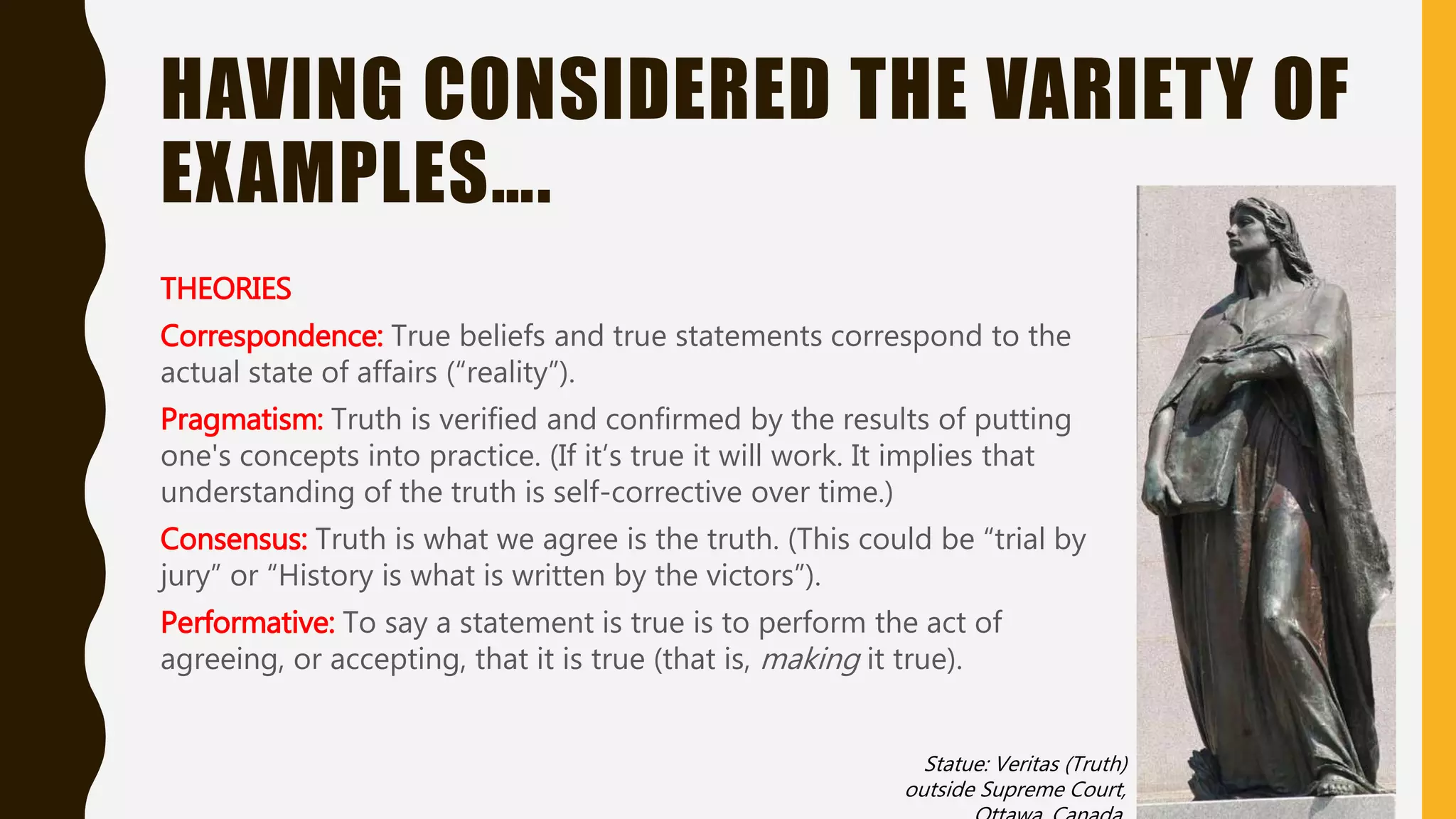
Statue: Veritas (Truth)
outside Supreme Court,
Ottawa, Canada
TO CLARIFY….
It is constructive to make distinctions. Statements about truth vary
according to what we are talking about.
Truth in logic. Patterns in reason tell us if a statement is true or not.
Illustration: Inside a logical system, things may be true or not true
according to the meanings assigned.
Truth in mathematics. Again, statements may be true or not, or
provable or not, within the set of axioms accepted.
Semantics (language). Statements are true or not true within the
parameters of the language. Truth has to do with the meanings
assigned to words and sentences.
Immanuel Kant: Yes, truth is the agreement of cognition with its
object (correspondence theory), but this does not tell us which
particular judgements are true.
TO PURSUE AND RESOLVE….
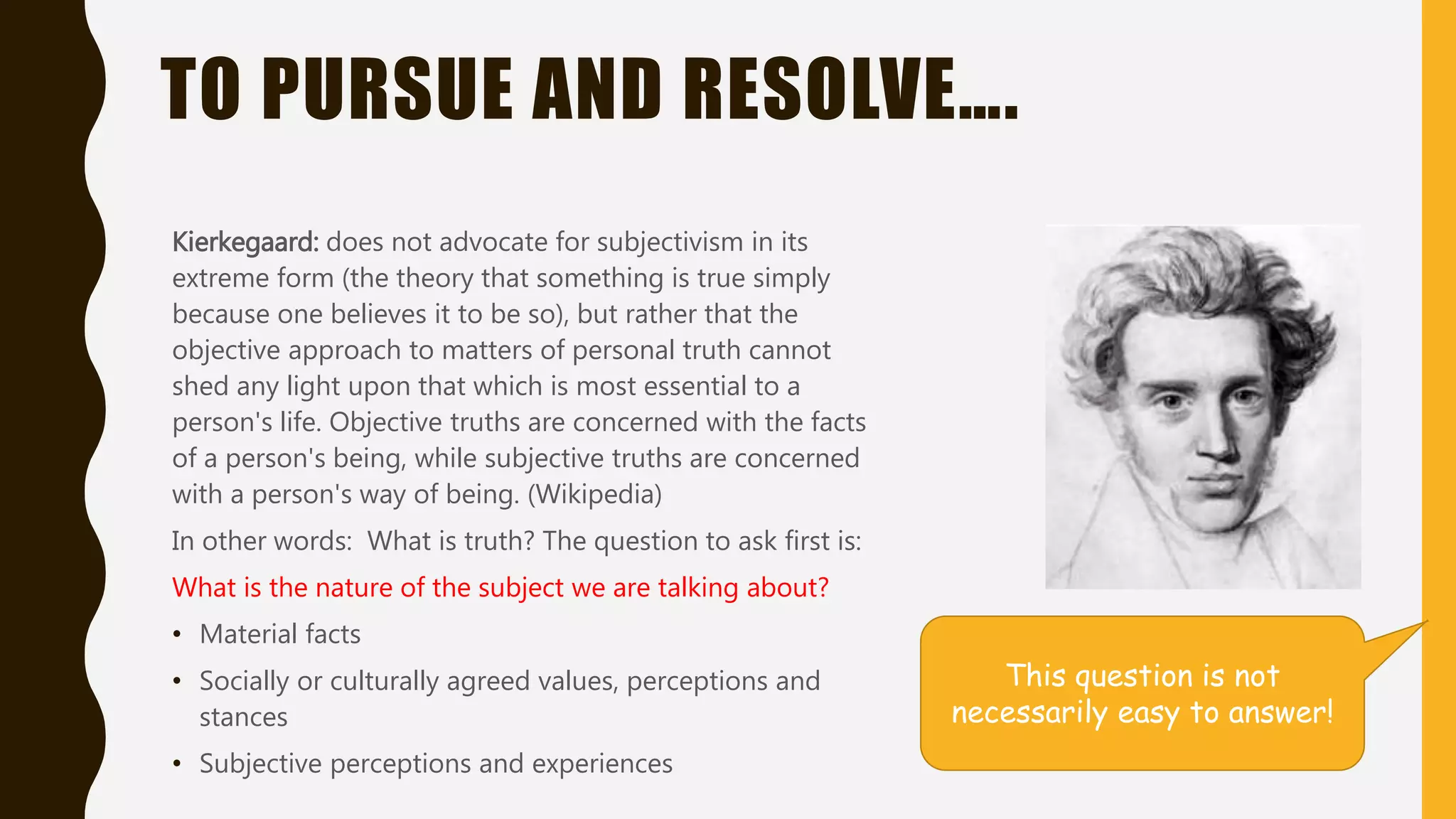
Kierkegaard: does not advocate for subjectivism in its
extreme form (the theory that something is true simply
because one believes it to be so), but rather that the
objective approach to matters of personal truth cannot
shed any light upon that which is most essential to a
person's life. Objective truths are concerned with the facts
of a person's being, while subjective truths are concerned
with a person's way of being. (Wikipedia)
In other words: What is truth? The question to ask first is:
What is the nature of the subject we are talking about?
• Material facts
• Socially or culturally agreed values, perceptions and
stances
• Subjective perceptions and experiences
This question is not
necessarily easy to answer!
SOURCES AND POINTERS
Wikipedia article on Truth which offers many further references as well as a good
overview.
Book: True to Life by Michael P. Lynch, 2004, Bradford Books, MIT Press, Cambridge MA.
Slideshare presentation: Does absolute truth exist? (Beware: Can you unpick the logic?)
Critique of the movie “Truth”
AND AFTER TRUTH….?
What we think about truth interrelates with what we
think about the self, ethics and power.
Truth
Power Ethics
Self
The work of Glenn Martin
24 July 2016
www.glennmartin.com.au
Tomorrow, the truth will still be the truth, but I may think differently.

Questions about the truth

  • 1.
    QUESTIONS ABOUT THE TRUTH GL E N N M A R T I N J U L Y 2 0 1 6
  • 2.
    WHY This slide setis intended to give a brief overview of ideas about what truth is. It seeks to share, to clarify and to raise questions. Painting by Rene Magritte
  • 3.
    TRUTH IN THEHEADLINES Here are the headlines of some news articles concerning truth: • Ten years on: how Al Gore’s An Inconvenient Truth made its mark • The truth about for-profit colleges and Trump University • Gorillas in zoos – the unpalatable truth • Hillsborough: at last, the shameful truth is out • The deadly truth about loneliness • Revealed: the truth about ethnic diversity of neighbourhoods • Culloden: why the truth about the battle for Britain lay hidden for three centuries Is the word “truth” being used in the same way in each case? What kind of “thing” is it referring to?
  • 4.
    WHAT IS TRUTH? STATEMENTS Truthis stranger than fiction. Beauty is truth, truth beauty – that is all ye know on earth, and all you need to know. (John Keats) The only truth is music. (Jack Kerouac) Art is the lie that enables us to realise the truth. (Pablo Picasso) There’s a world of difference between truth and facts. Facts can obscure truth. (Maya Angelou) Whatever satisfies the soul is truth. (Walt Whitman)
  • 5.
    MORE PERSPECTIVES ONTRUTH All truths are easy to understand once they are discovered; the point is to discover them. (Galileo Galilei) Anyone who doesn’t take truth seriously in small matters cannot be trusted in large ones either. (Albert Einstein) When in doubt, tell the truth. (Mark Twain) There are only two mistakes one can make along the road to truth: not going all the way and not starting. (Buddha)
  • 6.
    A STORY ABOUTTRUTH In 2015 a movie called “Truth” was released (starring Robert Redford and Cate Blanchett). It examines a team of journalists who uncover a story about the US President that brings his past into question. Or did they? What was the truth? The movie is of interest because it looks at the difficulties of determining the truth, but also at the influence of power over the story that is given to us as the truth. Watch the trailer for the movie. What conceptions of truth are at play here?
  • 7.
    THE CONTEST FORTRUTH Somewhere in the middle of the twentieth century, fundamentalism and postmodernism, the religious right and the academic left, met up: either the only truth is the truth of the divine or there is no truth; for both, empiricism is an error. That epistemological havoc has never ended: much of contemporary discourse and pretty much all of American politics is a dispute over evidence. An American Presidential debate has a lot more in common with trial by combat1 than with trial by jury2. Jill Lepore (Professor of history, Harvard University; The New Yorker, 21 March 2016) 1 Truth = whoever wins the battle (God was on their side) 2 Truth = whoever the jury decides has the best evidence
  • 8.
    THE PROBLEM WITHTRUTH We have conflicting beliefs about truth; we sometimes think it is discovered, sometimes created, sometimes knowable, sometimes mysterious. - Michael P. Lynch, True to Life, MIT Press, 2004; professor of philosophy.
  • 9.
    CAN WE PUTUP PERSUASIVE PROPOSITIONS ABOUT TRUTH? Truth is not necessarily what works (pragmatism) – lies can “work”. Truth is not necessarily what makes us feel good – bad news can be true. Truth is not necessarily what the majority thinks – the majority can be wrong. What we believe is not necessarily the truth. The truth corresponds with facts, or reality. Truth means being true to something (to a standard, or true to oneself). Examples of statements that are true or false The chair is red. There is $1,000 in my bank account. You lied about where you were last night. The earth is not flat. 2 + 2 = 4
  • 10.
    BUT….. The meaning oftruth depends on the context. For example: 2 + 2 = 4 is true (that is, not false) in a mathematical context. But even here, it depends. In a base 4 system, 2 + 2 = 10. And, the statement has no correspondence in physical reality, except as particular examples (2 apples + 2 apples = 4 apples) “It is Tuesday” is only true on Tuesdays, and only in cultures that have a calendar containing Tuesdays. Clearly, “Beauty is truth” is not the same kind of statement as “The chair is red”. So how do we explain the difference? What does it mean “to be true to oneself”?
  • 11.
    AND WHAT ABOUTTHESE STATEMENTS…. The truth about depression is…. The truth about climate change is…. The truth about God is…. The truth about beauty is…. The truth about kindness is…. The truth about being healthy is….
  • 12.
    HAVING CONSIDERED THEVARIETY OF EXAMPLES…. THEORIES Correspondence: True beliefs and true statements correspond to the actual state of affairs (“reality”). Pragmatism: Truth is verified and confirmed by the results of putting one's concepts into practice. (If it’s true it will work. It implies that understanding of the truth is self-corrective over time.) Consensus: Truth is what we agree is the truth. (This could be “trial by jury” or “History is what is written by the victors”). Performative: To say a statement is true is to perform the act of agreeing, or accepting, that it is true (that is, making it true). Statue: Veritas (Truth) outside Supreme Court, Ottawa, Canada
  • 13.
    TO CLARIFY…. It isconstructive to make distinctions. Statements about truth vary according to what we are talking about. Truth in logic. Patterns in reason tell us if a statement is true or not. Illustration: Inside a logical system, things may be true or not true according to the meanings assigned. Truth in mathematics. Again, statements may be true or not, or provable or not, within the set of axioms accepted. Semantics (language). Statements are true or not true within the parameters of the language. Truth has to do with the meanings assigned to words and sentences. Immanuel Kant: Yes, truth is the agreement of cognition with its object (correspondence theory), but this does not tell us which particular judgements are true.
  • 14.
    TO PURSUE ANDRESOLVE…. Kierkegaard: does not advocate for subjectivism in its extreme form (the theory that something is true simply because one believes it to be so), but rather that the objective approach to matters of personal truth cannot shed any light upon that which is most essential to a person's life. Objective truths are concerned with the facts of a person's being, while subjective truths are concerned with a person's way of being. (Wikipedia) In other words: What is truth? The question to ask first is: What is the nature of the subject we are talking about? • Material facts • Socially or culturally agreed values, perceptions and stances • Subjective perceptions and experiences This question is not necessarily easy to answer!
  • 15.
    SOURCES AND POINTERS Wikipediaarticle on Truth which offers many further references as well as a good overview. Book: True to Life by Michael P. Lynch, 2004, Bradford Books, MIT Press, Cambridge MA. Slideshare presentation: Does absolute truth exist? (Beware: Can you unpick the logic?) Critique of the movie “Truth”
  • 17.
    AND AFTER TRUTH….? Whatwe think about truth interrelates with what we think about the self, ethics and power. Truth Power Ethics Self
  • 18.
    The work ofGlenn Martin 24 July 2016 www.glennmartin.com.au Tomorrow, the truth will still be the truth, but I may think differently.