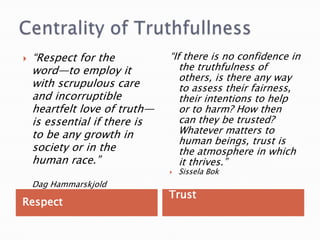
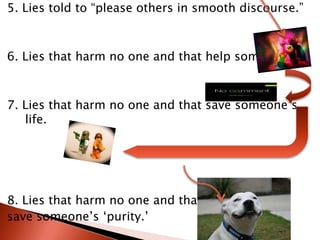
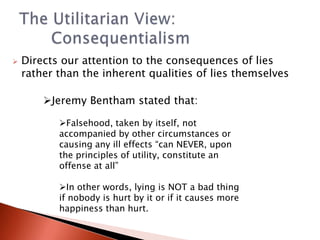
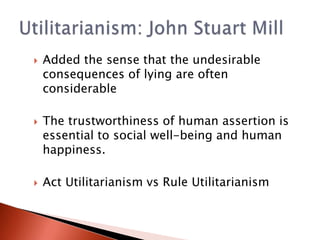
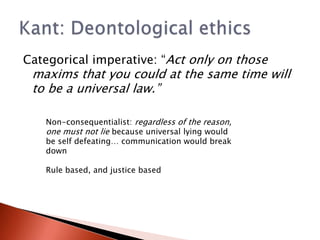
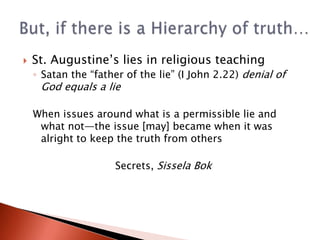
This document discusses the ethics of lying and secrecy. It presents several perspectives on when lying may or may not be justified, from an absolute prohibition on lying to consequentialist views that lying can be acceptable if it causes more benefit than harm. It also distinguishes between lies, secrets, and privacy. St. Augustine proposed a hierarchy of lies ranging from most harmful to least harmful. Utilitarians believe the consequences of an act determine its morality, so lying could be acceptable if it helps more than it harms. Kant argued lying is never justified because it undermines trust which is necessary for society. The document explores these philosophical debates and how they relate to concepts of secrecy and privacy.
![1. Lies in religious teaching.2. Lies that harm others and help no one.3. Lies that harm others and help someone.4. Lies told for the pleasure of lying.St. Augustine’s Hierarchy of Lies [8]](https://image.slidesharecdn.com/lying-100722141943-phpapp01/85/Lying-3-320.jpg)
![St. Augustine’s lies in religious teachingSatan the “father of the lie” (I John 2.22) denial of God equals a lieWhen issues around what is a permissible lie and what not—the issue [may] became when it was alright to keep the truth from others Secrets, Sissela BokBut, if there is a Hierarchy of truth…](https://image.slidesharecdn.com/lying-100722141943-phpapp01/85/Lying-10-320.jpg)