You shall know the truth (veritas) and the truth will make you free
A Haller - Lecture
Math Awareness Week
Palm Beach State College
2019
A Hypothesis is a Claim
A Claim seeks to Determine Truth with a Certain Level of
Certainty, Confidence, Significance, or Reliability
• Truth can be knowable with certain degrees of certainty
• Truth can at times defy being identifiable
• Truth can be conclusive to elusive
• Truth is missed due to wrong observations, misinterpretations,
misapplications, and wrong paradigms. How a question is framed is
so crucial!
• Truth is exclusive not inclusive.
• Truth can be rude and unpleasant
Definition: Truth
• That which is factual
• That which conforms with reality
I) Historical Truth: the Past
– Subject to credible eye witnesses – the more the better
– Physical evidence of some type. Crime labs - Archaeology – a manuscript
– When written internal evidence such as meeting grammar, syntax, style,
language of the time and place in question.
– Courts of law attempt to determine a historical event
– Historical accounts and narratives are dissected to confirm the past.
– Descriptive statistics fall in this area.
Codex Sinaiticus 300AD: If a reproductive copy of the 1st
century we expect it to follow Greek grammar, syntax,
vocabulary, paper, and confirm historical/geographical
characteristics unique to that era. Also, notice to forge or
insert words is not possible. Sentences are run on
sentences.
Descriptive Statistics
• How tall are people in a group?
• What is their weight?
• What is their age?
II) Empirical Truth: the
Present
– Subject to the scientific method
– Repeatable, measurable, and verifiable
– Example water boils at 100 degrees C.
– Hypothesis Testing
» Determine if there is reason to reject
the hypothesis or claim
» Set a boundary of how accurate does
one wish to be
– Forensic Testing
III) Predictive Truth: the Future
• Inferential Statistics – Forecasting, modeling, simulation –
prophetic in nature
Why do we use statistics?
It permits seeing through a hazy fog of uncertainty
with greater clarity - truth
The Beloved Family Canary
Statistics is a blurred photograph
of the real world
Strengths, weaknesses, opportunities, and threats
Statistics gives clarity, certainty,
confidence, reliability, and significance
Strengths, weaknesses, opportunities, and threats
IV) Personal Experience:
• We touch boiling water we (ex)claim- it is hot!
• It every language are words like hunch, insight of
pattern recognition, intuition, illumination,
enlightenment, revelation, epiphany, an intense
catharsis.
• See Eureka effect – see
the unseen
• See Epiphany
an emotional catharsis
• These tend to be highly subjective in nature. Our senses can deceive
us. Others will naturally be skeptical especially if it is an experience
uncommon such as having an extraordinary or supernatural origin.
Fall into 3 categories.
– Unintentional self delusion – a hallucination
– Intentional deception – a lie
– Reliable and confirmed by the other truths
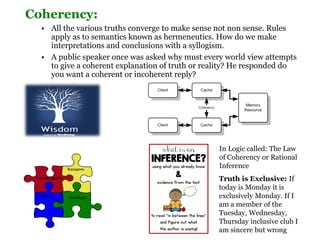
Coherency:
• All the various truths converge to make sense not non sense. Rules
apply as to semantics known as hermeneutics. How do we make
interpretations and conclusions with a syllogism.
• A public speaker once was asked why must every world view attempts
to give a coherent explanation of truth or reality? He responded do
you want a coherent or incoherent reply?
In Logic called: The Law
of Coherency or Rational
Inference
Truth is Exclusive: If
today is Monday it is
exclusively Monday. If I
am a member of the
Tuesday, Wednesday,
Thursday inclusive club I
am sincere but wrong
• Truth can be Distorted by Semantics –
Words
• False syllogisms
• Hermeneutics – the science of
interpretation – what is the noun, what is
the verb, is what stated literal or figurative?
Types of Logical Fallacies
Fallacies of Relevance
• Ad Hominem
(Personal Attack)
• Bandwagon Fallacy
• Fallacist’s Fallacy
• Fallacy of
Composition
• Fallacy of Division
• Gambler’s Fallacy
• Genetic Fallacy
Prosecutor’s Fallacy
Fallacies of Ambiguity
• Accent Fallacies
• Equivocation Fallacy
• Straw Man Fallacy
Irrelevant Appeals
• Appeal to Antiquity /
Tradition
• Appeal to Authority
• Appeal to Consequences
• Appeal to Force
• Appeal to Novelty
• Appeal to Pity
• Appeal to Popularity
• Appeal to Poverty
• Appeal to Wealth
Red Herring
Weak Analogy
Moralistic Fallacy
Naturalistic Fallacy
Fallacies of Presumption
• Affirming the Consequent
• Arguing from Ignorance
• Begging the Question / Circular Reasoning
• Complex Question Fallacy
• Cum Hoc Fallacy
• False Dilemma / Bifurcation Fallacy
• Hasty Generalization Fallacy
• ‘No True Scotsman’ Fallacy
• Post Hoc Fallacy
• Slippery Slope Fallacy
• Sweeping Generalization Fallacy
• Subjectivist Fallacy
• Tu Quoque Fallacy
Trends in a Post Truth Era
Post Truth: Circumstances in which the truth is no longer reliably
known or figured out (due to conflicting sources and the sheer amount
of nonsense in the world, for example). Debates are often about which
"facts" are actually true instead of what they mean or how to put them
together.
Post truth is where public opinion is shaped more-so by subjective
opinion and emotion rather than objective facts. It appeals to
emotion and personal belief.
Post Truth Era -2016
Truth Declared not Discovered or Validated with Facts
Relating to or denoting circumstances in which objective facts
are less influential in shaping public opinion than appeals to
emotion and personal belief.
‘in this era of post-truth politics, it's easy to cherry-pick data
and come to whatever conclusion you desire’
‘some commentators have observed that we are living in a
post-truth age…we make up our own subjective reality
Post-truth’ named 2016 word of the year by Oxford
Dictionaries
It's official: Truth is dead. Facts are passe.
“Given that usage of the term hasn’t shown any signs of slowing down, I
wouldn’t be surprised if post-truth becomes one of the defining
words of our time,” said Grathwohl, the Oxford Dictionaries
president.
For what it's worth, “post-truth” is not to be confused
with “truthiness,” the phenomenon of “believing
something that feels true, even if it isn't supported by
fact.”
1. The concept that a person's perception and how they 'feel'
about things supersedes fact
2. The complete disregard for any body of evidence or advice
from the scientific community when contesting facts
3. Negation of events or information widely accepted to be true.
"Truthiness is 'What I say is right, and nothing anyone else says
could possibly be true.' " -Stephen Colbert
“Who's Britannica to tell me the Panama Canal was finished in
1914?!" he continued in the segment. “If I want to say it happened
in 1941, that's my right. I don't trust books. They're all fact, no
heart.”
Post Truth
Seen in
I) History of Ideas:
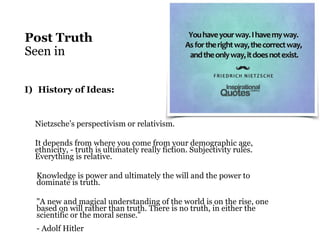
Nietzsche’s perspectivism or relativism.
It depends from where you come from your demographic age,
ethnicity, - truth is ultimately really fiction. Subjectivity rules.
Everything is relative.
Knowledge is power and ultimately the will and the power to
dominate is truth.
"A new and magical understanding of the world is on the rise, one
based on will rather than truth. There is no truth, in either the
scientific or the moral sense."
- Adolf Hitler
II) Social Sciences
Everything is socially constructed. The majority opinion states what is true.
Word, words, there are nothing but words formed and shaped by culture and
time.
Why must there be a sole interpretation and application to everything?
Why do you dogmatically insist things must be coherent?
I wish to claim I am an Eskimo – who is to deny me my declaration. Where is the
discover by birth certificates or other factual proofs other than I like to live in an
Igloo? Truth needs to correspond to reality otherwise we have conjecture and a
fantasy.
Lack of
• No Truth
• No Meaning
• No Certainty – deconstruct words
Post Truth
Seen in
III) Media
– If we see visually and hear
audibly or in print it carries
the weight of being true.
– John Kennedy’s Dallas
speech never took place. It
was a composite of various
speeches pasted together.
– The media can Photoshop
any picture. It can blend two
unrelated audiovisual things
into one. It does not matter
if it is accurate or true.
Post Truth
Seen in
III) Media
– If we see visually and
hear audibly or in
print it carries the
weight of being true.
– John Kennedy’s
Dallas speech never
took place. It was a
composite of various
speeches pasted
together.
Post Truth Seen in Hear JFK's voice deliver the Dallas
speech he never gave in 1963
Updated: 1:39 PM CDT March 16, 2018
DALLAS – A Scottish technology company has
used computers to recreate the speech President
John F. Kennedy was set to deliver at the Dallas
Trade Mart the day he was assassinated.
CereProc, which specializes in text-to-speech
technology, collected 116,777 sound units from
831 of JFK’s speeches and radio addresses,
according to British newspaper The Times,
which commissioned the project.
III) Media
– If we see visually and hear audibly
or in print it carries the weight of
being true.
– The media can Photoshop any
picture. It can blend two unrelated
audiovisual things into one. It does
not matter if it is accurate or true.
Post Truth Seen in
IV) Danger
– Consequences to the loss of the truth
– We lose the ability to trust
– We are easily deceived and adopt post
truth thinking our self. Ex: Justice is
lost. Legally win at all costs
– For Freedom to Flourish
» Needs the absence of domination
by others, such as the politically
elite, commercial interests, etc. who
attempt to control us.
» Needs the presence of the ability
to be – unrestricted to ascend and
achieve one’s purpose in life due to
one’s efforts and natural abilities
Fall of Berlin Wall – one of the slogans
“we are not like them” speaking of the
Soviet Union and its distortions of lies and
political suppression. We wish to be free
You shall know the truth (veritas) and the truth will make you free
A Haller - Lecture
Math Awareness Week
Palm Beach State College
2019
You shall know the truth (veritas) and the truth
will make you free

Math awareness 2019

  • 1.
    You shall knowthe truth (veritas) and the truth will make you free A Haller - Lecture Math Awareness Week Palm Beach State College 2019
  • 2.
    A Hypothesis isa Claim A Claim seeks to Determine Truth with a Certain Level of Certainty, Confidence, Significance, or Reliability • Truth can be knowable with certain degrees of certainty • Truth can at times defy being identifiable • Truth can be conclusive to elusive • Truth is missed due to wrong observations, misinterpretations, misapplications, and wrong paradigms. How a question is framed is so crucial! • Truth is exclusive not inclusive. • Truth can be rude and unpleasant Definition: Truth • That which is factual • That which conforms with reality
  • 3.
    I) Historical Truth:the Past – Subject to credible eye witnesses – the more the better – Physical evidence of some type. Crime labs - Archaeology – a manuscript – When written internal evidence such as meeting grammar, syntax, style, language of the time and place in question. – Courts of law attempt to determine a historical event – Historical accounts and narratives are dissected to confirm the past. – Descriptive statistics fall in this area. Codex Sinaiticus 300AD: If a reproductive copy of the 1st century we expect it to follow Greek grammar, syntax, vocabulary, paper, and confirm historical/geographical characteristics unique to that era. Also, notice to forge or insert words is not possible. Sentences are run on sentences. Descriptive Statistics • How tall are people in a group? • What is their weight? • What is their age?
  • 4.
    II) Empirical Truth:the Present – Subject to the scientific method – Repeatable, measurable, and verifiable – Example water boils at 100 degrees C. – Hypothesis Testing » Determine if there is reason to reject the hypothesis or claim » Set a boundary of how accurate does one wish to be – Forensic Testing
  • 5.
    III) Predictive Truth:the Future • Inferential Statistics – Forecasting, modeling, simulation – prophetic in nature
  • 6.
    Why do weuse statistics? It permits seeing through a hazy fog of uncertainty with greater clarity - truth The Beloved Family Canary
  • 7.
    Statistics is ablurred photograph of the real world Strengths, weaknesses, opportunities, and threats
  • 8.
    Statistics gives clarity,certainty, confidence, reliability, and significance Strengths, weaknesses, opportunities, and threats
  • 9.
    IV) Personal Experience: •We touch boiling water we (ex)claim- it is hot! • It every language are words like hunch, insight of pattern recognition, intuition, illumination, enlightenment, revelation, epiphany, an intense catharsis. • See Eureka effect – see the unseen • See Epiphany an emotional catharsis • These tend to be highly subjective in nature. Our senses can deceive us. Others will naturally be skeptical especially if it is an experience uncommon such as having an extraordinary or supernatural origin. Fall into 3 categories. – Unintentional self delusion – a hallucination – Intentional deception – a lie – Reliable and confirmed by the other truths
  • 10.
    Coherency: • All thevarious truths converge to make sense not non sense. Rules apply as to semantics known as hermeneutics. How do we make interpretations and conclusions with a syllogism. • A public speaker once was asked why must every world view attempts to give a coherent explanation of truth or reality? He responded do you want a coherent or incoherent reply? In Logic called: The Law of Coherency or Rational Inference Truth is Exclusive: If today is Monday it is exclusively Monday. If I am a member of the Tuesday, Wednesday, Thursday inclusive club I am sincere but wrong
  • 11.
    • Truth canbe Distorted by Semantics – Words • False syllogisms • Hermeneutics – the science of interpretation – what is the noun, what is the verb, is what stated literal or figurative?
  • 12.
    Types of LogicalFallacies Fallacies of Relevance • Ad Hominem (Personal Attack) • Bandwagon Fallacy • Fallacist’s Fallacy • Fallacy of Composition • Fallacy of Division • Gambler’s Fallacy • Genetic Fallacy Prosecutor’s Fallacy Fallacies of Ambiguity • Accent Fallacies • Equivocation Fallacy • Straw Man Fallacy Irrelevant Appeals • Appeal to Antiquity / Tradition • Appeal to Authority • Appeal to Consequences • Appeal to Force • Appeal to Novelty • Appeal to Pity • Appeal to Popularity • Appeal to Poverty • Appeal to Wealth Red Herring Weak Analogy Moralistic Fallacy Naturalistic Fallacy
  • 13.
    Fallacies of Presumption •Affirming the Consequent • Arguing from Ignorance • Begging the Question / Circular Reasoning • Complex Question Fallacy • Cum Hoc Fallacy • False Dilemma / Bifurcation Fallacy • Hasty Generalization Fallacy • ‘No True Scotsman’ Fallacy • Post Hoc Fallacy • Slippery Slope Fallacy • Sweeping Generalization Fallacy • Subjectivist Fallacy • Tu Quoque Fallacy
  • 14.
    Trends in aPost Truth Era Post Truth: Circumstances in which the truth is no longer reliably known or figured out (due to conflicting sources and the sheer amount of nonsense in the world, for example). Debates are often about which "facts" are actually true instead of what they mean or how to put them together. Post truth is where public opinion is shaped more-so by subjective opinion and emotion rather than objective facts. It appeals to emotion and personal belief. Post Truth Era -2016 Truth Declared not Discovered or Validated with Facts
  • 15.
    Relating to ordenoting circumstances in which objective facts are less influential in shaping public opinion than appeals to emotion and personal belief. ‘in this era of post-truth politics, it's easy to cherry-pick data and come to whatever conclusion you desire’ ‘some commentators have observed that we are living in a post-truth age…we make up our own subjective reality Post-truth’ named 2016 word of the year by Oxford Dictionaries It's official: Truth is dead. Facts are passe. “Given that usage of the term hasn’t shown any signs of slowing down, I wouldn’t be surprised if post-truth becomes one of the defining words of our time,” said Grathwohl, the Oxford Dictionaries president.
  • 16.
    For what it'sworth, “post-truth” is not to be confused with “truthiness,” the phenomenon of “believing something that feels true, even if it isn't supported by fact.” 1. The concept that a person's perception and how they 'feel' about things supersedes fact 2. The complete disregard for any body of evidence or advice from the scientific community when contesting facts 3. Negation of events or information widely accepted to be true. "Truthiness is 'What I say is right, and nothing anyone else says could possibly be true.' " -Stephen Colbert “Who's Britannica to tell me the Panama Canal was finished in 1914?!" he continued in the segment. “If I want to say it happened in 1941, that's my right. I don't trust books. They're all fact, no heart.”
  • 17.
    Post Truth Seen in I)History of Ideas: Nietzsche’s perspectivism or relativism. It depends from where you come from your demographic age, ethnicity, - truth is ultimately really fiction. Subjectivity rules. Everything is relative. Knowledge is power and ultimately the will and the power to dominate is truth. "A new and magical understanding of the world is on the rise, one based on will rather than truth. There is no truth, in either the scientific or the moral sense." - Adolf Hitler
  • 18.
    II) Social Sciences Everythingis socially constructed. The majority opinion states what is true. Word, words, there are nothing but words formed and shaped by culture and time. Why must there be a sole interpretation and application to everything? Why do you dogmatically insist things must be coherent? I wish to claim I am an Eskimo – who is to deny me my declaration. Where is the discover by birth certificates or other factual proofs other than I like to live in an Igloo? Truth needs to correspond to reality otherwise we have conjecture and a fantasy. Lack of • No Truth • No Meaning • No Certainty – deconstruct words Post Truth Seen in
  • 19.
    III) Media – Ifwe see visually and hear audibly or in print it carries the weight of being true. – John Kennedy’s Dallas speech never took place. It was a composite of various speeches pasted together. – The media can Photoshop any picture. It can blend two unrelated audiovisual things into one. It does not matter if it is accurate or true. Post Truth Seen in
  • 20.
    III) Media – Ifwe see visually and hear audibly or in print it carries the weight of being true. – John Kennedy’s Dallas speech never took place. It was a composite of various speeches pasted together. Post Truth Seen in Hear JFK's voice deliver the Dallas speech he never gave in 1963 Updated: 1:39 PM CDT March 16, 2018 DALLAS – A Scottish technology company has used computers to recreate the speech President John F. Kennedy was set to deliver at the Dallas Trade Mart the day he was assassinated. CereProc, which specializes in text-to-speech technology, collected 116,777 sound units from 831 of JFK’s speeches and radio addresses, according to British newspaper The Times, which commissioned the project.
  • 21.
    III) Media – Ifwe see visually and hear audibly or in print it carries the weight of being true. – The media can Photoshop any picture. It can blend two unrelated audiovisual things into one. It does not matter if it is accurate or true. Post Truth Seen in
  • 22.
    IV) Danger – Consequencesto the loss of the truth – We lose the ability to trust – We are easily deceived and adopt post truth thinking our self. Ex: Justice is lost. Legally win at all costs – For Freedom to Flourish » Needs the absence of domination by others, such as the politically elite, commercial interests, etc. who attempt to control us. » Needs the presence of the ability to be – unrestricted to ascend and achieve one’s purpose in life due to one’s efforts and natural abilities Fall of Berlin Wall – one of the slogans “we are not like them” speaking of the Soviet Union and its distortions of lies and political suppression. We wish to be free You shall know the truth (veritas) and the truth will make you free
  • 23.
    A Haller -Lecture Math Awareness Week Palm Beach State College 2019
  • 24.
    You shall knowthe truth (veritas) and the truth will make you free