Assoc. Prof. Rachel E. Khan
Journalism Department, College of Mass Communication
University of the Philippines, Diliman
L. Day:
“The commitment to truth is perhaps the most
ancient and revered ethical principle of human
civilization.”
2500 BC Babylon: Code of Hammurabi
33 AD: Judeo-Christian “Thou shalt not bear false
witness against thy neighbor.”
Today, Oath-taking in Judicial courts:
“Do you swear to tell the truth and nothing but
the truth?”
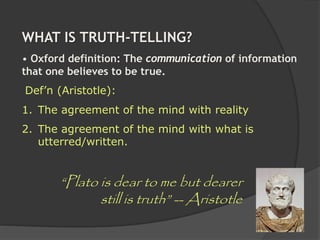
WHAT IS TRUTH-TELLING?
• Oxford definition: The communication of information
that one believes to be true.
Def’n (Aristotle):
1. The agreement of the mind with reality
2. The agreement of the mind with what is
utterred/written.
“Plato is dear to me but dearer
still is truth” -- Aristotle
IMPORTANCE OF TRUTH-TELLING*:
1. Truth is integral to all communication
because, as rational beings, we depend
on it to make informed decisions.
• Journalists should bear in mind that
inaccurate or untruthful information
violates the viewer’s right to truthful
information and undermines his freedom.
*Source: Louis Day, Mass Media Ethics, Wadsworth
IMPORTANCE OF TRUTH-TELLING:
• This is because he would not have the tools to
make an informed decision; or worse, he would be
making a decision based on false information.
2. A commitment to truth demonstrates a respect
for persons as equals rather than tools to be
manipulated.
• Deception is done in self-interest.
3. Truthfulness in communication builds trust.
4. Truth is essential in a democratic process.
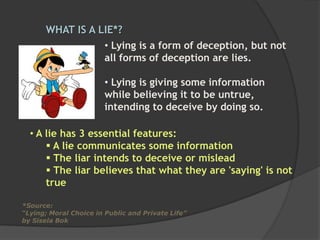
WHAT IS A LIE*?
• Lying is a form of deception, but not
all forms of deception are lies.
• Lying is giving some information
while believing it to be untrue,
intending to deceive by doing so.
*Source:
“Lying; Moral Choice in Public and Private Life”
by Sisela Bok
• A lie has 3 essential features:
 A lie communicates some information
 The liar intends to deceive or mislead
 The liar believes that what they are 'saying' is not
true
WHAT HARM DO LIES DO?
EFFECTS ON THE PERSON/S LIED TO:
They are deprived of some control over their future
because:
 They can no longer make an informed choice
about the issue concerned
 They are not fully informed about their possible
courses of action
 They may make a decision that they would not
otherwise have made
In mass media, the audience may suffer damages as a
result of the misinformation (e.g. buying the wrong
stocks, panic and paranoia, etc.)
EFFECTS ON THE LIAR:
•The person who intentionally released false information
will also suffer the consequences of his actions:
 He has to remember the lies he's told
 He must act in conformity with the lies
 He may have to tell more lies to avoid being found
out
 He has to be wary of those he's lied to
 His long-term credibility is at risk
 He will probably suffer harm if he's found out
• If he's found out, people are more likely to lie to
him
• If he's found out he's less likely to be believed in
future.
Point to ponder:
Is there such a thing as a “good lie”?
Can we say that there can be a “morally correct”
reason to lie?

Media Ethics: Truth-telling

  • 1.
    Assoc. Prof. RachelE. Khan Journalism Department, College of Mass Communication University of the Philippines, Diliman
  • 2.
    L. Day: “The commitmentto truth is perhaps the most ancient and revered ethical principle of human civilization.” 2500 BC Babylon: Code of Hammurabi 33 AD: Judeo-Christian “Thou shalt not bear false witness against thy neighbor.” Today, Oath-taking in Judicial courts: “Do you swear to tell the truth and nothing but the truth?”
  • 3.
    WHAT IS TRUTH-TELLING? •Oxford definition: The communication of information that one believes to be true. Def’n (Aristotle): 1. The agreement of the mind with reality 2. The agreement of the mind with what is utterred/written. “Plato is dear to me but dearer still is truth” -- Aristotle
  • 4.
    IMPORTANCE OF TRUTH-TELLING*: 1.Truth is integral to all communication because, as rational beings, we depend on it to make informed decisions. • Journalists should bear in mind that inaccurate or untruthful information violates the viewer’s right to truthful information and undermines his freedom. *Source: Louis Day, Mass Media Ethics, Wadsworth
  • 5.
    IMPORTANCE OF TRUTH-TELLING: •This is because he would not have the tools to make an informed decision; or worse, he would be making a decision based on false information. 2. A commitment to truth demonstrates a respect for persons as equals rather than tools to be manipulated. • Deception is done in self-interest. 3. Truthfulness in communication builds trust. 4. Truth is essential in a democratic process.
  • 6.
    WHAT IS ALIE*? • Lying is a form of deception, but not all forms of deception are lies. • Lying is giving some information while believing it to be untrue, intending to deceive by doing so. *Source: “Lying; Moral Choice in Public and Private Life” by Sisela Bok • A lie has 3 essential features:  A lie communicates some information  The liar intends to deceive or mislead  The liar believes that what they are 'saying' is not true
  • 7.
    WHAT HARM DOLIES DO? EFFECTS ON THE PERSON/S LIED TO: They are deprived of some control over their future because:  They can no longer make an informed choice about the issue concerned  They are not fully informed about their possible courses of action  They may make a decision that they would not otherwise have made In mass media, the audience may suffer damages as a result of the misinformation (e.g. buying the wrong stocks, panic and paranoia, etc.)
  • 8.
    EFFECTS ON THELIAR: •The person who intentionally released false information will also suffer the consequences of his actions:  He has to remember the lies he's told  He must act in conformity with the lies  He may have to tell more lies to avoid being found out  He has to be wary of those he's lied to  His long-term credibility is at risk  He will probably suffer harm if he's found out • If he's found out, people are more likely to lie to him • If he's found out he's less likely to be believed in future.
  • 9.
    Point to ponder: Isthere such a thing as a “good lie”? Can we say that there can be a “morally correct” reason to lie?