Ben Hawkes
Hmmm Squad, 26 June 2014
LIAR, LIAR…
Do you lie?
People tell an average of one or two lies a day.
Most frequently about their feelings, their
preferences, and their attitudes and opinions.
Lies about achievements and failures are also
commonplace.
Less often, they lie about their actions, plans,
and whereabouts.
Source: DePaulo, B. M., Lindsay, J. J., Malone, B. E., Muhlenbruck, L., Charlton, K., & Cooper, H. (2003). Cues to deception.
Psychological bulletin, 129(1), 74.
THE OLDEST LIE
IN THE BOOK…
And the serpent
said unto the
woman, ye shall
not surely die:
For God doth
know that in the
day ye eat thereof,
then your eyes
shall be opened,
and ye shall be as
gods, knowing
good and evil.
Genesis 3:4-5
ASK A PHILOSOPHER:
IS IT ALWAYS
WRONG TO LIE?
St. Augustine,
is it always wrong to lie?
Yes
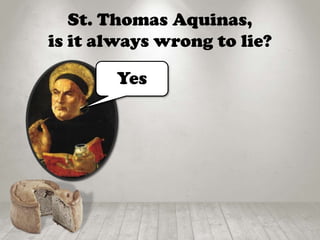
St. Thomas Aquinas,
is it always wrong to lie?
Yes
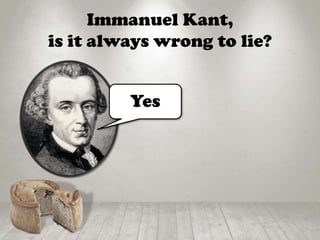
Immanuel Kant,
is it always wrong to lie?
Yes
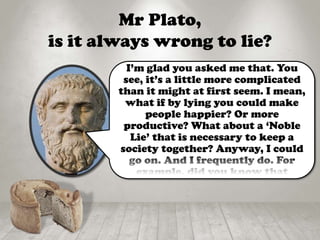
Mr Plato,
is it always wrong to lie?
I’m glad you asked me that. You
see, it’s a little more complicated
than it might at first seem. I mean,
what if by lying you could make
people happier? Or more
productive? What about a ‘Noble
Lie’ that is necessary to keep a
society together? Anyway, I could
go on. And I frequently do. For
example, did you know that
WHAT IS A LIE?
A definition
To lie:
To make an intentionally
false statement.
Mahon, James Edwin, "The Definition of Lying and Deception",

The Stanford Encyclopedia of Philosophy (Fall 2008 Edition), Edward N. Zalta (ed.)
Another definition
To lie:
To make an assertion that is believed to be
false to some audience with the intention
to deceive the audience about the content
of that assertion.
Mahon, James Edwin, "The Definition of Lying and Deception",
The Stanford Encyclopedia of Philosophy (Fall 2008 Edition), Edward N. Zalta (ed.)
A better definition..?
To lie:
To make a believed-false statement to
another person with the intention that
that other person believe that statement
to be true and the intention that that
other person believe that that statement
is believed to be true.
Mahon, James Edwin, "The Definition of Lying and Deception",
The Stanford Encyclopedia of Philosophy (Fall 2008 Edition), Edward N. Zalta (ed.)
A betterer definition..?
To lie:
To make a believed-not-true or believed-false statement to
another person, under conditions that are such that the person
making the statement believes:
(a) that the person hearing the statement is justified in
believing that the person making the statement believes the
statement to be true, and
(b) that the person hearing the statement is justified in
believing that the person making the statement intends that
the person hearing the statement believes that the person
making the statement believes the statement to be true.
Mahon, James Edwin, "The Definition of Lying and Deception",
The Stanford Encyclopedia of Philosophy (Fall 2008 Edition), Edward N. Zalta (ed.)
Moving on…
To deceive:
To intentionally cause another person to
have or continue to have a false belief that
is truly believed to be false by the person
intentionally causing the false belief by
bringing about evidence on the basis of
which the other person has or continues
to have that false belief.
Mahon, James Edwin, "The Definition of Lying and Deception",
The Stanford Encyclopedia of Philosophy (Fall 2008 Edition), Edward N. Zalta (ed.)
MONKEY LIE,
MONKEY DO.
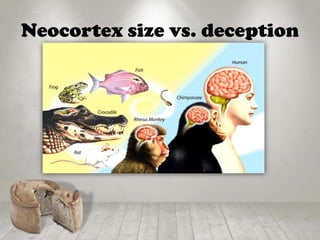
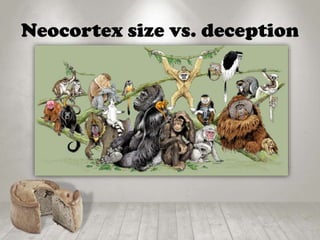
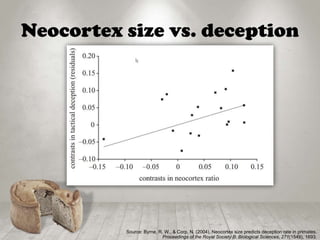
Neocortex size vs. deception
Source: Byrne, R. W., & Corp, N. (2004). Neocortex size predicts deception rate in primates.
Proceedings of the Royal Society B: Biological Sciences, 271(1549), 1693.
LYING AND
POWER.
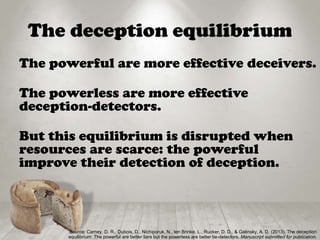
The deception equilibrium
The powerful are more effective deceivers.
The powerless are more effective
deception-detectors.
But this equilibrium is disrupted when
resources are scarce: the powerful
improve their detection of deception.
Source: Carney, D. R., Dubois, D., Nichiporuk, N., ten Brinke, L., Rucker, D. D., & Galinsky, A. D. (2013). The deception
equilibrium: The powerful are better liars but the powerless are better lie-detectors. Manuscript submitted for publication.
THE COMPLICITY
OF THE VICTIM?
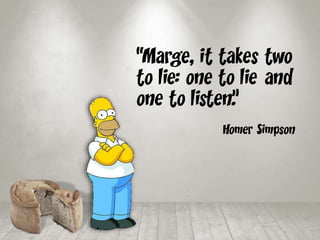
“Marge, it takes two
to lie: one to lie and
one to listen.”
Homer Simpson
TELLING
LIARS.
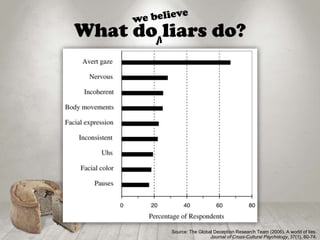
What do liars do?
Source: The Global Deception Research Team (2006). A world of lies.
Journal of Cross-Cultural Psychology, 37(1), 60-74.
V
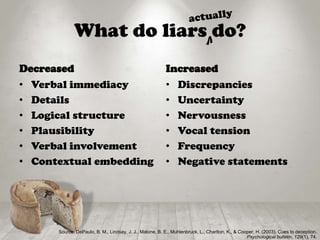
What do liars do?
Decreased
• Verbal immediacy
• Details
• Logical structure
• Plausibility
• Verbal involvement
• Contextual embedding
Increased
• Discrepancies
• Uncertainty
• Nervousness
• Vocal tension
• Frequency
• Negative statements
Source: DePaulo, B. M., Lindsay, J. J., Malone, B. E., Muhlenbruck, L., Charlton, K., & Cooper, H. (2003). Cues to deception.
Psychological bulletin, 129(1), 74.
V
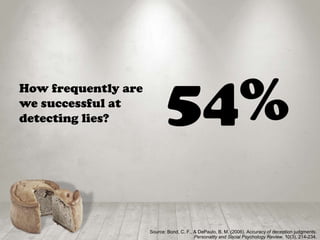
How frequently are
we successful at
detecting lies? 54%
Source: Bond, C. F., & DePaulo, B. M. (2006). Accuracy of deception judgments.
Personality and Social Psychology Review, 10(3), 214-234.
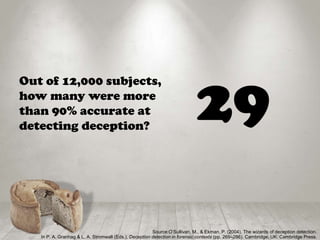
Out of 12,000 subjects,
how many were more
than 90% accurate at
detecting deception?
29
Source:O’Sullivan, M., & Ekman, P. (2004). The wizards of deception detection.
In P. A. Granhag & L. A. Stromwall (Eds.), Deception detection in forensic contexts (pp. 269–286). Cambridge, UK: Cambridge Press.
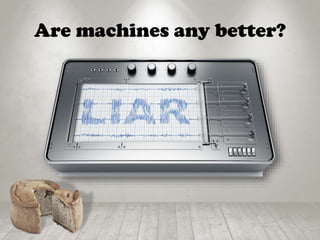
Are machines any better?
“Listen, I don’t know anything about
polygraphs and I don’t know how
accurate they are, but I know they’ll
scare the hell out of people.”
Richard M. Nixon
Purposes of the polygraph exam
1. Reveal truth
2. Detect deception
What does a
polygraph measure?
• Respiration rate
• Heart rate
• Blood pressure
• Skin conductance
• Stress, not deception
Polygraphs
“Almost a century of research in
scientific psychology and physiology
provides little basis for the
expectation that a polygraph test
could have extremely high accuracy.”
Source: National Research Council (2003). The polygraph and lie detection.
Committee to Review the Scientific Evidence on the Polygraph. Washington, DC: The National Academic Press
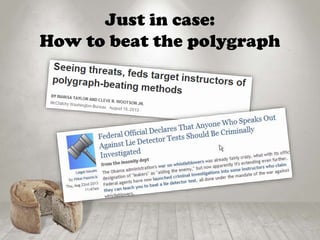
Just in case:
How to beat the polygraph
Just in case:
How to beat the polygraph
Physical countermeasures
• Bite tongue
• Press toes against floor
• Breath heavily
Mental/emotional countermeasures
• Counting sheep
• Recall distressing or pleasurable situations
Take drugs
Source: Ben-Shakhar, G., & Dolev, K. (1996). Psychophysiological detection through the guilty knowledge technique:
Effect of mental countermeasures. Journal of applied psychology, 81(3), 273.
ASK ME NO
QUESTIONS?
AND I’LL TELL YOU NO LIES
For a copy of this deck, email ben@yacmo.com

The Truth About Lying

  • 1.
  • 2.
  • 3.
    Do you lie? Peopletell an average of one or two lies a day. Most frequently about their feelings, their preferences, and their attitudes and opinions. Lies about achievements and failures are also commonplace. Less often, they lie about their actions, plans, and whereabouts. Source: DePaulo, B. M., Lindsay, J. J., Malone, B. E., Muhlenbruck, L., Charlton, K., & Cooper, H. (2003). Cues to deception. Psychological bulletin, 129(1), 74.
  • 4.
    THE OLDEST LIE INTHE BOOK…
  • 5.
    And the serpent saidunto the woman, ye shall not surely die: For God doth know that in the day ye eat thereof, then your eyes shall be opened, and ye shall be as gods, knowing good and evil. Genesis 3:4-5
  • 6.
    ASK A PHILOSOPHER: ISIT ALWAYS WRONG TO LIE?
  • 7.
    St. Augustine, is italways wrong to lie? Yes
  • 8.
    St. Thomas Aquinas, isit always wrong to lie? Yes
  • 9.
    Immanuel Kant, is italways wrong to lie? Yes
  • 10.
    Mr Plato, is italways wrong to lie? I’m glad you asked me that. You see, it’s a little more complicated than it might at first seem. I mean, what if by lying you could make people happier? Or more productive? What about a ‘Noble Lie’ that is necessary to keep a society together? Anyway, I could go on. And I frequently do. For example, did you know that
  • 11.
  • 12.
    A definition To lie: Tomake an intentionally false statement. Mahon, James Edwin, "The Definition of Lying and Deception", The Stanford Encyclopedia of Philosophy (Fall 2008 Edition), Edward N. Zalta (ed.)
  • 13.
    Another definition To lie: Tomake an assertion that is believed to be false to some audience with the intention to deceive the audience about the content of that assertion. Mahon, James Edwin, "The Definition of Lying and Deception", The Stanford Encyclopedia of Philosophy (Fall 2008 Edition), Edward N. Zalta (ed.)
  • 14.
    A better definition..? Tolie: To make a believed-false statement to another person with the intention that that other person believe that statement to be true and the intention that that other person believe that that statement is believed to be true. Mahon, James Edwin, "The Definition of Lying and Deception", The Stanford Encyclopedia of Philosophy (Fall 2008 Edition), Edward N. Zalta (ed.)
  • 15.
    A betterer definition..? Tolie: To make a believed-not-true or believed-false statement to another person, under conditions that are such that the person making the statement believes: (a) that the person hearing the statement is justified in believing that the person making the statement believes the statement to be true, and (b) that the person hearing the statement is justified in believing that the person making the statement intends that the person hearing the statement believes that the person making the statement believes the statement to be true. Mahon, James Edwin, "The Definition of Lying and Deception", The Stanford Encyclopedia of Philosophy (Fall 2008 Edition), Edward N. Zalta (ed.)
  • 16.
    Moving on… To deceive: Tointentionally cause another person to have or continue to have a false belief that is truly believed to be false by the person intentionally causing the false belief by bringing about evidence on the basis of which the other person has or continues to have that false belief. Mahon, James Edwin, "The Definition of Lying and Deception", The Stanford Encyclopedia of Philosophy (Fall 2008 Edition), Edward N. Zalta (ed.)
  • 17.
  • 18.
  • 19.
  • 20.
    Neocortex size vs.deception Source: Byrne, R. W., & Corp, N. (2004). Neocortex size predicts deception rate in primates. Proceedings of the Royal Society B: Biological Sciences, 271(1549), 1693.
  • 21.
  • 22.
    The deception equilibrium Thepowerful are more effective deceivers. The powerless are more effective deception-detectors. But this equilibrium is disrupted when resources are scarce: the powerful improve their detection of deception. Source: Carney, D. R., Dubois, D., Nichiporuk, N., ten Brinke, L., Rucker, D. D., & Galinsky, A. D. (2013). The deception equilibrium: The powerful are better liars but the powerless are better lie-detectors. Manuscript submitted for publication.
  • 23.
  • 24.
    “Marge, it takestwo to lie: one to lie and one to listen.” Homer Simpson
  • 25.
  • 26.
    What do liarsdo? Source: The Global Deception Research Team (2006). A world of lies. Journal of Cross-Cultural Psychology, 37(1), 60-74. V
  • 27.
    What do liarsdo? Decreased • Verbal immediacy • Details • Logical structure • Plausibility • Verbal involvement • Contextual embedding Increased • Discrepancies • Uncertainty • Nervousness • Vocal tension • Frequency • Negative statements Source: DePaulo, B. M., Lindsay, J. J., Malone, B. E., Muhlenbruck, L., Charlton, K., & Cooper, H. (2003). Cues to deception. Psychological bulletin, 129(1), 74. V
  • 28.
    How frequently are wesuccessful at detecting lies? 54% Source: Bond, C. F., & DePaulo, B. M. (2006). Accuracy of deception judgments. Personality and Social Psychology Review, 10(3), 214-234.
  • 29.
    Out of 12,000subjects, how many were more than 90% accurate at detecting deception? 29 Source:O’Sullivan, M., & Ekman, P. (2004). The wizards of deception detection. In P. A. Granhag & L. A. Stromwall (Eds.), Deception detection in forensic contexts (pp. 269–286). Cambridge, UK: Cambridge Press.
  • 30.
  • 31.
    “Listen, I don’tknow anything about polygraphs and I don’t know how accurate they are, but I know they’ll scare the hell out of people.” Richard M. Nixon
  • 32.
    Purposes of thepolygraph exam 1. Reveal truth 2. Detect deception
  • 33.
    What does a polygraphmeasure? • Respiration rate • Heart rate • Blood pressure • Skin conductance • Stress, not deception
  • 34.
    Polygraphs “Almost a centuryof research in scientific psychology and physiology provides little basis for the expectation that a polygraph test could have extremely high accuracy.” Source: National Research Council (2003). The polygraph and lie detection. Committee to Review the Scientific Evidence on the Polygraph. Washington, DC: The National Academic Press
  • 35.
    Just in case: Howto beat the polygraph
  • 36.
    Just in case: Howto beat the polygraph Physical countermeasures • Bite tongue • Press toes against floor • Breath heavily Mental/emotional countermeasures • Counting sheep • Recall distressing or pleasurable situations Take drugs Source: Ben-Shakhar, G., & Dolev, K. (1996). Psychophysiological detection through the guilty knowledge technique: Effect of mental countermeasures. Journal of applied psychology, 81(3), 273.
  • 37.
    ASK ME NO QUESTIONS? ANDI’LL TELL YOU NO LIES For a copy of this deck, email ben@yacmo.com

Editor's Notes

  • #23 These two studies establish a deception equilibrium between the powerful and the powerless—even when power is endowed for only a short time. In an instant, the powerful are more effective deceivers but the powerless are more effective deception-detectors. And this equilibrium is disrupted when resources are scarce; when resources are scarce, the powerful are at their most powerful. lying is not a stressor for the powerful as they have an abundance of cognitive and psychological resources available to control their behavior, allowing them to produce a more convincing lie. The opposite is true of the powerless. The powerless consistently experience more stress, leading to poorly constructed and more easily detected lies.