Definition
Lie: (verb)
to saysomething that is not true in order to deceive
someone.
Example Usage:
o I think he lies about his
age.
o Are you lying to me?
3.
Learning Objectives
1. Understandand know how to use the vocabulary related to the
topic.
2. Be able to use the vocabulary related to the topic correctly.
3. Be active, brave, and confident through the sessions.
4.
Table of contents
1.Brainstorming
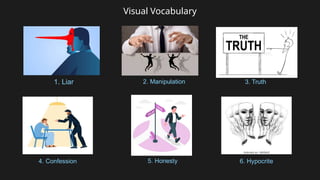
2. Visual Vocabulary
3. Sentence Vocabulary
4. Dialogue and Grammar
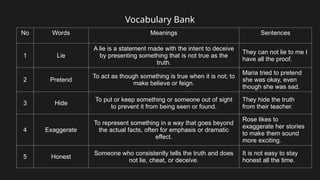
Vocabulary Bank
No WordsMeanings Sentences
1 Lie
A lie is a statement made with the intent to deceive
by presenting something that is not true as the
truth.
They can not lie to me I
have all the proof.
2 Pretend
To act as though something is true when it is not; to
make believe or feign.
Maria tried to pretend
she was okay, even
though she was sad.
3 Hide
To put or keep something or someone out of sight
to prevent it from being seen or found.
They hide the truth
from their teacher.
4 Exaggerate
To represent something in a way that goes beyond
the actual facts, often for emphasis or dramatic
effect.
Rose likes to
exaggerate her stories
to make them sound
more exciting.
5 Honest
Someone who consistently tells the truth and does
not lie, cheat, or deceive.
It is not easy to stay
honest all the time.
8.
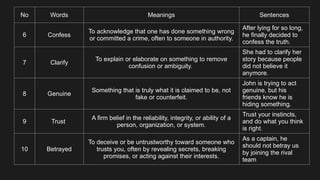
No Words MeaningsSentences
6 Confess
To acknowledge that one has done something wrong
or committed a crime, often to someone in authority.
After lying for so long,
he finally decided to
confess the truth.
7 Clarify
To explain or elaborate on something to remove
confusion or ambiguity.
She had to clarify her
story because people
did not believe it
anymore.
8 Genuine
Something that is truly what it is claimed to be, not
fake or counterfeit.
John is trying to act
genuine, but his
friends know he is
hiding something.
9 Trust
A firm belief in the reliability, integrity, or ability of a
person, organization, or system.
Trust your instincts,
and do what you think
is right.
10 Betrayed
To deceive or be untrustworthy toward someone who
trusts you, often by revealing secrets, breaking
promises, or acting against their interests.
As a captain, he
should not betray us
by joining the rival
team
9.
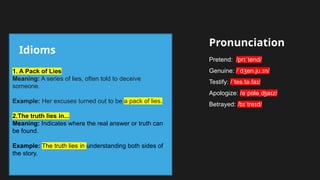
Idioms
Pronunciation
1. A Packof Lies
Meaning: A series of lies, often told to deceive
someone.
Example: Her excuses turned out to be a pack of lies.
2.The truth lies in...
Meaning: Indicates where the real answer or truth can
be found.
Example: The truth lies in understanding both sides of
the story.
Pretend: /pr tend/
ɪˈ
Genuine: / d en.ju. n/
ˈ ʒ ɪ
Testify: / tes.tə.fa /
ˈ ɪ
Apologize: /ə p lə a z/
ˈ ɑ ˌʤ ɪ
Betrayed: /b tre d/
ɪˈ ɪ
10.
Dialogue: Lying inDifferent Cultures
Sarah: Ahmed, I came across this fascinating article about how different cultures perceive lying. Did you know that
in some societies, lying isn't always seen as inherently bad?
Ahmed: Really? That’s interesting. In my culture, lying is generally frowned upon, but we do have this concept of
“white lies,” where it’s okay to bend the truth a little to avoid hurting someone’s feelings.
Sarah: Oh, we have that too. But the article I read talked about how, in some East Asian cultures, people might lie
or give indirect answers to avoid confrontation or maintain harmony. For instance, instead of saying “no” outright,
they might give a response that seems non-committal, just to save face for everyone involved.
Ahmed: That’s true. I’ve seen something similar in some Middle Eastern cultures. There’s a saying in Arabic, “Say
something nice, or stay silent.” People often avoid confrontation, not because they want to lie, but because they
prioritize relationships.
Sarah: That’s a thoughtful approach. You know, I think in Western cultures like ours, there’s a tendency to see lying
as a personal moral failure. It’s very black-and-white—either you’re honest, or you’re not.
11.
Ahmed: Exactly. Butin other cultures, lying might serve a collective purpose, like protecting someone’s reputation
or ensuring peace within the community. For example, have you heard of taqiyya?
Sarah: Yes, isn’t that a concept in Islam where lying is permitted in certain circumstances, like protecting one’s life
or family?
Ahmed: That’s right. Islam generally emphasizes truthfulness, but taqiyya allows for lying in extreme cases, like
during persecution or to prevent harm. There’s also the idea that lying can be justified for specific reasons, like
reconciling between two people, in war, or to protect one’s spouse from unnecessary pain.
Sarah: That’s such a balanced perspective. It recognizes the complexities of human interactions. It’s not just about
the lie itself but the reason behind it.
Ahmed: Exactly. Even in my personal experience, I’ve noticed differences in how honesty is practiced in business. In
some cultures, people are very direct—they’ll tell you exactly what they think, even if it’s harsh. But in others, like
Japan, for instance, people tend to be more subtle. You have to read between the lines to understand their true
feelings.
Sarah: That reminds me of a situation my friend told me about. She was working with a team in India, and they
were reluctant to say “no” to her requests directly. Instead, they’d say something like, “We’ll try,” which she initially
interpreted as a yes. It led to a lot of confusion until she realized they were being polite.
12.
Ahmed: Politeness andrespect are so central to communication in many cultures. I think it’s similar to the concept
of adab in Islam, where you aim to be respectful and considerate in all your interactions, even if it means not being
entirely straightforward.
Sarah: That’s a beautiful principle. But at the same time, I wonder if there’s a downside to being too indirect. Can it
lead to misunderstandings or even mistrust?
Ahmed: It can. That’s why context matters so much. If someone lies to manipulate or deceive for selfish reasons,
it’s wrong. But if the intention is to protect, avoid harm, or maintain harmony, the situation becomes more
nuanced.
Sarah: You’re right. It reminds me of how children are taught about honesty in different cultures. In the West, we
often hear stories like “The Boy Who Cried Wolf” to emphasize the consequences of lying. Are there similar stories
in your culture?
Ahmed: Yes, we have plenty of stories and proverbs about honesty. One of my favorites is “A lie has no legs,” which
means lies don’t last and will eventually collapse under their weight. But at the same time, there’s an
acknowledgment that life isn’t always straightforward.
Sarah: I guess that’s true everywhere. Even in Western culture, there’s a recognition that “the truth hurts”
sometimes, and people might soften it for someone else’s benefit.
13.
Ahmed: That’s whyI think understanding someone’s cultural background is so important. What might seem like
dishonesty to one person could be seen as kindness or diplomacy to another.
Sarah: Definitely. It’s all about empathy and seeing the bigger picture. If we understand the reasons behind
someone’s behavior, we’re more likely to respond with compassion instead of judgment.
Ahmed: Well said, Sarah. So, do you think you’ll change your perspective on lying after reading that article?a
Sarah: I already have! I think I’ll be more mindful of cultural differences and try to look beyond the surface before
forming an opinion.
Ahmed: That’s a great takeaway. It’s a reminder that values like honesty and truthfulness are universal, but how
they’re practiced can vary so much depending on the context.






![OPINION AND TRUTH [Autosaved].pptx](https://cdn.slidesharecdn.com/ss_thumbnails/opinionandtruthautosaved-220918075834-197262be-thumbnail.jpg?width=640&height=640&fit=bounds)


