Fallacies of Relevance
All Fallacies of Relevance share the
common problem of appealing to features
that are irrelevant for the evaluation of a
line of reasoning or evidence—they appeal
to factors that do not speak to the truth of
a position or the quality of evidence for it.
Personal Attack (Ad Hominem)
 Literally: “against the man”
 Replaces evaluation of ideas or evidence
with a personal attack
 Ad Hominem is not fallacious if it is
relevant to evaluating a line of reasoning
 Circumstantial: group-based version of the
ad Hominem
 Abusive Form
 To Quoque
TYPES OF PERSONAL
ATTACK “ AD HOMINEM”
1. Abusive Form- attacking the character
or personality of the opponent.
2. Circumstantial - group-based version of
the ad Hominem.
3. To Quoque- which means “you’re another”
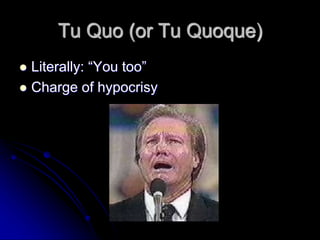
Tu Quo (or Tu Quoque)
 Literally: “You too”
 Charge of hypocrisy
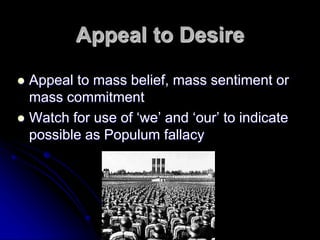
Appeal to Desire
 Appeal to mass belief, mass sentiment or
mass commitment
 Watch for use of ‘we’ and ‘our’ to indicate
possible as Populum fallacy
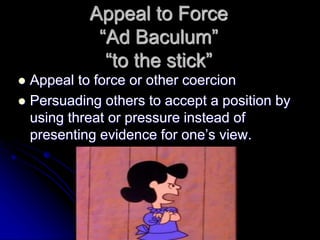
Appeal to Force
“Ad Baculum”
“to the stick”
 Appeal to force or other coercion
 Persuading others to accept a position by
using threat or pressure instead of
presenting evidence for one’s view.
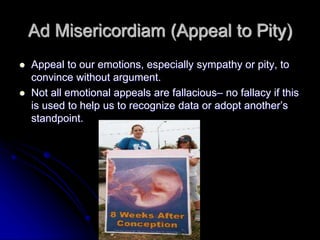
Ad Misericordiam (Appeal to Pity)
 Appeal to our emotions, especially sympathy or pity, to
convince without argument.
 Not all emotional appeals are fallacious– no fallacy if this
is used to help us to recognize data or adopt another’s
standpoint.
Begging the Question
“Petitio Principii”
“ Circularity”
 Circular reasoning assumes what it is out
to prove; the evidence already assumes
the truth of the conclusion
 Circular arguments may be deductively
valid (and sound!), but are still fallacious
Straw Man
 Deliberate misrepresentation of an
opposing viewpoint; distorts or caricatures
for ease of refutation
 Look for attributions of extreme views: this
is a red flag for a Straw Man
 Look for attributions of absurd views: this
is a red flag for a Straw Man
 Different from a Reductio argument
Slippery Slope
 Predictive story without supporting evidence, or
where the only evidence is “common sense”
 Connections in the story are assumed, not
demonstrated
 Can be progressive (if we just do X, all these
great things will happen!) or gloom-and-doom (of
we do X, the sky will fall!)
 Related to Golden Age Fallacy (things were so
much better in the past) and Utopian Fallacy
(things are so much better than they once were)
Slippery Slope continued
 Predictive stories are never more certain
than their first step
 This is because with each additional step
in the story that isn’t CERTAIN, the
likelihood that the whole story is true
DECREASES
 The irony: the features that make a
slippery slope a good story undermine the
likelihood of the story’s truth
THE RED HERRING FALLACY

Fallacies of relevance

  • 1.
    Fallacies of Relevance AllFallacies of Relevance share the common problem of appealing to features that are irrelevant for the evaluation of a line of reasoning or evidence—they appeal to factors that do not speak to the truth of a position or the quality of evidence for it.
  • 2.
    Personal Attack (AdHominem)  Literally: “against the man”  Replaces evaluation of ideas or evidence with a personal attack  Ad Hominem is not fallacious if it is relevant to evaluating a line of reasoning  Circumstantial: group-based version of the ad Hominem  Abusive Form  To Quoque
  • 3.
    TYPES OF PERSONAL ATTACK“ AD HOMINEM” 1. Abusive Form- attacking the character or personality of the opponent. 2. Circumstantial - group-based version of the ad Hominem. 3. To Quoque- which means “you’re another”
  • 4.
    Tu Quo (orTu Quoque)  Literally: “You too”  Charge of hypocrisy
  • 5.
    Appeal to Desire Appeal to mass belief, mass sentiment or mass commitment  Watch for use of ‘we’ and ‘our’ to indicate possible as Populum fallacy
  • 6.
    Appeal to Force “AdBaculum” “to the stick”  Appeal to force or other coercion  Persuading others to accept a position by using threat or pressure instead of presenting evidence for one’s view.
  • 7.
    Ad Misericordiam (Appealto Pity)  Appeal to our emotions, especially sympathy or pity, to convince without argument.  Not all emotional appeals are fallacious– no fallacy if this is used to help us to recognize data or adopt another’s standpoint.
  • 8.
    Begging the Question “PetitioPrincipii” “ Circularity”  Circular reasoning assumes what it is out to prove; the evidence already assumes the truth of the conclusion  Circular arguments may be deductively valid (and sound!), but are still fallacious
  • 9.
    Straw Man  Deliberatemisrepresentation of an opposing viewpoint; distorts or caricatures for ease of refutation  Look for attributions of extreme views: this is a red flag for a Straw Man  Look for attributions of absurd views: this is a red flag for a Straw Man  Different from a Reductio argument
  • 10.
    Slippery Slope  Predictivestory without supporting evidence, or where the only evidence is “common sense”  Connections in the story are assumed, not demonstrated  Can be progressive (if we just do X, all these great things will happen!) or gloom-and-doom (of we do X, the sky will fall!)  Related to Golden Age Fallacy (things were so much better in the past) and Utopian Fallacy (things are so much better than they once were)
  • 11.
    Slippery Slope continued Predictive stories are never more certain than their first step  This is because with each additional step in the story that isn’t CERTAIN, the likelihood that the whole story is true DECREASES  The irony: the features that make a slippery slope a good story undermine the likelihood of the story’s truth
  • 12.