WELCOME
SREE NARAYANA TRAINING COLLEGE 
Sreekandeswaram 
Poochakkal 
B.ed 2013-2014 
Kerala university
Submitted by, 
Name : Sreekala .T 
Option : Physical science 
Reg. No : 13383022 (182)
Submitted to, 
LINIMOL . K.S 
Lecturer in Physical Science
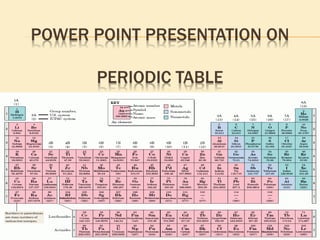
POWER POINT PRESENTATION ON 
PERIODIC TABLE
CLASSIFICATION OF ELEMENTS 
As more elements were discovered, the 
study of elements and their properties and 
also their classification became very alive 
in the scientific world. So many scientists 
were try to study the characters of 
elements were known and made an 
attempt to classify according to their 
characters.
CLASSIFICATION BY ANTONIE LAVOSIERE 
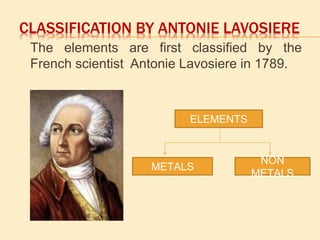
The elements are first classified by the 
French scientist Antonie Lavosiere in 1789. 
ELEMENTS 
METALS 
NON 
METALS
Early attempts at classification of elements :- 
The earliest attempt to classify elements was 
grouping the then known elements (about 30 
elements) into two groups called metals and 
non metals. 
The defect in this classification was that it had 
no place for metalloids (elements which have 
properties of both metals and non metals) 
which were discovered later.
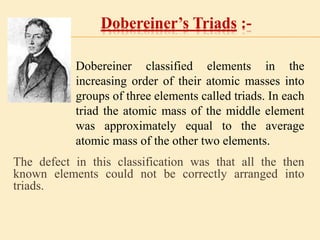
Dobereiner’s Triads :- 
Dobereiner classified elements in the 
increasing order of their atomic masses into 
groups of three elements called triads. In each 
triad the atomic mass of the middle element 
was approximately equal to the average 
atomic mass of the other two elements. 
The defect in this classification was that all the then 
known elements could not be correctly arranged into 
triads.
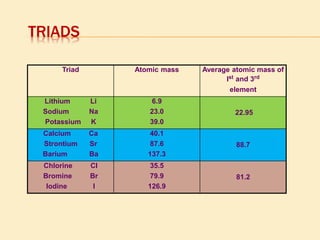
TRIADS 
Triad Atomic mass Average atomic mass of 
Ist and 3rd 
element 
Lithium Li 
Sodium Na 
Potassium K 
6.9 
23.0 
39.0 
22.95 
Calcium Ca 
Strontium Sr 
Barium Ba 
40.1 
87.6 
137.3 
88.7 
Chlorine CI 
Bromine Br 
Iodine I 
35.5 
79.9 
126.9 
81.2
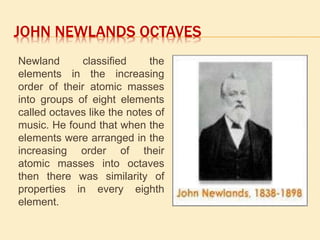
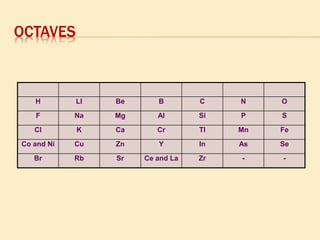
JOHN NEWLANDS OCTAVES 
Newland classified the 
elements in the increasing 
order of their atomic masses 
into groups of eight elements 
called octaves like the notes of 
music. He found that when the 
elements were arranged in the 
increasing order of their 
atomic masses into octaves 
then there was similarity of 
properties in every eighth 
element.
OCTAVES 
H LI Be B C N O 
F Na Mg Al Si P S 
Cl K Ca Cr Tl Mn Fe 
Co and Ni Cu Zn Y In As Se 
Br Rb Sr Ce and La Zr - -
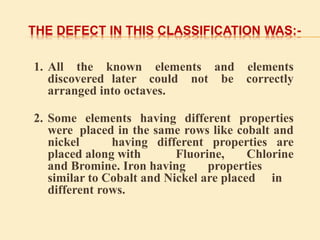
THE DEFECT IN THIS CLASSIFICATION WAS:- 
1. All the known elements and elements 
discovered later could not be correctly 
arranged into octaves. 
2. Some elements having different properties 
were placed in the same rows like cobalt and 
nickel having different properties are 
placed along with Fluorine, Chlorine 
and Bromine. Iron having properties 
similar to Cobalt and Nickel are placed in 
different rows.
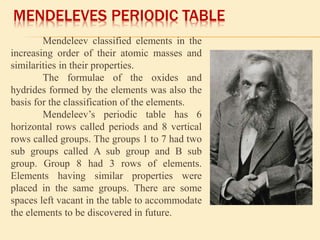
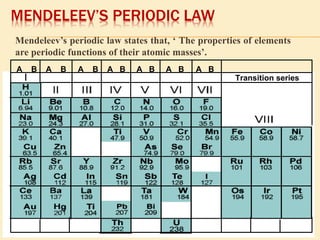
MENDELEVES PERIODIC TABLE 
Mendeleev classified elements in the 
increasing order of their atomic masses and 
similarities in their properties. 
The formulae of the oxides and 
hydrides formed by the elements was also the 
basis for the classification of the elements. 
Mendeleev’s periodic table has 6 
horizontal rows called periods and 8 vertical 
rows called groups. The groups 1 to 7 had two 
sub groups called A sub group and B sub 
group. Group 8 had 3 rows of elements. 
Elements having similar properties were 
placed in the same groups. There are some 
spaces left vacant in the table to accommodate 
the elements to be discovered in future.
MERITS OF MENDELEEV’S PERIODIC TABLE 
i) Elements were classified on a more fundamental basis 
of their atomic masses and properties. 
ii) Spaces were left vacant to accommodate the 
elements to be discovered in future. 
iii) It could predict the properties of the elements which 
helped in the discovery of new elements. 
iv) The inert gas elements discovered later could be 
placed in a separate group without disturbing the 
table.
DEFECTS OF MENDELEEV’S PERIODIC TABLE 
i) Some elements are not arranged in the 
increasing order of their atomic masses. Co is 
placed before Ni, Te is placed before I etc. 
ii) Position of hydrogen is not clear because it 
shows properties similar to metals as well as 
non metals. 
iii) The position of isotopes of elements is not clear.
MENDELEEV’S PERIODIC LAW 
Mendeleev’s periodic law states that, ‘ The properties of elements 
are periodic functions of their atomic masses’. 
A B A B A B A B A B A B A B 
Transition series
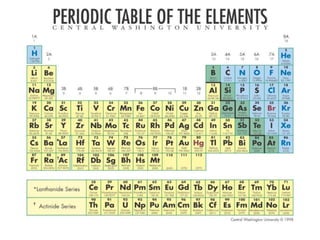
MODERN PERIODIC TABLE 
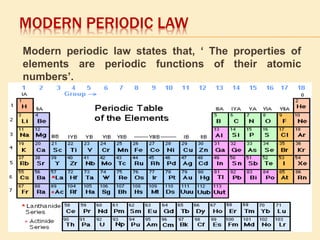
In the modern periodic table elements are 
arranged in the increasing order of their 
atomic numbers in the form of a table 
having 7 horizontal rows of elements called 
periods and 18 vertical rows of elements 
called groups.
PERIODS 
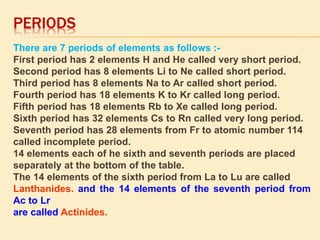
There are 7 periods of elements as follows :- 
First period has 2 elements H and He called very short period. 
Second period has 8 elements Li to Ne called short period. 
Third period has 8 elements Na to Ar called short period. 
Fourth period has 18 elements K to Kr called long period. 
Fifth period has 18 elements Rb to Xe called long period. 
Sixth period has 32 elements Cs to Rn called very long period. 
Seventh period has 28 elements from Fr to atomic number 114 
called incomplete period. 
14 elements each of he sixth and seventh periods are placed 
separately at the bottom of the table. 
The 14 elements of the sixth period from La to Lu are called 
Lanthanides. and the 14 elements of the seventh period from 
Ac to Lr 
are called Actinides.
GROUPS 
There are 18 groups of elements divided into 9 main groups. They are 
I, II, III, IV, V, VI, VII, VIII and 0 groups. The groups I to VII has two sub 
groups each called A – sub group and B – sub group. Group VIII has 3 
rows of elements and 0 group has one row of elements. 
The A sub group elements are called normal elements. 
The B sub group elements are called transition elements. 
Lanthanides and Actinides are called inner transition elements. 
Group 1 (I A ) elements are called alkali metals 
Group 2 (II A) elements are called alkaline earth metals. 
Group 17 (VII A) elements are called halogens. 
Group 18 (0 group) are called noble gases. 
In a group all the elements have the same number of valence 
electrons. Group I elements have 1 valence electron, Group II 
elements have 2 valence electron, Group III elements have 3 valence 
electrons 
etc. 
In a period all the elements contain the same number of shells.
PROPERTIES OF ELEMENTS IN PERIODS AND GROUPS 
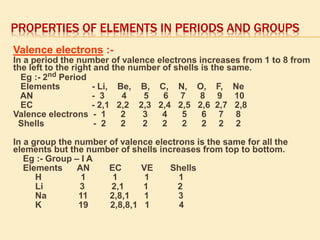
Valence electrons :- 
In a period the number of valence electrons increases from 1 to 8 from 
the left to the right and the number of shells is the same. 
Eg :- 2nd Period 
Elements - Li, Be, B, C, N, O, F, Ne 
AN - 3 4 5 6 7 8 9 10 
EC - 2,1 2,2 2,3 2,4 2,5 2,6 2,7 2,8 
Valence electrons - 1 2 3 4 5 6 7 8 
Shells - 2 2 2 2 2 2 2 2 
In a group the number of valence electrons is the same for all the 
elements but the number of shells increases from top to bottom. 
Eg :- Group – I A 
Elements AN EC VE Shells 
H 1 1 1 1 
Li 3 2,1 1 2 
Na 11 2,8,1 1 3 
K 19 2,8,8,1 1 4
VALENCY 
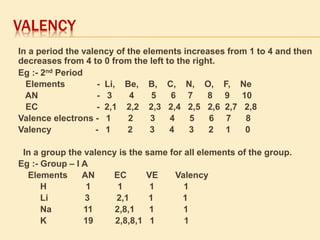
In a period the valency of the elements increases from 1 to 4 and then 
decreases from 4 to 0 from the left to the right. 
Eg :- 2nd Period 
Elements - Li, Be, B, C, N, O, F, Ne 
AN - 3 4 5 6 7 8 9 10 
EC - 2,1 2,2 2,3 2,4 2,5 2,6 2,7 2,8 
Valence electrons - 1 2 3 4 5 6 7 8 
Valency - 1 2 3 4 3 2 1 0 
In a group the valency is the same for all elements of the group. 
Eg :- Group – I A 
Elements AN EC VE Valency 
H 1 1 1 1 
Li 3 2,1 1 1 
Na 11 2,8,1 1 1 
K 19 2,8,8,1 1 1
MODERN PERIODIC LAW 
Modern periodic law states that, ‘ The properties of 
elements are periodic functions of their atomic 
numbers’.
THANKS

Periodic classification of elements

  • 1.
  • 2.
    SREE NARAYANA TRAININGCOLLEGE Sreekandeswaram Poochakkal B.ed 2013-2014 Kerala university
  • 3.
    Submitted by, Name: Sreekala .T Option : Physical science Reg. No : 13383022 (182)
  • 4.
    Submitted to, LINIMOL. K.S Lecturer in Physical Science
  • 5.
    POWER POINT PRESENTATIONON PERIODIC TABLE
  • 6.
    CLASSIFICATION OF ELEMENTS As more elements were discovered, the study of elements and their properties and also their classification became very alive in the scientific world. So many scientists were try to study the characters of elements were known and made an attempt to classify according to their characters.
  • 7.
    CLASSIFICATION BY ANTONIELAVOSIERE The elements are first classified by the French scientist Antonie Lavosiere in 1789. ELEMENTS METALS NON METALS
  • 8.
    Early attempts atclassification of elements :- The earliest attempt to classify elements was grouping the then known elements (about 30 elements) into two groups called metals and non metals. The defect in this classification was that it had no place for metalloids (elements which have properties of both metals and non metals) which were discovered later.
  • 9.
    Dobereiner’s Triads :- Dobereiner classified elements in the increasing order of their atomic masses into groups of three elements called triads. In each triad the atomic mass of the middle element was approximately equal to the average atomic mass of the other two elements. The defect in this classification was that all the then known elements could not be correctly arranged into triads.
  • 10.
    TRIADS Triad Atomicmass Average atomic mass of Ist and 3rd element Lithium Li Sodium Na Potassium K 6.9 23.0 39.0 22.95 Calcium Ca Strontium Sr Barium Ba 40.1 87.6 137.3 88.7 Chlorine CI Bromine Br Iodine I 35.5 79.9 126.9 81.2
  • 11.
    JOHN NEWLANDS OCTAVES Newland classified the elements in the increasing order of their atomic masses into groups of eight elements called octaves like the notes of music. He found that when the elements were arranged in the increasing order of their atomic masses into octaves then there was similarity of properties in every eighth element.
  • 12.
    OCTAVES H LIBe B C N O F Na Mg Al Si P S Cl K Ca Cr Tl Mn Fe Co and Ni Cu Zn Y In As Se Br Rb Sr Ce and La Zr - -
  • 13.
    THE DEFECT INTHIS CLASSIFICATION WAS:- 1. All the known elements and elements discovered later could not be correctly arranged into octaves. 2. Some elements having different properties were placed in the same rows like cobalt and nickel having different properties are placed along with Fluorine, Chlorine and Bromine. Iron having properties similar to Cobalt and Nickel are placed in different rows.
  • 14.
    MENDELEVES PERIODIC TABLE Mendeleev classified elements in the increasing order of their atomic masses and similarities in their properties. The formulae of the oxides and hydrides formed by the elements was also the basis for the classification of the elements. Mendeleev’s periodic table has 6 horizontal rows called periods and 8 vertical rows called groups. The groups 1 to 7 had two sub groups called A sub group and B sub group. Group 8 had 3 rows of elements. Elements having similar properties were placed in the same groups. There are some spaces left vacant in the table to accommodate the elements to be discovered in future.
  • 15.
    MERITS OF MENDELEEV’SPERIODIC TABLE i) Elements were classified on a more fundamental basis of their atomic masses and properties. ii) Spaces were left vacant to accommodate the elements to be discovered in future. iii) It could predict the properties of the elements which helped in the discovery of new elements. iv) The inert gas elements discovered later could be placed in a separate group without disturbing the table.
  • 16.
    DEFECTS OF MENDELEEV’SPERIODIC TABLE i) Some elements are not arranged in the increasing order of their atomic masses. Co is placed before Ni, Te is placed before I etc. ii) Position of hydrogen is not clear because it shows properties similar to metals as well as non metals. iii) The position of isotopes of elements is not clear.
  • 17.
    MENDELEEV’S PERIODIC LAW Mendeleev’s periodic law states that, ‘ The properties of elements are periodic functions of their atomic masses’. A B A B A B A B A B A B A B Transition series
  • 20.
    MODERN PERIODIC TABLE In the modern periodic table elements are arranged in the increasing order of their atomic numbers in the form of a table having 7 horizontal rows of elements called periods and 18 vertical rows of elements called groups.
  • 21.
    PERIODS There are7 periods of elements as follows :- First period has 2 elements H and He called very short period. Second period has 8 elements Li to Ne called short period. Third period has 8 elements Na to Ar called short period. Fourth period has 18 elements K to Kr called long period. Fifth period has 18 elements Rb to Xe called long period. Sixth period has 32 elements Cs to Rn called very long period. Seventh period has 28 elements from Fr to atomic number 114 called incomplete period. 14 elements each of he sixth and seventh periods are placed separately at the bottom of the table. The 14 elements of the sixth period from La to Lu are called Lanthanides. and the 14 elements of the seventh period from Ac to Lr are called Actinides.
  • 22.
    GROUPS There are18 groups of elements divided into 9 main groups. They are I, II, III, IV, V, VI, VII, VIII and 0 groups. The groups I to VII has two sub groups each called A – sub group and B – sub group. Group VIII has 3 rows of elements and 0 group has one row of elements. The A sub group elements are called normal elements. The B sub group elements are called transition elements. Lanthanides and Actinides are called inner transition elements. Group 1 (I A ) elements are called alkali metals Group 2 (II A) elements are called alkaline earth metals. Group 17 (VII A) elements are called halogens. Group 18 (0 group) are called noble gases. In a group all the elements have the same number of valence electrons. Group I elements have 1 valence electron, Group II elements have 2 valence electron, Group III elements have 3 valence electrons etc. In a period all the elements contain the same number of shells.
  • 23.
    PROPERTIES OF ELEMENTSIN PERIODS AND GROUPS Valence electrons :- In a period the number of valence electrons increases from 1 to 8 from the left to the right and the number of shells is the same. Eg :- 2nd Period Elements - Li, Be, B, C, N, O, F, Ne AN - 3 4 5 6 7 8 9 10 EC - 2,1 2,2 2,3 2,4 2,5 2,6 2,7 2,8 Valence electrons - 1 2 3 4 5 6 7 8 Shells - 2 2 2 2 2 2 2 2 In a group the number of valence electrons is the same for all the elements but the number of shells increases from top to bottom. Eg :- Group – I A Elements AN EC VE Shells H 1 1 1 1 Li 3 2,1 1 2 Na 11 2,8,1 1 3 K 19 2,8,8,1 1 4
  • 24.
    VALENCY In aperiod the valency of the elements increases from 1 to 4 and then decreases from 4 to 0 from the left to the right. Eg :- 2nd Period Elements - Li, Be, B, C, N, O, F, Ne AN - 3 4 5 6 7 8 9 10 EC - 2,1 2,2 2,3 2,4 2,5 2,6 2,7 2,8 Valence electrons - 1 2 3 4 5 6 7 8 Valency - 1 2 3 4 3 2 1 0 In a group the valency is the same for all elements of the group. Eg :- Group – I A Elements AN EC VE Valency H 1 1 1 1 Li 3 2,1 1 1 Na 11 2,8,1 1 1 K 19 2,8,8,1 1 1
  • 25.
    MODERN PERIODIC LAW Modern periodic law states that, ‘ The properties of elements are periodic functions of their atomic numbers’.
  • 26.