Democritus Abdera 460-370 B.C. He first attempted to create materialism. Everything is composed of atoms .
Antione Lavoisier 1772 Total mass of a product of a chemical reaction is always the same thing as the total mass Conservation of mass
Law of Conservation of Mass 1789 Matter can not disappear it can only be rearranged At high speeds mass changes to energy
Joseph Louis Proust 1798 Created the law of constant composition Constant composition
Dalton’s Atomic Theory 1799 Law of constant composition  Oxygen and Carbon combined make 2 compounds
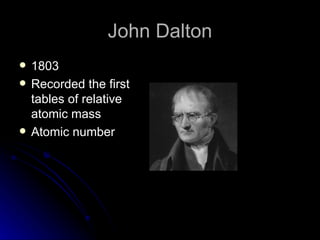
John Dalton 1803 Recorded the first tables of relative atomic mass Atomic number
Law of Definite Proportions 1805 Law say if formula AB is constant then the weight ratio will stay the same Weight ratio stays the same
Dmitri Mendeleev  1869 Created the periodic table List of elements
Eugene Goldstein 1886 Investigated X-rays Discovered cathode rays
Erwin Schrodinger 1887-1961 Created the Schrodinger Wave Equation Used to describe behavior of electrons in atoms
Cathode Ray Tube 1893 2  positive leads connected into a neon tube will make it light up Electric makes light
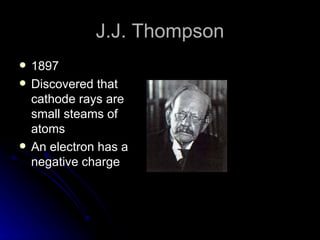
J.J. Thompson 1897 Discovered that cathode rays are small steams of atoms An electron has a negative charge
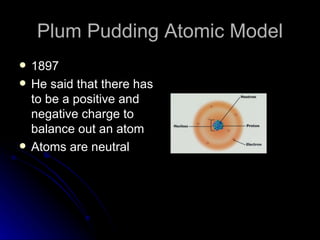
Plum Pudding Atomic Model 1897 He said that there has to be a positive and negative charge to balance out an atom Atoms are neutral
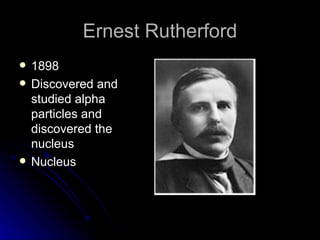
Ernest Rutherford 1898 Discovered and studied alpha particles and discovered the nucleus Nucleus
Marie Curie 1902 Discovered the radio active elements Radio active elements
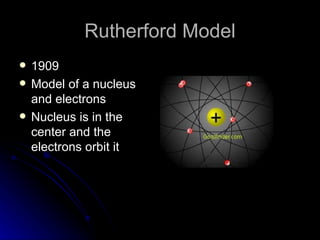
Rutherford Model 1909 Model of a nucleus and electrons Nucleus is in the center and the electrons orbit it
Robert Millikan 1911 Made an oil drop experiment Made electron have an electric charge
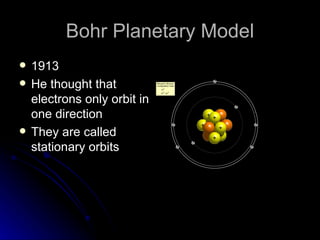
Bohr Planetary Model 1913 He thought that electrons only orbit in one direction They are called stationary orbits
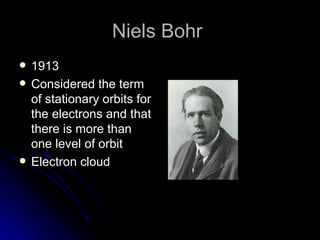
Niels Bohr  1913 Considered the term of stationary orbits for the electrons and that there is more than one level of orbit Electron cloud
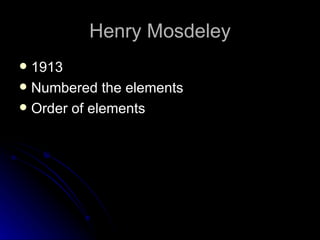
Henry Mosdeley 1913 Numbered the elements Order of elements
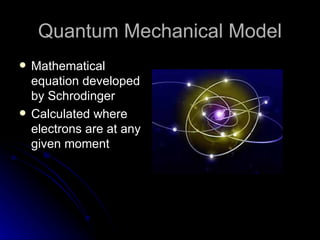
Quantum Mechanical Model Mathematical equation developed by Schrodinger Calculated where electrons are at any given moment
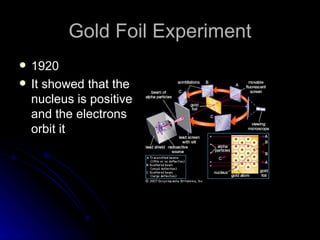
Gold Foil Experiment 1920 It showed that the nucleus is positive and the electrons orbit it
James Chadwick 1932 Found the neutron His discovery led to nuclear fission and the atomic bomb
Lise Meitner  1966 First discovered nuclear fission

Atomic Theory Timeline Kyle, Justin, Mike

  • 1.
    Democritus Abdera 460-370B.C. He first attempted to create materialism. Everything is composed of atoms .
  • 2.
    Antione Lavoisier 1772Total mass of a product of a chemical reaction is always the same thing as the total mass Conservation of mass
  • 3.
    Law of Conservationof Mass 1789 Matter can not disappear it can only be rearranged At high speeds mass changes to energy
  • 4.
    Joseph Louis Proust1798 Created the law of constant composition Constant composition
  • 5.
    Dalton’s Atomic Theory1799 Law of constant composition Oxygen and Carbon combined make 2 compounds
  • 6.
    John Dalton 1803Recorded the first tables of relative atomic mass Atomic number
  • 7.
    Law of DefiniteProportions 1805 Law say if formula AB is constant then the weight ratio will stay the same Weight ratio stays the same
  • 8.
    Dmitri Mendeleev 1869 Created the periodic table List of elements
  • 9.
    Eugene Goldstein 1886Investigated X-rays Discovered cathode rays
  • 10.
    Erwin Schrodinger 1887-1961Created the Schrodinger Wave Equation Used to describe behavior of electrons in atoms
  • 11.
    Cathode Ray Tube1893 2 positive leads connected into a neon tube will make it light up Electric makes light
  • 12.
    J.J. Thompson 1897Discovered that cathode rays are small steams of atoms An electron has a negative charge
  • 13.
    Plum Pudding AtomicModel 1897 He said that there has to be a positive and negative charge to balance out an atom Atoms are neutral
  • 14.
    Ernest Rutherford 1898Discovered and studied alpha particles and discovered the nucleus Nucleus
  • 15.
    Marie Curie 1902Discovered the radio active elements Radio active elements
  • 16.
    Rutherford Model 1909Model of a nucleus and electrons Nucleus is in the center and the electrons orbit it
  • 17.
    Robert Millikan 1911Made an oil drop experiment Made electron have an electric charge
  • 18.
    Bohr Planetary Model1913 He thought that electrons only orbit in one direction They are called stationary orbits
  • 19.
    Niels Bohr 1913 Considered the term of stationary orbits for the electrons and that there is more than one level of orbit Electron cloud
  • 20.
    Henry Mosdeley 1913Numbered the elements Order of elements
  • 21.
    Quantum Mechanical ModelMathematical equation developed by Schrodinger Calculated where electrons are at any given moment
  • 22.
    Gold Foil Experiment1920 It showed that the nucleus is positive and the electrons orbit it
  • 23.
    James Chadwick 1932Found the neutron His discovery led to nuclear fission and the atomic bomb
  • 24.
    Lise Meitner 1966 First discovered nuclear fission