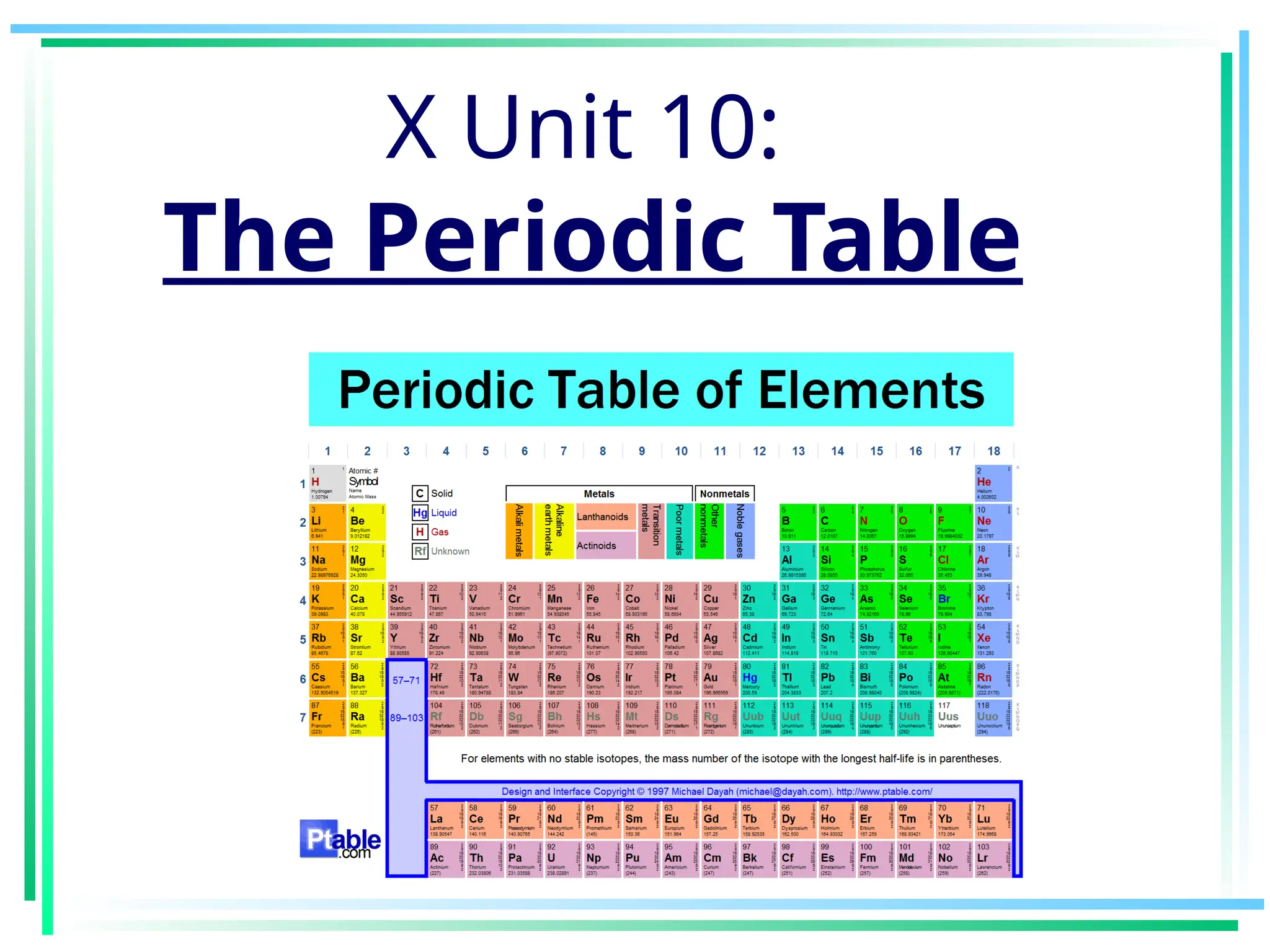
X Unit 10:
The Periodic Table
History of the Periodic Table
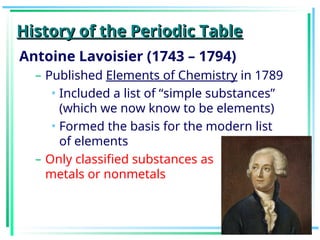
Antoine Lavoisier (1743 – 1794)
– Published Elements of Chemistry in 1789
• Included a list of “simple substances”
(which we now know to be elements)
• Formed the basis for the modern list
of elements
– Only classified substances as
metals or nonmetals
History of the Periodic Table
Johann Döbereiner (1780 – 1849)
– Classified elements into “triads”
• Groups of three elements with related
properties and weights
• Began in 1817 when he realized Sr was
halfway between the weights of Ca and
Ba and they all possessed similar traits
– Döbereiner’s triads:
• Cl, Br, I  S, Se, Te
• Ca, Sr, Ba  Li, Na, K
History of the Periodic Table
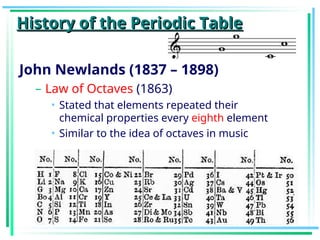
John Newlands (1837 – 1898)
– Law of Octaves (1863)
• Stated that elements repeated their
chemical properties every eighth element
• Similar to the idea of octaves in music
History of the Periodic Table
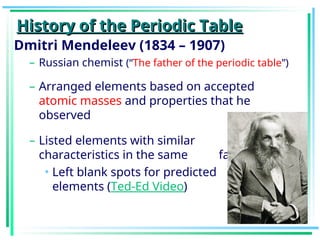
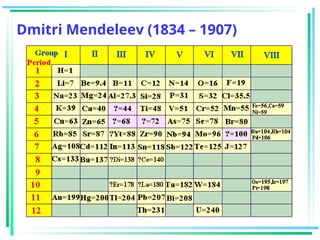
Dmitri Mendeleev (1834 – 1907)
– Russian chemist (“The father of the periodic table”)
– Arranged elements based on accepted
atomic masses and properties that he
observed
– Listed elements with similar
characteristics in the same family/group
• Left blank spots for predicted
elements (Ted-Ed Video)
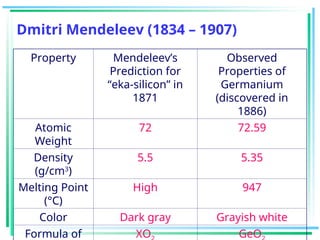
Dmitri Mendeleev (1834 – 1907)
Property Mendeleev’s
Prediction for
“eka-silicon” in
1871
Observed
Properties of
Germanium
(discovered in
1886)
Atomic
Weight
72 72.59
Density
(g/cm3
)
5.5 5.35
Melting Point
(°C)
High 947
Color Dark gray Grayish white
Formula of XO GeO
History of the Periodic Table
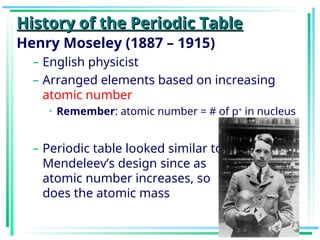
Henry Moseley (1887 – 1915)
– English physicist
– Arranged elements based on increasing
atomic number
• Remember: atomic number = # of p+
in nucleus
– Periodic table looked similar to
Mendeleev’s design since as
atomic number increases, so
does the atomic mass
Periodic Law
Periodic Law
• Periodic – occurring at regular intervals
– Relates to trends on the periodic table of
elements
• Modern Periodic Law
– When elements are arranged in order of
increasing atomic number, there is a
periodic repetition of their properties
• Just like Mendeleev suspected!!
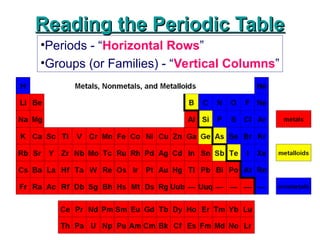
Reading the Periodic Table
•Periods - “Horizontal Rows”
•Groups (or Families) - “Vertical Columns”
Reading the Periodic Table
• Valence electrons are periodic!
• Notice the similarities
– Ex.) Write the noble gas configurations for:
• F [He]2s2
2p5
7 valence electrons
• Cl [Ne]3s2
3p5
7 valence electrons
• Br [Ar]4s2
3d10
4p5
7 valence electrons
• I [Kr]5s2
4d10
5p5
7 valence electrons
– GROUPS have similar valence electron
configurations!
Groups of Elements
Groups of Elements
• Group 1 = Alkali Metals
– Located in Group 1 (except Hydrogen)
– Extremely reactive
• Want to lose 1 e- to become “noble gas-like”
• Group 2 = Alkaline Earth Metals
– Also very reactive
– Both Group 1 & 2 occur naturally as
compounds not elements
Groups of Elements
Groups of Elements
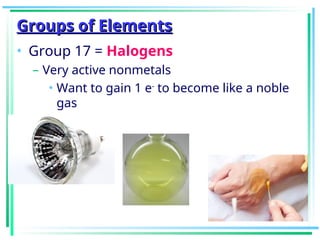
• Group 17 = Halogens
– Very active nonmetals
• Want to gain 1 e-
to become like a noble
gas
Groups of Elements
Groups of Elements
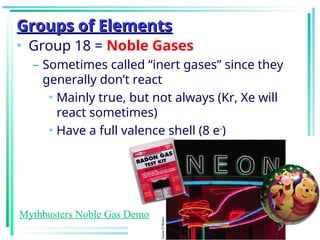
• Group 18 = Noble Gases
– Sometimes called “inert gases” since they
generally don’t react
• Mainly true, but not always (Kr, Xe will
react sometimes)
• Have a full valence shell (8 e-
)
Mythbusters Noble Gas Demo
Groups of Elements
Groups of Elements
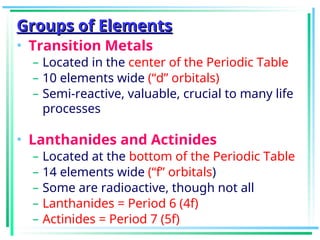
• Transition Metals
– Located in the center of the Periodic Table
– 10 elements wide (“d” orbitals)
– Semi-reactive, valuable, crucial to many life
processes
• Lanthanides and Actinides
– Located at the bottom of the Periodic Table
– 14 elements wide (“f” orbitals)
– Some are radioactive, though not all
– Lanthanides = Period 6 (4f)
– Actinides = Period 7 (5f)
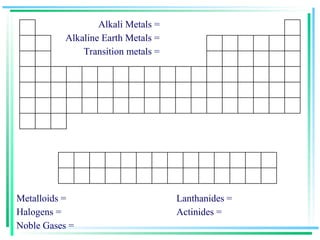
Alkali Metals =
Alkaline Earth Metals =
Transition metals =
Metalloids = Lanthanides =
Halogens = Actinides =
Noble Gases =
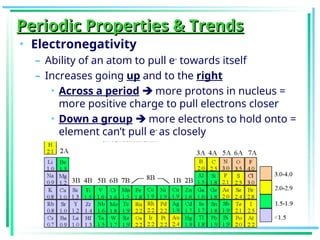
• Electronegativity
– Ability of an atom to pull e-
towards itself
– Increases going up and to the right
• Across a period  more protons in nucleus =
more positive charge to pull electrons closer
• Down a group  more electrons to hold onto =
element can’t pull e-
as closely
Periodic Properties & Trends
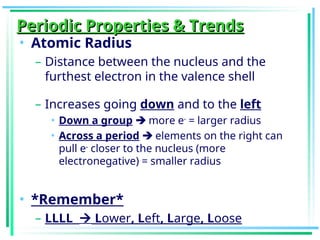
• Atomic Radius
– Distance between the nucleus and the
furthest electron in the valence shell
– Increases going down and to the left
• Down a group  more e-
= larger radius
• Across a period  elements on the right can
pull e-
closer to the nucleus (more
electronegative) = smaller radius
• *Remember*
– LLLL  Lower, Left, Large, Loose
Periodic Properties & Trends
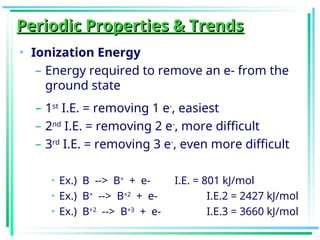
• Ionization Energy
– Energy required to remove an e- from the
ground state
– 1st
I.E. = removing 1 e-
, easiest
– 2nd
I.E. = removing 2 e-
, more difficult
– 3rd
I.E. = removing 3 e-
, even more difficult
• Ex.) B --> B+
+ e- I.E. = 801 kJ/mol
• Ex.) B+
--> B+2
+ e- I.E.2 = 2427 kJ/mol
• Ex.) B+2
--> B+3
+ e- I.E.3 = 3660 kJ/mol
Periodic Properties & Trends
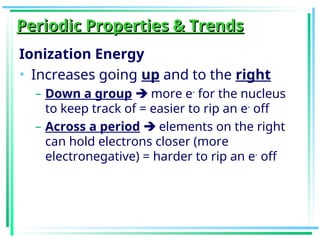
Ionization Energy
• Increases going up and to the right
– Down a group  more e-
for the nucleus
to keep track of = easier to rip an e-
off
– Across a period  elements on the right
can hold electrons closer (more
electronegative) = harder to rip an e-
off
Periodic Properties & Trends
• Metallic Character
– How “metal-like” an element is
• Metals lose e-
– Most Metallic: Cs, Fr
– Least: F, O
– Increases going down and to the left
Think about where the metals & nonmetals are
located on the periodic table to help you remember!
Periodic Properties & Trends
• Ionic Radius
– Radius of an atom when e-
are lost or
gained different from atomic radius
– Ionic Radius of Cations
• Decreases when e- are removed
– Ionic Radius of Anions
• Increases when e- are added
Sizes of Ions
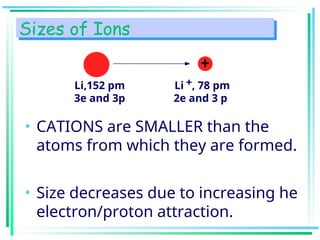
• CATIONS are SMALLER than the
atoms from which they are formed.
• Size decreases due to increasing he
electron/proton attraction.
Li,152 pm
3e and 3p
Li +, 78 pm
2e and 3 p
+
Sizes of Ions
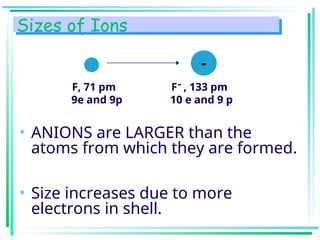
• ANIONS are LARGER than the
atoms from which they are formed.
• Size increases due to more
electrons in shell.
F, 71 pm
9e and 9p
F- , 133 pm
10 e and 9 p
-
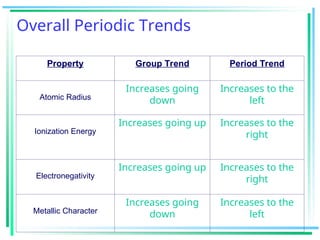
Overall Periodic Trends
Property Group Trend Period Trend
Atomic Radius
Increases going
down
Increases to the
left
Ionization Energy
Increases going up Increases to the
right
Electronegativity
Increases going up Increases to the
right
Metallic Character
Increases going
down
Increases to the
left
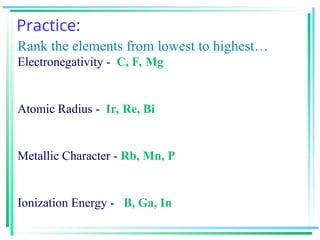
Practice:
Rank the elements from lowest to highest…
Electronegativity - C, F, Mg
Atomic Radius - Ir, Re, Bi
Metallic Character - Rb, Mn, P
Ionization Energy - B, Ga, In
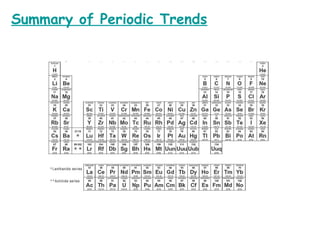
Summary of Periodic Trends

PP - Unit 10 Notes_Periodic Table (1).ppt

  • 1.
    X Unit 10: ThePeriodic Table
  • 2.
    History of thePeriodic Table History of the Periodic Table Antoine Lavoisier (1743 – 1794) – Published Elements of Chemistry in 1789 • Included a list of “simple substances” (which we now know to be elements) • Formed the basis for the modern list of elements – Only classified substances as metals or nonmetals
  • 3.
    History of thePeriodic Table History of the Periodic Table Johann Döbereiner (1780 – 1849) – Classified elements into “triads” • Groups of three elements with related properties and weights • Began in 1817 when he realized Sr was halfway between the weights of Ca and Ba and they all possessed similar traits – Döbereiner’s triads: • Cl, Br, I  S, Se, Te • Ca, Sr, Ba  Li, Na, K
  • 4.
    History of thePeriodic Table History of the Periodic Table John Newlands (1837 – 1898) – Law of Octaves (1863) • Stated that elements repeated their chemical properties every eighth element • Similar to the idea of octaves in music
  • 5.
    History of thePeriodic Table History of the Periodic Table Dmitri Mendeleev (1834 – 1907) – Russian chemist (“The father of the periodic table”) – Arranged elements based on accepted atomic masses and properties that he observed – Listed elements with similar characteristics in the same family/group • Left blank spots for predicted elements (Ted-Ed Video)
  • 6.
  • 7.
    Dmitri Mendeleev (1834– 1907) Property Mendeleev’s Prediction for “eka-silicon” in 1871 Observed Properties of Germanium (discovered in 1886) Atomic Weight 72 72.59 Density (g/cm3 ) 5.5 5.35 Melting Point (°C) High 947 Color Dark gray Grayish white Formula of XO GeO
  • 8.
    History of thePeriodic Table History of the Periodic Table Henry Moseley (1887 – 1915) – English physicist – Arranged elements based on increasing atomic number • Remember: atomic number = # of p+ in nucleus – Periodic table looked similar to Mendeleev’s design since as atomic number increases, so does the atomic mass
  • 9.
    Periodic Law Periodic Law •Periodic – occurring at regular intervals – Relates to trends on the periodic table of elements • Modern Periodic Law – When elements are arranged in order of increasing atomic number, there is a periodic repetition of their properties • Just like Mendeleev suspected!!
  • 10.
    Reading the PeriodicTable Reading the Periodic Table •Periods - “Horizontal Rows” •Groups (or Families) - “Vertical Columns”
  • 11.
    Reading the PeriodicTable Reading the Periodic Table • Valence electrons are periodic! • Notice the similarities – Ex.) Write the noble gas configurations for: • F [He]2s2 2p5 7 valence electrons • Cl [Ne]3s2 3p5 7 valence electrons • Br [Ar]4s2 3d10 4p5 7 valence electrons • I [Kr]5s2 4d10 5p5 7 valence electrons – GROUPS have similar valence electron configurations!
  • 12.
    Groups of Elements Groupsof Elements • Group 1 = Alkali Metals – Located in Group 1 (except Hydrogen) – Extremely reactive • Want to lose 1 e- to become “noble gas-like” • Group 2 = Alkaline Earth Metals – Also very reactive – Both Group 1 & 2 occur naturally as compounds not elements
  • 13.
    Groups of Elements Groupsof Elements • Group 17 = Halogens – Very active nonmetals • Want to gain 1 e- to become like a noble gas
  • 14.
    Groups of Elements Groupsof Elements • Group 18 = Noble Gases – Sometimes called “inert gases” since they generally don’t react • Mainly true, but not always (Kr, Xe will react sometimes) • Have a full valence shell (8 e- ) Mythbusters Noble Gas Demo
  • 15.
    Groups of Elements Groupsof Elements • Transition Metals – Located in the center of the Periodic Table – 10 elements wide (“d” orbitals) – Semi-reactive, valuable, crucial to many life processes • Lanthanides and Actinides – Located at the bottom of the Periodic Table – 14 elements wide (“f” orbitals) – Some are radioactive, though not all – Lanthanides = Period 6 (4f) – Actinides = Period 7 (5f)
  • 16.
    Alkali Metals = AlkalineEarth Metals = Transition metals = Metalloids = Lanthanides = Halogens = Actinides = Noble Gases =
  • 17.
    • Electronegativity – Abilityof an atom to pull e- towards itself – Increases going up and to the right • Across a period  more protons in nucleus = more positive charge to pull electrons closer • Down a group  more electrons to hold onto = element can’t pull e- as closely Periodic Properties & Trends Periodic Properties & Trends
  • 18.
    Periodic Properties &Trends Periodic Properties & Trends • Atomic Radius – Distance between the nucleus and the furthest electron in the valence shell – Increases going down and to the left • Down a group  more e- = larger radius • Across a period  elements on the right can pull e- closer to the nucleus (more electronegative) = smaller radius • *Remember* – LLLL  Lower, Left, Large, Loose
  • 19.
    Periodic Properties &Trends Periodic Properties & Trends • Ionization Energy – Energy required to remove an e- from the ground state – 1st I.E. = removing 1 e- , easiest – 2nd I.E. = removing 2 e- , more difficult – 3rd I.E. = removing 3 e- , even more difficult • Ex.) B --> B+ + e- I.E. = 801 kJ/mol • Ex.) B+ --> B+2 + e- I.E.2 = 2427 kJ/mol • Ex.) B+2 --> B+3 + e- I.E.3 = 3660 kJ/mol
  • 20.
    Periodic Properties &Trends Periodic Properties & Trends Ionization Energy • Increases going up and to the right – Down a group  more e- for the nucleus to keep track of = easier to rip an e- off – Across a period  elements on the right can hold electrons closer (more electronegative) = harder to rip an e- off
  • 21.
    Periodic Properties &Trends Periodic Properties & Trends • Metallic Character – How “metal-like” an element is • Metals lose e- – Most Metallic: Cs, Fr – Least: F, O – Increases going down and to the left Think about where the metals & nonmetals are located on the periodic table to help you remember!
  • 22.
    Periodic Properties &Trends Periodic Properties & Trends • Ionic Radius – Radius of an atom when e- are lost or gained different from atomic radius – Ionic Radius of Cations • Decreases when e- are removed – Ionic Radius of Anions • Increases when e- are added
  • 23.
    Sizes of Ions •CATIONS are SMALLER than the atoms from which they are formed. • Size decreases due to increasing he electron/proton attraction. Li,152 pm 3e and 3p Li +, 78 pm 2e and 3 p +
  • 24.
    Sizes of Ions •ANIONS are LARGER than the atoms from which they are formed. • Size increases due to more electrons in shell. F, 71 pm 9e and 9p F- , 133 pm 10 e and 9 p -
  • 25.
    Overall Periodic Trends PropertyGroup Trend Period Trend Atomic Radius Increases going down Increases to the left Ionization Energy Increases going up Increases to the right Electronegativity Increases going up Increases to the right Metallic Character Increases going down Increases to the left
  • 26.
    Practice: Rank the elementsfrom lowest to highest… Electronegativity - C, F, Mg Atomic Radius - Ir, Re, Bi Metallic Character - Rb, Mn, P Ionization Energy - B, Ga, In
  • 27.