Recall
Complete the following information by using
your periodic table of elements
Argon
Silver
Silicon
Atomic number
Symbol
Atomic mass
Number of
protons
Number of
electrons
Number of
neutrons
Recall
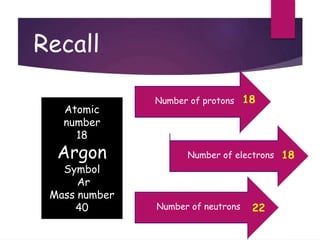
Atomic
number
18
Argon
Symbol
Ar
Mass number
40
18
18
Number of protons
Number of electrons
22
Number of neutrons
Recall
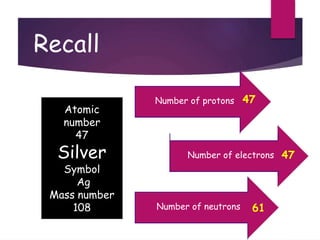
Atomic
number
47
Silver
Symbol
Ag
Mass number
108
47
47
Number of protons
Number of electrons
61
Number of neutrons
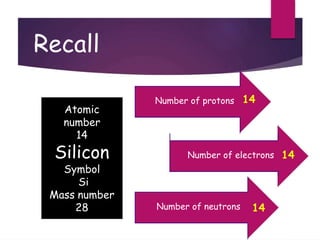
Recall
Atomic
number
14
Silicon
Symbol
Si
Mass number
28
14
14
Number of protons
Number of electrons
14
Number of neutrons
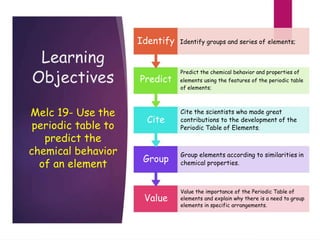
Learning
Objectives
Identify Identify groups and series of elements;
Predict the chemical behavior and properties of
Predict elements using the features of the periodic table
of elements;
Melc 19- Use the
periodic table to
predict the
chemical behavior
of an element
Cite
Group
Value
Cite the scientists who made great
contributions to the development of the
Periodic Table of Elements;
Group elements according to similarities in
chemical properties.
Value the importance of the Periodic Table of
elements and explain why there is a need to group
elements in specific arrangements.
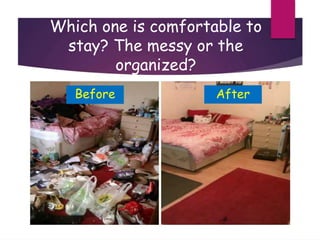
Which one is comfortable to
stay? The messy or the
organized?
Before After
Introduction:
In this lesson you will learn that elements
were arranged in the periodic table in rows
and columns according to increasing atomic
number. This arrangement was based on
properties of elements which were found to
be repeated regularly through the elements
arranged according to increasing atomic
number.
Key Questions
How did the
Periodic table
develop?
What information
about elements can
be obtained from
this organized tool?
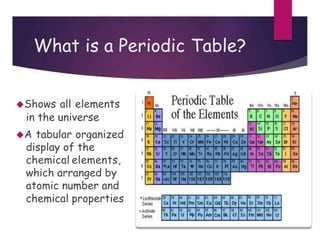
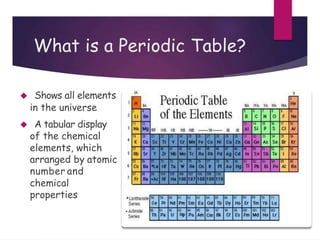
What is a Periodic Table?
Shows all elements
in the universe
A tabular organized
display of the
chemical elements,
which arranged by
atomic number and
chemical properties
Development of the Periodic
Table
Scientist have always searched for patterns,
regularities and symmetries in nature. It can
be discovered, information and data can be
arranged and organized in ways that will make
it more understandable, meaningful and
useful. An excellent example of this is the
periodic table
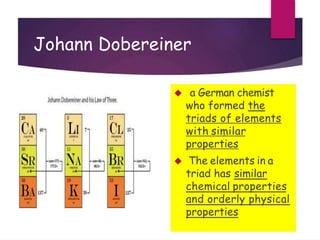
Johann Dobereiner
 a German chemist
who formed the
triads of elements
with similar
properties
 The elements in a
triad has similar
chemical properties
and orderly physical
properties
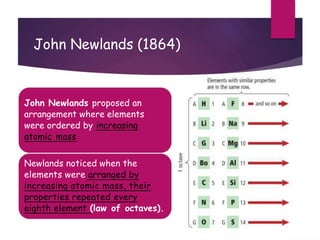
John Newlands (1864)
John Newlands proposed an
arrangement where elements
were ordered by increasing
atomic mass
Newlands noticed when the
elements were arranged by
increasing atomic mass, their
properties repeated every
eighth element (law of octaves).
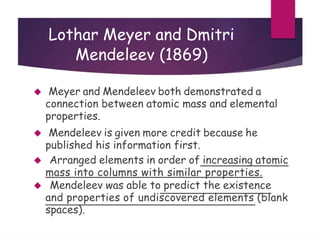
Lothar Meyer and Dmitri
Mendeleev (1869)
 Meyer and Mendeleev both demonstrated a
connection between atomic mass and elemental
properties.
 Mendeleev is given more credit because he
published his information first.
 Arranged elements in order of increasing atomic
mass into columns with similar properties.
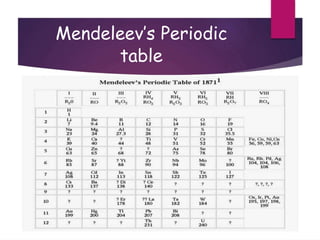
 Mendeleev was able to predict the existence
and properties of undiscovered elements (blank
spaces).
Mendeleev’s Periodic
table
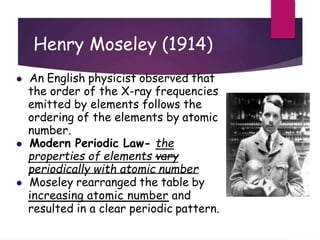
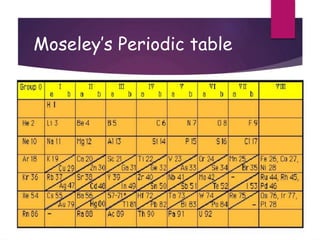
Henry Moseley (1914)
 An English physicist observed that
the order of the X-ray frequencies
emitted by elements follows the
ordering of the elements by atomic
number.
 Modern Periodic Law- the
properties of elements vary
periodically with atomic number
 Moseley rearranged the table by
increasing atomic number and
resulted in a clear periodic pattern.
Moseley’s Periodic table
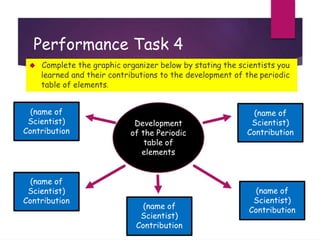
Performance Task 4
 Complete the graphic organizer below by stating the scientists you
learned and their contributions to the development of the periodic
table of elements.
(name of
Scientist)
Contribution
(name of
Scientist)
Contribution
Development
of the Periodic
table of
elements
(name of
Scientist)
Contribution
(name of
Scientist)
Contribution
(name of
Scientist)
Contribution
Week 8
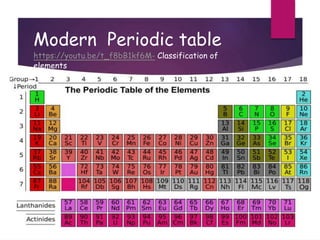
Modern Periodic table
https://youtu.be/t_f8bB1kf6M- Classification of
elements
What is a Periodic Table?
 Shows all elements
in the universe
 A tabular display
of the chemical
elements, which
arranged by atomic
number and
chemical
properties
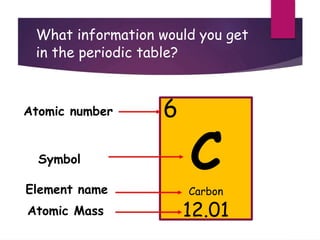
What information would you get
in the periodic table?
Atomic number
Symbol
Element name
Atomic Mass
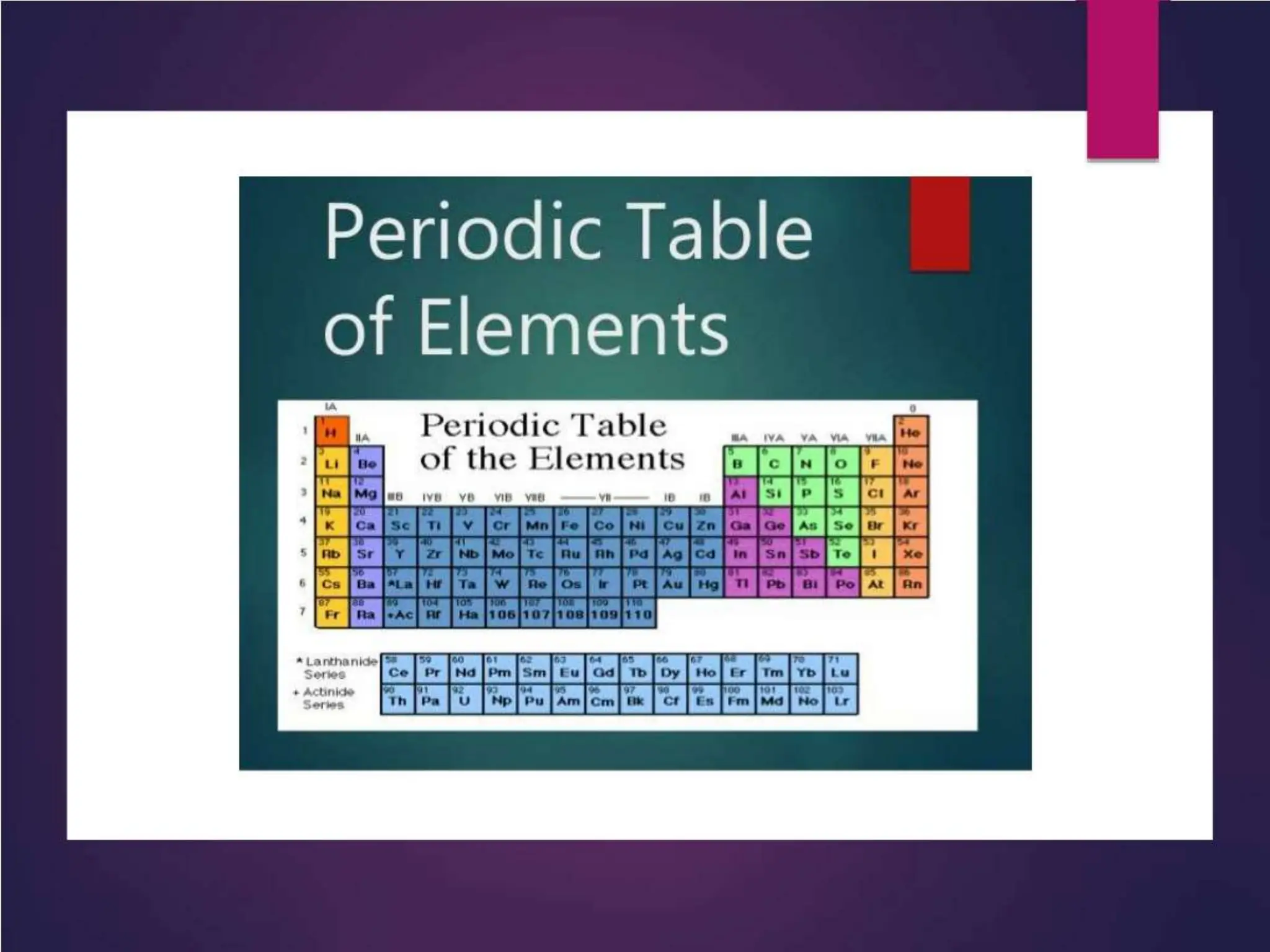
6
C
Carbon
12.01
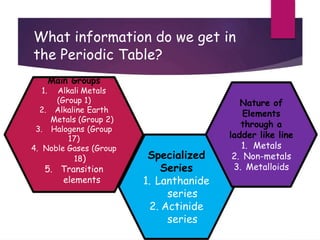
What information do we get in
the Periodic Table?
Main Groups
1. Alkali Metals
(Group 1)
2. Alkaline Earth
Metals (Group 2)
3. Halogens (Group
17)
4. Noble Gases (Group
18)
5. Transition
elements
Specialized
Series
1. Lanthanide
series
2. Actinide
series
Nature of
Elements
through a
ladder like line
1. Metals
2. Non-metals
3. Metalloids
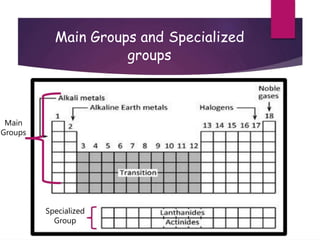
Main Groups and Specialized
groups
Main
Groups
Specialized
Group
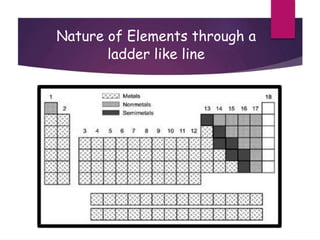
Nature of Elements through a
ladder like line
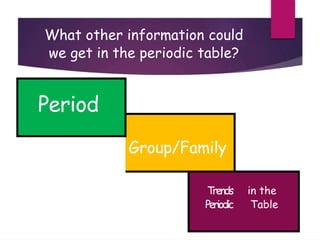
What other information could
we get in the periodic table?
Period
Group/Family
Trends
Periodic
in the
Table
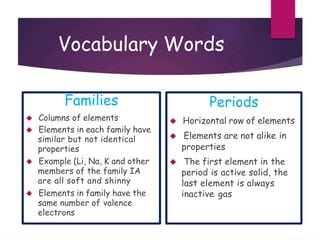
Vocabulary Words
Families
 Columns of elements
 Elements in each family have
similar but not identical
properties
 Example (Li, Na, K and other
members of the family IA
are all soft and shinny
 Elements in family have the
same number of valence
electrons
Periods
 Horizontal row of elements
 Elements are not alike in
properties
 The first element in the
period is active solid, the
last element is always
inactive gas
What are
the
examples of
non-metals?
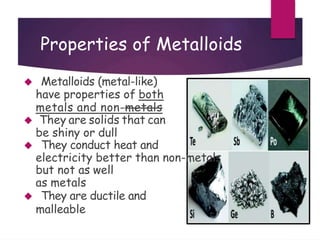
Properties of Metalloids
 Metalloids (metal-like)
have properties of both
metals and non-metals
 They are solids that can
be shiny or dull
 They conduct heat and
electricity better than non-metals
but not as well
as metals
 They are ductile and
malleable
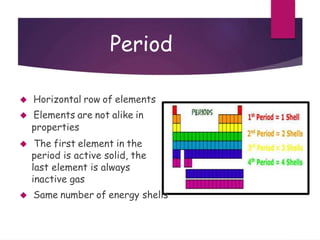
Period
 Horizontal row of elements
 Elements are not alike in
properties
 The first element in the
period is active solid, the
last element is always
inactive gas
 Same number of energy shells
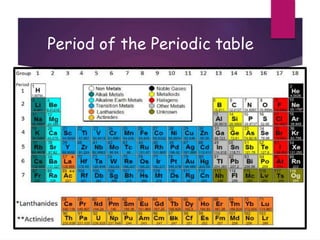
Period of the Periodic table
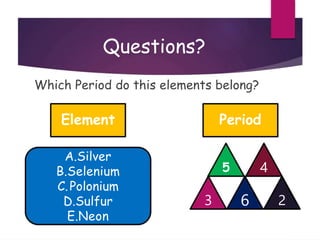
Questions?
Which Period do this elements belong?
Element Period
A.Silver
B.Selenium
C.Polonium
D.Sulfur
E.Neon
3
5
6
4
2
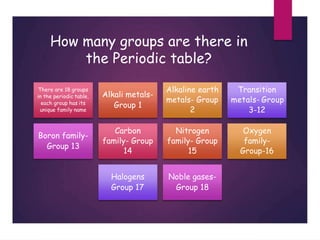
How many groups are there in
the Periodic table?
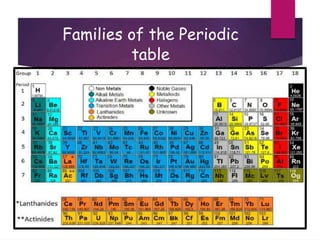
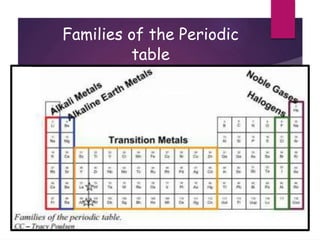
There are 18 groups
in the periodic table,
each group has its
unique family name
Alkali metals-
Group 1
Alkaline earth
metals- Group
2
Transition
metals- Group
3-12
Boron family-
Group 13
Carbon
family- Group
14
Nitrogen
family- Group
15
Oxygen
family-
Group-16
Halogens
Group 17
Noble gases-
Group 18
What do
you think
are the
basis in
grouping
the
elements?
 Base on their
similarities and
chemical properties,
each group of elements
have the same number
of valence electrons.
 Example (Li, Na, K )
and other members of
the family IA/group 1
are all soft and shinny
Families of the Periodic
table
Families of the Periodic
table
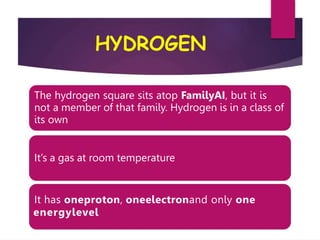
HYDROGEN
The hydrogen square sits atop FamilyAI, but it is
not a member of that family. Hydrogen is in a class of
its own
It’s a gas at room temperature
It has oneproton, oneelectronand only one
energylevel
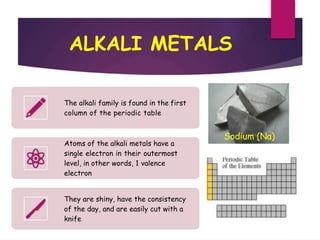
ALKALI METALS
The alkali family is found in the first
column of the periodic table
Atoms of the alkali metals have a
single electron in their outermost
level, in other words, 1 valence
electron
They are shiny, have the consistency
of the day, and are easily cut with a
knife
Sodium (Na)
ALKALI METALS
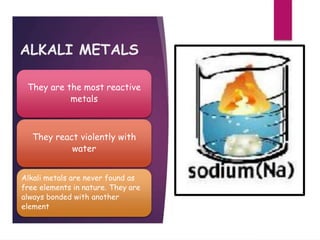
They are the most reactive
metals
They react violently with
water
Alkali metals are never found as
free elements in nature. They are
always bonded with another
element
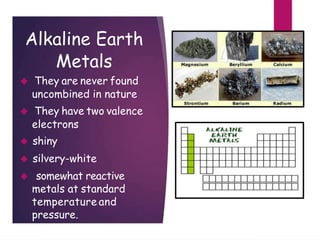
Alkaline Earth
Metals
 They are never found
uncombined in nature
 They have two valence
electrons
 shiny
 silvery-white
 somewhat reactive
metals at standard
temperature and
pressure.
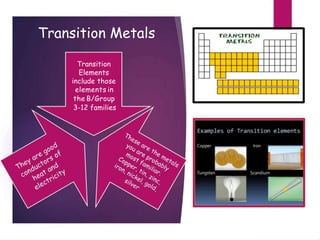
Transition Metals
Transition
Elements
include those
elements in
the B/Group
3-12 families
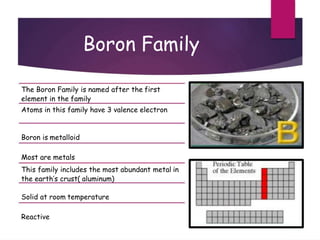
Boron Family
The Boron Family is named after the first
element in the family
Atoms in this family have 3 valence electron
Boron is metalloid
Most are metals
This family includes the most abundant metal in
the earth’s crust( aluminum)
Solid at room temperature
Reactive
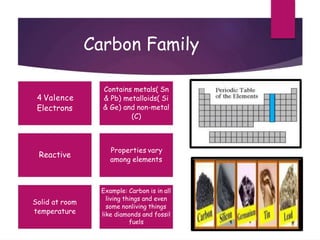
Carbon Family
4 Valence
Electrons
Contains metals( Sn
& Pb) metalloids( Si
& Ge) and non-metal
(C)
Reactive
Properties vary
among elements
Solid at room
temperature
Example: Carbon is in all
living things and even
some nonliving things
like diamonds and fossil
fuels
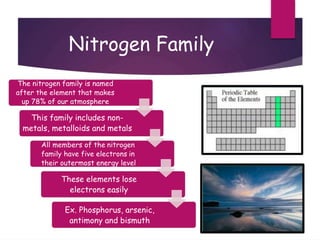
Nitrogen Family
The nitrogen family is named
after the element that makes
up 78% of our atmosphere
This family includes non-
metals, metalloids and metals
All members of the nitrogen
family have five electrons in
their outermost energy level
These elements lose
electrons easily
Ex. Phosphorus, arsenic,
antimony and bismuth
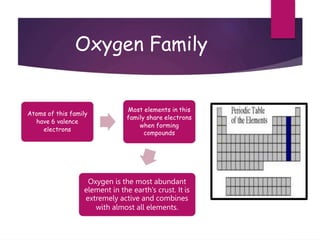
Oxygen Family
Atoms of this family
have 6 valence
electrons
Most elements in this
family share electrons
when forming
compounds
Oxygen is the most abundant
element in the earth’s crust. It is
extremely active and combines
with almost all elements.
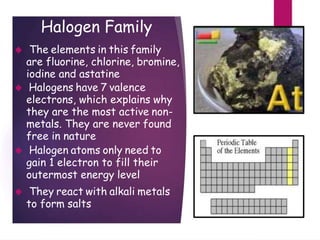
Halogen Family
 The elements in this family
are fluorine, chlorine, bromine,
iodine and astatine
 Halogens have 7 valence
electrons, which explains why
they are the most active non-
metals. They are never found
free in nature
 Halogen atoms only need to
gain 1 electron to fill their
outermost energy level
 They react with alkali metals
to form salts
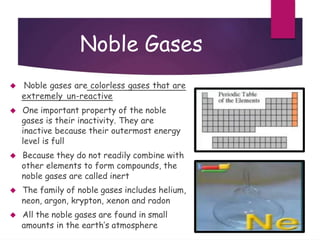
Noble Gases
 Noble gases are colorless gases that are
extremely un-reactive
 One important property of the noble
gases is their inactivity. They are
inactive because their outermost energy
level is full
 Because they do not readily combine with
other elements to form compounds, the
noble gases are called inert
 The family of noble gases includes helium,
neon, argon, krypton, xenon and radon
 All the noble gases are found in small
amounts in the earth’s atmosphere
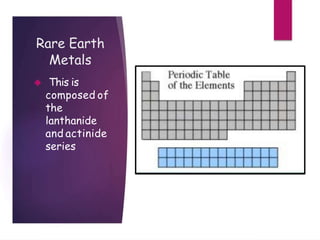
Rare Earth
Metals
 This is
composed of
the
lanthanide
and actinide
series
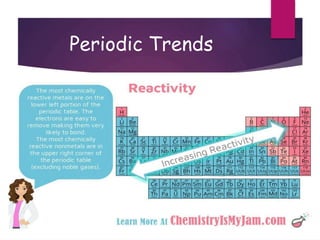
Periodic Trends
Why are
some
elements
so
reactive?
Valence electron
determine the
reactivity of some
elements, if a group
of elements has 1
valence electron,
they are highly
reactive.
Periodic Trends
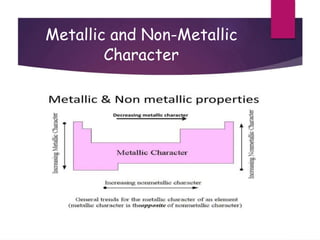
Metallic
Property
 Relates to how easy
it is for an atom to
lose electron
Non-Metallic
Property
 Relates to how easy
it is for an atom to
gain an electron
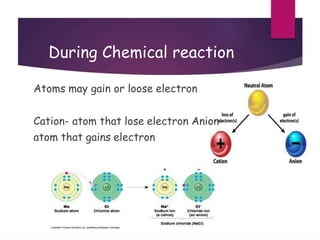
During Chemical reaction
Atoms may gain or loose electron
Cation- atom that lose electron Anion-
atom that gains electron
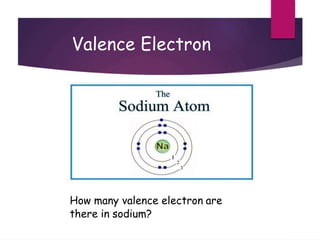
Valence Electron
How many valence electron are
there in sodium?
Metallic and Non-Metallic
Character
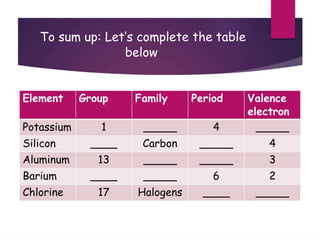
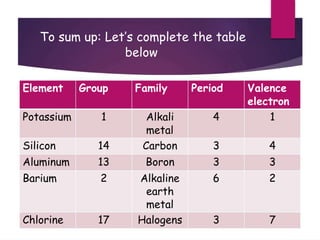
To sum up: Let’s complete the table
below
Element Group Family Period Valence
electron
Potassium 1 _____ 4 _____
Silicon ____ Carbon _____ 4
Aluminum 13 _____ _____ 3
Barium ____ _____ 6 2
Chlorine 17 Halogens ____ _____
To sum up: Let’s complete the table
below
Element Group Family Period Valence
electron
Potassium 1 Alkali
metal
4 1
Silicon 14 Carbon 3 4
Aluminum 13 Boron 3 3
Barium 2 Alkaline
earth
metal
6 2
Chlorine 17 Halogens 3 7
Who are you?
If you have given a
chance to be one of an
element in the periodic
table, what of element
are you and why?
theperiodictable-230424123040-0a5237d0.pptx

theperiodictable-230424123040-0a5237d0.pptx

  • 2.
    Recall Complete the followinginformation by using your periodic table of elements Argon Silver Silicon Atomic number Symbol Atomic mass Number of protons Number of electrons Number of neutrons
  • 3.
    Recall Atomic number 18 Argon Symbol Ar Mass number 40 18 18 Number ofprotons Number of electrons 22 Number of neutrons
  • 4.
    Recall Atomic number 47 Silver Symbol Ag Mass number 108 47 47 Number ofprotons Number of electrons 61 Number of neutrons
  • 5.
    Recall Atomic number 14 Silicon Symbol Si Mass number 28 14 14 Number ofprotons Number of electrons 14 Number of neutrons
  • 6.
    Learning Objectives Identify Identify groupsand series of elements; Predict the chemical behavior and properties of Predict elements using the features of the periodic table of elements; Melc 19- Use the periodic table to predict the chemical behavior of an element Cite Group Value Cite the scientists who made great contributions to the development of the Periodic Table of Elements; Group elements according to similarities in chemical properties. Value the importance of the Periodic Table of elements and explain why there is a need to group elements in specific arrangements.
  • 7.
    Which one iscomfortable to stay? The messy or the organized? Before After
  • 8.
    Introduction: In this lessonyou will learn that elements were arranged in the periodic table in rows and columns according to increasing atomic number. This arrangement was based on properties of elements which were found to be repeated regularly through the elements arranged according to increasing atomic number.
  • 9.
    Key Questions How didthe Periodic table develop? What information about elements can be obtained from this organized tool?
  • 10.
    What is aPeriodic Table? Shows all elements in the universe A tabular organized display of the chemical elements, which arranged by atomic number and chemical properties
  • 11.
    Development of thePeriodic Table Scientist have always searched for patterns, regularities and symmetries in nature. It can be discovered, information and data can be arranged and organized in ways that will make it more understandable, meaningful and useful. An excellent example of this is the periodic table
  • 12.
    Johann Dobereiner  aGerman chemist who formed the triads of elements with similar properties  The elements in a triad has similar chemical properties and orderly physical properties
  • 13.
    John Newlands (1864) JohnNewlands proposed an arrangement where elements were ordered by increasing atomic mass Newlands noticed when the elements were arranged by increasing atomic mass, their properties repeated every eighth element (law of octaves).
  • 14.
    Lothar Meyer andDmitri Mendeleev (1869)  Meyer and Mendeleev both demonstrated a connection between atomic mass and elemental properties.  Mendeleev is given more credit because he published his information first.  Arranged elements in order of increasing atomic mass into columns with similar properties.  Mendeleev was able to predict the existence and properties of undiscovered elements (blank spaces).
  • 15.
  • 16.
    Henry Moseley (1914) An English physicist observed that the order of the X-ray frequencies emitted by elements follows the ordering of the elements by atomic number.  Modern Periodic Law- the properties of elements vary periodically with atomic number  Moseley rearranged the table by increasing atomic number and resulted in a clear periodic pattern.
  • 17.
  • 18.
    Performance Task 4 Complete the graphic organizer below by stating the scientists you learned and their contributions to the development of the periodic table of elements. (name of Scientist) Contribution (name of Scientist) Contribution Development of the Periodic table of elements (name of Scientist) Contribution (name of Scientist) Contribution (name of Scientist) Contribution
  • 19.
  • 20.
  • 21.
    What is aPeriodic Table?  Shows all elements in the universe  A tabular display of the chemical elements, which arranged by atomic number and chemical properties
  • 22.
    What information wouldyou get in the periodic table? Atomic number Symbol Element name Atomic Mass 6 C Carbon 12.01
  • 23.
    What information dowe get in the Periodic Table? Main Groups 1. Alkali Metals (Group 1) 2. Alkaline Earth Metals (Group 2) 3. Halogens (Group 17) 4. Noble Gases (Group 18) 5. Transition elements Specialized Series 1. Lanthanide series 2. Actinide series Nature of Elements through a ladder like line 1. Metals 2. Non-metals 3. Metalloids
  • 24.
    Main Groups andSpecialized groups Main Groups Specialized Group
  • 25.
    Nature of Elementsthrough a ladder like line
  • 26.
    What other informationcould we get in the periodic table? Period Group/Family Trends Periodic in the Table
  • 27.
    Vocabulary Words Families  Columnsof elements  Elements in each family have similar but not identical properties  Example (Li, Na, K and other members of the family IA are all soft and shinny  Elements in family have the same number of valence electrons Periods  Horizontal row of elements  Elements are not alike in properties  The first element in the period is active solid, the last element is always inactive gas
  • 28.
  • 29.
    Properties of Metalloids Metalloids (metal-like) have properties of both metals and non-metals  They are solids that can be shiny or dull  They conduct heat and electricity better than non-metals but not as well as metals  They are ductile and malleable
  • 30.
    Period  Horizontal rowof elements  Elements are not alike in properties  The first element in the period is active solid, the last element is always inactive gas  Same number of energy shells
  • 31.
    Period of thePeriodic table
  • 32.
    Questions? Which Period dothis elements belong? Element Period A.Silver B.Selenium C.Polonium D.Sulfur E.Neon 3 5 6 4 2
  • 33.
    How many groupsare there in the Periodic table? There are 18 groups in the periodic table, each group has its unique family name Alkali metals- Group 1 Alkaline earth metals- Group 2 Transition metals- Group 3-12 Boron family- Group 13 Carbon family- Group 14 Nitrogen family- Group 15 Oxygen family- Group-16 Halogens Group 17 Noble gases- Group 18
  • 34.
    What do you think arethe basis in grouping the elements?  Base on their similarities and chemical properties, each group of elements have the same number of valence electrons.  Example (Li, Na, K ) and other members of the family IA/group 1 are all soft and shinny
  • 35.
    Families of thePeriodic table
  • 36.
    Families of thePeriodic table
  • 37.
    HYDROGEN The hydrogen squaresits atop FamilyAI, but it is not a member of that family. Hydrogen is in a class of its own It’s a gas at room temperature It has oneproton, oneelectronand only one energylevel
  • 38.
    ALKALI METALS The alkalifamily is found in the first column of the periodic table Atoms of the alkali metals have a single electron in their outermost level, in other words, 1 valence electron They are shiny, have the consistency of the day, and are easily cut with a knife Sodium (Na)
  • 39.
    ALKALI METALS They arethe most reactive metals They react violently with water Alkali metals are never found as free elements in nature. They are always bonded with another element
  • 40.
    Alkaline Earth Metals  Theyare never found uncombined in nature  They have two valence electrons  shiny  silvery-white  somewhat reactive metals at standard temperature and pressure.
  • 41.
  • 42.
    Boron Family The BoronFamily is named after the first element in the family Atoms in this family have 3 valence electron Boron is metalloid Most are metals This family includes the most abundant metal in the earth’s crust( aluminum) Solid at room temperature Reactive
  • 43.
    Carbon Family 4 Valence Electrons Containsmetals( Sn & Pb) metalloids( Si & Ge) and non-metal (C) Reactive Properties vary among elements Solid at room temperature Example: Carbon is in all living things and even some nonliving things like diamonds and fossil fuels
  • 44.
    Nitrogen Family The nitrogenfamily is named after the element that makes up 78% of our atmosphere This family includes non- metals, metalloids and metals All members of the nitrogen family have five electrons in their outermost energy level These elements lose electrons easily Ex. Phosphorus, arsenic, antimony and bismuth
  • 45.
    Oxygen Family Atoms ofthis family have 6 valence electrons Most elements in this family share electrons when forming compounds Oxygen is the most abundant element in the earth’s crust. It is extremely active and combines with almost all elements.
  • 46.
    Halogen Family  Theelements in this family are fluorine, chlorine, bromine, iodine and astatine  Halogens have 7 valence electrons, which explains why they are the most active non- metals. They are never found free in nature  Halogen atoms only need to gain 1 electron to fill their outermost energy level  They react with alkali metals to form salts
  • 47.
    Noble Gases  Noblegases are colorless gases that are extremely un-reactive  One important property of the noble gases is their inactivity. They are inactive because their outermost energy level is full  Because they do not readily combine with other elements to form compounds, the noble gases are called inert  The family of noble gases includes helium, neon, argon, krypton, xenon and radon  All the noble gases are found in small amounts in the earth’s atmosphere
  • 48.
    Rare Earth Metals  Thisis composed of the lanthanide and actinide series
  • 49.
  • 50.
    Why are some elements so reactive? Valence electron determinethe reactivity of some elements, if a group of elements has 1 valence electron, they are highly reactive.
  • 51.
    Periodic Trends Metallic Property  Relatesto how easy it is for an atom to lose electron Non-Metallic Property  Relates to how easy it is for an atom to gain an electron
  • 52.
    During Chemical reaction Atomsmay gain or loose electron Cation- atom that lose electron Anion- atom that gains electron
  • 53.
    Valence Electron How manyvalence electron are there in sodium?
  • 54.
  • 55.
    To sum up:Let’s complete the table below Element Group Family Period Valence electron Potassium 1 _____ 4 _____ Silicon ____ Carbon _____ 4 Aluminum 13 _____ _____ 3 Barium ____ _____ 6 2 Chlorine 17 Halogens ____ _____
  • 56.
    To sum up:Let’s complete the table below Element Group Family Period Valence electron Potassium 1 Alkali metal 4 1 Silicon 14 Carbon 3 4 Aluminum 13 Boron 3 3 Barium 2 Alkaline earth metal 6 2 Chlorine 17 Halogens 3 7
  • 57.
    Who are you? Ifyou have given a chance to be one of an element in the periodic table, what of element are you and why?