The OscilloscopeFor the measurement of voltage: AC and DC
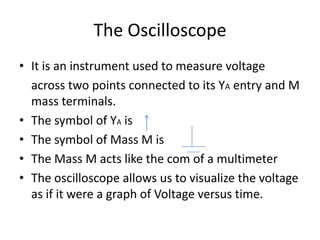
The OscilloscopeIt is an instrument used to measure voltage    across two points connected to its YA entry and M mass terminals. The symbol of YA is The symbol of Mass M is The Mass M acts like the com of a multimeterThe oscilloscope allows us to visualize the voltage as if it were a graph of Voltage versus time.
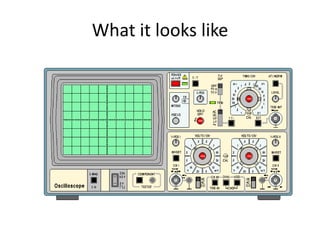
What it looks like
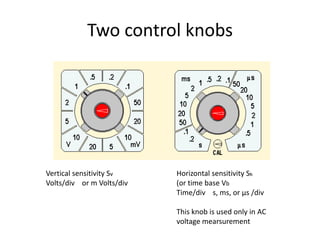
Two control knobsHorizontal sensitivity Sh(or time base VbTime/div    s, ms, or µs /divThis knob is used only in AC voltage mearsurementVertical sensitivity SvVolts/div    or m Volts/div
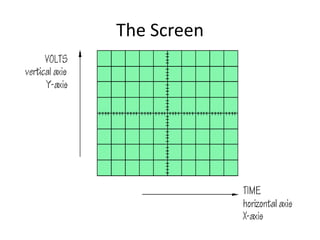
The Screen
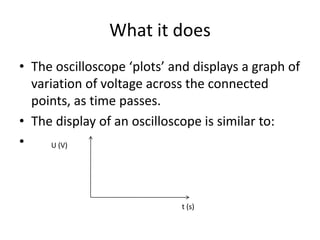
What it doesThe oscilloscope ‘plots’ and displays a graph of variation of voltage across the connected points, as time passes.The display of an oscilloscope is similar to:U (V)t (s)
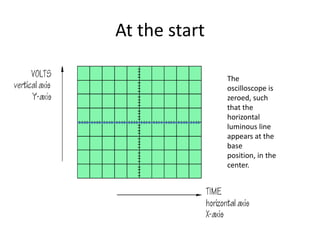
At the start The oscilloscope is zeroed, such that the horizontal luminous line appears at the base position, in the center.
Then    The terminals of the oscilloscope are connected across points in a circuit.    The luminous line is noticed to displace.    The number of divisions between the luminous line and the base position is referred to as y.
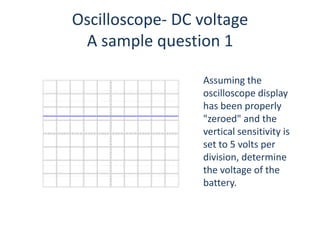
Oscilloscope- DC voltageA sample question 1Assuming the oscilloscope display has been properly "zeroed" and the vertical sensitivity is set to 5 volts per division, determine the voltage of the battery.
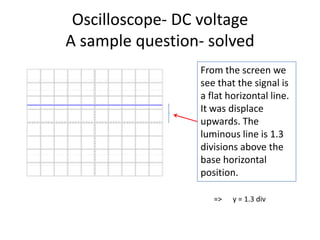
From the screen we see that the signal is a flat horizontal line. It was displace upwards. The luminous line is 1.3 divisions above the base horizontal position.Oscilloscope- DC voltageA sample question- solved=>      y = 1.3 div
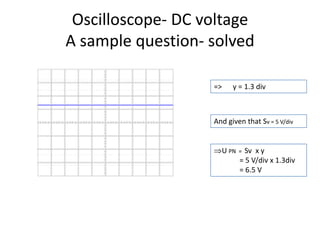
Oscilloscope- DC voltageA sample question- solved=>      y = 1.3 divAnd given that Sv = 5 V/divU PN  =  Sv  x y             = 5 V/div x 1.3div             = 6.5 V
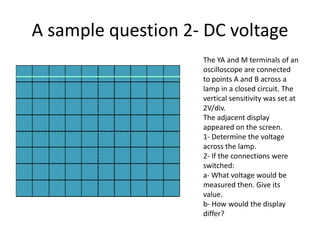
A sample question 2- DC voltage The YA and M terminals of an oscilloscope are connected  to points A and B across a lamp in a closed circuit. The vertical sensitivity was set at 2V/div.The adjacent display appeared on the screen.1- Determine the voltage across the lamp.2- If the connections were switched:a- What voltage would be measured then. Give its value.b- How would the display differ?
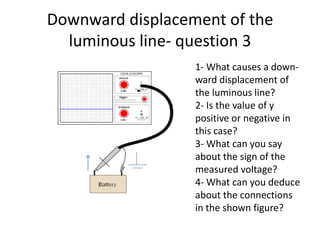
Downward displacement of the luminous line- question 31- What causes a down-ward displacement of the luminous line?2- Is the value of y positive or negative in this case?3- What can you say about the sign of the measured voltage?4- What can you deduce about the connections in the shown figure?
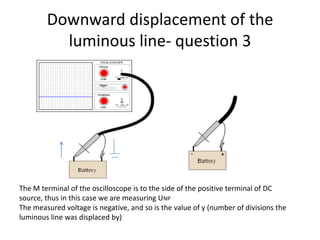
Downward displacement of the luminous line- question 3The M terminal of the oscilloscope is to the side of the positive terminal of DC source, thus in this case we are measuring UNP  The measured voltage is negative, and so is the value of y (number of divisions the luminous line was displaced by)
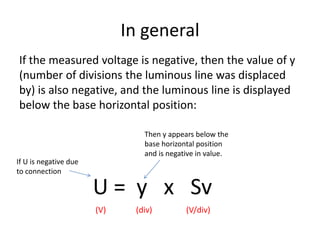
In generalIf the measured voltage is negative, then the value of y (number of divisions the luminous line was displaced by) is also negative, and the luminous line is displayed below the base horizontal position:U =  y   x   SvThen y appears below the base horizontal position and is negative in value.If U is negative due to connection(V)               (div)                 (V/div)
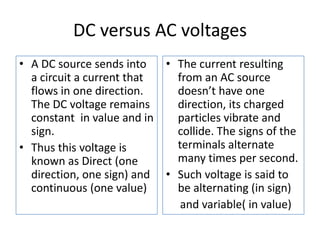
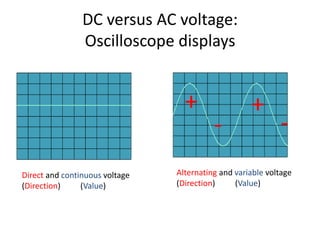
DC versus AC voltagesA DC source sends into a circuit a current that flows in one direction. The DC voltage remains constant  in value and in sign.Thus this voltage is known as Direct (one direction, one sign) and continuous (one value)The current resulting from an AC source doesn’t have one direction, its charged particles vibrate and collide. The signs of the terminals alternate many times per second.Such voltage is said to be alternating (in sign)     and variable( in value)
DC versus AC voltage:Oscilloscope displays+++--Alternating and variable voltage(Direction)          (Value)Direct and continuous voltage(Direction)          (Value)
Thank you Next:exercises 12 and 13 on page 68 in the book.

The Oscilloscope

  • 1.
    The OscilloscopeFor themeasurement of voltage: AC and DC
  • 2.
    The OscilloscopeIt isan instrument used to measure voltage across two points connected to its YA entry and M mass terminals. The symbol of YA is The symbol of Mass M is The Mass M acts like the com of a multimeterThe oscilloscope allows us to visualize the voltage as if it were a graph of Voltage versus time.
  • 3.
  • 4.
    Two control knobsHorizontalsensitivity Sh(or time base VbTime/div s, ms, or µs /divThis knob is used only in AC voltage mearsurementVertical sensitivity SvVolts/div or m Volts/div
  • 5.
  • 6.
    What it doesTheoscilloscope ‘plots’ and displays a graph of variation of voltage across the connected points, as time passes.The display of an oscilloscope is similar to:U (V)t (s)
  • 7.
    At the startThe oscilloscope is zeroed, such that the horizontal luminous line appears at the base position, in the center.
  • 8.
    Then The terminals of the oscilloscope are connected across points in a circuit. The luminous line is noticed to displace. The number of divisions between the luminous line and the base position is referred to as y.
  • 9.
    Oscilloscope- DC voltageAsample question 1Assuming the oscilloscope display has been properly "zeroed" and the vertical sensitivity is set to 5 volts per division, determine the voltage of the battery.
  • 10.
    From the screenwe see that the signal is a flat horizontal line. It was displace upwards. The luminous line is 1.3 divisions above the base horizontal position.Oscilloscope- DC voltageA sample question- solved=> y = 1.3 div
  • 11.
    Oscilloscope- DC voltageAsample question- solved=> y = 1.3 divAnd given that Sv = 5 V/divU PN = Sv x y = 5 V/div x 1.3div = 6.5 V
  • 12.
    A sample question2- DC voltage The YA and M terminals of an oscilloscope are connected to points A and B across a lamp in a closed circuit. The vertical sensitivity was set at 2V/div.The adjacent display appeared on the screen.1- Determine the voltage across the lamp.2- If the connections were switched:a- What voltage would be measured then. Give its value.b- How would the display differ?
  • 13.
    Downward displacement ofthe luminous line- question 31- What causes a down-ward displacement of the luminous line?2- Is the value of y positive or negative in this case?3- What can you say about the sign of the measured voltage?4- What can you deduce about the connections in the shown figure?
  • 14.
    Downward displacement ofthe luminous line- question 3The M terminal of the oscilloscope is to the side of the positive terminal of DC source, thus in this case we are measuring UNP The measured voltage is negative, and so is the value of y (number of divisions the luminous line was displaced by)
  • 15.
    In generalIf themeasured voltage is negative, then the value of y (number of divisions the luminous line was displaced by) is also negative, and the luminous line is displayed below the base horizontal position:U = y x SvThen y appears below the base horizontal position and is negative in value.If U is negative due to connection(V) (div) (V/div)
  • 16.
    DC versus ACvoltagesA DC source sends into a circuit a current that flows in one direction. The DC voltage remains constant in value and in sign.Thus this voltage is known as Direct (one direction, one sign) and continuous (one value)The current resulting from an AC source doesn’t have one direction, its charged particles vibrate and collide. The signs of the terminals alternate many times per second.Such voltage is said to be alternating (in sign) and variable( in value)
  • 17.
    DC versus ACvoltage:Oscilloscope displays+++--Alternating and variable voltage(Direction) (Value)Direct and continuous voltage(Direction) (Value)
  • 18.
    Thank you Next:exercises12 and 13 on page 68 in the book.