Introduction
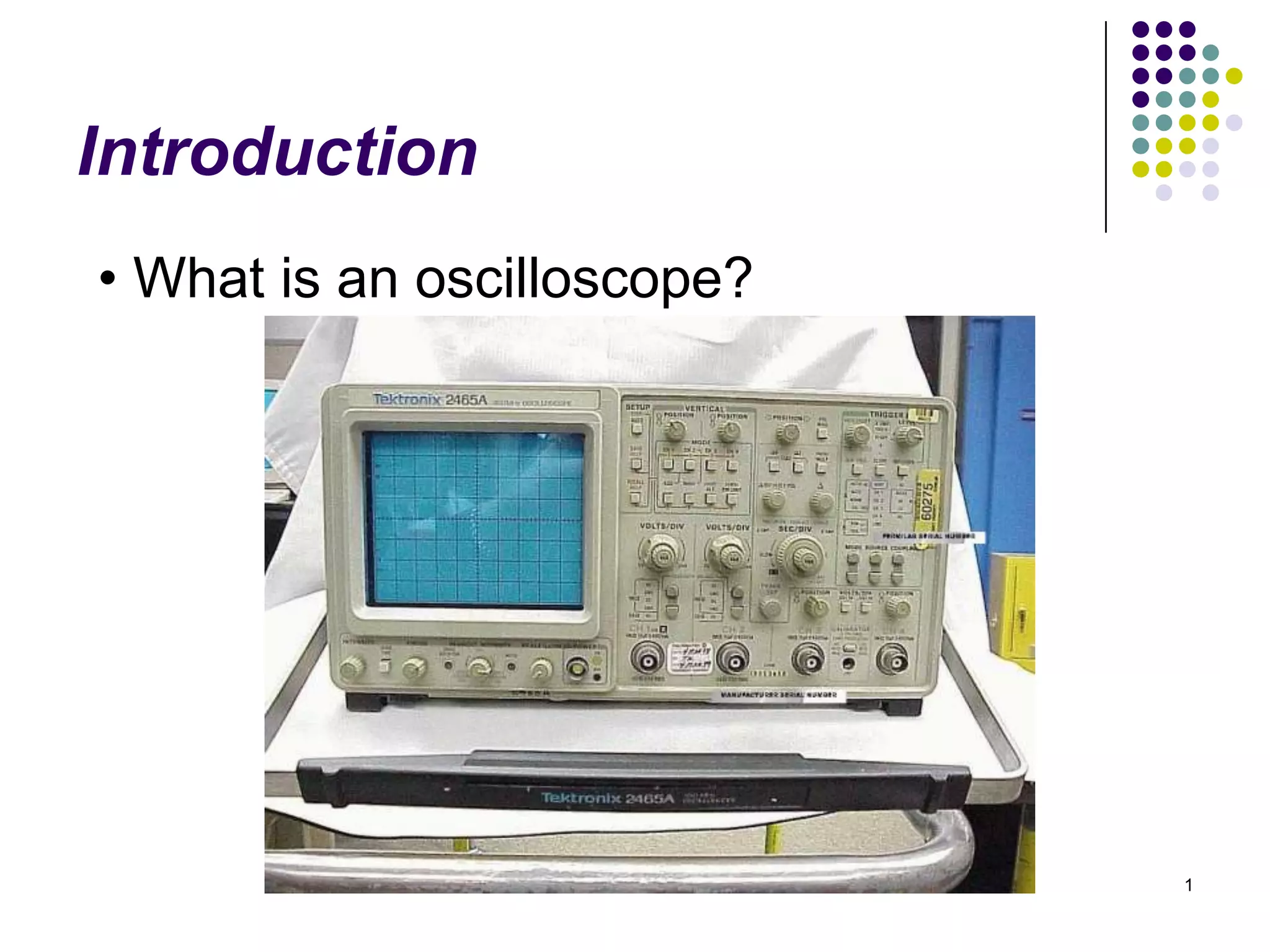
• What is an oscilloscope?

1
Introduction


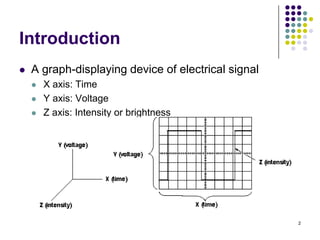
A graph-displaying device of electrical signal




X axis: Time
Y axis: Voltage
Z axis: Intensity or brightness

2
Introduction


Information given by oscilloscopes







Time and voltage
Frequency and phase
DC and AC components
Spectral analysis
Rise and fall time
Mathematical analysis

3
Control panel of an
oscilloscope




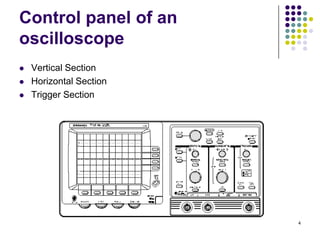
Vertical Section
Horizontal Section
Trigger Section

4
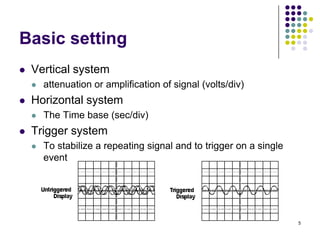
Basic setting


Vertical system




Horizontal system




attenuation or amplification of signal (volts/div)
The Time base (sec/div)

Trigger system


To stabilize a repeating signal and to trigger on a single
event

5
Analog oscilloscope



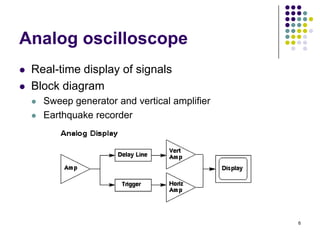
Real-time display of signals
Block diagram



Sweep generator and vertical amplifier
Earthquake recorder

6
Digital oscilloscope


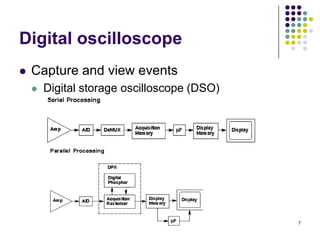
Capture and view events


Digital storage oscilloscope (DSO)

7
Digital oscilloscope (contd.)


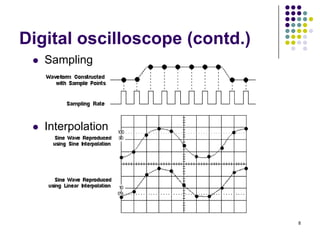
Sampling



Interpolation

8
Advantage of Digital Scope








Trend towards digital.
Easy to use.
One-shot measurement
Recoding
Triggering
Data reuse
Connectivity

9
Probes


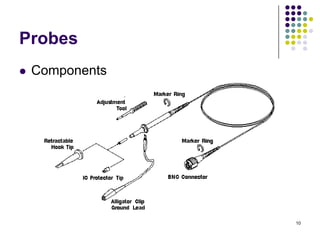
Components

10
Probes
High quality connector
 High impedance (10M )
 50 for high frequency measurement


11
Passive probe




10 attenuation
 Good for low circuit loading
 Suitable to high frequency signal
 Difficult to measure less than 10mV
signals
1 attenuation
 Good for small signals
 Introducing more interference
12
Active probe
Signal conditioning ⇒ oscilloscope
 Require power source
 Good for high speed digital signals over
100MHz clock frequency


13

Oscilloscopes