An introduction to oscilloscopes
http://www.useoscilloscope.com
What is an oscilloscope ?

¤  Oscilloscope are devices made to observe time-varying
    voltage signals

¤  They can be considered as the most important
    measurement devices in any lab

¤  They are used in many domains : engineering, but also
    medicine, and science in general
Basics of measurement

¤  There are different analog quantities we can measure
    with an oscilloscope :
  ¤  Information about the voltage trace : mean value,
      amplitude, maximum value …
  ¤  Information about time : frequency of the signal, some
      oscilloscopes can also directly compute a Fourier transform
      of the signal


¤  Some digital oscilloscopes can also analyze digital
    signals, like decode USB frames
Different kind of oscilloscopes

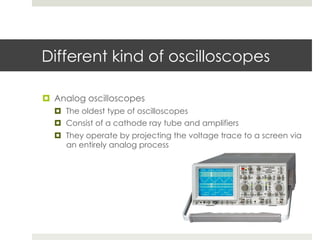
¤  Analog oscilloscopes
  ¤  The oldest type of oscilloscopes
  ¤  Consist of a cathode ray tube and amplifiers
  ¤  They operate by projecting the voltage trace to a screen via
      an entirely analog process
Different kind of oscilloscopes

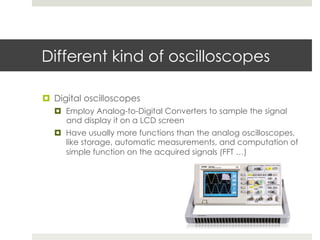
¤  Digital oscilloscopes
   ¤  Employ Analog-to-Digital Converters to sample the signal
       and display it on a LCD screen
   ¤  Have usually more functions than the analog oscilloscopes,
       like storage, automatic measurements, and computation of
       simple function on the acquired signals (FFT …)
Different kind of oscilloscopes

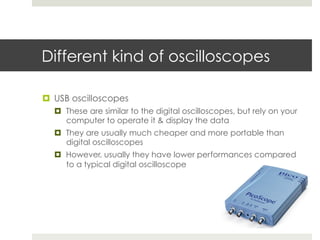
¤  USB oscilloscopes
  ¤  These are similar to the digital oscilloscopes, but rely on your
      computer to operate it & display the data
  ¤  They are usually much cheaper and more portable than
      digital oscilloscopes
  ¤  However, usually they have lower performances compared
      to a typical digital oscilloscope
Main characteristics

¤  As they are the most commonly used today, especially
    for portable oscilloscopes, we will talk about some
    characteristics of digital oscilloscopes

¤  Bandwidth : it is a measure of the maximum frequency
    that can be measured and displayed with the
    oscilloscope. It is usually the frequency at which the
    attenuation reach -3 dB

¤  Sampling rate : the maximum number of measurement
    points per second that the oscilloscope can acquire
Operating your oscilloscope

¤  There are basically two main parameters to set when
    using an oscilloscope : the voltage axis, and the time axis

¤  Setting the voltage axis is done via the volts/div knob. You
    will usually set it to display the voltage trace on the whole
    screen of the oscilloscope.
Operating your oscilloscope

¤  The other knob to set is the time/div knob. If you are
    observing a periodic signal, use it to set the time axis so
    that you see some periods of the signal on the screen.
Thank you !
And find more on our website : http://www.useoscilloscope.com

An introduction to oscilloscopes

  • 1.
    An introduction tooscilloscopes http://www.useoscilloscope.com
  • 2.
    What is anoscilloscope ? ¤  Oscilloscope are devices made to observe time-varying voltage signals ¤  They can be considered as the most important measurement devices in any lab ¤  They are used in many domains : engineering, but also medicine, and science in general
  • 3.
    Basics of measurement ¤ There are different analog quantities we can measure with an oscilloscope : ¤  Information about the voltage trace : mean value, amplitude, maximum value … ¤  Information about time : frequency of the signal, some oscilloscopes can also directly compute a Fourier transform of the signal ¤  Some digital oscilloscopes can also analyze digital signals, like decode USB frames
  • 4.
    Different kind ofoscilloscopes ¤  Analog oscilloscopes ¤  The oldest type of oscilloscopes ¤  Consist of a cathode ray tube and amplifiers ¤  They operate by projecting the voltage trace to a screen via an entirely analog process
  • 5.
    Different kind ofoscilloscopes ¤  Digital oscilloscopes ¤  Employ Analog-to-Digital Converters to sample the signal and display it on a LCD screen ¤  Have usually more functions than the analog oscilloscopes, like storage, automatic measurements, and computation of simple function on the acquired signals (FFT …)
  • 6.
    Different kind ofoscilloscopes ¤  USB oscilloscopes ¤  These are similar to the digital oscilloscopes, but rely on your computer to operate it & display the data ¤  They are usually much cheaper and more portable than digital oscilloscopes ¤  However, usually they have lower performances compared to a typical digital oscilloscope
  • 7.
    Main characteristics ¤  Asthey are the most commonly used today, especially for portable oscilloscopes, we will talk about some characteristics of digital oscilloscopes ¤  Bandwidth : it is a measure of the maximum frequency that can be measured and displayed with the oscilloscope. It is usually the frequency at which the attenuation reach -3 dB ¤  Sampling rate : the maximum number of measurement points per second that the oscilloscope can acquire
  • 8.
    Operating your oscilloscope ¤ There are basically two main parameters to set when using an oscilloscope : the voltage axis, and the time axis ¤  Setting the voltage axis is done via the volts/div knob. You will usually set it to display the voltage trace on the whole screen of the oscilloscope.
  • 9.
    Operating your oscilloscope ¤ The other knob to set is the time/div knob. If you are observing a periodic signal, use it to set the time axis so that you see some periods of the signal on the screen.
  • 10.
    Thank you ! Andfind more on our website : http://www.useoscilloscope.com