UMM-E-ROOMAN YAQOOB
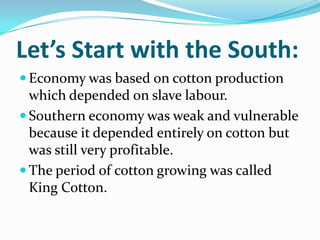
Let’s Start with the South:
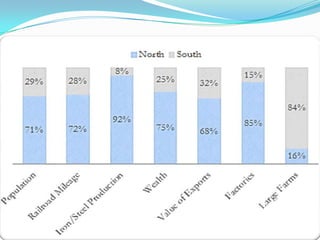
 Economy was based on cotton production
which depended on slave labour.
 Southern economy was weak and vulnerable
because it depended entirely on cotton but
was still very profitable.
 The period of cotton growing was called
King Cotton.
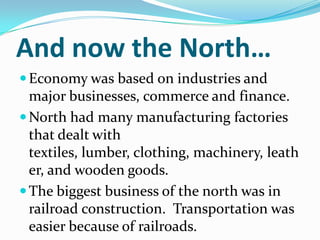
And now the North…
Economy was based on industries and
major businesses, commerce and finance.
North had many manufacturing factories
that dealt with
textiles, lumber, clothing, machinery, leath
er, and wooden goods.
The biggest business of the north was in
railroad construction. Transportation was
easier because of railroads.
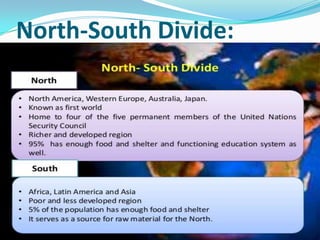
North-South Divide:
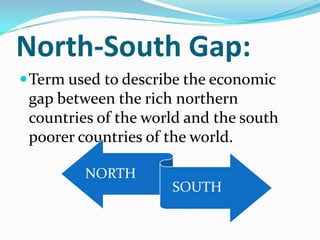
North-South Gap:
Term used to describe the economic
gap between the rich northern
countries of the world and the south
poorer countries of the world.
NORTH
SOUTH
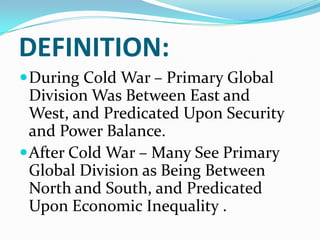
DEFINITION:
During Cold War – Primary Global
Division Was Between East and
West, and Predicated Upon Security
and Power Balance.
After Cold War – Many See Primary
Global Division as Being Between
North and South, and Predicated
Upon Economic Inequality .
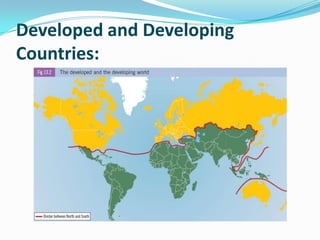
Developed and Developing
Countries:
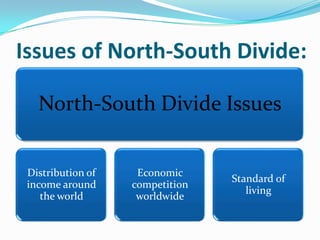
Issues of North-South Divide:
North-South Divide Issues
Distribution of
income around
the world
Economic
competition
worldwide
Standard of
living
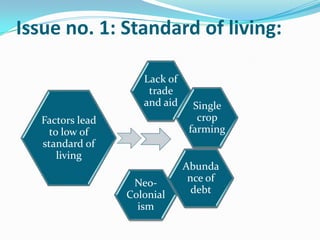
Issue no. 1: Standard of living:
Factors lead
to low of
standard of
living
Lack of
trade
and aid Single
crop
farming
Abunda
nce of
debt
Neo-
Colonial
ism
Issue no.2: Distribution of
income around the world:
 Liberalization of market occurs , most South
countries lost to the competition from the
North.
 Encourage migration of people from South
to North for having a more good income.
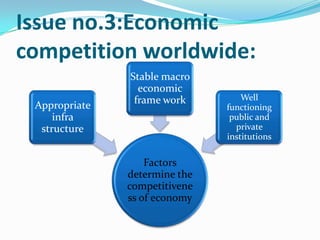
Issue no.3:Economic
competition worldwide:
Factors
determine the
competitivene
ss of economy
Appropriate
infra
structure
Stable macro
economic
frame work Well
functioning
public and
private
institutions
Reasons for development gap:
ENVIRONMENTAL
natural features e.g. soil
HISTORICAL
things which have happen in years before
e.g war
SOCIO – ECONOMIC
society, culture and money e.g religion
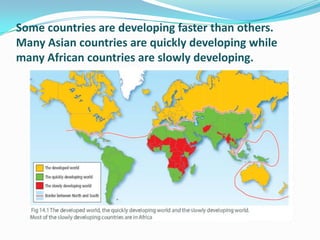
Some countries are developing faster than others.
Many Asian countries are quickly developing while
many African countries are slowly developing.
MAJOR DIFFERENCES
IN NORTH AND SOUTH:-
Some of the major differences in North and South
countries
are as follows:-
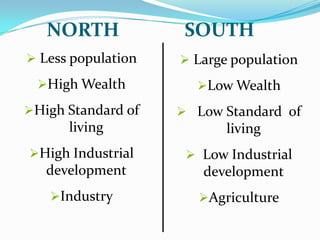
NORTH SOUTH
 Less population
High Wealth
High Standard of
living
High Industrial
development
Industry
 Large population
Low Wealth
 Low Standard of
living
 Low Industrial
development
Agriculture
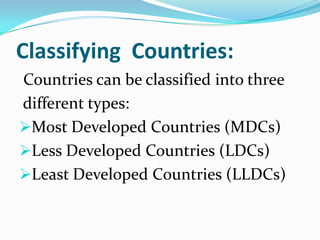
Classifying Countries:
Countries can be classified into three
different types:
Most Developed Countries (MDCs)
Less Developed Countries (LDCs)
Least Developed Countries (LLDCs)
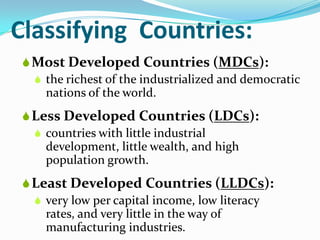
Classifying Countries:
Most Developed Countries (MDCs):
 the richest of the industrialized and democratic
nations of the world.
Less Developed Countries (LDCs):
 countries with little industrial
development, little wealth, and high
population growth.
Least Developed Countries (LLDCs):
 very low per capital income, low literacy
rates, and very little in the way of
manufacturing industries.
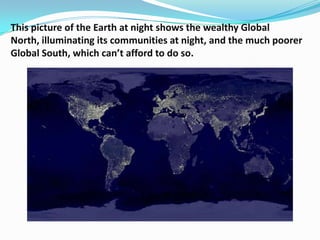
This picture of the Earth at night shows the wealthy Global
North, illuminating its communities at night, and the much poorer
Global South, which can’t afford to do so.
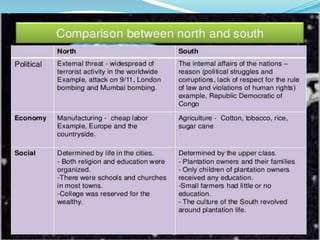
Comparison:
The comparison between North and South is not of
only one aspect . It can be seen through different
angels that is:
• Political
• Economical
• Social
Reasons:
There are 3 main reasons why our world is so
unequal today:
 Colonialism
 Trade
 Debt
Colonialism:
 Today’s North-South gap traces its roots to
the colonization of the Southern world
regions by Europe over the past several
centuries. This colonization occurred at
different times in different parts of the
world, as did decolonization.
 Control by one power over a dependant area
or people.
Trade:
 What you are spending to bring goods into your
country is a greater sum that what you are making
by selling products in the global economy.
 You are loosing money.
 Southern countries suffered from this.
Debt:
 Their products were loosing money in the
global economy, so they needed to increase
production.
 The only way they could do this was to
borrow money from the rich northern
countries.
 This put them in debt.
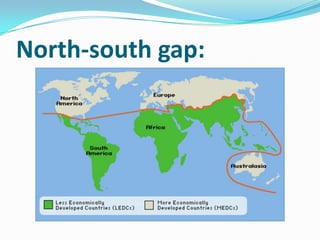
North-south gap:
Division of north and south:
 The North-South Divide (or Rich-Poor Divide) is
the socio-economic and political division that exists
between the wealthy developed countries, known
collectively as “the North,” and the poorer
developing countries (least developed countries), or
“the South.” Although most nations comprising the
“North” are in fact located in the Northern
Hemisphere, the divide is not primarily defined by
geography.
Division of north and south:
 As nations become economically
developed, they may become part of the
“North,” regardless of geographical
location, while any other nations which do
not qualify for “developed” status are in
effect deemed to be part of the “South.”
 “The North” mostly covers the West and the
First World, with much of the Second
World.
Development gap:
 The North-South divide has more recently
been named the development gap. This
places greater emphasis on closing the
evident gap between rich (more
economically developed) countries and poor
(less economically developed countries)
countries.
Globalization:
 In Terms of Economic Development, There
Exists an Enormous Gap Between Northern and
Southern Countries, Which Has Been Increased
By Globalization (Rich Get Richer).
 The process by which regional
economies, societies, and cultures have become
integrated through a global network of political
ideas through communication, transportation, and
trade.
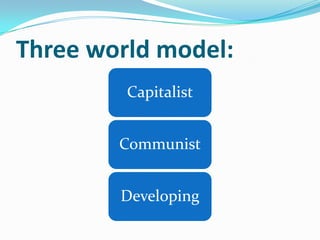
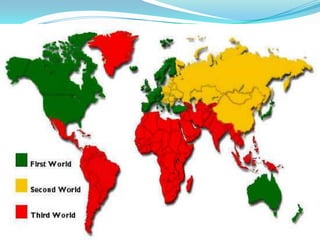
Three world model:
Capitalist
Communist
Developing
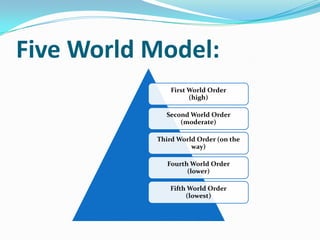
Five World Model:
First World Order
(high)
Second World Order
(moderate)
Third World Order (on the
way)
Fourth World Order
(lower)
Fifth World Order
(lowest)
Why is the gap between the economic
north and south widening?
 The richest 1% of the world’s population now receives as much
income as the poorest 57%.
 Lack of trade.
 Lack of aid.
 Abundance of debt.
 Failure of international organisations (e.g. IMF, World
Bank, WTO).
 Neo-colonialism.
 Adverse climatic conditions.
 The difficulty of transforming the established.
Closing The Gap:
 The United Nations has developed a
program dedicated to narrowing the divide
through its Millennium Development Goals.
This includes improving education and
health care, promoting gender equality, and
ensuring environmental sustainability.
The North-South Gap

The North-South Gap

  • 1.
  • 2.
    Let’s Start withthe South:  Economy was based on cotton production which depended on slave labour.  Southern economy was weak and vulnerable because it depended entirely on cotton but was still very profitable.  The period of cotton growing was called King Cotton.
  • 3.
    And now theNorth… Economy was based on industries and major businesses, commerce and finance. North had many manufacturing factories that dealt with textiles, lumber, clothing, machinery, leath er, and wooden goods. The biggest business of the north was in railroad construction. Transportation was easier because of railroads.
  • 4.
  • 5.
    North-South Gap: Term usedto describe the economic gap between the rich northern countries of the world and the south poorer countries of the world. NORTH SOUTH
  • 6.
    DEFINITION: During Cold War– Primary Global Division Was Between East and West, and Predicated Upon Security and Power Balance. After Cold War – Many See Primary Global Division as Being Between North and South, and Predicated Upon Economic Inequality .
  • 7.
  • 8.
    Issues of North-SouthDivide: North-South Divide Issues Distribution of income around the world Economic competition worldwide Standard of living
  • 9.
    Issue no. 1:Standard of living: Factors lead to low of standard of living Lack of trade and aid Single crop farming Abunda nce of debt Neo- Colonial ism
  • 10.
    Issue no.2: Distributionof income around the world:  Liberalization of market occurs , most South countries lost to the competition from the North.  Encourage migration of people from South to North for having a more good income.
  • 11.
    Issue no.3:Economic competition worldwide: Factors determinethe competitivene ss of economy Appropriate infra structure Stable macro economic frame work Well functioning public and private institutions
  • 12.
    Reasons for developmentgap: ENVIRONMENTAL natural features e.g. soil HISTORICAL things which have happen in years before e.g war SOCIO – ECONOMIC society, culture and money e.g religion
  • 13.
    Some countries aredeveloping faster than others. Many Asian countries are quickly developing while many African countries are slowly developing.
  • 14.
    MAJOR DIFFERENCES IN NORTHAND SOUTH:- Some of the major differences in North and South countries are as follows:-
  • 15.
    NORTH SOUTH  Lesspopulation High Wealth High Standard of living High Industrial development Industry  Large population Low Wealth  Low Standard of living  Low Industrial development Agriculture
  • 17.
    Classifying Countries: Countries canbe classified into three different types: Most Developed Countries (MDCs) Less Developed Countries (LDCs) Least Developed Countries (LLDCs)
  • 18.
    Classifying Countries: Most DevelopedCountries (MDCs):  the richest of the industrialized and democratic nations of the world. Less Developed Countries (LDCs):  countries with little industrial development, little wealth, and high population growth. Least Developed Countries (LLDCs):  very low per capital income, low literacy rates, and very little in the way of manufacturing industries.
  • 19.
    This picture ofthe Earth at night shows the wealthy Global North, illuminating its communities at night, and the much poorer Global South, which can’t afford to do so.
  • 20.
    Comparison: The comparison betweenNorth and South is not of only one aspect . It can be seen through different angels that is: • Political • Economical • Social
  • 22.
    Reasons: There are 3main reasons why our world is so unequal today:  Colonialism  Trade  Debt
  • 23.
    Colonialism:  Today’s North-Southgap traces its roots to the colonization of the Southern world regions by Europe over the past several centuries. This colonization occurred at different times in different parts of the world, as did decolonization.  Control by one power over a dependant area or people.
  • 24.
    Trade:  What youare spending to bring goods into your country is a greater sum that what you are making by selling products in the global economy.  You are loosing money.  Southern countries suffered from this.
  • 25.
    Debt:  Their productswere loosing money in the global economy, so they needed to increase production.  The only way they could do this was to borrow money from the rich northern countries.  This put them in debt.
  • 26.
  • 27.
    Division of northand south:  The North-South Divide (or Rich-Poor Divide) is the socio-economic and political division that exists between the wealthy developed countries, known collectively as “the North,” and the poorer developing countries (least developed countries), or “the South.” Although most nations comprising the “North” are in fact located in the Northern Hemisphere, the divide is not primarily defined by geography.
  • 28.
    Division of northand south:  As nations become economically developed, they may become part of the “North,” regardless of geographical location, while any other nations which do not qualify for “developed” status are in effect deemed to be part of the “South.”  “The North” mostly covers the West and the First World, with much of the Second World.
  • 29.
    Development gap:  TheNorth-South divide has more recently been named the development gap. This places greater emphasis on closing the evident gap between rich (more economically developed) countries and poor (less economically developed countries) countries.
  • 30.
    Globalization:  In Termsof Economic Development, There Exists an Enormous Gap Between Northern and Southern Countries, Which Has Been Increased By Globalization (Rich Get Richer).  The process by which regional economies, societies, and cultures have become integrated through a global network of political ideas through communication, transportation, and trade.
  • 31.
  • 33.
    Five World Model: FirstWorld Order (high) Second World Order (moderate) Third World Order (on the way) Fourth World Order (lower) Fifth World Order (lowest)
  • 34.
    Why is thegap between the economic north and south widening?  The richest 1% of the world’s population now receives as much income as the poorest 57%.  Lack of trade.  Lack of aid.  Abundance of debt.  Failure of international organisations (e.g. IMF, World Bank, WTO).  Neo-colonialism.  Adverse climatic conditions.  The difficulty of transforming the established.
  • 35.
    Closing The Gap: The United Nations has developed a program dedicated to narrowing the divide through its Millennium Development Goals. This includes improving education and health care, promoting gender equality, and ensuring environmental sustainability.