On Political Systems
1
CONTINUUM OF POLITICAL SYSTEMS
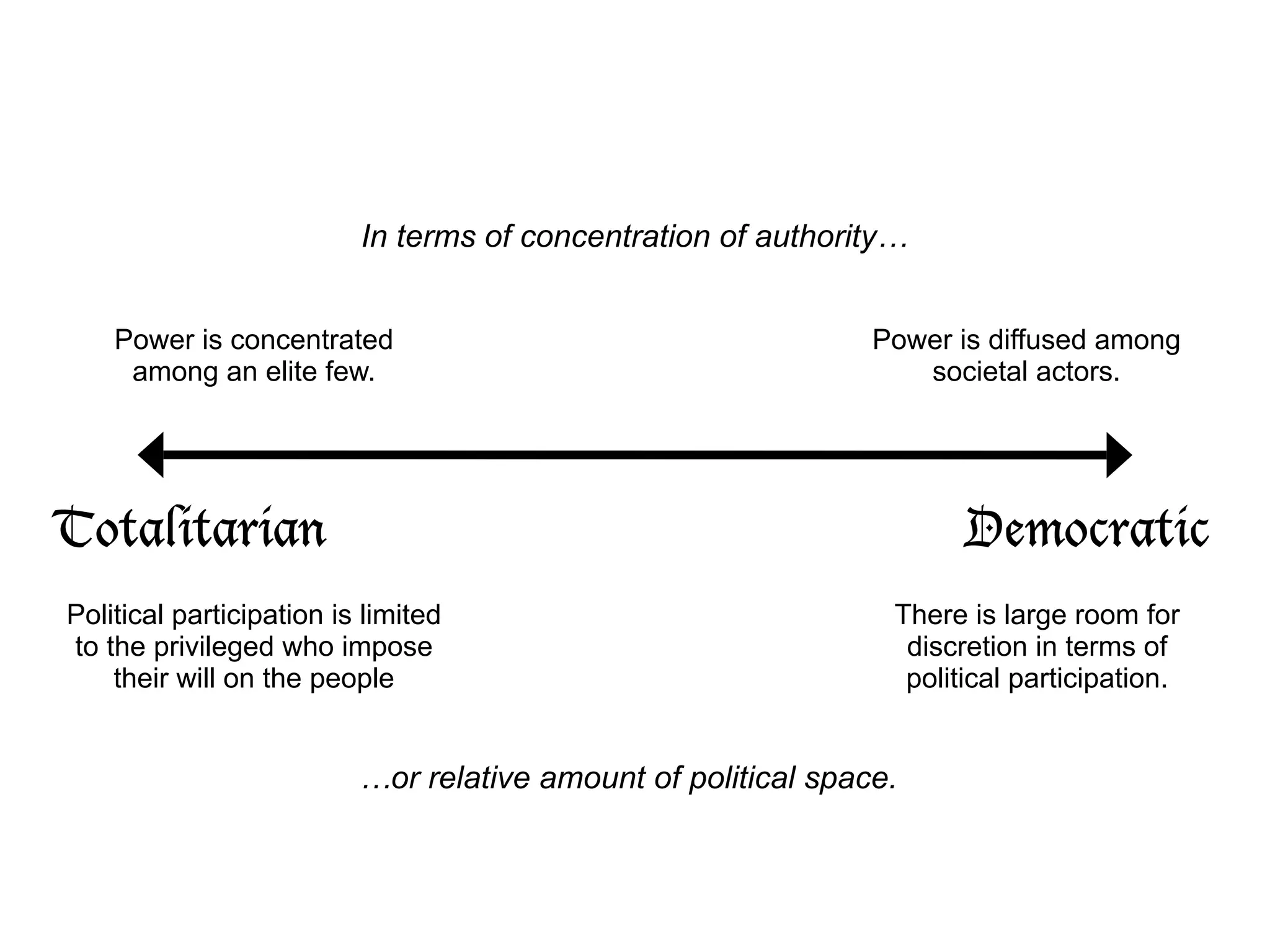
Totalitarian Democratic
In terms of concentration of authority…
Power is concentrated
among an elite few.
Power is diffused among
societal actors.
There is large room for
discretion in terms of
political participation.
Political participation is limited
to the privileged who impose
their will on the people
…or relative amount of political space.
Totalitarian Democratic
“[Authoritarian regimes are] political systems with limited,
non-responsible political pluralism without an elaborated
and guiding ideology, but with distinctive mentalities,
without extensive or intensive political mobilization,
except at some points in their development, and in which
a leader to, occasionally, a small group exercises power
within formally ill-defined, but actually quite predictable
limits.”
(Morlino, 1981: 91)
Juan Linz’s (1964) Definition of Authoritarian Regimes
Westminster (Majoritarian)
Model of Democracy
Consensual
Model of Democracy
Concentration of Power
One-Party, Bare Majority
Cabinet
Power-Sharing Coalition
Executive-Legislative
Relations
Strong Cabinet Durability
Less Durable Executive
Cabinets
Party System Two-Party Multiparty
Party Differentiation One-Dimensional Parties Multidimensional Parties
Method of Election Plurality Proportional Representation
Government Structure Unitary-Centralized Federal-Decentralized
Legislative Structure Unicameral Bicameral
Type of Constitution Unwritten Rigid
Type of Democracy Exclusively Representative Exclusively Direct
Majoritarian vs. Consensual Democracies
Plurality Systems (First-Past-the-Post)
• Winning an election entails getting the most
number of votes among candidates running.
Variations:
1. Bloc Vote
2. Cumulative Vote
3. Limited Vote
4. Single Nontransferable Vote
Majority Systems
• Winning an election entails getting more than half
(i.e. 50% + 1) of votes cast.
Variations:
1. Majority-runoff
2. Majority-plurality
3. Alternative Vote
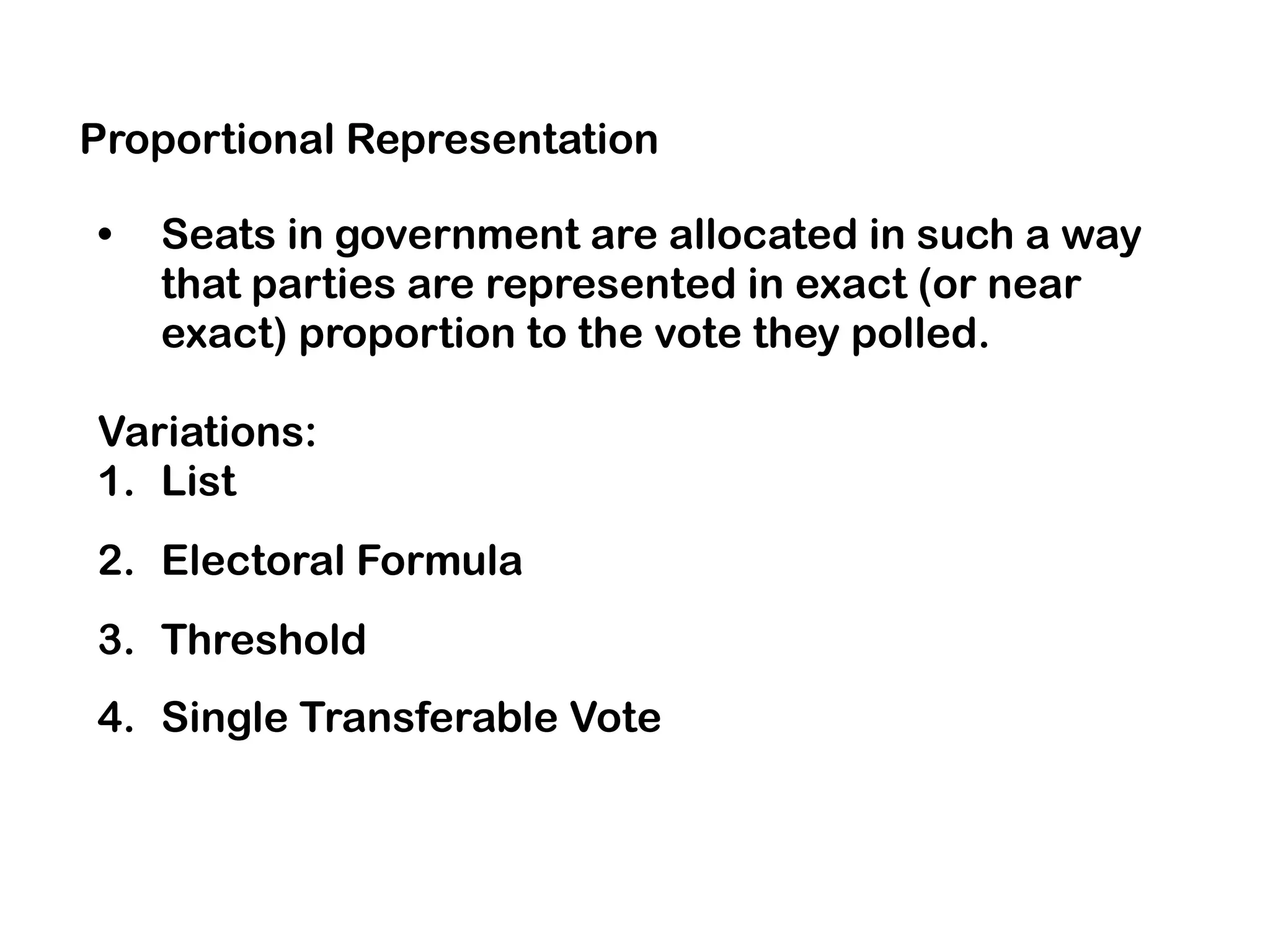
Proportional Representation
• Seats in government are allocated in such a way
that parties are represented in exact (or near
exact) proportion to the vote they polled.
Variations:
1. List
2. Electoral Formula
3. Threshold
4. Single Transferable Vote

Political Systems (Handout)

  • 1.
  • 2.
    CONTINUUM OF POLITICALSYSTEMS Totalitarian Democratic
  • 3.
    In terms ofconcentration of authority… Power is concentrated among an elite few. Power is diffused among societal actors. There is large room for discretion in terms of political participation. Political participation is limited to the privileged who impose their will on the people …or relative amount of political space. Totalitarian Democratic
  • 4.
    “[Authoritarian regimes are]political systems with limited, non-responsible political pluralism without an elaborated and guiding ideology, but with distinctive mentalities, without extensive or intensive political mobilization, except at some points in their development, and in which a leader to, occasionally, a small group exercises power within formally ill-defined, but actually quite predictable limits.” (Morlino, 1981: 91) Juan Linz’s (1964) Definition of Authoritarian Regimes
  • 5.
    Westminster (Majoritarian) Model ofDemocracy Consensual Model of Democracy Concentration of Power One-Party, Bare Majority Cabinet Power-Sharing Coalition Executive-Legislative Relations Strong Cabinet Durability Less Durable Executive Cabinets Party System Two-Party Multiparty Party Differentiation One-Dimensional Parties Multidimensional Parties Method of Election Plurality Proportional Representation Government Structure Unitary-Centralized Federal-Decentralized Legislative Structure Unicameral Bicameral Type of Constitution Unwritten Rigid Type of Democracy Exclusively Representative Exclusively Direct Majoritarian vs. Consensual Democracies
  • 6.
    Plurality Systems (First-Past-the-Post) •Winning an election entails getting the most number of votes among candidates running. Variations: 1. Bloc Vote 2. Cumulative Vote 3. Limited Vote 4. Single Nontransferable Vote
  • 7.
    Majority Systems • Winningan election entails getting more than half (i.e. 50% + 1) of votes cast. Variations: 1. Majority-runoff 2. Majority-plurality 3. Alternative Vote
  • 8.
    Proportional Representation • Seatsin government are allocated in such a way that parties are represented in exact (or near exact) proportion to the vote they polled. Variations: 1. List 2. Electoral Formula 3. Threshold 4. Single Transferable Vote