1
WHAT IS GLOBALIZATION?
• Globalization can be defined as a process of rapid
economic, cultural, and institutional integration among
countries.
• This unification is driven by the liberalization of trade,
investment and capital flow, technological advances, and
pressures for assimilation towards international standards.
• Globalization makes the world more accessible to everyone.
2
TYPES OF GLOBALIZATION
1. Economic: Countries that trade with many others and
have few trade barriers are economically globalized.
2. Social: A measure of how easily information and ideas
pass between people in their own country and between
different countries (includes access to internet and social
media networks).
3.Political: The amount of political co-operation there is
between countries.
3
CAUSES OF GLOBALIZATION
• Trade liberalization
• Improvements in technology
• Reduced cost/improvement of communications and
transportation
• Deregulation of financial markets.
• Increased significance of TNCs (transnational
corporations)
4
TRADE LIBERALIZATION
 Trade liberalization refers to a reduction of trade barriers,
this will open up worldwide markets.
 Trade barriers have fallen since the Second World War.
 New organizations were formed to increase integration –
GATT (General Agreement on Tariffs and Trade, WTO
from 1995)
5
IMPROVEMENTS IN TECHNOLOGY
 Improved technology makes it easier to communicate
and share information around the world.
 The most important development in the recent years is
the internet.
6
REDUCED COST AND IMPROVEMENT OF
COMMUNICATIONS AND TRANSPORTATION.
 Fall in the real cost of transporting goods has allowed
cheaper importation and exportation of goods.
 Decline in the cost of communications has also helped
this.
 Improvements in transportation have also allowed
firms to split up the production process to cash in on
varying cost conditions in different parts of the world.
 This has helped to facilitate the growth of TNCs.
7
DEREGULATION OF FINANCIAL
MARKETS
 There have been moves towards removing restrictions on the
movement of financial capital between countries.
 Many countries have removed capital controls – made it easier
for firms to operate globally.
 Reinforced by developments in technology that enable
financial transactions to be undertaken more quickly and
efficiently – i.e. the Internet.
 Financial markets have increased globalization due to their
being set up in various countries.
 They allow for more interface and communication between
different parts of the world over the trade of financial assets.
8
INCREASED SIGNIFICANCE OF TNCs
 After the Second World War more economic power was
shifted to corporations – accelerated growth.
 TNCs have grown even further due to favorable corporation
tax rates in many countries and tax breaks, as TNCs
supposedly bring in more jobs.
 TNCs partake in foreign direct investment, which increases
the integration of economies.
 Many TNCs want to gain entry to, for example, the EU due
to its single market, and China due to its large and growing
market.
9
EFFECTS OF GLOBALIZATION
10
Globalization has led
to increase in
competition.
11
Globalization causes exchange of technology.
Globalization helps in
knowledge and
information transfer
across the globe.
12
13
Globalization has led to increase in investment levels
and rise in opportunities.
14
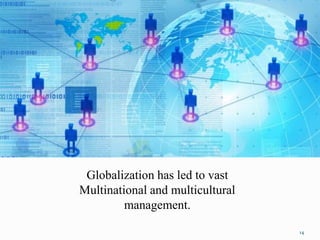
Globalization has led to vast
Multinational and multicultural
management.
15
Globalization leads to Procurement & Outsourcing.
Accenture provides Procurement & Outsourcing services
includes sourcing, demand management,
invoice processing, travel and expense processing, contract
administration and many more.
0
2
4
6
8
10
12
1989 1990 1991 1992 1993 1995 1996 2004 2005 2006 2007
GDP growth rate %
GDP
growth
rate %
16
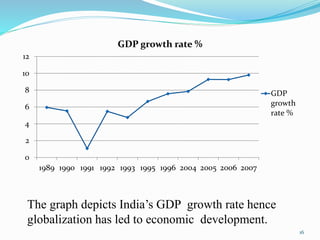
The graph depicts India’s GDP growth rate hence
globalization has led to economic development.
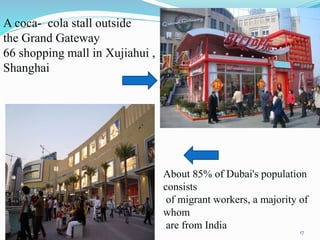
A coca- cola stall outside
the Grand Gateway
66 shopping mall in Xujiahui ,
Shanghai
About 85% of Dubai's population
consists
of migrant workers, a majority of
whom
are from India
17
ADVANTAGES OF GLOBALIZATION
18
Cheaper Goods For Consumers and Better Product Quality:
Increased competitiveness may also lead to
decline in the price of goods, improvements in
quality of goods and choice of goods. 19
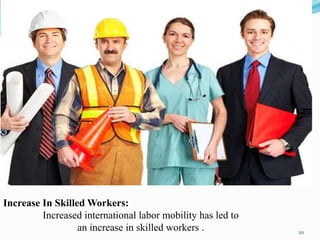
Increase In Skilled Workers:
Increased international labor mobility has led to
an increase in skilled workers . 20
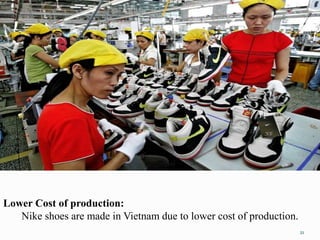
Lower Cost of production:
Nike shoes are made in Vietnam due to lower cost of production.
21
Improvement In Education:
The spread of the internet has helped to improve education.
22
Cultural Diversity:
Increased movement of labor leads to an increase in the spread of
different cultural ideas.
23
Poverty Reduction:
GDP of the developing countries has
increased twice as much as before 24
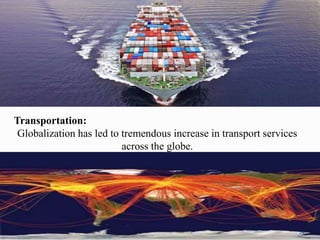
Transportation:
Globalization has led to tremendous increase in transport services
across the globe.
25
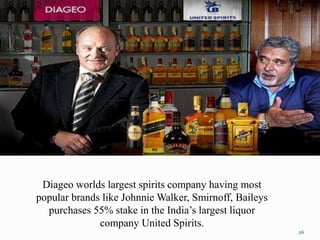
Diageo worlds largest spirits company having most
popular brands like Johnnie Walker, Smirnoff, Baileys
purchases 55% stake in the India’s largest liquor
company United Spirits.
26
DISADVANTAGES OF
GLOBALIZATION
27
Increased Commodity Price:
Prices then and now have increase tremendously.
28
Exploitation Of Cheap Labor:
Workers working day and night to
produce goods for very little money.
29
Cause Of Diseases:
It is the cause of very serious health problems all
over the globe. 30
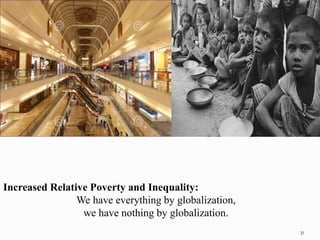
Increased Relative Poverty and Inequality:
We have everything by globalization,
we have nothing by globalization.
31
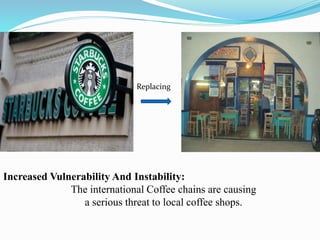
Replacing
Increased Vulnerability And Instability:
The international Coffee chains are causing
a serious threat to local coffee shops.
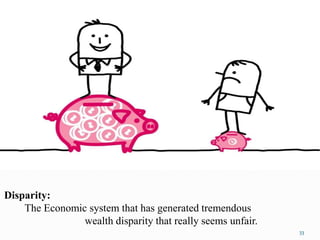
Disparity:
The Economic system that has generated tremendous
wealth disparity that really seems unfair.
33
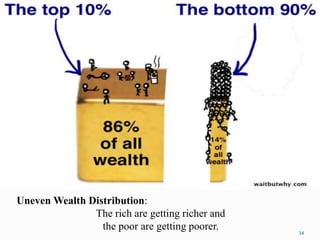
Uneven Wealth Distribution:
The rich are getting richer and
the poor are getting poorer. 34
The local players suffer
huge losses as they lack
the potential to advertise
or export their products on
a large scale. Therefore the
domestic markets shrink.
People are ready to shell out
extra money for a product
that may be available at a
lower price.
This is because of the modern
marketing techniques like
advertising and branding.
35
HOW CAN COMPANIES CAN
ENTER FOREIGN MARKETS?
 Export – Direct & Indirect
 JV - Joint Ventures
 Mergers and Acquisitions
 Licensing, Franchising
 Strategic Alliances
 Management Contracts
 Contract Manufacturing
 FDI – Foreign Direct Investments
36
37
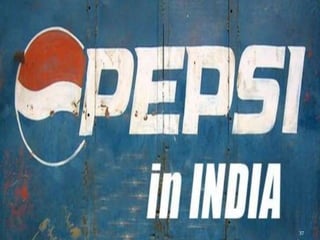
PEPSI’S ENTRY INTO INDIA
 Pepsi, in 1988, tried really hard to enter the Indian
market since they realized that the US market had
seemed to be reaching its saturation level. Also, India
was a market that every MNC wanted to enter due to
the vast population.
 Earlier, in 1977, Coca-Cola had been thrown out of
India.
 In 1980’s economy was marked by high government
interventions which made it even more difficult for
Pepsi to launch in India.
38
A LETTER TO PEPSI
“I learned that you are coming here. I am the one that
threw Coca-
Cola out, and we are soon going to come back into the g
overnment. If you come into the country, you have to re
member that the same fate awaits you as CocaCola."
George Fernandes
The General Secretary – Janta Dal
39
40
41
42
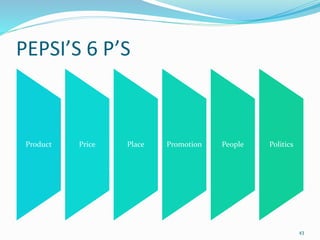
PEPSI’S 6 P’S
Product Price Place Promotion People Politics
43
CONCLUSION
 Globalization is the key factor for international business.
 This new era of globalization brings with it opportunities
and also new considerations and challenges with the
dynamics of a free market.
 Globalization grant access to benefit from the international
division of labor, technologies, international specialization,
inter-cultural exchange and the consumers enjoy a wider
variety of products at lower prices.
 With globalization, there comes a higher level of thinking
and strategizing. Business evolves in new ways.
44
REFERENCES
 http://www.globalization101.org/what-is-
globalization/
 http://www.eolss.net/sample-chapters/c13/e1-45-03-
16.pdf
 http://www.icmrindia.org/casestudies/catalogue/Busi
ness%20Strategy1/Pepsi%20Entry%20into%20India%2
0A%20Lesson%20in%20Globalization.htm
45
BY: L001- HITAKSHI ARORA
L006- YASH BHAKKAD
L007- VARUN BORKAR
46

Globalization

  • 1.
  • 2.
    WHAT IS GLOBALIZATION? •Globalization can be defined as a process of rapid economic, cultural, and institutional integration among countries. • This unification is driven by the liberalization of trade, investment and capital flow, technological advances, and pressures for assimilation towards international standards. • Globalization makes the world more accessible to everyone. 2
  • 3.
    TYPES OF GLOBALIZATION 1.Economic: Countries that trade with many others and have few trade barriers are economically globalized. 2. Social: A measure of how easily information and ideas pass between people in their own country and between different countries (includes access to internet and social media networks). 3.Political: The amount of political co-operation there is between countries. 3
  • 4.
    CAUSES OF GLOBALIZATION •Trade liberalization • Improvements in technology • Reduced cost/improvement of communications and transportation • Deregulation of financial markets. • Increased significance of TNCs (transnational corporations) 4
  • 5.
    TRADE LIBERALIZATION  Tradeliberalization refers to a reduction of trade barriers, this will open up worldwide markets.  Trade barriers have fallen since the Second World War.  New organizations were formed to increase integration – GATT (General Agreement on Tariffs and Trade, WTO from 1995) 5
  • 6.
    IMPROVEMENTS IN TECHNOLOGY Improved technology makes it easier to communicate and share information around the world.  The most important development in the recent years is the internet. 6
  • 7.
    REDUCED COST ANDIMPROVEMENT OF COMMUNICATIONS AND TRANSPORTATION.  Fall in the real cost of transporting goods has allowed cheaper importation and exportation of goods.  Decline in the cost of communications has also helped this.  Improvements in transportation have also allowed firms to split up the production process to cash in on varying cost conditions in different parts of the world.  This has helped to facilitate the growth of TNCs. 7
  • 8.
    DEREGULATION OF FINANCIAL MARKETS There have been moves towards removing restrictions on the movement of financial capital between countries.  Many countries have removed capital controls – made it easier for firms to operate globally.  Reinforced by developments in technology that enable financial transactions to be undertaken more quickly and efficiently – i.e. the Internet.  Financial markets have increased globalization due to their being set up in various countries.  They allow for more interface and communication between different parts of the world over the trade of financial assets. 8
  • 9.
    INCREASED SIGNIFICANCE OFTNCs  After the Second World War more economic power was shifted to corporations – accelerated growth.  TNCs have grown even further due to favorable corporation tax rates in many countries and tax breaks, as TNCs supposedly bring in more jobs.  TNCs partake in foreign direct investment, which increases the integration of economies.  Many TNCs want to gain entry to, for example, the EU due to its single market, and China due to its large and growing market. 9
  • 10.
  • 11.
    Globalization has led toincrease in competition. 11
  • 12.
    Globalization causes exchangeof technology. Globalization helps in knowledge and information transfer across the globe. 12
  • 13.
    13 Globalization has ledto increase in investment levels and rise in opportunities.
  • 14.
    14 Globalization has ledto vast Multinational and multicultural management.
  • 15.
    15 Globalization leads toProcurement & Outsourcing. Accenture provides Procurement & Outsourcing services includes sourcing, demand management, invoice processing, travel and expense processing, contract administration and many more.
  • 16.
    0 2 4 6 8 10 12 1989 1990 19911992 1993 1995 1996 2004 2005 2006 2007 GDP growth rate % GDP growth rate % 16 The graph depicts India’s GDP growth rate hence globalization has led to economic development.
  • 17.
    A coca- colastall outside the Grand Gateway 66 shopping mall in Xujiahui , Shanghai About 85% of Dubai's population consists of migrant workers, a majority of whom are from India 17
  • 18.
  • 19.
    Cheaper Goods ForConsumers and Better Product Quality: Increased competitiveness may also lead to decline in the price of goods, improvements in quality of goods and choice of goods. 19
  • 20.
    Increase In SkilledWorkers: Increased international labor mobility has led to an increase in skilled workers . 20
  • 21.
    Lower Cost ofproduction: Nike shoes are made in Vietnam due to lower cost of production. 21
  • 22.
    Improvement In Education: Thespread of the internet has helped to improve education. 22
  • 23.
    Cultural Diversity: Increased movementof labor leads to an increase in the spread of different cultural ideas. 23
  • 24.
    Poverty Reduction: GDP ofthe developing countries has increased twice as much as before 24
  • 25.
    Transportation: Globalization has ledto tremendous increase in transport services across the globe. 25
  • 26.
    Diageo worlds largestspirits company having most popular brands like Johnnie Walker, Smirnoff, Baileys purchases 55% stake in the India’s largest liquor company United Spirits. 26
  • 27.
  • 28.
    Increased Commodity Price: Pricesthen and now have increase tremendously. 28
  • 29.
    Exploitation Of CheapLabor: Workers working day and night to produce goods for very little money. 29
  • 30.
    Cause Of Diseases: Itis the cause of very serious health problems all over the globe. 30
  • 31.
    Increased Relative Povertyand Inequality: We have everything by globalization, we have nothing by globalization. 31
  • 32.
    Replacing Increased Vulnerability AndInstability: The international Coffee chains are causing a serious threat to local coffee shops.
  • 33.
    Disparity: The Economic systemthat has generated tremendous wealth disparity that really seems unfair. 33
  • 34.
    Uneven Wealth Distribution: Therich are getting richer and the poor are getting poorer. 34
  • 35.
    The local playerssuffer huge losses as they lack the potential to advertise or export their products on a large scale. Therefore the domestic markets shrink. People are ready to shell out extra money for a product that may be available at a lower price. This is because of the modern marketing techniques like advertising and branding. 35
  • 36.
    HOW CAN COMPANIESCAN ENTER FOREIGN MARKETS?  Export – Direct & Indirect  JV - Joint Ventures  Mergers and Acquisitions  Licensing, Franchising  Strategic Alliances  Management Contracts  Contract Manufacturing  FDI – Foreign Direct Investments 36
  • 37.
  • 38.
    PEPSI’S ENTRY INTOINDIA  Pepsi, in 1988, tried really hard to enter the Indian market since they realized that the US market had seemed to be reaching its saturation level. Also, India was a market that every MNC wanted to enter due to the vast population.  Earlier, in 1977, Coca-Cola had been thrown out of India.  In 1980’s economy was marked by high government interventions which made it even more difficult for Pepsi to launch in India. 38
  • 39.
    A LETTER TOPEPSI “I learned that you are coming here. I am the one that threw Coca- Cola out, and we are soon going to come back into the g overnment. If you come into the country, you have to re member that the same fate awaits you as CocaCola." George Fernandes The General Secretary – Janta Dal 39
  • 40.
  • 41.
  • 42.
  • 43.
    PEPSI’S 6 P’S ProductPrice Place Promotion People Politics 43
  • 44.
    CONCLUSION  Globalization isthe key factor for international business.  This new era of globalization brings with it opportunities and also new considerations and challenges with the dynamics of a free market.  Globalization grant access to benefit from the international division of labor, technologies, international specialization, inter-cultural exchange and the consumers enjoy a wider variety of products at lower prices.  With globalization, there comes a higher level of thinking and strategizing. Business evolves in new ways. 44
  • 45.
    REFERENCES  http://www.globalization101.org/what-is- globalization/  http://www.eolss.net/sample-chapters/c13/e1-45-03- 16.pdf http://www.icmrindia.org/casestudies/catalogue/Busi ness%20Strategy1/Pepsi%20Entry%20into%20India%2 0A%20Lesson%20in%20Globalization.htm 45
  • 46.
    BY: L001- HITAKSHIARORA L006- YASH BHAKKAD L007- VARUN BORKAR 46