Sectors of Industry Some trends and explanations...
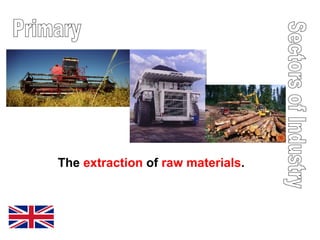
Sectors of Industry Primary The  extraction  of  raw materials .
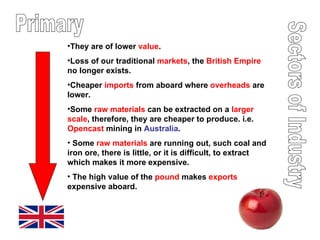
Sectors of Industry Primary They are of lower  value . Loss of our traditional  markets , the  British Empire  no longer exists.  Cheaper  imports  from aboard where  overheads  are lower. Some  raw materials  can be extracted on a  larger scale , therefore, they are cheaper to produce. i.e.  Opencast  mining in  Australia . Some  raw materials  are running out, such coal and iron ore, there is little, or it is difficult, to extract which makes it more expensive. The high value of the  pound  makes  exports  expensive aboard.
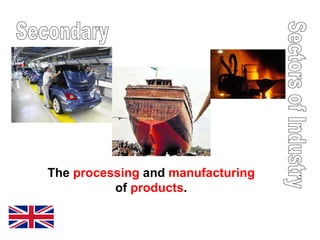
Sectors of Industry Secondary The  processing  and  manufacturing  of  products .
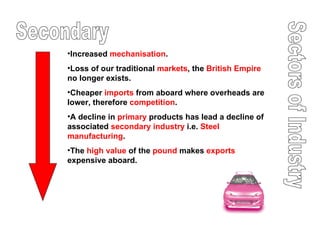
Sectors of Industry Secondary Increased  mechanisation .  Loss of our traditional  markets , the  British Empire  no longer exists.  Cheaper  imports  from aboard where overheads are lower, therefore  competition . A decline in  primary  products has lead a decline of associated  secondary   industry  i.e.  Steel manufacturing . The  high value  of the  pound  makes  exports  expensive aboard.
Sectors of Industry Tertiary Providing a  service .
Tertiary Sectors of Industry Expansion in  employment  in the public sector e.g.  N.H.S. Labour saving devices  mean people have more   time for  leisure and entertainment. People have greater  disposable incomes . The population is increasingly becoming  elderly .
Sectors of Industry Quaternary Innovation ,  research  and  design .
Sectors of Industry Quaternary Increase in demand for  hi-tech consumer products . Hi-tech products  require  research  and  development . This creates greater  demand  for more sophisticated products.

Sectors of Industry

  • 1.
    Sectors of IndustrySome trends and explanations...
  • 2.
    Sectors of IndustryPrimary The extraction of raw materials .
  • 3.
    Sectors of IndustryPrimary They are of lower value . Loss of our traditional markets , the British Empire no longer exists. Cheaper imports from aboard where overheads are lower. Some raw materials can be extracted on a larger scale , therefore, they are cheaper to produce. i.e. Opencast mining in Australia . Some raw materials are running out, such coal and iron ore, there is little, or it is difficult, to extract which makes it more expensive. The high value of the pound makes exports expensive aboard.
  • 4.
    Sectors of IndustrySecondary The processing and manufacturing of products .
  • 5.
    Sectors of IndustrySecondary Increased mechanisation . Loss of our traditional markets , the British Empire no longer exists. Cheaper imports from aboard where overheads are lower, therefore competition . A decline in primary products has lead a decline of associated secondary industry i.e. Steel manufacturing . The high value of the pound makes exports expensive aboard.
  • 6.
    Sectors of IndustryTertiary Providing a service .
  • 7.
    Tertiary Sectors ofIndustry Expansion in employment in the public sector e.g. N.H.S. Labour saving devices mean people have more time for leisure and entertainment. People have greater disposable incomes . The population is increasingly becoming elderly .
  • 8.
    Sectors of IndustryQuaternary Innovation , research and design .
  • 9.
    Sectors of IndustryQuaternary Increase in demand for hi-tech consumer products . Hi-tech products require research and development . This creates greater demand for more sophisticated products.