Umm-e-Rooman Yaqoob (Roll no. 3)
6th Semester
Point of View
Definition:
Pointof viewisthe angle of consideringthings,whichshowsusthe opinion,orfeelingsof the individuals
involvedinasituation.Inliterature,pointof view isthe mode of narrationthatan author employstolet
the readers“hear” and“see”what takesplace ina story, poem, essay etc.
Pointof viewisa reflectionof the opinionanindividual fromreal life orfictioncanhave.
Function of Point of View:
Pointof viewisan integral tool of descriptioninthe author’shandstoportraypersonal emotionsor
characters’feelingsaboutanexperience orsituation.Writersuse apointof view toexpresseffectively
whattheywant to conveytotheirreaders.
Examples:
Examplesof pointof viewbelongtoone of these three majorkinds:
1. First personpointof viewinvolvesthe use of eitherof the twopronouns“I”and “we”.
“I feltlike Iwasgettingdrownedwithshame anddisgrace.”
2. Secondpersonpointof viewemploysthe pronoun“you”.
“Sometimes youcannotclearlydiscernbetweenangerandfrustration.”
3. Third personpointof viewusespronounslike“he”,“she”,“it”,“they”ora name.
“Mr. Stewart isa principledman. He acts by the bookand neverletsyoudeceive himeasily.”
Example
Notice howWilliamWordsworthusesthe firstpersonpointof view toexpresshissubjectivefeelings
aboutthe scene of daffodilsinhisfamouspoem“Daffodils”.
“I gazed–andgazed–butlittle thought
What wealththe showto me had brought.”
The use of the pronoun“I” givesa special qualitytothe feelingsexpressedinthese lines.The readercan
see that the poethas employedfirstpersonpointof view toshare withushisownpersonal emotions.
Who's Doing the Talking?
I Am
If the narrator referstohimor herself as I or me, you'll know the storyisbeingtoldfroma first person
POV.First personnarratorsare characters inside the story,andwill provide mostof the narrative.
You Are
If the narrator speaksdirectlytothe readeras you,the story isin the secondperson POV.Second
personPOV isusedmore rarelyinliterature;however,one famousexample isinJayMcInerney's
novel BrightLightsBig City.
She/he Is
If the narrator refersto all characters inthe storyas he or she,and knowstheirthoughtsandseestheir
actionsevenwhenthey're alone,the storyisinthe third person POV.VariationsonthirdpersonPOV
are below.
Let's Put That in Writing
Let's sayyou've writtenastory that openswithyourmaincharacter goingoutfor coffee.
In the first personPOV,your narrator mightsay: I'vecome to this coffeeshop so often,thebarista
knowsme.
Your narrator in the secondperson POV mightsay somethinglikethis: You'vecometo this coffeeshop
so often,thebaristaknowsyou.
The third person POV knowswhatall the characters are thinking.Thisnarratormightreportwhat
someone sittingatthe table inthe coffee shopisthinking: Hehascome to thiscoffeeshop so often,the
baristaknowshim.
Point ofView
Point ofView List of Pronouns Typical WritingOccasions
1st Person
(Typicallywhere
studentsuse
their"SpokenVoice";in
most cases 1st person
shouldbe avoided)
I, me,mine,myself,we,
us,ours, ourselves
-A Personal narrative
-Itcan be appropriate ina formal
academicessayONLYWHEN giving a
specificpersonal experience as a
formof argumentative evidence
2nd Person
(Thisis NEVER
appropriate in the
formal academic essay)
You, yours,yourself,
yourselves
-A letteror email
-A writtenspeechorpublicaddress
-Directions(pamphlets,etc.)
3rd Person
(Typicallywhere
studentsuse their
"WrittenVoice";thisIS
appropriate)
he,she,it,him, her,his,
hers,himself,herself,
itself,they,themtheirs,
themselves
-Formal academicwriting,including:
Argumentative, Summary/Response,
Compare/Contrast,Expository
Essays,Descriptive Narrative,
Research

Point of view

  • 1.
    Umm-e-Rooman Yaqoob (Rollno. 3) 6th Semester Point of View Definition: Pointof viewisthe angle of consideringthings,whichshowsusthe opinion,orfeelingsof the individuals involvedinasituation.Inliterature,pointof view isthe mode of narrationthatan author employstolet the readers“hear” and“see”what takesplace ina story, poem, essay etc. Pointof viewisa reflectionof the opinionanindividual fromreal life orfictioncanhave. Function of Point of View: Pointof viewisan integral tool of descriptioninthe author’shandstoportraypersonal emotionsor characters’feelingsaboutanexperience orsituation.Writersuse apointof view toexpresseffectively whattheywant to conveytotheirreaders. Examples: Examplesof pointof viewbelongtoone of these three majorkinds: 1. First personpointof viewinvolvesthe use of eitherof the twopronouns“I”and “we”. “I feltlike Iwasgettingdrownedwithshame anddisgrace.” 2. Secondpersonpointof viewemploysthe pronoun“you”. “Sometimes youcannotclearlydiscernbetweenangerandfrustration.” 3. Third personpointof viewusespronounslike“he”,“she”,“it”,“they”ora name. “Mr. Stewart isa principledman. He acts by the bookand neverletsyoudeceive himeasily.” Example Notice howWilliamWordsworthusesthe firstpersonpointof view toexpresshissubjectivefeelings aboutthe scene of daffodilsinhisfamouspoem“Daffodils”. “I gazed–andgazed–butlittle thought What wealththe showto me had brought.” The use of the pronoun“I” givesa special qualitytothe feelingsexpressedinthese lines.The readercan see that the poethas employedfirstpersonpointof view toshare withushisownpersonal emotions.
  • 2.
    Who's Doing theTalking? I Am If the narrator referstohimor herself as I or me, you'll know the storyisbeingtoldfroma first person POV.First personnarratorsare characters inside the story,andwill provide mostof the narrative. You Are If the narrator speaksdirectlytothe readeras you,the story isin the secondperson POV.Second personPOV isusedmore rarelyinliterature;however,one famousexample isinJayMcInerney's novel BrightLightsBig City. She/he Is If the narrator refersto all characters inthe storyas he or she,and knowstheirthoughtsandseestheir actionsevenwhenthey're alone,the storyisinthe third person POV.VariationsonthirdpersonPOV are below. Let's Put That in Writing Let's sayyou've writtenastory that openswithyourmaincharacter goingoutfor coffee. In the first personPOV,your narrator mightsay: I'vecome to this coffeeshop so often,thebarista knowsme. Your narrator in the secondperson POV mightsay somethinglikethis: You'vecometo this coffeeshop so often,thebaristaknowsyou. The third person POV knowswhatall the characters are thinking.Thisnarratormightreportwhat someone sittingatthe table inthe coffee shopisthinking: Hehascome to thiscoffeeshop so often,the baristaknowshim.
  • 3.
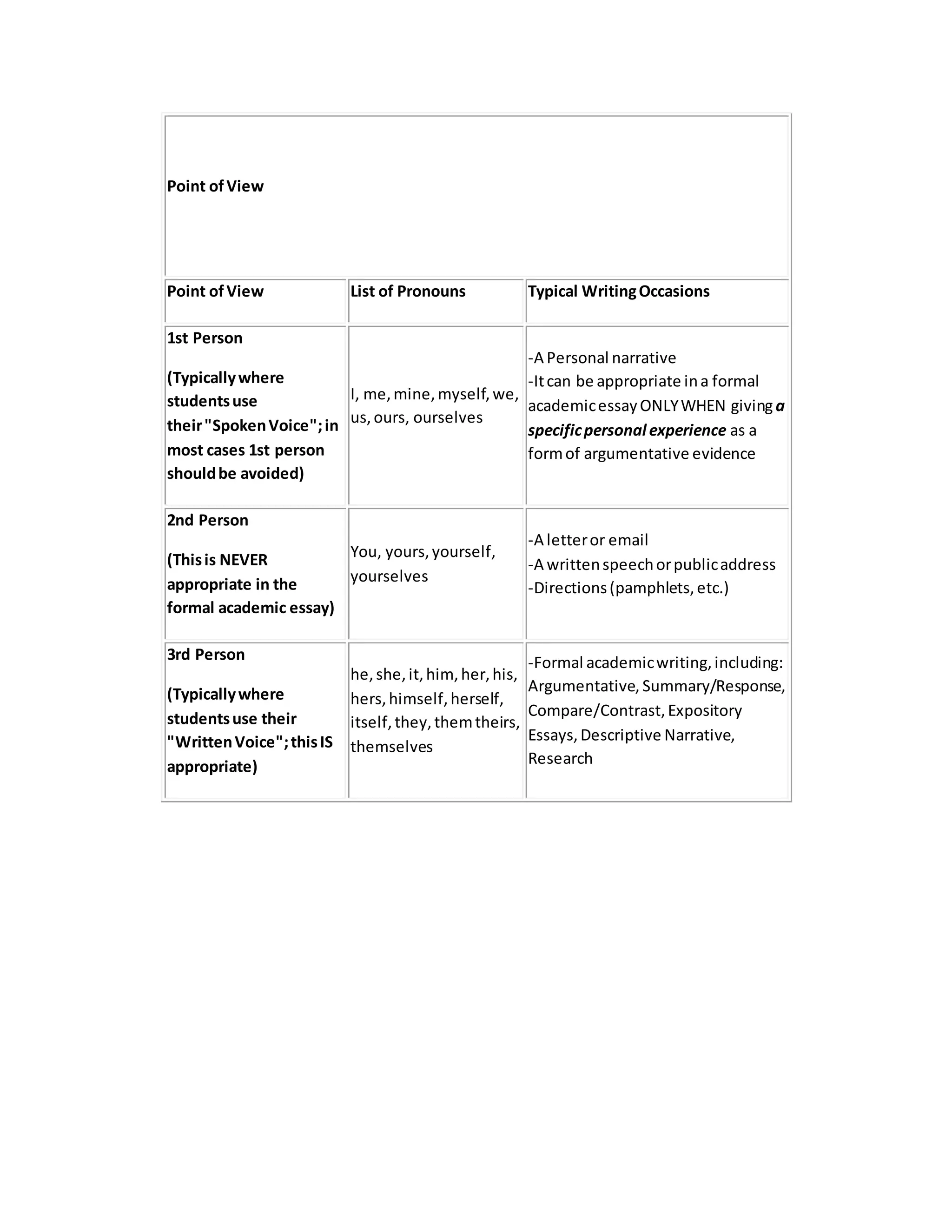
    Point ofView Point ofViewList of Pronouns Typical WritingOccasions 1st Person (Typicallywhere studentsuse their"SpokenVoice";in most cases 1st person shouldbe avoided) I, me,mine,myself,we, us,ours, ourselves -A Personal narrative -Itcan be appropriate ina formal academicessayONLYWHEN giving a specificpersonal experience as a formof argumentative evidence 2nd Person (Thisis NEVER appropriate in the formal academic essay) You, yours,yourself, yourselves -A letteror email -A writtenspeechorpublicaddress -Directions(pamphlets,etc.) 3rd Person (Typicallywhere studentsuse their "WrittenVoice";thisIS appropriate) he,she,it,him, her,his, hers,himself,herself, itself,they,themtheirs, themselves -Formal academicwriting,including: Argumentative, Summary/Response, Compare/Contrast,Expository Essays,Descriptive Narrative, Research