Umm-e-Rooman Yaqoob
Roll no. 3
B.S (English) 6th semester
Drama
Drama:
Drama is the specific mode of narrative, typically fictional, represented in performance. The
term comes from the Greek word meaning action or to act. The enactment of drama in theatre,
performed by actors on a stage before an audience, presupposes collaborative modes of
production and a collective form of reception.
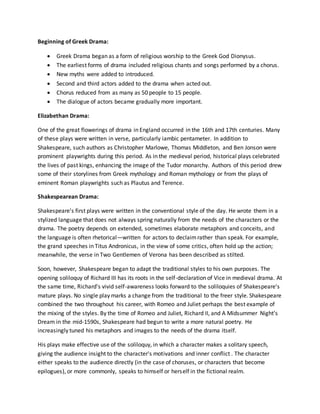
The two masks associated with drama represent the traditional generic division between
comedy and tragedy. They are symbols of the ancient Greek Muses, Thalia and Melpomene, the
Muse of comedy represented by the laughing face, and the Muse of tragedy represented by the
weeping face, respectively. Considered as a genre of poetry in general, the dramatic mode has
been contrasted with the epic and the lyrical modes ever since Aristotle's Poetics (c. 335 BC)—
the earliest work of dramatic theory.
Origin of Drama:
The word drama comes from the Greek meaning “to act, do or perform”, and it is inthe several
subtle and diverse meanings of “to perform” that drama can be said tohave begun.
The Greeks were the very first to have dramas. Between 600 and 200 BC (Twenty-five hundred
years ago) was when the Western theatre was born in Athens, Greece. The ancient Athenians
theatre culture is still around and used today. The Greek created plays that are still considers
the world’s greatest works of drama. The Athenians thought that the ideas for the dramas came
from one of their gods called Dionysus.
Beginning of Greek Drama:
 Greek Drama began as a form of religious worship to the Greek God Dionysus.
 The earliest forms of drama included religious chants and songs performed by a chorus.
 New myths were added to introduced.
 Second and third actors added to the drama when acted out.
 Chorus reduced from as many as 50 people to 15 people.
 The dialogue of actors became gradually more important.
Elizabethan Drama:
One of the great flowerings of drama in England occurred in the 16th and 17th centuries. Many
of these plays were written in verse, particularly iambic pentameter. In addition to
Shakespeare, such authors as Christopher Marlowe, Thomas Middleton, and Ben Jonson were
prominent playwrights during this period. As in the medieval period, historical plays celebrated
the lives of past kings, enhancing the image of the Tudor monarchy. Authors of this period drew
some of their storylines from Greek mythology and Roman mythology or from the plays of
eminent Roman playwrights such as Plautus and Terence.
Shakespearean Drama:
Shakespeare's first plays were written in the conventional style of the day. He wrote them in a
stylized language that does not always spring naturally from the needs of the characters or the
drama. The poetry depends on extended, sometimes elaborate metaphors and conceits, and
the language is often rhetorical—written for actors to declaimrather than speak. For example,
the grand speeches in Titus Andronicus, in the view of some critics, often hold up the action;
meanwhile, the verse in Two Gentlemen of Verona has been described as stilted.
Soon, however, Shakespeare began to adapt the traditional styles to his own purposes. The
opening soliloquy of Richard III has its roots in the self-declaration of Vice in medieval drama. At
the same time, Richard's vivid self-awareness looks forward to the soliloquies of Shakespeare's
mature plays. No single play marks a change from the traditional to the freer style. Shakespeare
combined the two throughout his career, with Romeo and Juliet perhaps the best example of
the mixing of the styles. By the time of Romeo and Juliet, Richard II, and A Midsummer Night's
Dream in the mid-1590s, Shakespeare had begun to write a more natural poetry. He
increasingly tuned his metaphors and images to the needs of the drama itself.
His plays make effective use of the soliloquy, in which a character makes a solitary speech,
giving the audience insight to the character's motivations and inner conflict . The character
either speaks to the audience directly (in the case of choruses, or characters that become
epilogues), or more commonly, speaks to himself or herself in the fictional realm.
Categories of Drama:
Drama was broadly categorized into three different forms, viz. opera, pantomime, and creative
drama. We explain them in the following points.
 Opera was accepted warmly during the Renaissance period due to its versatility. Theater
and music were in perfect harmony, and the actors displayed exceptional acting and
singing skills.
 Pantomimes were composed keeping the theme of folk tales as the primary element,
and symbolism occupied a prominent position. It was organized in the form of masques,
where characters wore elaborate costumes and makeup.
 Creative drama is the modern version of drama, which was popularized mostly by
youngsters, possessing innate acting skills. Stage shows and theaters were organized in
schools and colleges, which provided a platform for students to exhibit their talent.
No matter what the form, every drama contained some basic elements. The components of
drama are: theme, plot, audio-visual effects, and music. All these elements must be
synchronized perfectly for creating a masterpiece.
Types of Drama:
o Comedy – Comedies are lighter in tone than ordinary writers, and provide a happy
conclusion. The intention of dramatists in comedies is to make their audience laugh.
Hence, they use quaint circumstances, unusual characters and witty remarks.
o Tragedy – Tragic dramas use darker themes such as disaster, pain and death.
Protagonists often have a tragic flaw—a characteristic that leads them to their downfall.
o Farce – Generally, a farce is a nonsensical genre of drama, which often overacts or
engages slapstick humor.
o Melodrama – Melodrama is an exaggerated drama, which is sensational and appeals
directly to the senses of audience. Just like the farce, the characters are of single
dimension and simple, or may be stereotyped.
o Musical Drama – In musical drama, the dramatists not only tell their story through
acting and dialogue, nevertheless through dance as well as music. Often the story may
be comedic, though it may also involve serious subjects.