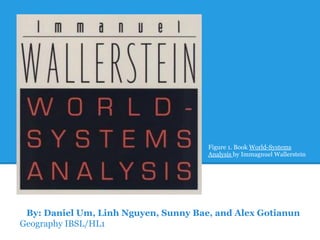
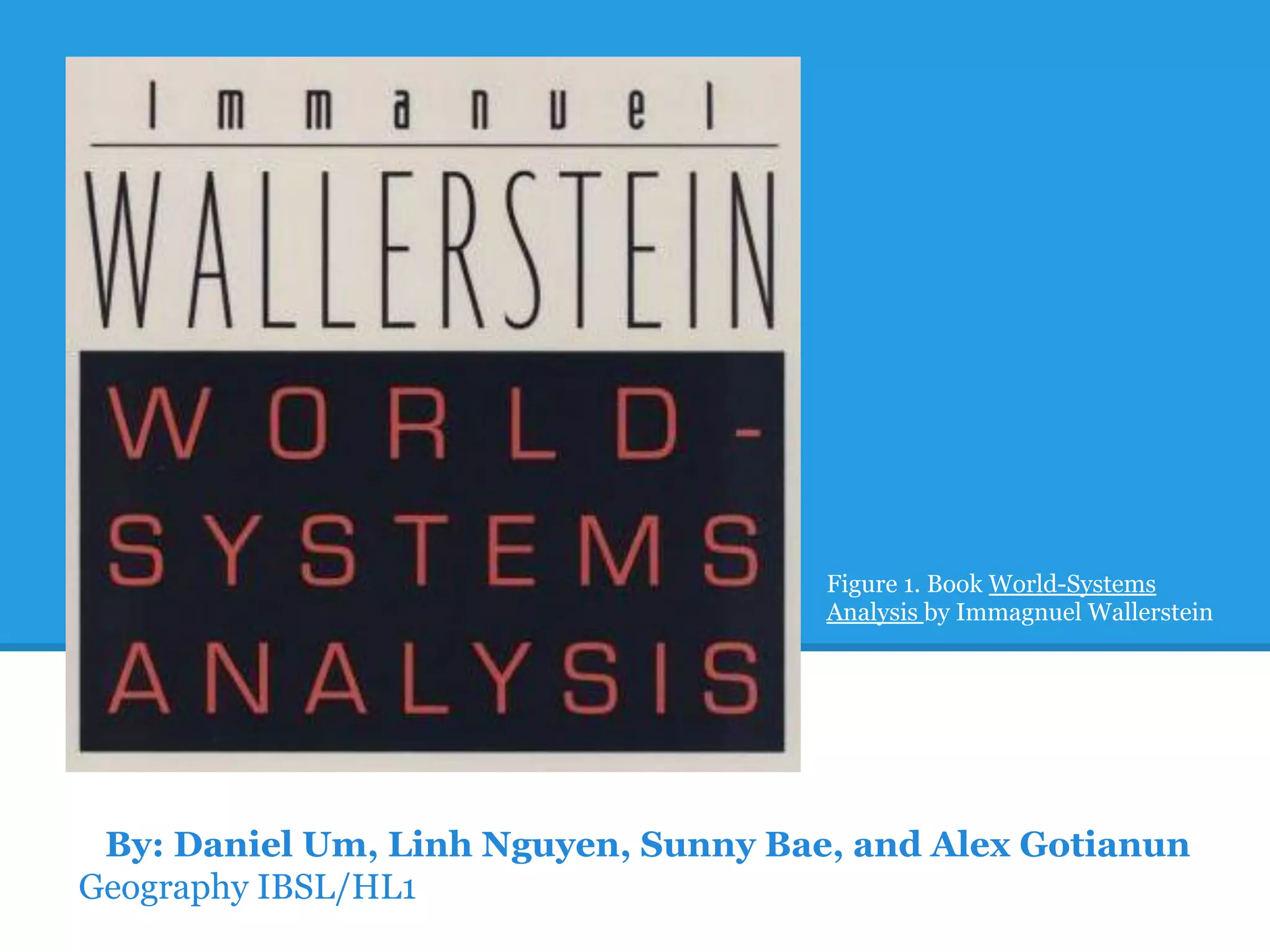
Figure 1. Book World-Systems
                                      Analysis by Immagnuel Wallerstein


 By: Daniel Um, Linh Nguyen, Sunny Bae, and Alex Gotianun
Geography IBSL/HL1
Describe the Theory
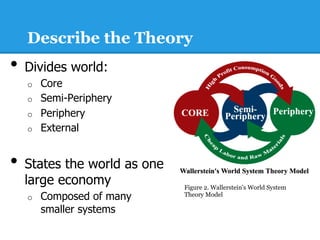
•  Divides world:
   o    Core
   o    Semi-Periphery
   o    Periphery
   o    External


•  States the world as one
  large economy              Figure 2. Wallerstein's World System
   o    Composed of many     Theory Model

        smaller systems
Explain Reasoning
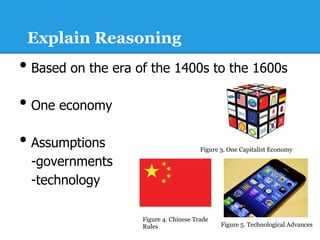
•  Based on the era of the 1400s to the 1600s
•  One economy
•  Assumptions                          Figure 3. One Capitalist Economy

  -governments
  -technology

                    Figure 4. Chinese Trade
                    Rules                      Figure 5. Technological Advances
Apply to Examples
  (Case Studies)
Core
strong centralized government
Northwestern Europe e.g.
  England, France, Holland
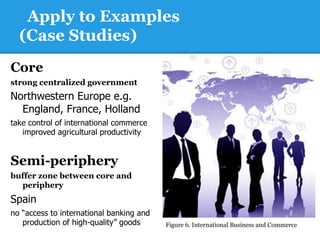
take control of international commerce
   improved agricultural productivity


Semi-periphery
buffer zone between core and
  periphery
Spain
no “access to international banking and
   production of high-quality” goods      Figure 6. International Business and Commerce
Apply to Examples
(Case Studies)

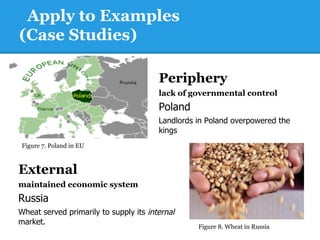
                                        Periphery
                                        lack of governmental control
                                        Poland
                                        Landlords in Poland overpowered the
                                        kings
Figure 7. Poland in EU


External
maintained economic system
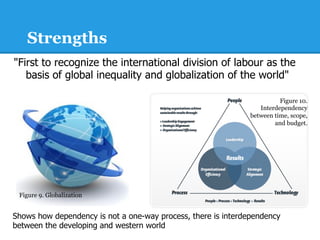
Russia
Wheat served primarily to supply its internal
market.
                                                  Figure 8. Wheat in Russia
Strengths
"First to recognize the international division of labour as the
   basis of global inequality and globalization of the world"

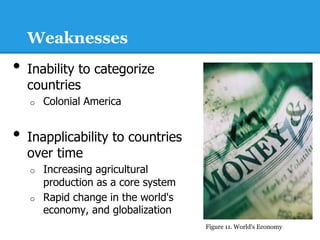
                                                                         Figure 10.
                                                                  Interdependency
                                                               between time, scope,
                                                                       and budget.


 Figure 9. Globalization


Shows how dependency is not a one-way process, there is interdependency
between the developing and western world
Weaknesses
•  Inability to categorize
  countries
   o    Colonial America


•  Inapplicability to countries
  over time
   o    Increasing agricultural
        production as a core system
   o    Rapid change in the world's
        economy, and globalization
                                      Figure 11. World's Economy
Works Cited
Chen, Kathy. "Wallerstein’s World Economic System Theory." Industrial America Day. Igitur-archive.library, 01 Feb. 2010. Web. 7 Oct. 2012. <http://
      www.andrew.cmu.edu/user/kathyc/files/written/wallerstein.pdf>


Goldfrank, Walter L. "Paradigm Regained? The Rules Of Wallerstein’s World-System Method." Department of Sociology. University of California, Santa Cruz, 2000.
      Web. 5 Oct. 2012. <http://jwsr.ucr.edu/archive/vol6/number2/pdf/jwsr-v6n2-goldfrank.pdf>.

      Halsall, Paul. "Internet History Sourcebooks." Fordham University. Internet History Sourcebooks, 1997. Web. 05 Oct. 2012. <http://www.fordham.edu/
      halsall/mod/Wallerstein.asp>.


KILEMBE, BUSEKESE MATTHEWS PENSTON. "RE-VISIONING MARXISM IN WORLD POLITICS." Department of Global Political Studies. Malmö University, Spring
     2010. Web. 5 Oct. 2012. <http://dspace.mah.se/bitstream/handle/2043/10224/RE-VISIONING_MARXISM_IN_WORLD_POLITICS.pdf>.


Network. "International Business Ethics." Content NetworkBooks. Technical Analysis Blog, 7 Aug. 2012. Web. 07 Oct. 2012. <http://contentnetworkbooks.com/
     tag/international-business-2>.


"Our Approach." Technology Alliance Partners. Http://www.techap.net/ourapproach.html, 2009. Web. 07 Oct. 2012. <http://www.techap.net/ourapproach.html>.


"Polish Pierogi Aka Pierogies –probably the Most Popular Polish Food Ever." Tasting Poland, n.d. Web. 07 Oct. 2012. <http://www.tastingpoland.com/food/
       pierogi.html>.


Rodrigue, Dr. Jean-Paul. "Core / Periphery Division of the World." Core / Periphery Division of the World. N.p., 2012. Web. 07 Oct. 2012. <http://
      people.hofstra.edu/geotrans/eng/ch2en/conc2en/coreperiphery.html>.


Wallerstein, Immanuel. "World-Systems Analysis." Google Books. A John Hope Franklin Center Book - Duke University Press, 2004. Web. 05 Oct. 2012. <http://
      books.google.com.ph/books?id=5vGr7kRsXBkC>.


"World-System Theory." The Globalization Website - Theories. Frank Lechner, 2001. Web. 05 Oct. 2012. <http://www.sociology.emory.edu/globalization/
      theories01.html>.


"WORLD SYSTEM THEORY." Wahyusetyaningrum. Wordpress, 6 Apr. 2012. Web. 05 Oct. 2012. http://wahyusetyaningrum.wordpress.com/2012/04/06/5/

Wallerstein's World Systems Analysis

  • 1.
    Figure 1. BookWorld-Systems Analysis by Immagnuel Wallerstein By: Daniel Um, Linh Nguyen, Sunny Bae, and Alex Gotianun Geography IBSL/HL1
  • 2.
    Describe the Theory • Divides world: o  Core o  Semi-Periphery o  Periphery o  External •  States the world as one large economy Figure 2. Wallerstein's World System o  Composed of many Theory Model smaller systems
  • 3.
    Explain Reasoning •  Basedon the era of the 1400s to the 1600s •  One economy •  Assumptions Figure 3. One Capitalist Economy -governments -technology Figure 4. Chinese Trade Rules Figure 5. Technological Advances
  • 4.
    Apply to Examples (Case Studies) Core strong centralized government Northwestern Europe e.g. England, France, Holland take control of international commerce improved agricultural productivity Semi-periphery buffer zone between core and periphery Spain no “access to international banking and production of high-quality” goods Figure 6. International Business and Commerce
  • 5.
    Apply to Examples (CaseStudies) Periphery lack of governmental control Poland Landlords in Poland overpowered the kings Figure 7. Poland in EU External maintained economic system Russia Wheat served primarily to supply its internal market. Figure 8. Wheat in Russia
  • 6.
    Strengths "First to recognizethe international division of labour as the basis of global inequality and globalization of the world" Figure 10. Interdependency between time, scope, and budget. Figure 9. Globalization Shows how dependency is not a one-way process, there is interdependency between the developing and western world
  • 7.
    Weaknesses •  Inability tocategorize countries o  Colonial America •  Inapplicability to countries over time o  Increasing agricultural production as a core system o  Rapid change in the world's economy, and globalization Figure 11. World's Economy
  • 8.
    Works Cited Chen, Kathy."Wallerstein’s World Economic System Theory." Industrial America Day. Igitur-archive.library, 01 Feb. 2010. Web. 7 Oct. 2012. <http:// www.andrew.cmu.edu/user/kathyc/files/written/wallerstein.pdf> Goldfrank, Walter L. "Paradigm Regained? The Rules Of Wallerstein’s World-System Method." Department of Sociology. University of California, Santa Cruz, 2000. Web. 5 Oct. 2012. <http://jwsr.ucr.edu/archive/vol6/number2/pdf/jwsr-v6n2-goldfrank.pdf>. Halsall, Paul. "Internet History Sourcebooks." Fordham University. Internet History Sourcebooks, 1997. Web. 05 Oct. 2012. <http://www.fordham.edu/ halsall/mod/Wallerstein.asp>. KILEMBE, BUSEKESE MATTHEWS PENSTON. "RE-VISIONING MARXISM IN WORLD POLITICS." Department of Global Political Studies. Malmö University, Spring 2010. Web. 5 Oct. 2012. <http://dspace.mah.se/bitstream/handle/2043/10224/RE-VISIONING_MARXISM_IN_WORLD_POLITICS.pdf>. Network. "International Business Ethics." Content NetworkBooks. Technical Analysis Blog, 7 Aug. 2012. Web. 07 Oct. 2012. <http://contentnetworkbooks.com/ tag/international-business-2>. "Our Approach." Technology Alliance Partners. Http://www.techap.net/ourapproach.html, 2009. Web. 07 Oct. 2012. <http://www.techap.net/ourapproach.html>. "Polish Pierogi Aka Pierogies –probably the Most Popular Polish Food Ever." Tasting Poland, n.d. Web. 07 Oct. 2012. <http://www.tastingpoland.com/food/ pierogi.html>. Rodrigue, Dr. Jean-Paul. "Core / Periphery Division of the World." Core / Periphery Division of the World. N.p., 2012. Web. 07 Oct. 2012. <http:// people.hofstra.edu/geotrans/eng/ch2en/conc2en/coreperiphery.html>. Wallerstein, Immanuel. "World-Systems Analysis." Google Books. A John Hope Franklin Center Book - Duke University Press, 2004. Web. 05 Oct. 2012. <http:// books.google.com.ph/books?id=5vGr7kRsXBkC>. "World-System Theory." The Globalization Website - Theories. Frank Lechner, 2001. Web. 05 Oct. 2012. <http://www.sociology.emory.edu/globalization/ theories01.html>. "WORLD SYSTEM THEORY." Wahyusetyaningrum. Wordpress, 6 Apr. 2012. Web. 05 Oct. 2012. http://wahyusetyaningrum.wordpress.com/2012/04/06/5/