THE GLOBAL DIVIDE
Presentation title 1
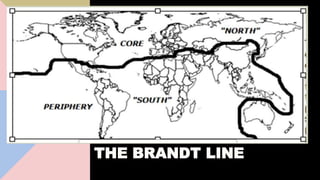
In the 1980s, the Brandt Line was
developed as a way of showing how
the world is geographically split into
relatively richer or poorer nations.
Presentation title 3
Willy Brandt was a
German politician
anda statesman who
was leader of the
Social Democratic
Party of Germany
from 1964 to 1987
and served as the
chancellor of West
Germany from 1969
to 1974.
THE BRANDT LINE
Presentation title 4
Almost all richer countries are
located in the northern hemisphere;
poorer countries in the southern
hemisphere.
The terms the North
and the South, when
used in a global context,
are alternative
designations for
developed and
developing countries,
respectively.
The North-South Divide
is broadly considered as
socio-economic division.
6
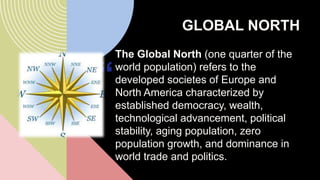
GLOBAL NORTH
“
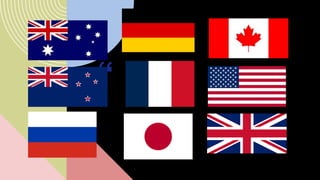
The Global North (one quarter of the
world population) refers to the
developed societes of Europe and
North America characterized by
established democracy, wealth,
technological advancement, political
stability, aging population, zero
population growth, and dominance in
world trade and politics.
“
 overconsumption and food wastage
 widespread poverty (Ireland and
UK)
 expensive healthcare
 increasing rate of mental health
problems
GLOBAL NORTH DILEMMAS
“
GLOBAL SOUTH
“
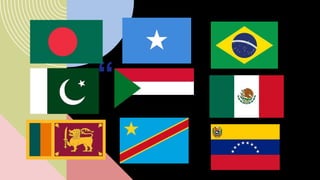
The Global South (three quarters of
the world population) mainly represent
the agrarian countries Africa, India,
China, and Latin America. developed
societes of Europe and North America
characterized by established
democracy, wealth, technological
advancement, political stability, aging
population, zero population growth,
and dominance in world trade and
“
GLOBAL SOUTH DILEMMAS
“
 poverty
 lack of resources
 lack of human rights
 Lack of job opportunities
 Expensive healthcare
 depletion and abuse of natural
resources
 overpopulation
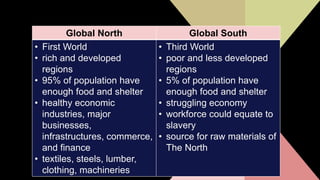
Global North Global South
• First World
• rich and developed
regions
• 95% of population have
enough food and shelter
• healthy economic
industries, major
businesses,
infrastructures, commerce,
and finance
• textiles, steels, lumber,
clothing, machineries
• Third World
• poor and less developed
regions
• 5% of population have
enough food and shelter
• struggling economy
• workforce could equate to
slavery
• source for raw materials of
The North
Global North Global South
• less population
• high wealth
• high standard of living
• high industrial
development
• industries
• large population
• low wealth
• low standard of living
• low industrial
development
• agriculture
MAJOR DIFFERENCES
Presentation title 15
The comparison of North and South is not
of only one aspect. It can be seen through
different angles:
North South
Political external threat -
-- widespread
of terrorist
activities in the
world
internal affairs ---
political struggles,
corruption, lack of
respect for a rule
of law, human
rights violations
Economi
c
industrial agricultural
Presentation title 16
Social • determined by
the life in the
cities
• Both religion
and education
are organic.
• schools and
churches in
most towns
• Tertiary is
reserved for
the wealthy.
• determined by
the upper class
• plantations
owned by
families
• Education is for
the haves.
• Culture of The
South revolves
around
agricultural life.

The Global Divide.pptx

  • 1.
  • 2.
    In the 1980s,the Brandt Line was developed as a way of showing how the world is geographically split into relatively richer or poorer nations.
  • 3.
    Presentation title 3 WillyBrandt was a German politician anda statesman who was leader of the Social Democratic Party of Germany from 1964 to 1987 and served as the chancellor of West Germany from 1969 to 1974.
  • 4.
  • 5.
    Almost all richercountries are located in the northern hemisphere; poorer countries in the southern hemisphere.
  • 6.
    The terms theNorth and the South, when used in a global context, are alternative designations for developed and developing countries, respectively. The North-South Divide is broadly considered as socio-economic division. 6
  • 7.
    GLOBAL NORTH “ The GlobalNorth (one quarter of the world population) refers to the developed societes of Europe and North America characterized by established democracy, wealth, technological advancement, political stability, aging population, zero population growth, and dominance in world trade and politics.
  • 8.
  • 9.
     overconsumption andfood wastage  widespread poverty (Ireland and UK)  expensive healthcare  increasing rate of mental health problems GLOBAL NORTH DILEMMAS “
  • 10.
    GLOBAL SOUTH “ The GlobalSouth (three quarters of the world population) mainly represent the agrarian countries Africa, India, China, and Latin America. developed societes of Europe and North America characterized by established democracy, wealth, technological advancement, political stability, aging population, zero population growth, and dominance in world trade and
  • 11.
  • 12.
    GLOBAL SOUTH DILEMMAS “ poverty  lack of resources  lack of human rights  Lack of job opportunities  Expensive healthcare  depletion and abuse of natural resources  overpopulation
  • 13.
    Global North GlobalSouth • First World • rich and developed regions • 95% of population have enough food and shelter • healthy economic industries, major businesses, infrastructures, commerce, and finance • textiles, steels, lumber, clothing, machineries • Third World • poor and less developed regions • 5% of population have enough food and shelter • struggling economy • workforce could equate to slavery • source for raw materials of The North
  • 14.
    Global North GlobalSouth • less population • high wealth • high standard of living • high industrial development • industries • large population • low wealth • low standard of living • low industrial development • agriculture MAJOR DIFFERENCES
  • 15.
    Presentation title 15 Thecomparison of North and South is not of only one aspect. It can be seen through different angles: North South Political external threat - -- widespread of terrorist activities in the world internal affairs --- political struggles, corruption, lack of respect for a rule of law, human rights violations Economi c industrial agricultural
  • 16.
    Presentation title 16 Social• determined by the life in the cities • Both religion and education are organic. • schools and churches in most towns • Tertiary is reserved for the wealthy. • determined by the upper class • plantations owned by families • Education is for the haves. • Culture of The South revolves around agricultural life.