Global
Divides
Global Divides
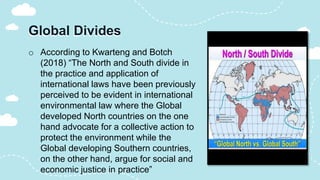
o It divide the world in half
geographically.
o The Global North contains all countries
North of the Equator in the Northern
Hemisphere while Global South holds
all the countries in the Southern
Hemisphere.
Global Divides
o According to Kwarteng and Botch
(2018) “The North and South divide in
the practice and application of
international laws have been previously
perceived to be evident in international
environmental law where the Global
developed North countries on the one
hand advocate for a collective action to
protect the environment while the
Global developing Southern countries,
on the other hand, argue for social and
economic justice in practice”
THE GAP BETWEEN THE NORTH AND
SOUTH
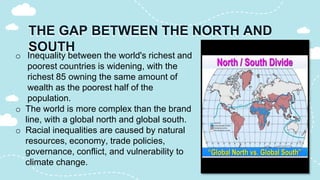
o Inequality between the world's richest and
poorest countries is widening, with the
richest 85 owning the same amount of
wealth as the poorest half of the
population.
o The world is more complex than the brand
line, with a global north and global south.
o Racial inequalities are caused by natural
resources, economy, trade policies,
governance, conflict, and vulnerability to
climate change.
What is Global South?
o The nations of the world which are
regarded as having a relatively low level
of economic and industrial development
and are typically located to the south of
move industrialized nation.
o Global south have been unable to evolve
an indigenous technology appropriate to
their own resources and have been
dependent on powerful Global north
multinational corporation (MNCs) to
transfer technical know-how.
Mahler (2017) coined three primary
definitions of global south.
1. It is traditionally been used
within intergovernmental
developmental organization.
2. Primarily those that
originated in the non-aligned
movement.
3. To refer to economically
disadvantage nation states and as
a post-cold war alternative to
"Third-world".
Global South
o Captures a deterritorialized geography
of capitalism’s externalities and means
to account for subjugated peoples within
the borders of wealthier countries, such
that there are economic Souths in the
geographic North and Norths in the
geographic South.
o Refers to the resistant imaginary of a
transnational political subject that results
from a shared experience of subjugation
under contemporary global capitalism.
o Refers broadly to the regions of
Latin America, Asia, Africa, and
Oceania. It is one of a family of
terms, including “Third World” and
“Periphery,” that denote regions
outside Europe and North
America, mostly (though not all)
low-income and often politically or
culturally marginalized.
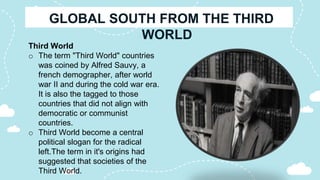
Third World
o The term "Third World" countries
was coined by Alfred Sauvy, a
french demographer, after world
war II and during the cold war era.
It is also the tagged to those
countries that did not align with
democratic or communist
countries.
o Third World become a central
political slogan for the radical
left.The term in it's origins had
suggested that societies of the
Third World.
 Olaf Kaltmeier
o He is Managing Director of the
Center for InterAmerican Studies
(CIAS) at Bielefeld
University,
GLOBAL SOUTH by Olaf Kaltmeier
o The term Global South has been
of great benefit in re-introducing
studies on Africa, Asia, and Latin
America into the academic field.
o The end of the "Third World" has
been proclaimed, which has led to
a significant reduction of studies
on these areas.
o After the end of the bipolar world,
and in the context of an
accelerated globalization process,
Area Studies - especially on the
so called Third- World countries -
have been displaced by Global
Studies.
o Nevertheless, the concept of the
Global South shares some of the
limitations of the concept of the
Third World.
o Areas incorporated under the
label Global South can also be
found in the geographical
North.
o Ethnic ghettos and barrios in
US American cities are one
example; the "Latinoization" of
the US is another.
Asian
Regionalism
Regionalism
o an approach to study the behavior
that emphasizes the geographical
region as the unit of analysis,
stressing the relationship between
man and his immediate physical
environment.
o Economic social and cultural
organisations are analyzed in
terms of their interrelationships
and functions within the
geographic region“ -W.P. Scott.
o Regionalism conveys the sense of
intentional, top-down region-building-
moving inter-governmental collaboration.
o Regionalization on the other hand, refers
to the growing density of interaction and co-
operation between neighboring countries.
o But for He and Inoguchi (2011),
Regionalism is an inspirational and
revolutionary volving the reorganization of
political, economic, cultural, and social lives
along the lines of magined region rather
than according to the standard political unit
of the nation-state.
Marshall E. Dimock considers regionalism "as a
clustering of environmental economic, social and
governmental factors to such an extent that a distinct
consciousness of separate identity within the whole,
a need for autonomous planning, a manifestation of
cultural peculiarities and a desire for administrative
freedom, are theoretically recognized and actually
put into effect. Regionalism is something which
remains to be realized and further developed, as well
as a phenomenon which has already appeared and
taken form. In one sense, and perhaps the best one,
regionalism is a way of life, it is a self-conscious
process."
Regionalism
o The process through which geographical
regions becomes significant politics and/or
economics units serving as the basis for
cooperation and possible identity whereas.
Globalization
o The interconnectedness and
interdependence of states, forming a
process of international integration
arising from the interchange of world
views, products, ideas, and other aspects
of culture.
Benefits of Regionalism
According to ADB report (2008), the following are benefits of Asia from regionalism, namely;
1. Link the competitive strengths of its diverse economies in order to boost their productivity and
sustain the regions exceptional growth;
2. Connect the regions capital market to enhance financial stability, reduce the cost of capital,
and improve opportunities for sharing risks;
3. Cooperate in setting exchange rate and macroeconomic policies in order to minimize the
effects of global and regional shocks and to facilitate the resolution of global imbalances;
4. Pool the regions foreign exchange reserves to make sure resources available for investment
and development;
5. Exercise leadership in global decision making to sustain the open global trade and financial
systems that have supported a half century of unparalleled economic development;
6. Build connected infrastructure and collaborate on inclusive development to reduce inequalities
within and across economies and thus to strengthen support for pro-growth policies; and
7. Create regional mechanisms to manage cross-border health, safety, and environmental
issues better.
Conversely, ADB (2008) further stated the benefits of the world to Asian
regionalism are as follows:
1. Generate productivity gains, new ideas, and competition that boost
economic growth and raise incomes across the world;
2. Contribute to the efficiency and stability of global financial markets by
making Asian capital markets stronger and safer, and by maximizing the
productive use of Asian savings;
3. Diversify sources of global demand, helping to stabilize the world
economy and diminish the risks posed by global imbalances and
downturns in other major economies;
4. Provide leadership to help sustain open global trade and financial
systems; and
5. Create regional mechanisms to manage health, safety, and
environmental issues better, and thus contribute to more effective global
solutions of these problems.
Characteristics of Regionalism
o Local Identity.
Strong local identity and a loyalty to the region. Politicians and many residents
feel pride in the local culture and its people. Politicians try to exploit that
identity to gain supporters for their proposals. They often claim that the
regional interest should always come before the national interest. Moreover,
emphasizes local development and well-being, at times without considering
other regions. Thus, the supporters commonly argue that their region suffers
unfair or discriminatory treatments from the national government and that, by
focusing on local issues, the region will do better, economically and socially.
Accordingly, if all regions do the same, the nation will benefit as a whole.
o The search of greater autonomy is usually a of regionalism. It
can be economic, in the form of more power to administer
economic resources and modify fiscal policies; it can also be
political, with stronger local institutions and the ability to pass
laws and enforce local policies. A regional political party,
however, is not automatically a form of regionalism. One group
that only exists in a certain region might promote local agendas
without looking for greater regional autonomy.
1. Regionalism is a psychic
phenomenon.
2. It is built around as an expression of
group identity, as well as loyalty to the
region.
3. It presupposes the concept of
development of one’s own region without
taking into consideration the interest of
other region.
4. It prohibits people from other regions
to be benefitted by a particular region.
1. Trade. The World economy is intertwined with each other
whether we like it or not. We all want something from another part
of the world, and Global trade facilitates that.
2. Similar culture. The culture of Asia is diverse but they do share
many things. this makes it an easier fit during times of negotiations.
3. Common goals. The Asian region recognize the mutual benefit
of a slow integration . The territories involve are not far from each
other and the industriousness of it's population can work as a
powerful negotiating block against those from other parts of the
world .

CONTEMPORARY WORLD PPT.pptx

  • 1.
  • 2.
    Global Divides o Itdivide the world in half geographically. o The Global North contains all countries North of the Equator in the Northern Hemisphere while Global South holds all the countries in the Southern Hemisphere.
  • 3.
    Global Divides o Accordingto Kwarteng and Botch (2018) “The North and South divide in the practice and application of international laws have been previously perceived to be evident in international environmental law where the Global developed North countries on the one hand advocate for a collective action to protect the environment while the Global developing Southern countries, on the other hand, argue for social and economic justice in practice”
  • 4.
    THE GAP BETWEENTHE NORTH AND SOUTH o Inequality between the world's richest and poorest countries is widening, with the richest 85 owning the same amount of wealth as the poorest half of the population. o The world is more complex than the brand line, with a global north and global south. o Racial inequalities are caused by natural resources, economy, trade policies, governance, conflict, and vulnerability to climate change.
  • 5.
    What is GlobalSouth? o The nations of the world which are regarded as having a relatively low level of economic and industrial development and are typically located to the south of move industrialized nation. o Global south have been unable to evolve an indigenous technology appropriate to their own resources and have been dependent on powerful Global north multinational corporation (MNCs) to transfer technical know-how.
  • 6.
    Mahler (2017) coinedthree primary definitions of global south. 1. It is traditionally been used within intergovernmental developmental organization. 2. Primarily those that originated in the non-aligned movement. 3. To refer to economically disadvantage nation states and as a post-cold war alternative to "Third-world".
  • 7.
    Global South o Capturesa deterritorialized geography of capitalism’s externalities and means to account for subjugated peoples within the borders of wealthier countries, such that there are economic Souths in the geographic North and Norths in the geographic South. o Refers to the resistant imaginary of a transnational political subject that results from a shared experience of subjugation under contemporary global capitalism.
  • 8.
    o Refers broadlyto the regions of Latin America, Asia, Africa, and Oceania. It is one of a family of terms, including “Third World” and “Periphery,” that denote regions outside Europe and North America, mostly (though not all) low-income and often politically or culturally marginalized.
  • 9.
    Third World o Theterm "Third World" countries was coined by Alfred Sauvy, a french demographer, after world war II and during the cold war era. It is also the tagged to those countries that did not align with democratic or communist countries. o Third World become a central political slogan for the radical left.The term in it's origins had suggested that societies of the Third World.
  • 10.
     Olaf Kaltmeier oHe is Managing Director of the Center for InterAmerican Studies (CIAS) at Bielefeld University, GLOBAL SOUTH by Olaf Kaltmeier
  • 11.
    o The termGlobal South has been of great benefit in re-introducing studies on Africa, Asia, and Latin America into the academic field. o The end of the "Third World" has been proclaimed, which has led to a significant reduction of studies on these areas.
  • 12.
    o After theend of the bipolar world, and in the context of an accelerated globalization process, Area Studies - especially on the so called Third- World countries - have been displaced by Global Studies. o Nevertheless, the concept of the Global South shares some of the limitations of the concept of the Third World.
  • 13.
    o Areas incorporatedunder the label Global South can also be found in the geographical North. o Ethnic ghettos and barrios in US American cities are one example; the "Latinoization" of the US is another.
  • 14.
  • 15.
    Regionalism o an approachto study the behavior that emphasizes the geographical region as the unit of analysis, stressing the relationship between man and his immediate physical environment. o Economic social and cultural organisations are analyzed in terms of their interrelationships and functions within the geographic region“ -W.P. Scott.
  • 16.
    o Regionalism conveysthe sense of intentional, top-down region-building- moving inter-governmental collaboration. o Regionalization on the other hand, refers to the growing density of interaction and co- operation between neighboring countries. o But for He and Inoguchi (2011), Regionalism is an inspirational and revolutionary volving the reorganization of political, economic, cultural, and social lives along the lines of magined region rather than according to the standard political unit of the nation-state.
  • 17.
    Marshall E. Dimockconsiders regionalism "as a clustering of environmental economic, social and governmental factors to such an extent that a distinct consciousness of separate identity within the whole, a need for autonomous planning, a manifestation of cultural peculiarities and a desire for administrative freedom, are theoretically recognized and actually put into effect. Regionalism is something which remains to be realized and further developed, as well as a phenomenon which has already appeared and taken form. In one sense, and perhaps the best one, regionalism is a way of life, it is a self-conscious process."
  • 18.
    Regionalism o The processthrough which geographical regions becomes significant politics and/or economics units serving as the basis for cooperation and possible identity whereas. Globalization o The interconnectedness and interdependence of states, forming a process of international integration arising from the interchange of world views, products, ideas, and other aspects of culture.
  • 19.
    Benefits of Regionalism Accordingto ADB report (2008), the following are benefits of Asia from regionalism, namely; 1. Link the competitive strengths of its diverse economies in order to boost their productivity and sustain the regions exceptional growth; 2. Connect the regions capital market to enhance financial stability, reduce the cost of capital, and improve opportunities for sharing risks; 3. Cooperate in setting exchange rate and macroeconomic policies in order to minimize the effects of global and regional shocks and to facilitate the resolution of global imbalances; 4. Pool the regions foreign exchange reserves to make sure resources available for investment and development; 5. Exercise leadership in global decision making to sustain the open global trade and financial systems that have supported a half century of unparalleled economic development; 6. Build connected infrastructure and collaborate on inclusive development to reduce inequalities within and across economies and thus to strengthen support for pro-growth policies; and 7. Create regional mechanisms to manage cross-border health, safety, and environmental issues better.
  • 20.
    Conversely, ADB (2008)further stated the benefits of the world to Asian regionalism are as follows: 1. Generate productivity gains, new ideas, and competition that boost economic growth and raise incomes across the world; 2. Contribute to the efficiency and stability of global financial markets by making Asian capital markets stronger and safer, and by maximizing the productive use of Asian savings; 3. Diversify sources of global demand, helping to stabilize the world economy and diminish the risks posed by global imbalances and downturns in other major economies; 4. Provide leadership to help sustain open global trade and financial systems; and 5. Create regional mechanisms to manage health, safety, and environmental issues better, and thus contribute to more effective global solutions of these problems.
  • 21.
    Characteristics of Regionalism oLocal Identity. Strong local identity and a loyalty to the region. Politicians and many residents feel pride in the local culture and its people. Politicians try to exploit that identity to gain supporters for their proposals. They often claim that the regional interest should always come before the national interest. Moreover, emphasizes local development and well-being, at times without considering other regions. Thus, the supporters commonly argue that their region suffers unfair or discriminatory treatments from the national government and that, by focusing on local issues, the region will do better, economically and socially. Accordingly, if all regions do the same, the nation will benefit as a whole.
  • 22.
    o The searchof greater autonomy is usually a of regionalism. It can be economic, in the form of more power to administer economic resources and modify fiscal policies; it can also be political, with stronger local institutions and the ability to pass laws and enforce local policies. A regional political party, however, is not automatically a form of regionalism. One group that only exists in a certain region might promote local agendas without looking for greater regional autonomy.
  • 23.
    1. Regionalism isa psychic phenomenon. 2. It is built around as an expression of group identity, as well as loyalty to the region. 3. It presupposes the concept of development of one’s own region without taking into consideration the interest of other region. 4. It prohibits people from other regions to be benefitted by a particular region.
  • 24.
    1. Trade. TheWorld economy is intertwined with each other whether we like it or not. We all want something from another part of the world, and Global trade facilitates that. 2. Similar culture. The culture of Asia is diverse but they do share many things. this makes it an easier fit during times of negotiations. 3. Common goals. The Asian region recognize the mutual benefit of a slow integration . The territories involve are not far from each other and the industriousness of it's population can work as a powerful negotiating block against those from other parts of the world .