The Network Layer
Chapter 3
1/4/2017 Mr Satyendra Mohan, JIT Barabanki 1
Network Layer Design Issues
• Store-and-Forward Packet Switching
• Services Provided to the Transport Layer
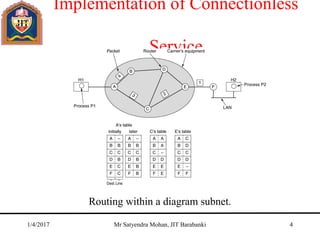
• Implementation of Connectionless Service
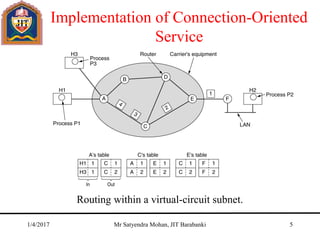
• Implementation of Connection-Oriented Service
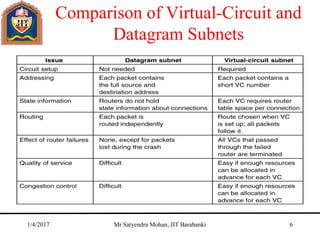
• Comparison of Virtual-Circuit and Datagram Subnets
1/4/2017 Mr Satyendra Mohan, JIT Barabanki 2
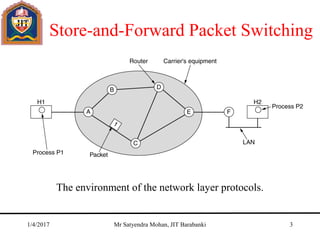
Store-and-Forward Packet Switching
The environment of the network layer protocols.
fig 5-1
1/4/2017 Mr Satyendra Mohan, JIT Barabanki 3
Implementation of Connectionless
Service
Routing within a diagram subnet.
1/4/2017 Mr Satyendra Mohan, JIT Barabanki 4
Implementation of Connection-Oriented
Service
Routing within a virtual-circuit subnet.
1/4/2017 Mr Satyendra Mohan, JIT Barabanki 5
Comparison of Virtual-Circuit and
Datagram Subnets
5-4
1/4/2017 Mr Satyendra Mohan, JIT Barabanki 6
Routing Algorithms
• The Optimality Principle
• Shortest Path Routing
• Flooding
• Distance Vector Routing
• Link State Routing
• Hierarchical Routing
• Broadcast Routing
• Multicast Routing
• Routing for Mobile Hosts
• Routing in Ad Hoc Networks
1/4/2017 Mr Satyendra Mohan, JIT Barabanki 7
Routing Algorithms
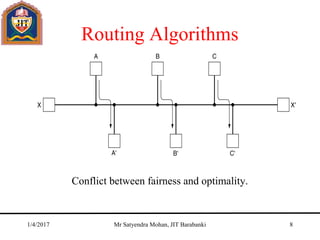
Conflict between fairness and optimality.
1/4/2017 Mr Satyendra Mohan, JIT Barabanki 8
The Optimality Principle
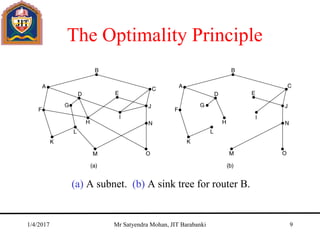
(a) A subnet. (b) A sink tree for router B.
1/4/2017 Mr Satyendra Mohan, JIT Barabanki 9
Shortest Path Routing
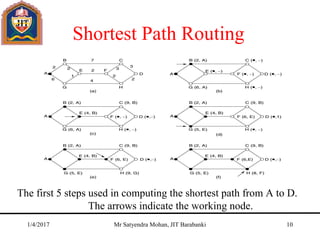
The first 5 steps used in computing the shortest path from A to D.
The arrows indicate the working node.
1/4/2017 Mr Satyendra Mohan, JIT Barabanki 10
Distance Vector Routing
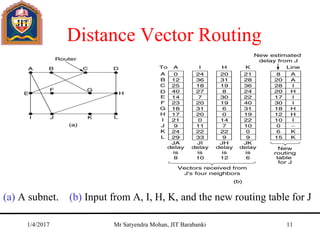
(a) A subnet. (b) Input from A, I, H, K, and the new routing table for J
1/4/2017 Mr Satyendra Mohan, JIT Barabanki 11
Distance Vector Routing
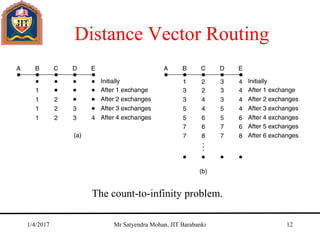
The count-to-infinity problem.
1/4/2017 Mr Satyendra Mohan, JIT Barabanki 12
Link State Routing
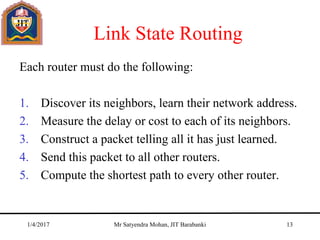
Each router must do the following:
1. Discover its neighbors, learn their network address.
2. Measure the delay or cost to each of its neighbors.
3. Construct a packet telling all it has just learned.
4. Send this packet to all other routers.
5. Compute the shortest path to every other router.
1/4/2017 Mr Satyendra Mohan, JIT Barabanki 13
Learning about the Neighbors
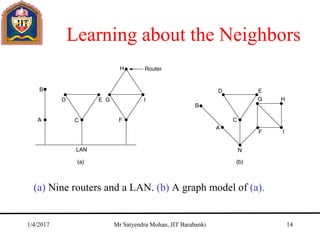
(a) Nine routers and a LAN. (b) A graph model of (a).
1/4/2017 Mr Satyendra Mohan, JIT Barabanki 14
Measuring Line Cost
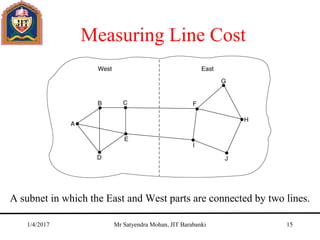
A subnet in which the East and West parts are connected by two lines.
1/4/2017 Mr Satyendra Mohan, JIT Barabanki 15
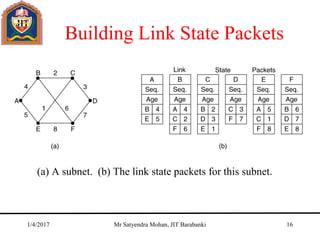
Building Link State Packets
(a) A subnet. (b) The link state packets for this subnet.
1/4/2017 Mr Satyendra Mohan, JIT Barabanki 16
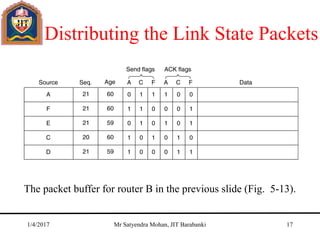
Distributing the Link State Packets
The packet buffer for router B in the previous slide (Fig. 5-13).
1/4/2017 Mr Satyendra Mohan, JIT Barabanki 17
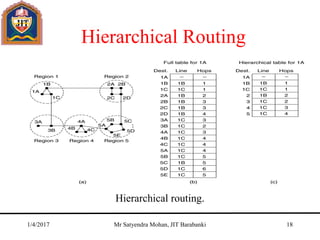
Hierarchical Routing
Hierarchical routing.
1/4/2017 Mr Satyendra Mohan, JIT Barabanki 18
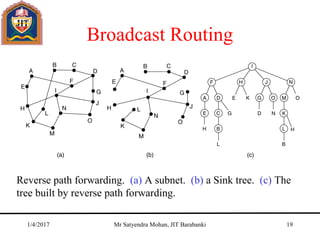
Broadcast Routing
Reverse path forwarding. (a) A subnet. (b) a Sink tree. (c) The
tree built by reverse path forwarding.
1/4/2017 Mr Satyendra Mohan, JIT Barabanki 19
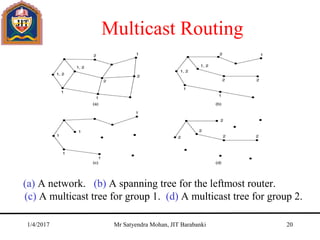
Multicast Routing
(a) A network. (b) A spanning tree for the leftmost router.
(c) A multicast tree for group 1. (d) A multicast tree for group 2.
1/4/2017 Mr Satyendra Mohan, JIT Barabanki 20
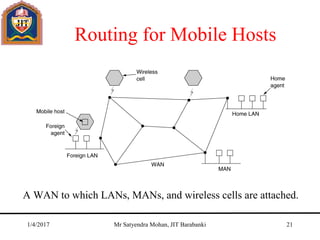
Routing for Mobile Hosts
A WAN to which LANs, MANs, and wireless cells are attached.
1/4/2017 Mr Satyendra Mohan, JIT Barabanki 21
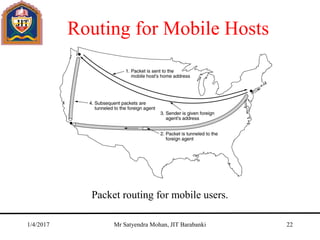
Routing for Mobile Hosts
Packet routing for mobile users.
1/4/2017 Mr Satyendra Mohan, JIT Barabanki 22
Routing in Ad Hoc Networks
Possibilities when the routers are mobile:
1. Military vehicles on battlefield.
– No infrastructure.
1. A fleet of ships at sea.
– All moving all the time
1. Emergency works at earthquake .
– The infrastructure destroyed.
1. A gathering of people with notebook computers.
– In an area lacking 802.11.
1/4/2017 Mr Satyendra Mohan, JIT Barabanki 23
Route Discovery
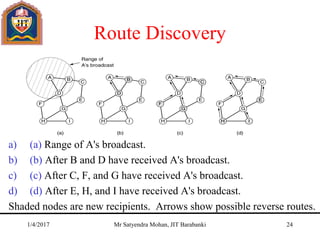
a) (a) Range of A's broadcast.
b) (b) After B and D have received A's broadcast.
c) (c) After C, F, and G have received A's broadcast.
d) (d) After E, H, and I have received A's broadcast.
Shaded nodes are new recipients. Arrows show possible reverse routes.
1/4/2017 Mr Satyendra Mohan, JIT Barabanki 24
Route Discovery
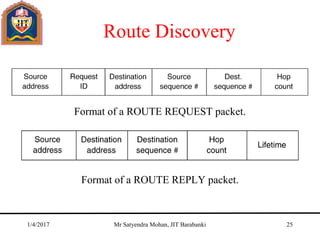
Format of a ROUTE REQUEST packet.
1/4/2017 Mr Satyendra Mohan, JIT Barabanki 25
Format of a ROUTE REPLY packet.
Route Maintenance
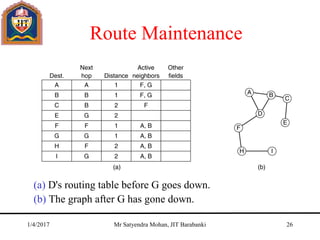
(a) D's routing table before G goes down.
(b) The graph after G has gone down.
1/4/2017 Mr Satyendra Mohan, JIT Barabanki 26
Node Lookup in Peer-to-Peer
Networks
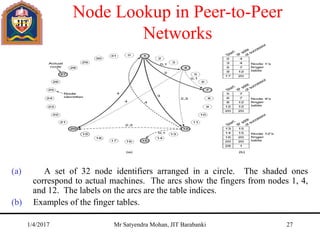
(a) A set of 32 node identifiers arranged in a circle. The shaded ones
correspond to actual machines. The arcs show the fingers from nodes 1, 4,
and 12. The labels on the arcs are the table indices.
(b) Examples of the finger tables.
1/4/2017 Mr Satyendra Mohan, JIT Barabanki 27
Congestion Control
Algorithms
• General Principles of Congestion Control
• Congestion Prevention Policies
• Congestion Control in Virtual-Circuit Subnets
• Congestion Control in Datagram Subnets
• Load Shedding
• Jitter Control
1/4/2017 Mr Satyendra Mohan, JIT Barabanki 28
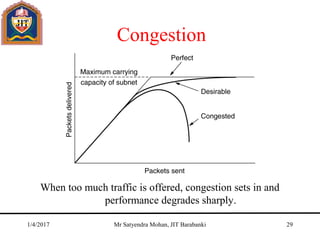
Congestion
When too much traffic is offered, congestion sets in and
performance degrades sharply.
1/4/2017 Mr Satyendra Mohan, JIT Barabanki 29
General Principles of Congestion
Control
1. Monitor the system .
– detect when and where congestion occurs.
1. Pass information to where action can be taken.
2. Adjust system operation to correct the problem.
1/4/2017 Mr Satyendra Mohan, JIT Barabanki 30
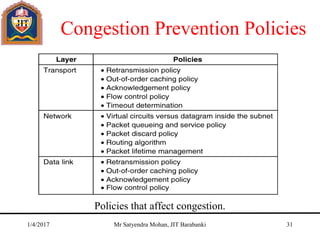
Congestion Prevention Policies
Policies that affect congestion.
5-26
1/4/2017 Mr Satyendra Mohan, JIT Barabanki 31
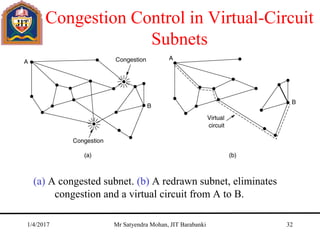
Congestion Control in Virtual-Circuit
Subnets
(a) A congested subnet. (b) A redrawn subnet, eliminates
congestion and a virtual circuit from A to B.
1/4/2017 Mr Satyendra Mohan, JIT Barabanki 32
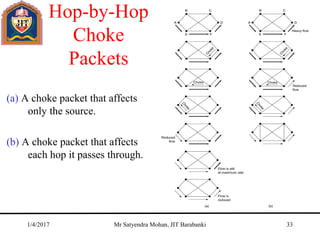
Hop-by-Hop
Choke
Packets
(a) A choke packet that affects
only the source.
(b) A choke packet that affects
each hop it passes through.
1/4/2017 Mr Satyendra Mohan, JIT Barabanki 33
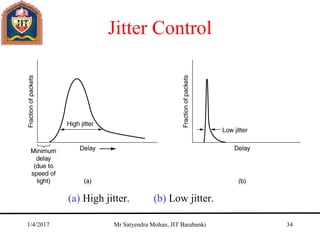
Jitter Control
(a) High jitter. (b) Low jitter.
1/4/2017 Mr Satyendra Mohan, JIT Barabanki 34
Quality of Service
• Requirements
• Techniques for Achieving Good Quality of Service
• Integrated Services
• Differentiated Services
• Label Switching and MPLS
1/4/2017 Mr Satyendra Mohan, JIT Barabanki 35
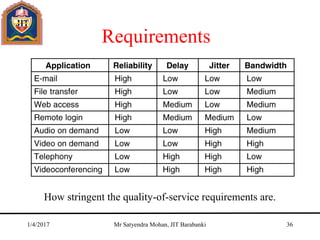
Requirements
How stringent the quality-of-service requirements are.
5-30
1/4/2017 Mr Satyendra Mohan, JIT Barabanki 36
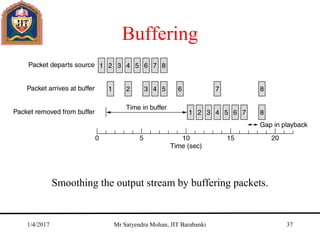
Buffering
Smoothing the output stream by buffering packets.
1/4/2017 Mr Satyendra Mohan, JIT Barabanki 37
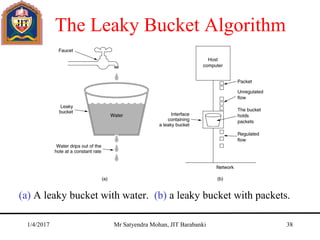
The Leaky Bucket Algorithm
(a) A leaky bucket with water. (b) a leaky bucket with packets.
1/4/2017 Mr Satyendra Mohan, JIT Barabanki 38
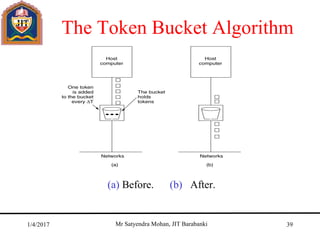
The Token Bucket Algorithm
(a) Before. (b) After.
5-34
1/4/2017 Mr Satyendra Mohan, JIT Barabanki 39
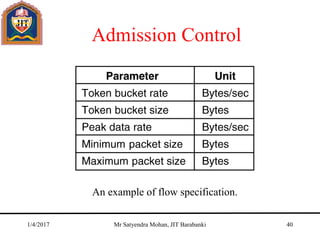
Admission Control
An example of flow specification.
5-34
1/4/2017 Mr Satyendra Mohan, JIT Barabanki 40
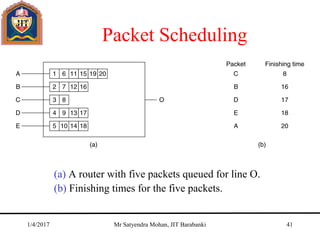
Packet Scheduling
(a) A router with five packets queued for line O.
(b) Finishing times for the five packets.
1/4/2017 Mr Satyendra Mohan, JIT Barabanki 41
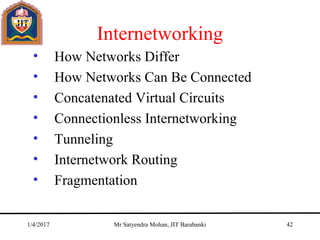
Internetworking
• How Networks Differ
• How Networks Can Be Connected
• Concatenated Virtual Circuits
• Connectionless Internetworking
• Tunneling
• Internetwork Routing
• Fragmentation
1/4/2017 Mr Satyendra Mohan, JIT Barabanki 42
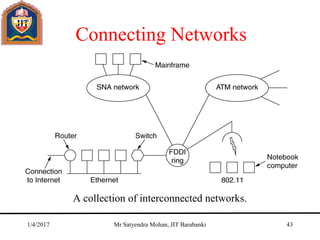
Connecting Networks
A collection of interconnected networks.
1/4/2017 Mr Satyendra Mohan, JIT Barabanki 43
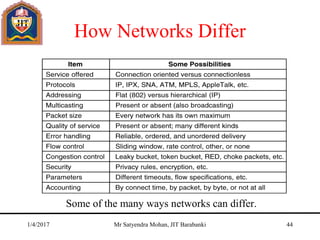
How Networks Differ
Some of the many ways networks can differ.
5-43
1/4/2017 Mr Satyendra Mohan, JIT Barabanki 44
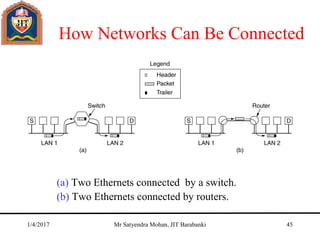
How Networks Can Be Connected
(a) Two Ethernets connected by a switch.
(b) Two Ethernets connected by routers.
1/4/2017 Mr Satyendra Mohan, JIT Barabanki 45
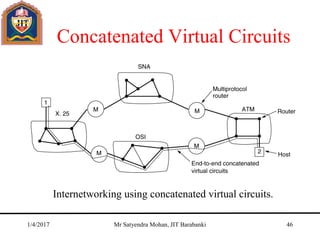
Concatenated Virtual Circuits
Internetworking using concatenated virtual circuits.
1/4/2017 Mr Satyendra Mohan, JIT Barabanki 46
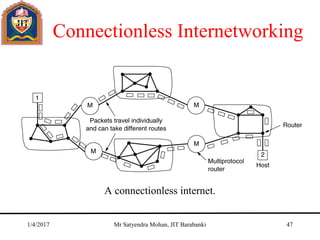
Connectionless Internetworking
A connectionless internet.
1/4/2017 Mr Satyendra Mohan, JIT Barabanki 47
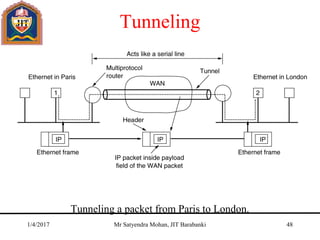
Tunneling
Tunneling a packet from Paris to London.
1/4/2017 Mr Satyendra Mohan, JIT Barabanki 48
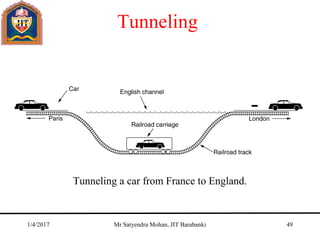
Tunneling
Tunneling a car from France to England.
1/4/2017 Mr Satyendra Mohan, JIT Barabanki 49
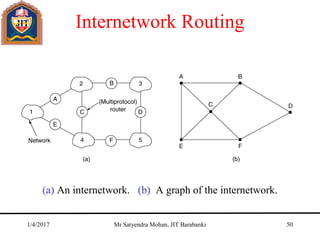
Internetwork Routing
(a) An internetwork. (b) A graph of the internetwork.
1/4/2017 Mr Satyendra Mohan, JIT Barabanki 50
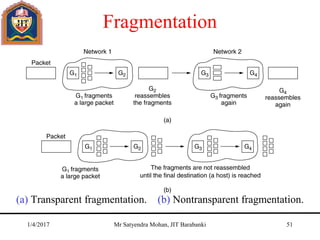
Fragmentation
(a) Transparent fragmentation. (b) Nontransparent fragmentation.
1/4/2017 Mr Satyendra Mohan, JIT Barabanki 51
Fragmentation
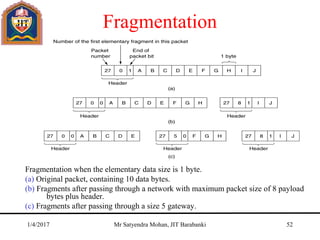
Fragmentation when the elementary data size is 1 byte.
(a) Original packet, containing 10 data bytes.
(b) Fragments after passing through a network with maximum packet size of 8 payload
bytes plus header.
(c) Fragments after passing through a size 5 gateway.
1/4/2017 Mr Satyendra Mohan, JIT Barabanki 52
The Network Layer in the Internet
• The IP Protocol
• IP Addresses
• Internet Control Protocols
• OSPF – The Interior Gateway Routing Protocol
• BGP – The Exterior Gateway Routing Protocol
• Internet Multicasting
• Mobile IP
• IPv6
1/4/2017 Mr Satyendra Mohan, JIT Barabanki 53
Design Principles for
Internet
1. Make sure it works.
2. Keep it simple.
3. Make clear choices.
4. Exploit modularity.
5. Expect heterogeneity.
6. Avoid static options and parameters.
7. Look for a good design; it need not be perfect.
8. Be strict when sending and tolerant when receiving.
9. Think about scalability.
10. Consider performance and cost.
1/4/2017 Mr Satyendra Mohan, JIT Barabanki 54
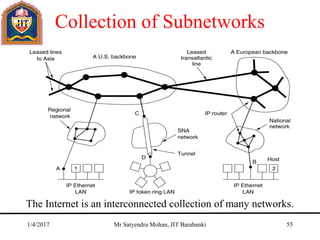
Collection of Subnetworks
The Internet is an interconnected collection of many networks.
1/4/2017 Mr Satyendra Mohan, JIT Barabanki 55
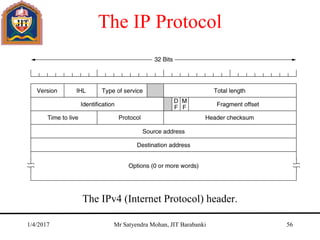
The IP Protocol
The IPv4 (Internet Protocol) header.
1/4/2017 Mr Satyendra Mohan, JIT Barabanki 56
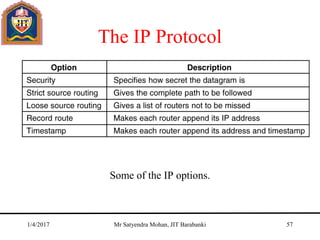
The IP Protocol
Some of the IP options.
5-54
1/4/2017 Mr Satyendra Mohan, JIT Barabanki 57
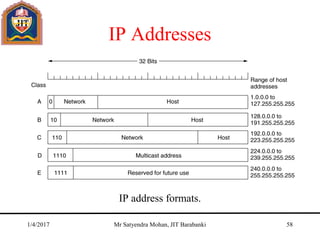
IP Addresses
IP address formats.
1/4/2017 Mr Satyendra Mohan, JIT Barabanki 58
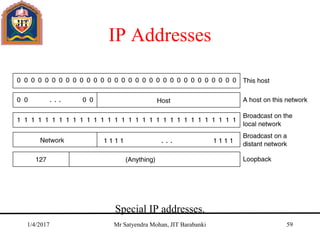
IP Addresses
Special IP addresses.
1/4/2017 Mr Satyendra Mohan, JIT Barabanki 59
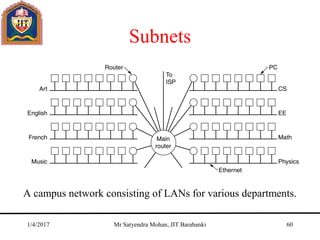
Subnets
A campus network consisting of LANs for various departments.
1/4/2017 Mr Satyendra Mohan, JIT Barabanki 60
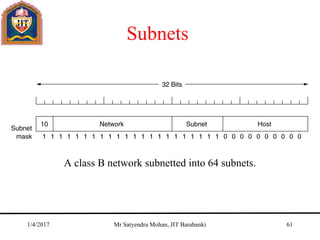
Subnets
A class B network subnetted into 64 subnets.
1/4/2017 Mr Satyendra Mohan, JIT Barabanki 61
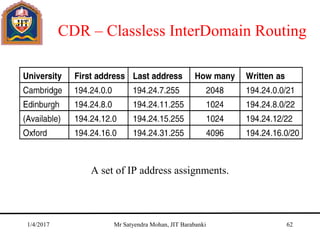
CDR – Classless InterDomain Routing
A set of IP address assignments.
5-59
1/4/2017 Mr Satyendra Mohan, JIT Barabanki 62
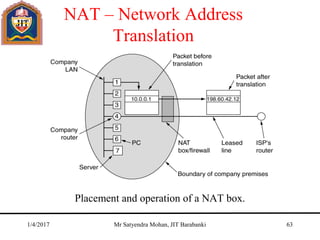
NAT – Network Address
Translation
Placement and operation of a NAT box.
1/4/2017 Mr Satyendra Mohan, JIT Barabanki 63
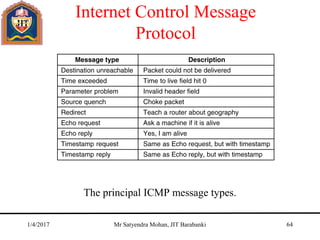
Internet Control Message
Protocol
The principal ICMP message types.
5-61
1/4/2017 Mr Satyendra Mohan, JIT Barabanki 64
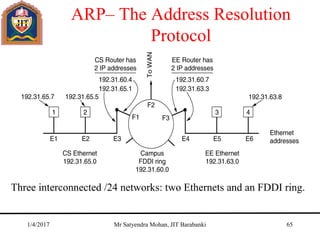
ARP– The Address Resolution
Protocol
Three interconnected /24 networks: two Ethernets and an FDDI ring.
1/4/2017 Mr Satyendra Mohan, JIT Barabanki 65
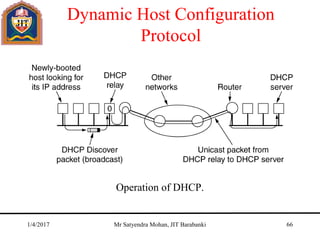
Dynamic Host Configuration
Protocol
Operation of DHCP.
1/4/2017 Mr Satyendra Mohan, JIT Barabanki 66
References
[1] A. S. Tanenbaum, “Computer Network”, Pearson Education
[2] Forouzen, “Data Communication and Networking”, TMH
1/4/2017 Mr Satyendra Mohan, JIT Barabanki 67
1/4/2017 Mr Satyendra Mohan, JIT Barabanki 68

The Network Layer in CN

  • 1.
    The Network Layer Chapter3 1/4/2017 Mr Satyendra Mohan, JIT Barabanki 1
  • 2.
    Network Layer DesignIssues • Store-and-Forward Packet Switching • Services Provided to the Transport Layer • Implementation of Connectionless Service • Implementation of Connection-Oriented Service • Comparison of Virtual-Circuit and Datagram Subnets 1/4/2017 Mr Satyendra Mohan, JIT Barabanki 2
  • 3.
    Store-and-Forward Packet Switching Theenvironment of the network layer protocols. fig 5-1 1/4/2017 Mr Satyendra Mohan, JIT Barabanki 3
  • 4.
    Implementation of Connectionless Service Routingwithin a diagram subnet. 1/4/2017 Mr Satyendra Mohan, JIT Barabanki 4
  • 5.
    Implementation of Connection-Oriented Service Routingwithin a virtual-circuit subnet. 1/4/2017 Mr Satyendra Mohan, JIT Barabanki 5
  • 6.
    Comparison of Virtual-Circuitand Datagram Subnets 5-4 1/4/2017 Mr Satyendra Mohan, JIT Barabanki 6
  • 7.
    Routing Algorithms • TheOptimality Principle • Shortest Path Routing • Flooding • Distance Vector Routing • Link State Routing • Hierarchical Routing • Broadcast Routing • Multicast Routing • Routing for Mobile Hosts • Routing in Ad Hoc Networks 1/4/2017 Mr Satyendra Mohan, JIT Barabanki 7
  • 8.
    Routing Algorithms Conflict betweenfairness and optimality. 1/4/2017 Mr Satyendra Mohan, JIT Barabanki 8
  • 9.
    The Optimality Principle (a)A subnet. (b) A sink tree for router B. 1/4/2017 Mr Satyendra Mohan, JIT Barabanki 9
  • 10.
    Shortest Path Routing Thefirst 5 steps used in computing the shortest path from A to D. The arrows indicate the working node. 1/4/2017 Mr Satyendra Mohan, JIT Barabanki 10
  • 11.
    Distance Vector Routing (a)A subnet. (b) Input from A, I, H, K, and the new routing table for J 1/4/2017 Mr Satyendra Mohan, JIT Barabanki 11
  • 12.
    Distance Vector Routing Thecount-to-infinity problem. 1/4/2017 Mr Satyendra Mohan, JIT Barabanki 12
  • 13.
    Link State Routing Eachrouter must do the following: 1. Discover its neighbors, learn their network address. 2. Measure the delay or cost to each of its neighbors. 3. Construct a packet telling all it has just learned. 4. Send this packet to all other routers. 5. Compute the shortest path to every other router. 1/4/2017 Mr Satyendra Mohan, JIT Barabanki 13
  • 14.
    Learning about theNeighbors (a) Nine routers and a LAN. (b) A graph model of (a). 1/4/2017 Mr Satyendra Mohan, JIT Barabanki 14
  • 15.
    Measuring Line Cost Asubnet in which the East and West parts are connected by two lines. 1/4/2017 Mr Satyendra Mohan, JIT Barabanki 15
  • 16.
    Building Link StatePackets (a) A subnet. (b) The link state packets for this subnet. 1/4/2017 Mr Satyendra Mohan, JIT Barabanki 16
  • 17.
    Distributing the LinkState Packets The packet buffer for router B in the previous slide (Fig. 5-13). 1/4/2017 Mr Satyendra Mohan, JIT Barabanki 17
  • 18.
    Hierarchical Routing Hierarchical routing. 1/4/2017Mr Satyendra Mohan, JIT Barabanki 18
  • 19.
    Broadcast Routing Reverse pathforwarding. (a) A subnet. (b) a Sink tree. (c) The tree built by reverse path forwarding. 1/4/2017 Mr Satyendra Mohan, JIT Barabanki 19
  • 20.
    Multicast Routing (a) Anetwork. (b) A spanning tree for the leftmost router. (c) A multicast tree for group 1. (d) A multicast tree for group 2. 1/4/2017 Mr Satyendra Mohan, JIT Barabanki 20
  • 21.
    Routing for MobileHosts A WAN to which LANs, MANs, and wireless cells are attached. 1/4/2017 Mr Satyendra Mohan, JIT Barabanki 21
  • 22.
    Routing for MobileHosts Packet routing for mobile users. 1/4/2017 Mr Satyendra Mohan, JIT Barabanki 22
  • 23.
    Routing in AdHoc Networks Possibilities when the routers are mobile: 1. Military vehicles on battlefield. – No infrastructure. 1. A fleet of ships at sea. – All moving all the time 1. Emergency works at earthquake . – The infrastructure destroyed. 1. A gathering of people with notebook computers. – In an area lacking 802.11. 1/4/2017 Mr Satyendra Mohan, JIT Barabanki 23
  • 24.
    Route Discovery a) (a)Range of A's broadcast. b) (b) After B and D have received A's broadcast. c) (c) After C, F, and G have received A's broadcast. d) (d) After E, H, and I have received A's broadcast. Shaded nodes are new recipients. Arrows show possible reverse routes. 1/4/2017 Mr Satyendra Mohan, JIT Barabanki 24
  • 25.
    Route Discovery Format ofa ROUTE REQUEST packet. 1/4/2017 Mr Satyendra Mohan, JIT Barabanki 25 Format of a ROUTE REPLY packet.
  • 26.
    Route Maintenance (a) D'srouting table before G goes down. (b) The graph after G has gone down. 1/4/2017 Mr Satyendra Mohan, JIT Barabanki 26
  • 27.
    Node Lookup inPeer-to-Peer Networks (a) A set of 32 node identifiers arranged in a circle. The shaded ones correspond to actual machines. The arcs show the fingers from nodes 1, 4, and 12. The labels on the arcs are the table indices. (b) Examples of the finger tables. 1/4/2017 Mr Satyendra Mohan, JIT Barabanki 27
  • 28.
    Congestion Control Algorithms • GeneralPrinciples of Congestion Control • Congestion Prevention Policies • Congestion Control in Virtual-Circuit Subnets • Congestion Control in Datagram Subnets • Load Shedding • Jitter Control 1/4/2017 Mr Satyendra Mohan, JIT Barabanki 28
  • 29.
    Congestion When too muchtraffic is offered, congestion sets in and performance degrades sharply. 1/4/2017 Mr Satyendra Mohan, JIT Barabanki 29
  • 30.
    General Principles ofCongestion Control 1. Monitor the system . – detect when and where congestion occurs. 1. Pass information to where action can be taken. 2. Adjust system operation to correct the problem. 1/4/2017 Mr Satyendra Mohan, JIT Barabanki 30
  • 31.
    Congestion Prevention Policies Policiesthat affect congestion. 5-26 1/4/2017 Mr Satyendra Mohan, JIT Barabanki 31
  • 32.
    Congestion Control inVirtual-Circuit Subnets (a) A congested subnet. (b) A redrawn subnet, eliminates congestion and a virtual circuit from A to B. 1/4/2017 Mr Satyendra Mohan, JIT Barabanki 32
  • 33.
    Hop-by-Hop Choke Packets (a) A chokepacket that affects only the source. (b) A choke packet that affects each hop it passes through. 1/4/2017 Mr Satyendra Mohan, JIT Barabanki 33
  • 34.
    Jitter Control (a) Highjitter. (b) Low jitter. 1/4/2017 Mr Satyendra Mohan, JIT Barabanki 34
  • 35.
    Quality of Service •Requirements • Techniques for Achieving Good Quality of Service • Integrated Services • Differentiated Services • Label Switching and MPLS 1/4/2017 Mr Satyendra Mohan, JIT Barabanki 35
  • 36.
    Requirements How stringent thequality-of-service requirements are. 5-30 1/4/2017 Mr Satyendra Mohan, JIT Barabanki 36
  • 37.
    Buffering Smoothing the outputstream by buffering packets. 1/4/2017 Mr Satyendra Mohan, JIT Barabanki 37
  • 38.
    The Leaky BucketAlgorithm (a) A leaky bucket with water. (b) a leaky bucket with packets. 1/4/2017 Mr Satyendra Mohan, JIT Barabanki 38
  • 39.
    The Token BucketAlgorithm (a) Before. (b) After. 5-34 1/4/2017 Mr Satyendra Mohan, JIT Barabanki 39
  • 40.
    Admission Control An exampleof flow specification. 5-34 1/4/2017 Mr Satyendra Mohan, JIT Barabanki 40
  • 41.
    Packet Scheduling (a) Arouter with five packets queued for line O. (b) Finishing times for the five packets. 1/4/2017 Mr Satyendra Mohan, JIT Barabanki 41
  • 42.
    Internetworking • How NetworksDiffer • How Networks Can Be Connected • Concatenated Virtual Circuits • Connectionless Internetworking • Tunneling • Internetwork Routing • Fragmentation 1/4/2017 Mr Satyendra Mohan, JIT Barabanki 42
  • 43.
    Connecting Networks A collectionof interconnected networks. 1/4/2017 Mr Satyendra Mohan, JIT Barabanki 43
  • 44.
    How Networks Differ Someof the many ways networks can differ. 5-43 1/4/2017 Mr Satyendra Mohan, JIT Barabanki 44
  • 45.
    How Networks CanBe Connected (a) Two Ethernets connected by a switch. (b) Two Ethernets connected by routers. 1/4/2017 Mr Satyendra Mohan, JIT Barabanki 45
  • 46.
    Concatenated Virtual Circuits Internetworkingusing concatenated virtual circuits. 1/4/2017 Mr Satyendra Mohan, JIT Barabanki 46
  • 47.
    Connectionless Internetworking A connectionlessinternet. 1/4/2017 Mr Satyendra Mohan, JIT Barabanki 47
  • 48.
    Tunneling Tunneling a packetfrom Paris to London. 1/4/2017 Mr Satyendra Mohan, JIT Barabanki 48
  • 49.
    Tunneling Tunneling a carfrom France to England. 1/4/2017 Mr Satyendra Mohan, JIT Barabanki 49
  • 50.
    Internetwork Routing (a) Aninternetwork. (b) A graph of the internetwork. 1/4/2017 Mr Satyendra Mohan, JIT Barabanki 50
  • 51.
    Fragmentation (a) Transparent fragmentation.(b) Nontransparent fragmentation. 1/4/2017 Mr Satyendra Mohan, JIT Barabanki 51
  • 52.
    Fragmentation Fragmentation when theelementary data size is 1 byte. (a) Original packet, containing 10 data bytes. (b) Fragments after passing through a network with maximum packet size of 8 payload bytes plus header. (c) Fragments after passing through a size 5 gateway. 1/4/2017 Mr Satyendra Mohan, JIT Barabanki 52
  • 53.
    The Network Layerin the Internet • The IP Protocol • IP Addresses • Internet Control Protocols • OSPF – The Interior Gateway Routing Protocol • BGP – The Exterior Gateway Routing Protocol • Internet Multicasting • Mobile IP • IPv6 1/4/2017 Mr Satyendra Mohan, JIT Barabanki 53
  • 54.
    Design Principles for Internet 1.Make sure it works. 2. Keep it simple. 3. Make clear choices. 4. Exploit modularity. 5. Expect heterogeneity. 6. Avoid static options and parameters. 7. Look for a good design; it need not be perfect. 8. Be strict when sending and tolerant when receiving. 9. Think about scalability. 10. Consider performance and cost. 1/4/2017 Mr Satyendra Mohan, JIT Barabanki 54
  • 55.
    Collection of Subnetworks TheInternet is an interconnected collection of many networks. 1/4/2017 Mr Satyendra Mohan, JIT Barabanki 55
  • 56.
    The IP Protocol TheIPv4 (Internet Protocol) header. 1/4/2017 Mr Satyendra Mohan, JIT Barabanki 56
  • 57.
    The IP Protocol Someof the IP options. 5-54 1/4/2017 Mr Satyendra Mohan, JIT Barabanki 57
  • 58.
    IP Addresses IP addressformats. 1/4/2017 Mr Satyendra Mohan, JIT Barabanki 58
  • 59.
    IP Addresses Special IPaddresses. 1/4/2017 Mr Satyendra Mohan, JIT Barabanki 59
  • 60.
    Subnets A campus networkconsisting of LANs for various departments. 1/4/2017 Mr Satyendra Mohan, JIT Barabanki 60
  • 61.
    Subnets A class Bnetwork subnetted into 64 subnets. 1/4/2017 Mr Satyendra Mohan, JIT Barabanki 61
  • 62.
    CDR – ClasslessInterDomain Routing A set of IP address assignments. 5-59 1/4/2017 Mr Satyendra Mohan, JIT Barabanki 62
  • 63.
    NAT – NetworkAddress Translation Placement and operation of a NAT box. 1/4/2017 Mr Satyendra Mohan, JIT Barabanki 63
  • 64.
    Internet Control Message Protocol Theprincipal ICMP message types. 5-61 1/4/2017 Mr Satyendra Mohan, JIT Barabanki 64
  • 65.
    ARP– The AddressResolution Protocol Three interconnected /24 networks: two Ethernets and an FDDI ring. 1/4/2017 Mr Satyendra Mohan, JIT Barabanki 65
  • 66.
    Dynamic Host Configuration Protocol Operationof DHCP. 1/4/2017 Mr Satyendra Mohan, JIT Barabanki 66
  • 67.
    References [1] A. S.Tanenbaum, “Computer Network”, Pearson Education [2] Forouzen, “Data Communication and Networking”, TMH 1/4/2017 Mr Satyendra Mohan, JIT Barabanki 67
  • 68.
    1/4/2017 Mr SatyendraMohan, JIT Barabanki 68