Network Layer
Goals:
• understand principles
behind network layer
services:
– routing (path selection)
– dealing with scale
– how a router works
– advanced topics: IPv6,
multicast
• instantiation and
implementation in the
Internet
Overview:
• network layer services
• routing principle: path
selection
• hierarchical routing
• IP
• Internet routing protocols
reliable transfer
– intra-domain
– inter-domain
• what’s inside a router?
• IPv6
• multicast routing
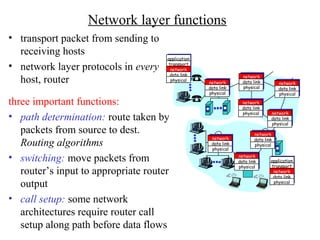
Network layer functions
• transport packet from sending to
receiving hosts
• network layer protocols in every
host, router
three important functions:
• path determination: route taken by
packets from source to dest.
Routing algorithms
• switching: move packets from
router’s input to appropriate router
output
• call setup: some network
architectures require router call
setup along path before data flows
network
data link
physical
network
data link
physical
network
data link
physical
network
data link
physical
network
data link
physical
network
data link
physical
network
data link
physical
network
data link
physical
application
transport
network
data link
physical
application
transport
network
data link
physical
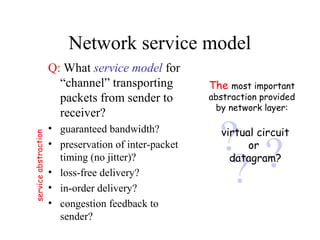
Network service model
Q: What service model for
“channel” transporting
packets from sender to
receiver?
• guaranteed bandwidth?
• preservation of inter-packet
timing (no jitter)?
• loss-free delivery?
• in-order delivery?
• congestion feedback to
sender?
? ??
virtual circuit
or
datagram?
The most important
abstraction provided
by network layer:
serviceabstraction
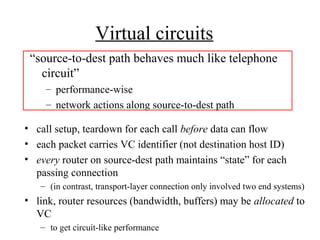
Virtual circuits
• call setup, teardown for each call before data can flow
• each packet carries VC identifier (not destination host ID)
• every router on source-dest path maintains “state” for each
passing connection
– (in contrast, transport-layer connection only involved two end systems)
• link, router resources (bandwidth, buffers) may be allocated to
VC
– to get circuit-like performance
“source-to-dest path behaves much like telephone
circuit”
– performance-wise
– network actions along source-to-dest path
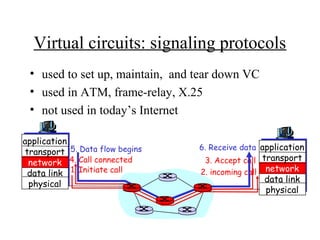
Virtual circuits: signaling protocols
• used to set up, maintain, and tear down VC
• used in ATM, frame-relay, X.25
• not used in today’s Internet
application
transport
network
data link
physical
application
transport
network
data link
physical
1. Initiate call 2. incoming call
3. Accept call4. Call connected
5. Data flow begins 6. Receive data
Datagram networks: the Internet model
• no call setup at network layer
• routers: no state about end-to-end connections
– no network-level concept of “connection”
• packets typically routed using destination host ID
– packets between same source-dest pair may take
different paths
application
transport
network
data link
physical
application
transport
network
data link
physical
1. Send data 2. Receive data
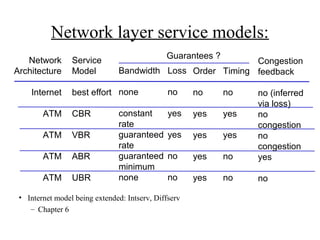
Network layer service models:
Network
Architecture
Internet
ATM
ATM
ATM
ATM
Service
Model
best effort
CBR
VBR
ABR
UBR
Bandwidth
none
constant
rate
guaranteed
rate
guaranteed
minimum
none
Loss
no
yes
yes
no
no
Order
no
yes
yes
yes
yes
Timing
no
yes
yes
no
no
Congestion
feedback
no (inferred
via loss)
no
congestion
no
congestion
yes
no
Guarantees ?
• Internet model being extended: Intserv, Diffserv
– Chapter 6
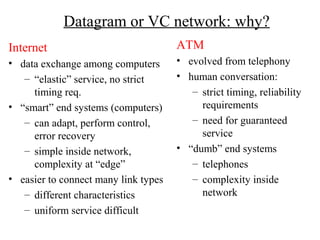
Datagram or VC network: why?
Internet
• data exchange among computers
– “elastic” service, no strict
timing req.
• “smart” end systems (computers)
– can adapt, perform control,
error recovery
– simple inside network,
complexity at “edge”
• easier to connect many link types
– different characteristics
– uniform service difficult
ATM
• evolved from telephony
• human conversation:
– strict timing, reliability
requirements
– need for guaranteed
service
• “dumb” end systems
– telephones
– complexity inside
network
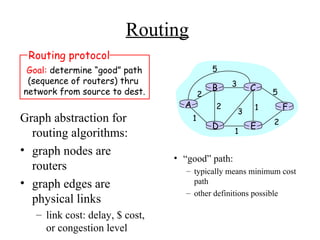
Routing
Graph abstraction for
routing algorithms:
• graph nodes are
routers
• graph edges are
physical links
– link cost: delay, $ cost,
or congestion level
Goal: determine “good” path
(sequence of routers) thru
network from source to dest.
Routing protocol
A
ED
CB
F
2
2
1
3
1
1
2
5
3
5
• “good” path:
– typically means minimum cost
path
– other definitions possible
Routing Algorithm classification
Global or decentralized
information?
Global:
• all routers have complete
topology, link cost info
• “link state” algorithms
Decentralized:
• router knows physically-
connected neighbors, link
costs to neighbors
• iterative process of
computation, exchange of info
with neighbors
• “distance vector” algorithms
Static or dynamic?
Static:
• routes change slowly over
time (usually by humans)
Dynamic:
• routes change more
quickly/automatically
– periodic update
– in response to link cost
changes
A Link-State Routing Algorithm
Dijkstra’s algorithm
• net topology, link costs
known to all nodes
– accomplished via “link
state broadcast”
– all nodes have same info
• computes least cost paths
from one node (‘source”) to
all other nodes
– gives routing table for
that node
• iterative: after k iterations,
know least cost path to k
destinations
Notation:
• c(i,j): link cost from node
i to j. cost infinite if not
direct neighbors
• D(v): current value of
cost of path from source to
dest. V
• p(v): predecessor node
along path from source to
v, that is next v
• N: set of nodes whose
least cost path definitively
known
Dijsktra’s Algorithm
1 Initialization:
2 N = {A}
3 for all nodes v
4 if v adjacent to A
5 then D(v) = c(A,v)
6 else D(v) = infty
7
8 Loop
9 find w not in N such that D(w) is a minimum (of nodes adjacent to previous w)
10 add w to N
11 update D(v) for all v adjacent to w and not in N:
12 D(v) = min( D(v), D(w) + c(w,v) )
13 /* new cost to v is either old cost to v or known
14 shortest path cost to w plus cost from w to v */
15 until all nodes in N
Dijkstra’s algorithm: example
Step
0
1
2
3
4
5
start N
A
AD
ADE
ADEB
ADEBC
ADEBCF
D(B),p(B)
2,A
2,A
2,A
D(C),p(C)
5,A
4,D
3,E
3,E
D(D),p(D)
1,A
D(E),p(E)
infinity
2,D
D(F),p(F)
infinity
infinity
4,E
4,E
4,E
A
ED
CB
F
2
2
1
3
1
1
2
5
3
5
Dijkstra’s algorithm, discussion
Algorithm complexity: n nodes
• each iteration: need to check all nodes, w, not in N
• n*(n+1)/2 comparisons: O(n**2)
• more efficient implementations possible: O(nlogn)
Oscillations possible:
• e.g., Suppose link cost = amount of carried traffic
(note: c(i,j) != c(j,i))
A
D
C
B
1 1+e
e0
e
1 1
0 0
A
D
C
B
2+e 0
00
1+e 1
A
D
C
B
0 2+e
1+e1
0 0
A
D
C
B
2+e 0
e0
1+e 1
initially
… recompute
routing
… recompute … recompute

Network layer

  • 1.
    Network Layer Goals: • understandprinciples behind network layer services: – routing (path selection) – dealing with scale – how a router works – advanced topics: IPv6, multicast • instantiation and implementation in the Internet Overview: • network layer services • routing principle: path selection • hierarchical routing • IP • Internet routing protocols reliable transfer – intra-domain – inter-domain • what’s inside a router? • IPv6 • multicast routing
  • 2.
    Network layer functions •transport packet from sending to receiving hosts • network layer protocols in every host, router three important functions: • path determination: route taken by packets from source to dest. Routing algorithms • switching: move packets from router’s input to appropriate router output • call setup: some network architectures require router call setup along path before data flows network data link physical network data link physical network data link physical network data link physical network data link physical network data link physical network data link physical network data link physical application transport network data link physical application transport network data link physical
  • 3.
    Network service model Q:What service model for “channel” transporting packets from sender to receiver? • guaranteed bandwidth? • preservation of inter-packet timing (no jitter)? • loss-free delivery? • in-order delivery? • congestion feedback to sender? ? ?? virtual circuit or datagram? The most important abstraction provided by network layer: serviceabstraction
  • 4.
    Virtual circuits • callsetup, teardown for each call before data can flow • each packet carries VC identifier (not destination host ID) • every router on source-dest path maintains “state” for each passing connection – (in contrast, transport-layer connection only involved two end systems) • link, router resources (bandwidth, buffers) may be allocated to VC – to get circuit-like performance “source-to-dest path behaves much like telephone circuit” – performance-wise – network actions along source-to-dest path
  • 5.
    Virtual circuits: signalingprotocols • used to set up, maintain, and tear down VC • used in ATM, frame-relay, X.25 • not used in today’s Internet application transport network data link physical application transport network data link physical 1. Initiate call 2. incoming call 3. Accept call4. Call connected 5. Data flow begins 6. Receive data
  • 6.
    Datagram networks: theInternet model • no call setup at network layer • routers: no state about end-to-end connections – no network-level concept of “connection” • packets typically routed using destination host ID – packets between same source-dest pair may take different paths application transport network data link physical application transport network data link physical 1. Send data 2. Receive data
  • 7.
    Network layer servicemodels: Network Architecture Internet ATM ATM ATM ATM Service Model best effort CBR VBR ABR UBR Bandwidth none constant rate guaranteed rate guaranteed minimum none Loss no yes yes no no Order no yes yes yes yes Timing no yes yes no no Congestion feedback no (inferred via loss) no congestion no congestion yes no Guarantees ? • Internet model being extended: Intserv, Diffserv – Chapter 6
  • 8.
    Datagram or VCnetwork: why? Internet • data exchange among computers – “elastic” service, no strict timing req. • “smart” end systems (computers) – can adapt, perform control, error recovery – simple inside network, complexity at “edge” • easier to connect many link types – different characteristics – uniform service difficult ATM • evolved from telephony • human conversation: – strict timing, reliability requirements – need for guaranteed service • “dumb” end systems – telephones – complexity inside network
  • 9.
    Routing Graph abstraction for routingalgorithms: • graph nodes are routers • graph edges are physical links – link cost: delay, $ cost, or congestion level Goal: determine “good” path (sequence of routers) thru network from source to dest. Routing protocol A ED CB F 2 2 1 3 1 1 2 5 3 5 • “good” path: – typically means minimum cost path – other definitions possible
  • 10.
    Routing Algorithm classification Globalor decentralized information? Global: • all routers have complete topology, link cost info • “link state” algorithms Decentralized: • router knows physically- connected neighbors, link costs to neighbors • iterative process of computation, exchange of info with neighbors • “distance vector” algorithms Static or dynamic? Static: • routes change slowly over time (usually by humans) Dynamic: • routes change more quickly/automatically – periodic update – in response to link cost changes
  • 11.
    A Link-State RoutingAlgorithm Dijkstra’s algorithm • net topology, link costs known to all nodes – accomplished via “link state broadcast” – all nodes have same info • computes least cost paths from one node (‘source”) to all other nodes – gives routing table for that node • iterative: after k iterations, know least cost path to k destinations Notation: • c(i,j): link cost from node i to j. cost infinite if not direct neighbors • D(v): current value of cost of path from source to dest. V • p(v): predecessor node along path from source to v, that is next v • N: set of nodes whose least cost path definitively known
  • 12.
    Dijsktra’s Algorithm 1 Initialization: 2N = {A} 3 for all nodes v 4 if v adjacent to A 5 then D(v) = c(A,v) 6 else D(v) = infty 7 8 Loop 9 find w not in N such that D(w) is a minimum (of nodes adjacent to previous w) 10 add w to N 11 update D(v) for all v adjacent to w and not in N: 12 D(v) = min( D(v), D(w) + c(w,v) ) 13 /* new cost to v is either old cost to v or known 14 shortest path cost to w plus cost from w to v */ 15 until all nodes in N
  • 13.
    Dijkstra’s algorithm: example Step 0 1 2 3 4 5 startN A AD ADE ADEB ADEBC ADEBCF D(B),p(B) 2,A 2,A 2,A D(C),p(C) 5,A 4,D 3,E 3,E D(D),p(D) 1,A D(E),p(E) infinity 2,D D(F),p(F) infinity infinity 4,E 4,E 4,E A ED CB F 2 2 1 3 1 1 2 5 3 5
  • 14.
    Dijkstra’s algorithm, discussion Algorithmcomplexity: n nodes • each iteration: need to check all nodes, w, not in N • n*(n+1)/2 comparisons: O(n**2) • more efficient implementations possible: O(nlogn) Oscillations possible: • e.g., Suppose link cost = amount of carried traffic (note: c(i,j) != c(j,i)) A D C B 1 1+e e0 e 1 1 0 0 A D C B 2+e 0 00 1+e 1 A D C B 0 2+e 1+e1 0 0 A D C B 2+e 0 e0 1+e 1 initially … recompute routing … recompute … recompute