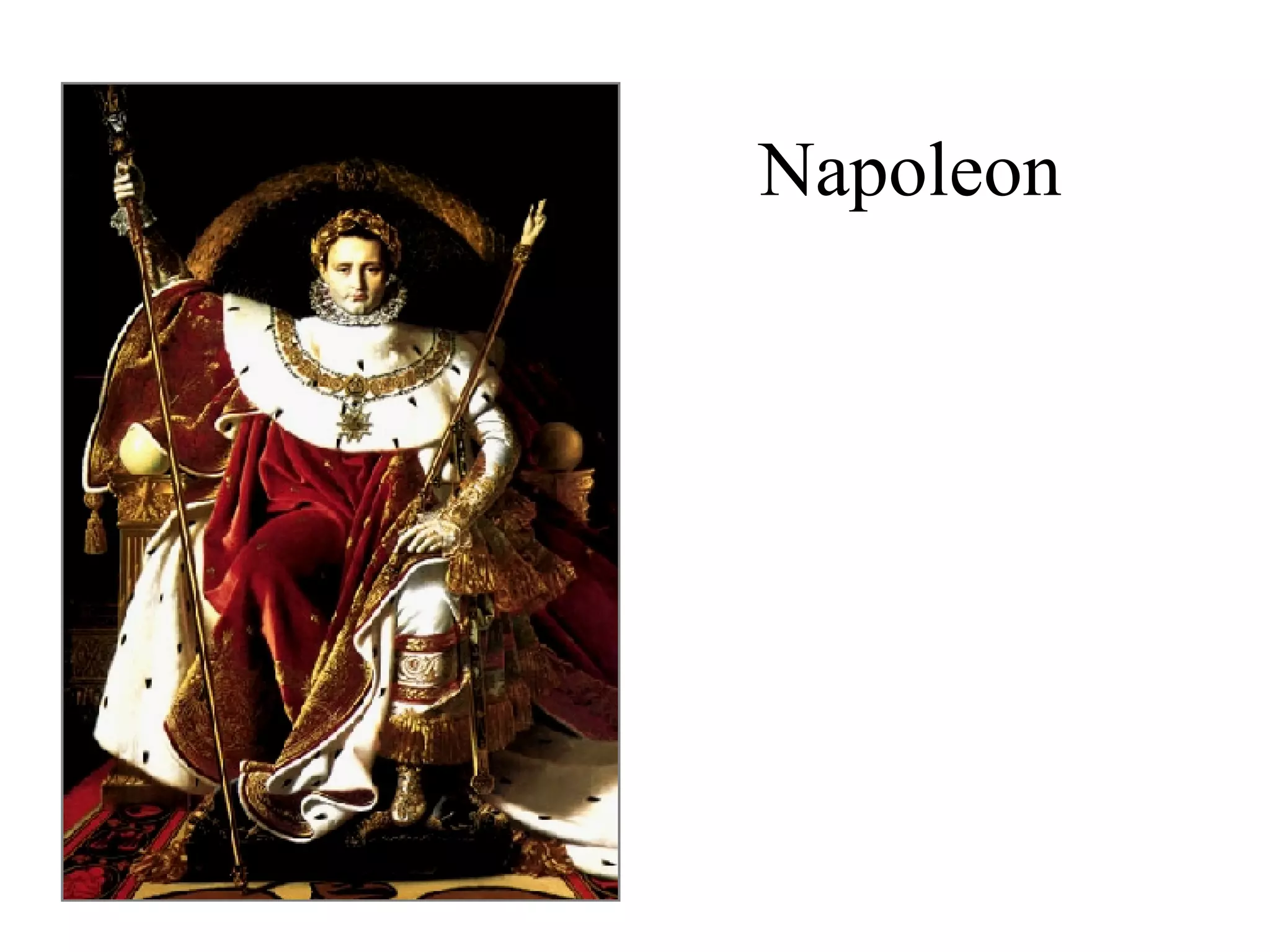
Napoleon
Key Events of the Empire Loss of Haiti, Sale of Louisiana, 1803 Loss at Trafalgar, 1805 Victories in Central Europe, 1805-1807 Establishment of Continental System Spread of Napoleonic Code
Key Events of the Empire Nationalist Resistance to Napoleon Retreat from Russia, 1812-13 Defeat at Leipzig, 1813 Return, and defeat at Waterloo, 1815
Napoleon, The Romantic Figure Movement from Enlightenment to Romanticism Reason and debate     Intuition and Action Democracy    Individual Hero Failure    Destiny
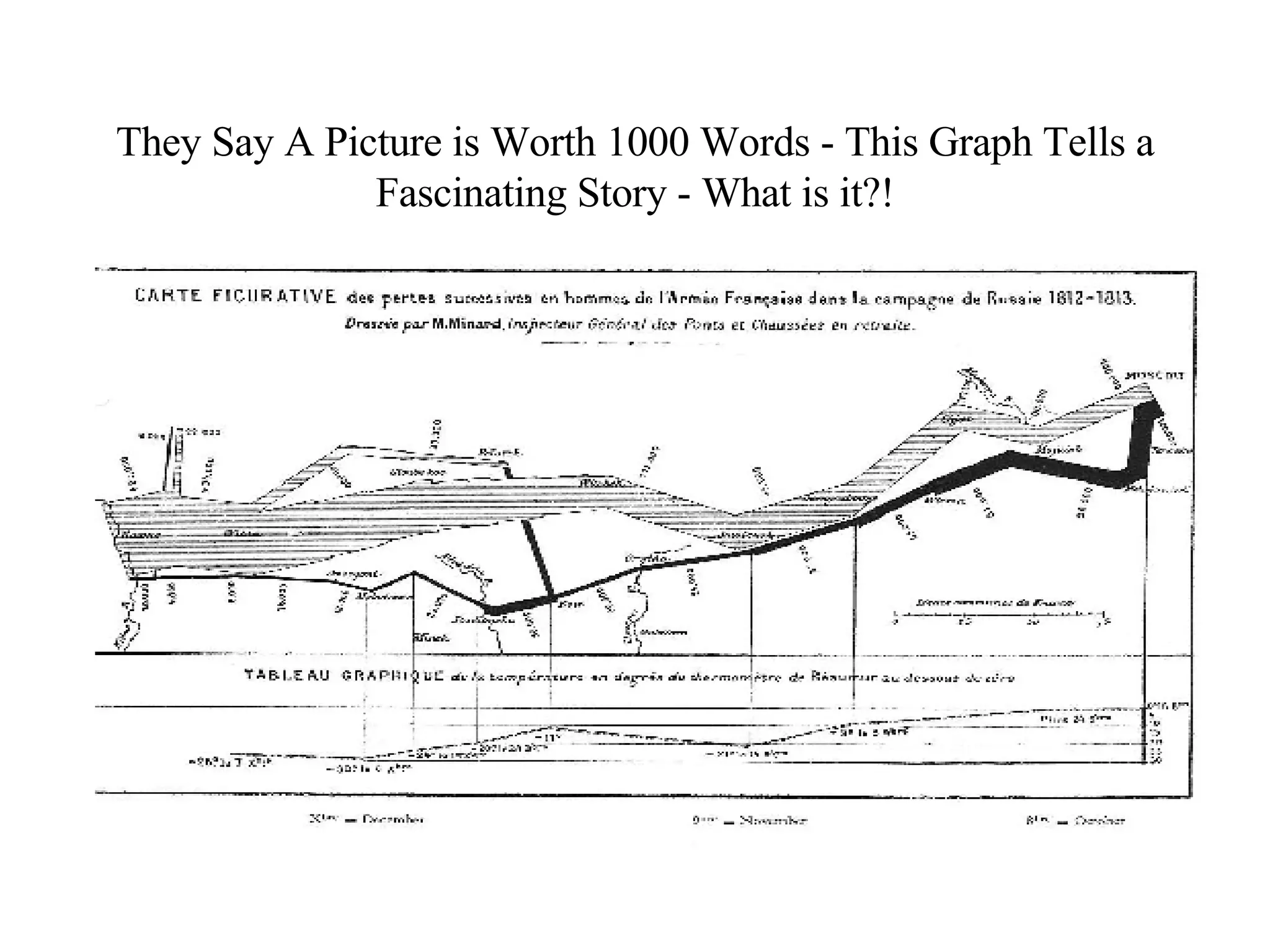
They Say A Picture is Worth 1000 Words - This Graph Tells a Fascinating Story - What is it?!
Height of Napoleon’s Power
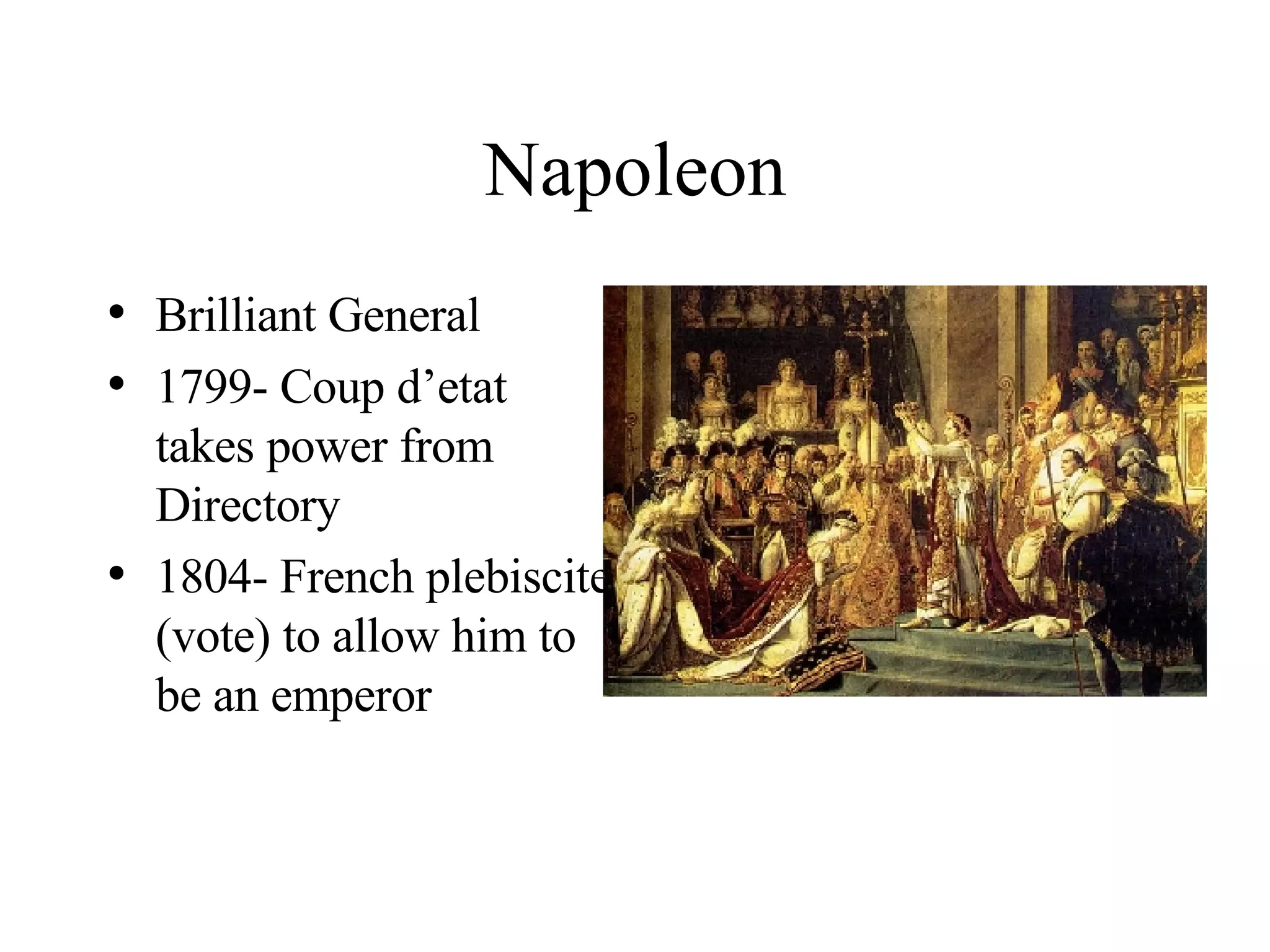
Napoleon Brilliant General 1799- Coup d’etat takes power from Directory 1804- French plebiscite (vote) to allow him to be an emperor
Social Achievements Concordat:   Patch relationship with Catholic Church - 1801 Napoleonic Code:   Uniform laws for all (except women and slaves) - 1804 (still basis of Louisiana’s law) Lycees:   Public Schools for all National Bank and Tax Reform:  To fix France’s financial Problems
Ambitions for Empire Americas: Louisiana territories (N. America) Guiana (S. America - still a French colony) Saint-Domingue (Haiti) (Caribbean)
… But Napoleon Decides to Ditch the Americas Sells Louisiana Territory to U.S. for $15 million to finance war, spite British Slave revolt in Saint-Domingue creates world’s first black republic (Haiti)
Haitian Independence, 1792-1804 Toussaint L’Ouverture
Louisiana Purchase, 1803 $15,000,000
Europe: Emperor of France Controls Spain, Confederation of Rhine, Grand Duchy of Warsaw, Italy, Kingdom of Naples, Switzerland (brothers and in-laws) Divorced Wife and “Married Up” into Austrian Royal Family (grand-niece of Marie Antoinette) Au Revroir Hey there…
Josephine’s Divorce Statement  (1807) With the permission of our august and dear husband, I must declare that, having no hope of bearing children who would fulfill the needs of his policies and the interests of France, I am pleased to offer him the greatest proof of attachment and devotion ever offered on this earth.
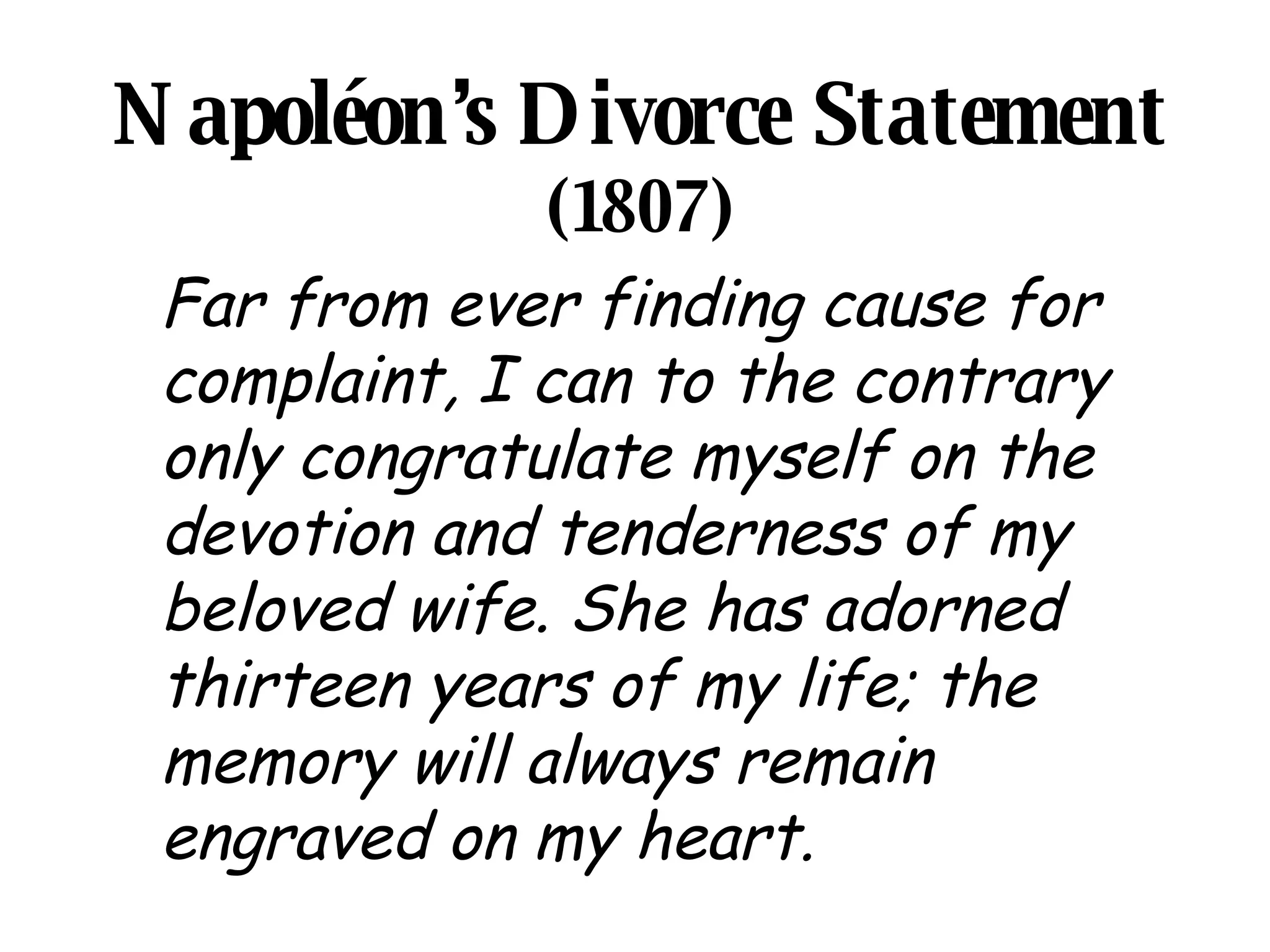
Napoléon’s Divorce Statement  (1807) Far from ever finding cause for complaint, I can to the contrary only congratulate myself on the devotion and tenderness of my beloved wife. She has adorned thirteen years of my life; the memory will always remain engraved on my heart.
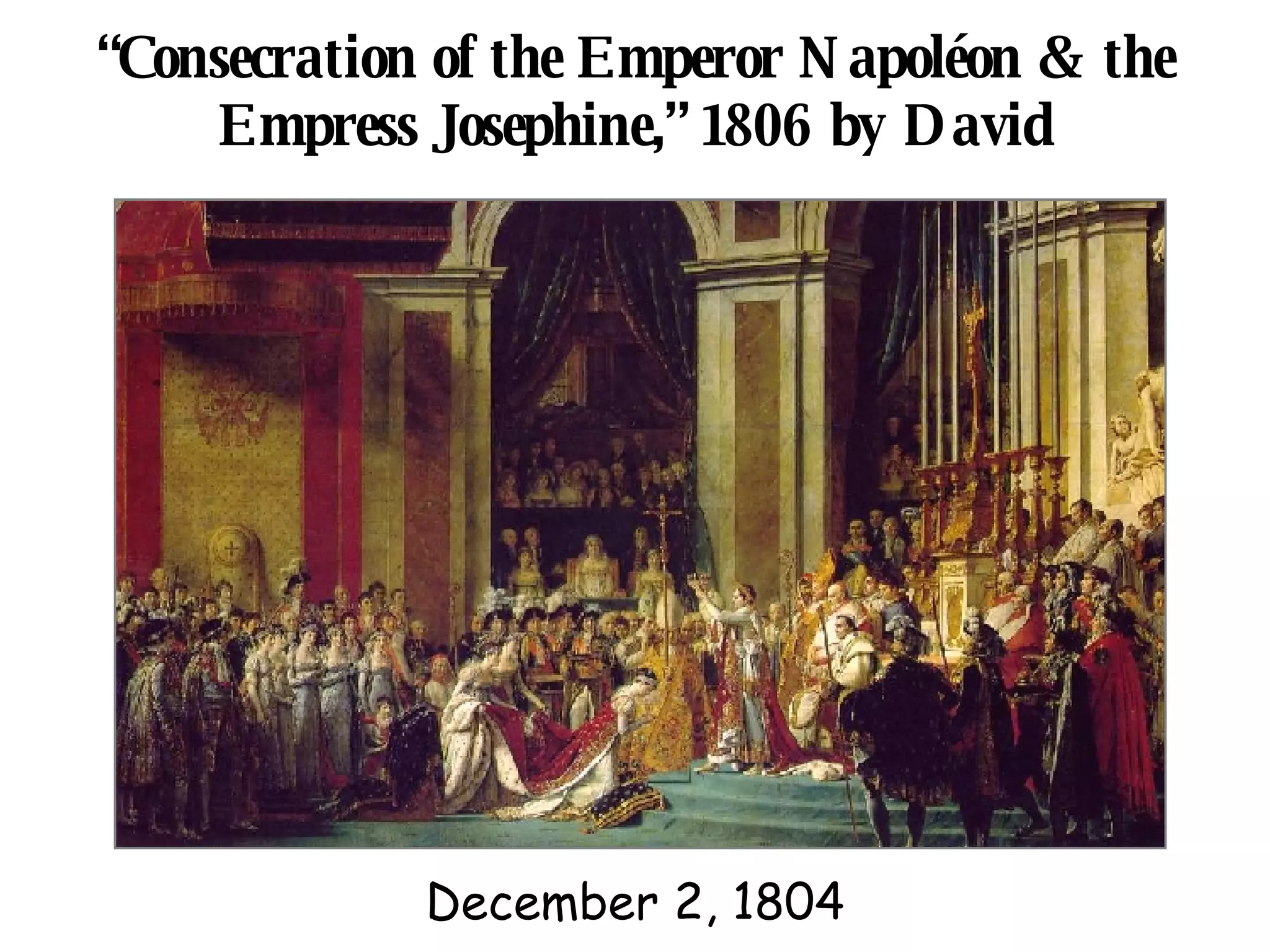
“ Consecration of the Emperor Napoléon & the Empress Josephine,” 1806 by David December 2, 1804
“ Consecration  of the Emperor Napoléon & the Empress Josephine,” (Detail) 1806  by David
Napoléon’s Throne
The Imperial Image
The “Empire” Style Madame Recamier  by David, 1808
Marie Louise (of Austria) married Napoléon on  March 12, 1810  in Vienna
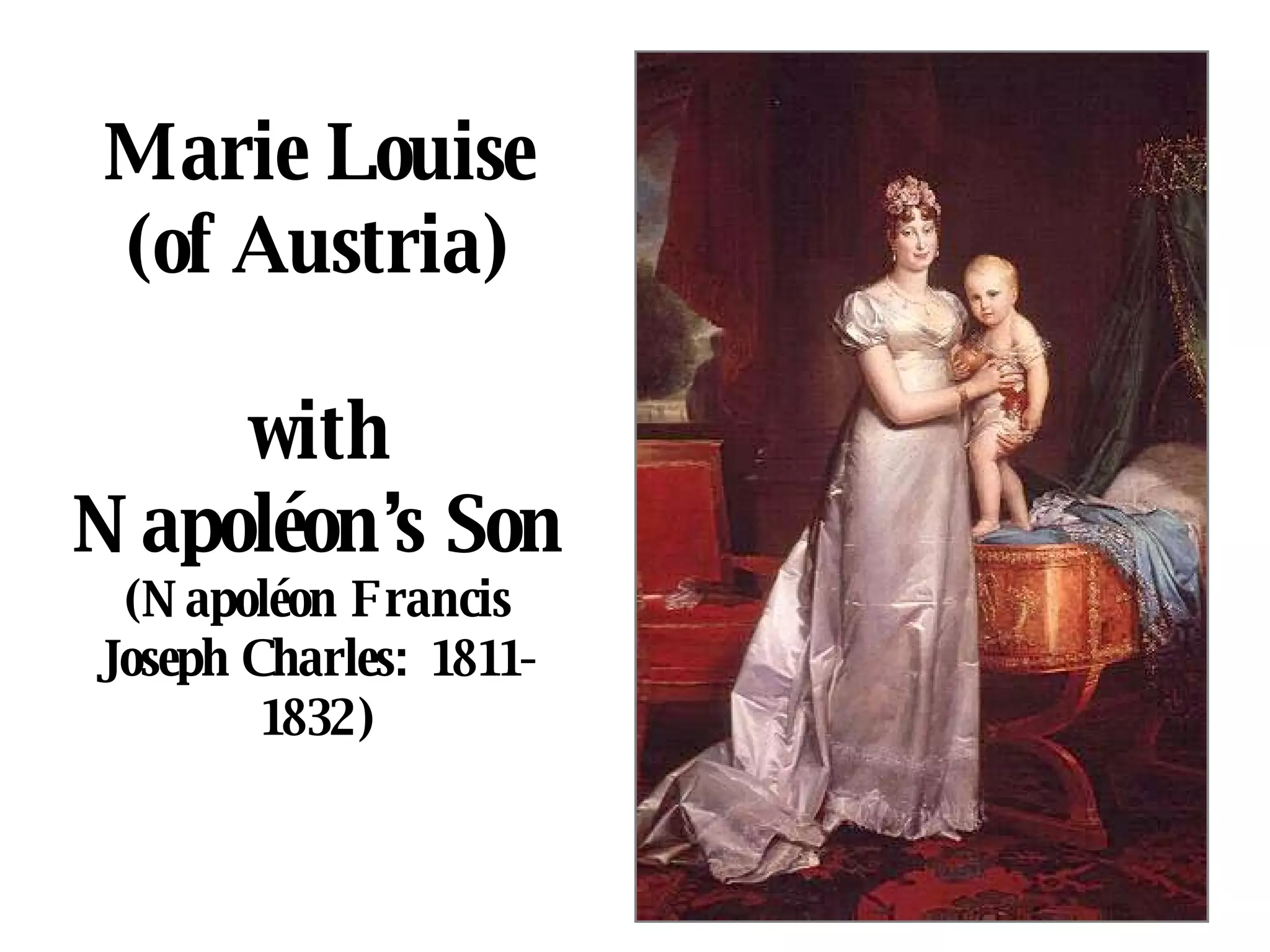
Marie Louise (of Austria) with Napoléon’s Son (Napoléon Francis Joseph Charles:  1811-1832)
Napoléon’s Family Rules! Jerome Bonaparte - King of Westphalia. Joseph Bonaparte - King of Spain Louise Bonaparte - King of Holland Pauline Bonaparte - Princess of Italy Napoléon Francis Joseph Charles - King of Rome Elisa Bonaparte - Grand Duchess of Tuscany Caroline Bonaparte - Queen of Naples
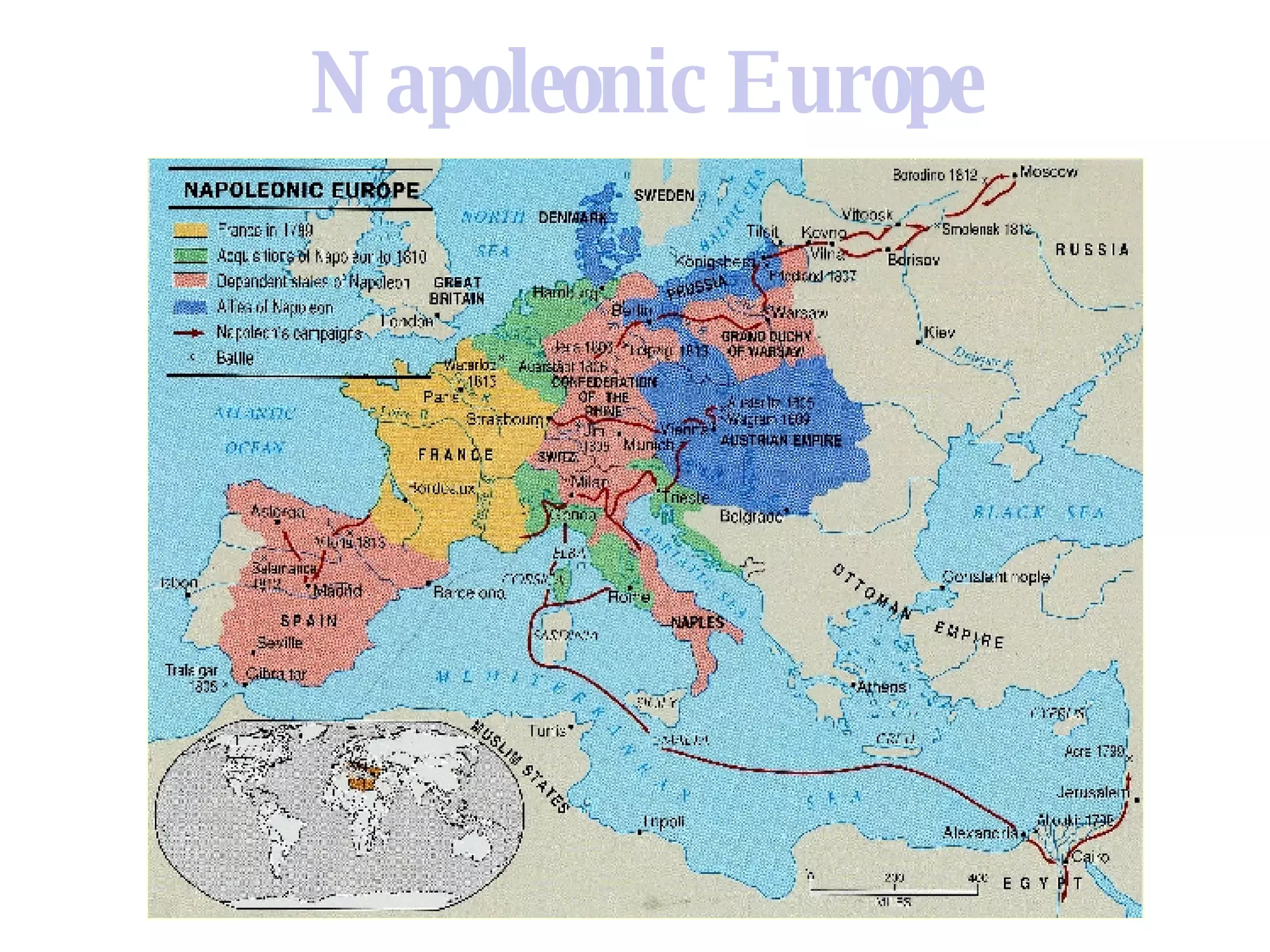
Napoleonic Europe
Napoleon Reaches His Peak from 1807-1812… But, Problems Are Forming: Napoleon’s control over other countries makes them realize that they are more loyal to their own people than Napoleon France’s Empire is huge and difficult to control Napoleon was his own worst enemy!
… And Then Things Fall Apart! Three Costly Mistakes: The Continental System The Peninsular War The Invasion of Russia
Napoléon’s Major Military Campaigns Trafalgar (Lord Nelson: Fr. Navy lost!)    Britain France   1805: Sea Power
Battle of Trafalgar
Continental System -  November 1806 A  blockade  designed to cut England off from Europe Napoleon’s navy lost at Trafalgar, so direct naval conflict out of question To destroy British trade, undermine it economically To exclude it from Europe’s affairs
Problems with Continental System Was not executed correctly - weakened British trade, did not destroy it British retaliated, made own blockade, and stopped all neutral ships going to Europe Including American ships, causing War of 1812 (only war in which U.S. invaded by foreign power) Weakened economy of France and lands controlled by Napoleon
The Peninsular War - 1808 Portugal ignored Continental System Napoleon sent army through Spain to overthrow Royal Family Spanish towns rioted in response, so Napoleon deposed Spanish king and made brother king of Spain and Portugal Port. Royals fled to Brazil, which became only colony to be the capital of its “mother country”
The Peninsular War - 1808 REALLY made Spanish mad Very loyal to king Feared that Napoleon would weaken power of Church as had happened in France Engaged in 5 years of  guerrilla warfare , which cost Napoleon 300,000 troops Encouraged  Nationalism  in other countries like Germany and Italy, who also started  guerrilla warfare
“ Third of May, 1808” by Goya (1810)
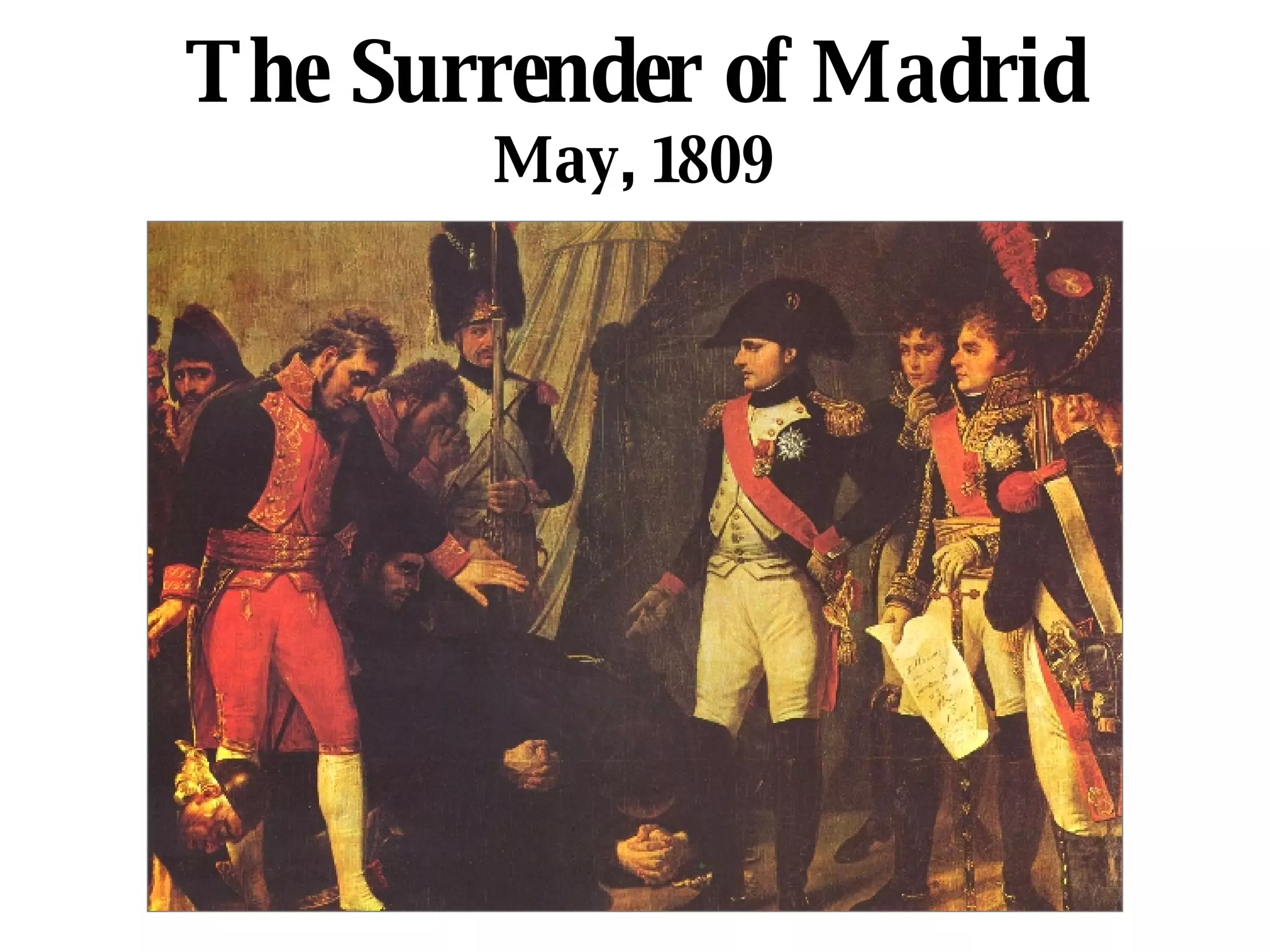
The Surrender of Madrid May, 1809
Invasion of Russia - 1812 Invading Russia = Losing Prospect!  Napoleon and Czar of Russia were allies Napoleon thought that czar was selling grain to Britain behind his back N. feared that czar wanted Poland from France N. decided to invade Russia
Invasion of Russia, cont’d. June, 1812:  420,000  Grand Army  leaves for Russia All drafted from throughout Europe and not loyal to Napoleon Scorched Earth Policy:   EVERYTHING destroyed to keep from French:  deaths and desertions Sept. 14, 1812:  Entered Moscow Czar ordered it burned down N. lingered for 5 weeks, waiting for peace offer - none came
Invasion of Russia, cont’d. Oct./Nov. 1812 - Ordered retreat from Moscow Snows began to fall Barefoot, starving soldiers attacked by Russians Temperature:  on one day, -30º:  Birds fell dead from sky Mid-December 1812:  Remaining 10,000 soldiers left Russia
Napoléon Invades Russia:  1812 614,000 French troops
Moscow on Fire!
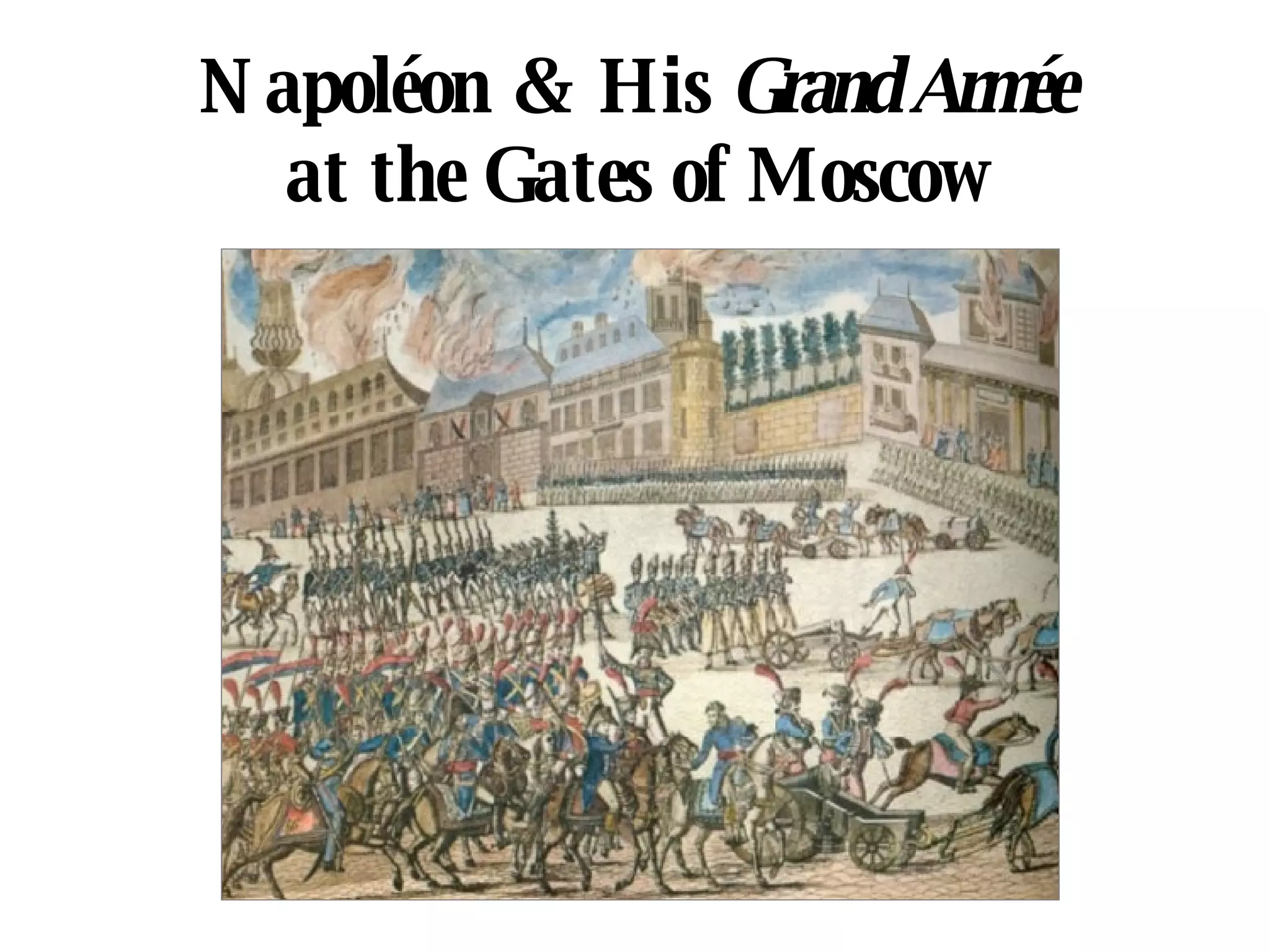
Napoléon & His  Grand Armée at the Gates of Moscow
Russian General Kutuzov The Russian army defeated the French at Borodino.
Napoléon’s Retreat  from Moscow  (Early 1813) 100,000 French troops retreat—40,000 survive!
So, A Picture is Worth 1000 words!
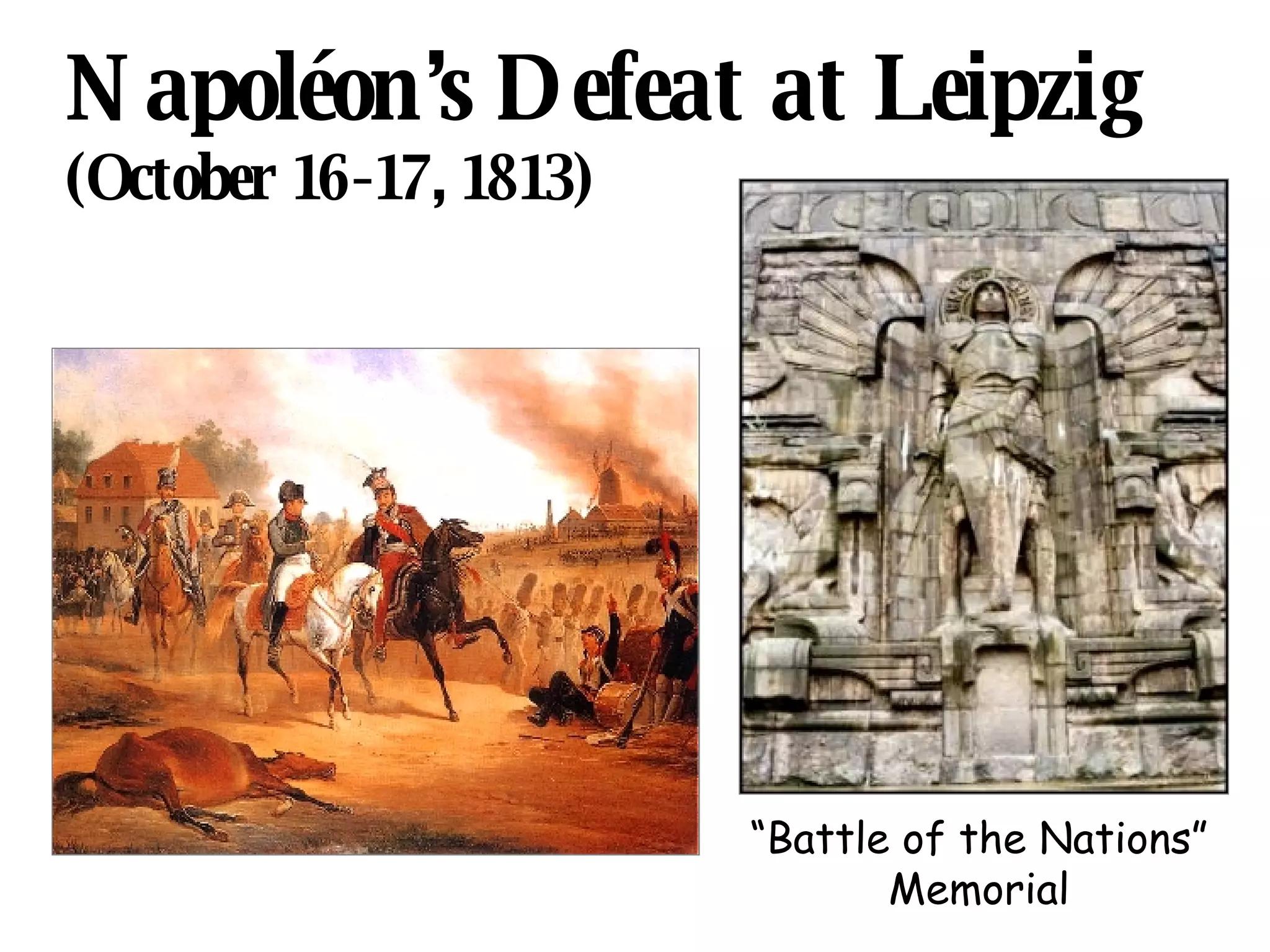
Mop-Up Duty Oct. 1813  - N. no longer has trained army - draftees destroyed by Allies at Leipzig Jan. 1814  - Austrians and Russians enter Paris April 1814  - Napoleon Abdicates, accepts surrender written by czar Napoleon given pension and banishment to Elba New French king:   Brother of Louis XVI installed as ruler
Napoléon’s Defeat at Leipzig (October 16-17, 1813) “ Battle of the Nations” Memorial
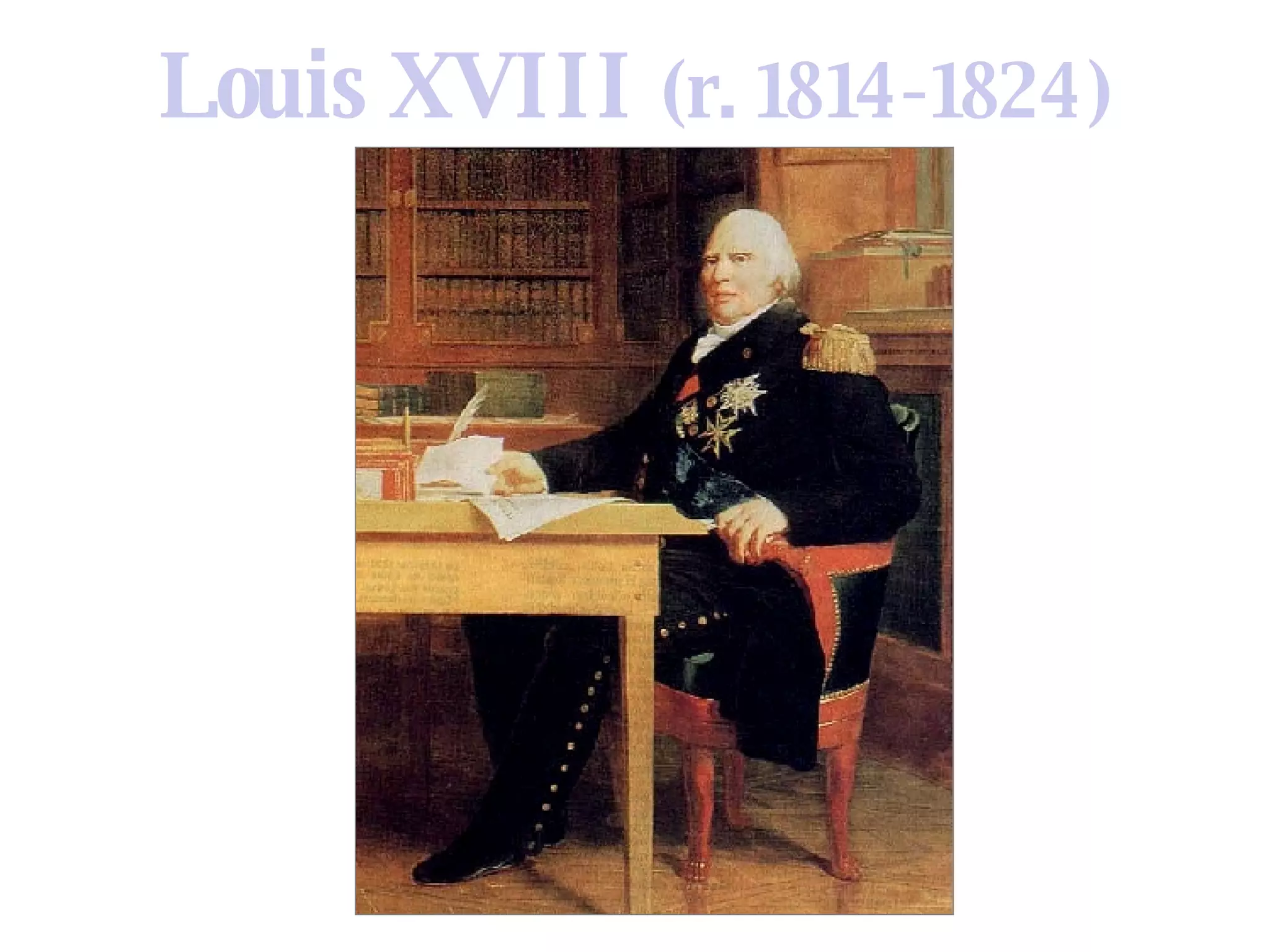
Napoléon Abdicates! Allied forces occupied Paris on March 31, 1814. Napoléon abdicated on April 6 in favor of his son, but the Allies insisted on unconditional surrender. Napoléon abdicated again on April 11. Treaty of Fontainbleau exiles Napoléon to Elba with an annual income of 2,000,000 francs. The royalists took control and restored  Louis XVIII to the throne.
Napoléon in Exile on Elba
Louis XVIII  (r. 1814-1824)
One More Time for Old Time’s Sake New French king unpopular Mar. 1815  - escaped Elba and landed in France Within days, become Emperor again and Louis XVIII flees
Napoléon  on His Way to His Final Exile on St. Helena
Napoléon’s Tomb
Waterloo - The Final Showdown Fought between Napoleon and British June 15, 1815:  French attacked June 17, 1815:  French lost Died 6 years later (stomach cancer) Marie Louise left him for Austrian officer assigned to watch over her Napoleon’s son died of tuberculosis in Austria
Aftermath Napoleon roused nationalism throughout Europe Led to unification of Germany and Italy as we know them U.S. gained middle 1/3 of its current land Haiti first colony other than US to win independence US attacked by British Spanish American colonies like semi-independence, rebel against re-establishment of Spanish King (Simon Bolivar)
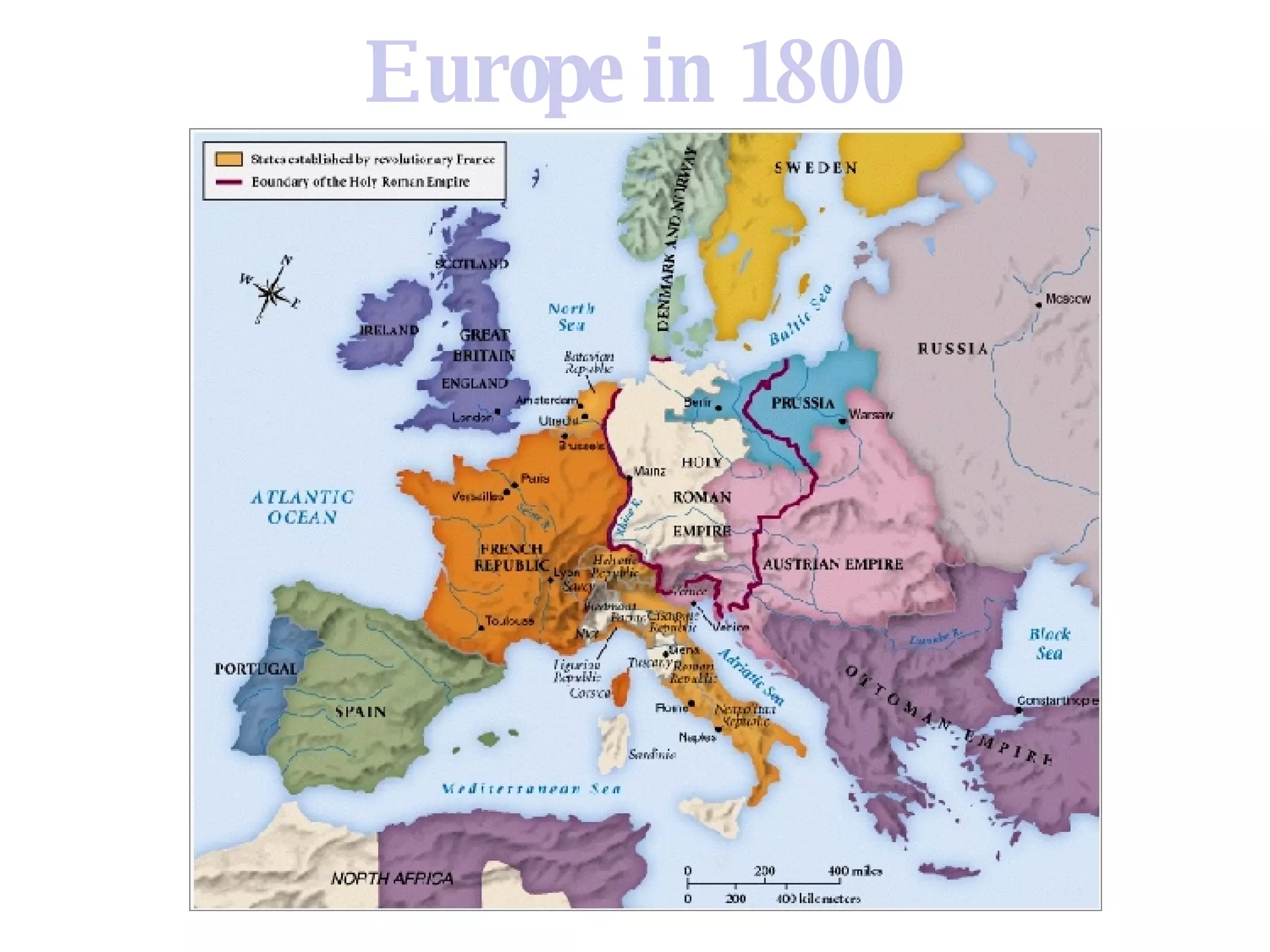
Europe in 1800
The Congress of Vienna (September 1, 1814 – June 9, 1815) It’s job was to undo everything that Napoléon had done: Reduce France to its old boundaries - her frontiers were pushed back to 1790 level. Restore as many of the old monarchies as possible that had lost their thrones during the Napoléonic era. Supported the resolution:  There is always an alternative to conflict .
Key Players  at Vienna The “Host” Prince Klemens von Metternich (Aus.) Foreign Minister,  Viscount Castlereagh (Br.) Tsar Alexander I (Rus.) King Frederick William III (Prus.) Foreign Minister, Charles Maurice de Tallyrand (Fr.)
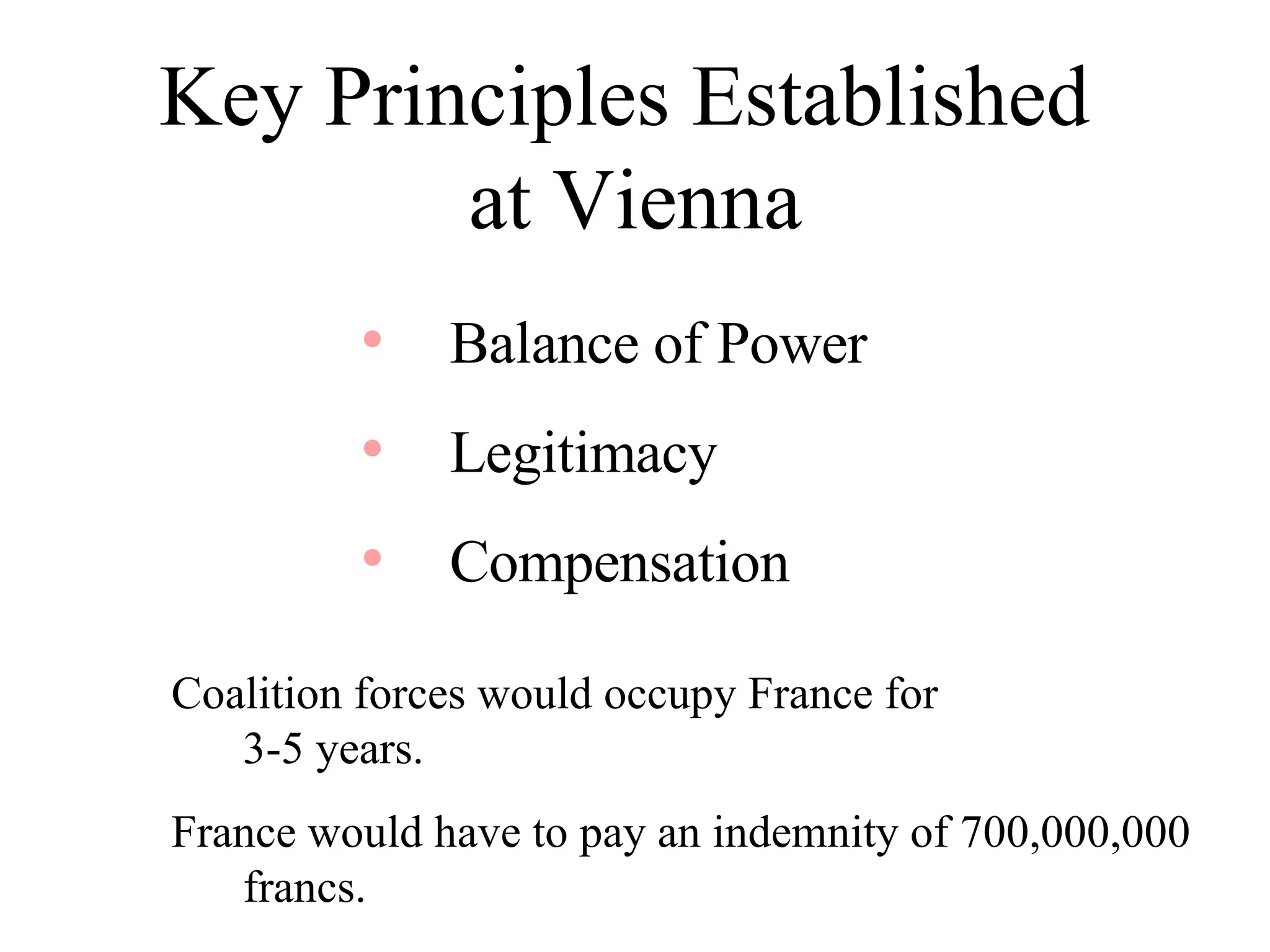
Key Principles Established  at Vienna Balance of Power Legitimacy Compensation Coalition forces would occupy France for  3-5 years. France would have to pay an indemnity of 700,000,000 francs.
France was deprived of all territory conquered by Napoléon. Russia was given most of Duchy of Warsaw (Poland).  Prussia was given half of Saxony, parts of Poland, and other German territories.  A Germanic Confederation of 39 states (including Prussia) was created from the previous 300, under Austrian rule.  Austria was given back territory it had lost recently, plus more in Germany and Italy.  The House of Orange was given the Dutch Republic and the Austrian Netherlands to rule. Changes Made at Vienna (1)
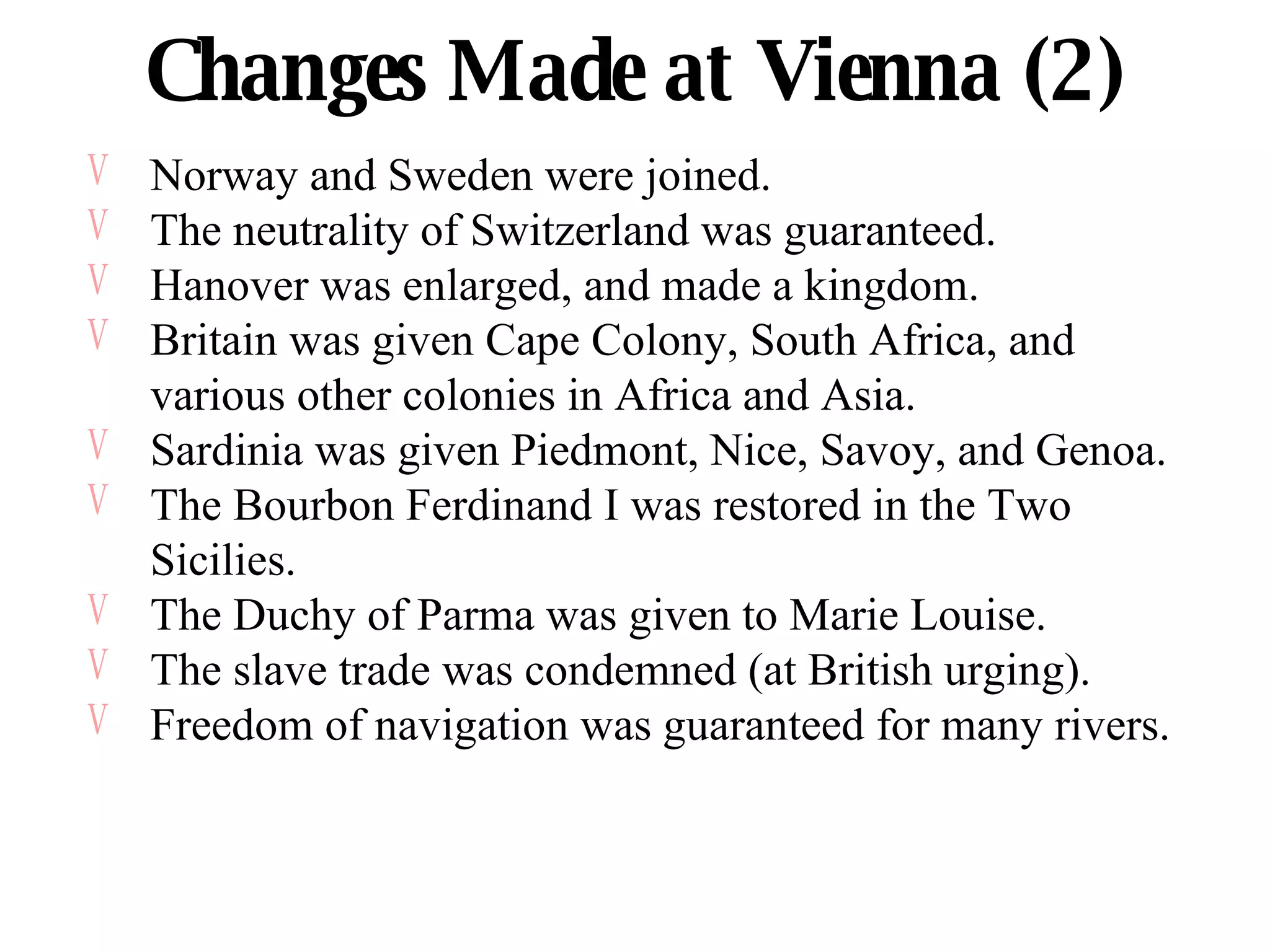
Changes Made at Vienna (2) Norway and Sweden were joined. The neutrality of Switzerland was guaranteed. Hanover was enlarged, and made a kingdom. Britain was given Cape Colony, South Africa, and various other colonies in Africa and Asia. Sardinia was given Piedmont, Nice, Savoy, and Genoa. The Bourbon Ferdinand I was restored in the Two Sicilies. The Duchy of Parma was given to Marie Louise. The slave trade was condemned (at British urging). Freedom of navigation was guaranteed for many rivers.
Napoléon’s Empire in 1810
Europe After the Congress of Vienna
To wrap up… After the death of Napoleon, how was France and Europe: The same as it had always been? Completely different?

Napoleon

  • 1.
  • 2.
    Key Events ofthe Empire Loss of Haiti, Sale of Louisiana, 1803 Loss at Trafalgar, 1805 Victories in Central Europe, 1805-1807 Establishment of Continental System Spread of Napoleonic Code
  • 3.
    Key Events ofthe Empire Nationalist Resistance to Napoleon Retreat from Russia, 1812-13 Defeat at Leipzig, 1813 Return, and defeat at Waterloo, 1815
  • 4.
    Napoleon, The RomanticFigure Movement from Enlightenment to Romanticism Reason and debate  Intuition and Action Democracy  Individual Hero Failure  Destiny
  • 5.
    They Say APicture is Worth 1000 Words - This Graph Tells a Fascinating Story - What is it?!
  • 6.
  • 7.
    Napoleon Brilliant General1799- Coup d’etat takes power from Directory 1804- French plebiscite (vote) to allow him to be an emperor
  • 8.
    Social Achievements Concordat: Patch relationship with Catholic Church - 1801 Napoleonic Code: Uniform laws for all (except women and slaves) - 1804 (still basis of Louisiana’s law) Lycees: Public Schools for all National Bank and Tax Reform: To fix France’s financial Problems
  • 9.
    Ambitions for EmpireAmericas: Louisiana territories (N. America) Guiana (S. America - still a French colony) Saint-Domingue (Haiti) (Caribbean)
  • 10.
    … But NapoleonDecides to Ditch the Americas Sells Louisiana Territory to U.S. for $15 million to finance war, spite British Slave revolt in Saint-Domingue creates world’s first black republic (Haiti)
  • 11.
    Haitian Independence, 1792-1804Toussaint L’Ouverture
  • 12.
  • 13.
    Europe: Emperor ofFrance Controls Spain, Confederation of Rhine, Grand Duchy of Warsaw, Italy, Kingdom of Naples, Switzerland (brothers and in-laws) Divorced Wife and “Married Up” into Austrian Royal Family (grand-niece of Marie Antoinette) Au Revroir Hey there…
  • 14.
    Josephine’s Divorce Statement (1807) With the permission of our august and dear husband, I must declare that, having no hope of bearing children who would fulfill the needs of his policies and the interests of France, I am pleased to offer him the greatest proof of attachment and devotion ever offered on this earth.
  • 15.
    Napoléon’s Divorce Statement (1807) Far from ever finding cause for complaint, I can to the contrary only congratulate myself on the devotion and tenderness of my beloved wife. She has adorned thirteen years of my life; the memory will always remain engraved on my heart.
  • 16.
    “ Consecration ofthe Emperor Napoléon & the Empress Josephine,” 1806 by David December 2, 1804
  • 17.
    “ Consecration of the Emperor Napoléon & the Empress Josephine,” (Detail) 1806 by David
  • 18.
  • 19.
  • 20.
    The “Empire” StyleMadame Recamier by David, 1808
  • 21.
    Marie Louise (ofAustria) married Napoléon on March 12, 1810 in Vienna
  • 22.
    Marie Louise (ofAustria) with Napoléon’s Son (Napoléon Francis Joseph Charles: 1811-1832)
  • 23.
    Napoléon’s Family Rules!Jerome Bonaparte - King of Westphalia. Joseph Bonaparte - King of Spain Louise Bonaparte - King of Holland Pauline Bonaparte - Princess of Italy Napoléon Francis Joseph Charles - King of Rome Elisa Bonaparte - Grand Duchess of Tuscany Caroline Bonaparte - Queen of Naples
  • 24.
  • 25.
    Napoleon Reaches HisPeak from 1807-1812… But, Problems Are Forming: Napoleon’s control over other countries makes them realize that they are more loyal to their own people than Napoleon France’s Empire is huge and difficult to control Napoleon was his own worst enemy!
  • 26.
    … And ThenThings Fall Apart! Three Costly Mistakes: The Continental System The Peninsular War The Invasion of Russia
  • 27.
    Napoléon’s Major MilitaryCampaigns Trafalgar (Lord Nelson: Fr. Navy lost!)  Britain France  1805: Sea Power
  • 28.
  • 29.
    Continental System - November 1806 A blockade designed to cut England off from Europe Napoleon’s navy lost at Trafalgar, so direct naval conflict out of question To destroy British trade, undermine it economically To exclude it from Europe’s affairs
  • 30.
    Problems with ContinentalSystem Was not executed correctly - weakened British trade, did not destroy it British retaliated, made own blockade, and stopped all neutral ships going to Europe Including American ships, causing War of 1812 (only war in which U.S. invaded by foreign power) Weakened economy of France and lands controlled by Napoleon
  • 31.
    The Peninsular War- 1808 Portugal ignored Continental System Napoleon sent army through Spain to overthrow Royal Family Spanish towns rioted in response, so Napoleon deposed Spanish king and made brother king of Spain and Portugal Port. Royals fled to Brazil, which became only colony to be the capital of its “mother country”
  • 32.
    The Peninsular War- 1808 REALLY made Spanish mad Very loyal to king Feared that Napoleon would weaken power of Church as had happened in France Engaged in 5 years of guerrilla warfare , which cost Napoleon 300,000 troops Encouraged Nationalism in other countries like Germany and Italy, who also started guerrilla warfare
  • 33.
    “ Third ofMay, 1808” by Goya (1810)
  • 34.
    The Surrender ofMadrid May, 1809
  • 35.
    Invasion of Russia- 1812 Invading Russia = Losing Prospect! Napoleon and Czar of Russia were allies Napoleon thought that czar was selling grain to Britain behind his back N. feared that czar wanted Poland from France N. decided to invade Russia
  • 36.
    Invasion of Russia,cont’d. June, 1812: 420,000 Grand Army leaves for Russia All drafted from throughout Europe and not loyal to Napoleon Scorched Earth Policy: EVERYTHING destroyed to keep from French: deaths and desertions Sept. 14, 1812: Entered Moscow Czar ordered it burned down N. lingered for 5 weeks, waiting for peace offer - none came
  • 37.
    Invasion of Russia,cont’d. Oct./Nov. 1812 - Ordered retreat from Moscow Snows began to fall Barefoot, starving soldiers attacked by Russians Temperature: on one day, -30º: Birds fell dead from sky Mid-December 1812: Remaining 10,000 soldiers left Russia
  • 38.
    Napoléon Invades Russia: 1812 614,000 French troops
  • 39.
  • 40.
    Napoléon & His Grand Armée at the Gates of Moscow
  • 41.
    Russian General KutuzovThe Russian army defeated the French at Borodino.
  • 42.
    Napoléon’s Retreat from Moscow (Early 1813) 100,000 French troops retreat—40,000 survive!
  • 43.
    So, A Pictureis Worth 1000 words!
  • 44.
    Mop-Up Duty Oct.1813 - N. no longer has trained army - draftees destroyed by Allies at Leipzig Jan. 1814 - Austrians and Russians enter Paris April 1814 - Napoleon Abdicates, accepts surrender written by czar Napoleon given pension and banishment to Elba New French king: Brother of Louis XVI installed as ruler
  • 45.
    Napoléon’s Defeat atLeipzig (October 16-17, 1813) “ Battle of the Nations” Memorial
  • 46.
    Napoléon Abdicates! Alliedforces occupied Paris on March 31, 1814. Napoléon abdicated on April 6 in favor of his son, but the Allies insisted on unconditional surrender. Napoléon abdicated again on April 11. Treaty of Fontainbleau exiles Napoléon to Elba with an annual income of 2,000,000 francs. The royalists took control and restored Louis XVIII to the throne.
  • 47.
  • 48.
    Louis XVIII (r. 1814-1824)
  • 49.
    One More Timefor Old Time’s Sake New French king unpopular Mar. 1815 - escaped Elba and landed in France Within days, become Emperor again and Louis XVIII flees
  • 50.
    Napoléon onHis Way to His Final Exile on St. Helena
  • 51.
  • 52.
    Waterloo - TheFinal Showdown Fought between Napoleon and British June 15, 1815: French attacked June 17, 1815: French lost Died 6 years later (stomach cancer) Marie Louise left him for Austrian officer assigned to watch over her Napoleon’s son died of tuberculosis in Austria
  • 53.
    Aftermath Napoleon rousednationalism throughout Europe Led to unification of Germany and Italy as we know them U.S. gained middle 1/3 of its current land Haiti first colony other than US to win independence US attacked by British Spanish American colonies like semi-independence, rebel against re-establishment of Spanish King (Simon Bolivar)
  • 54.
  • 55.
    The Congress ofVienna (September 1, 1814 – June 9, 1815) It’s job was to undo everything that Napoléon had done: Reduce France to its old boundaries - her frontiers were pushed back to 1790 level. Restore as many of the old monarchies as possible that had lost their thrones during the Napoléonic era. Supported the resolution: There is always an alternative to conflict .
  • 56.
    Key Players at Vienna The “Host” Prince Klemens von Metternich (Aus.) Foreign Minister, Viscount Castlereagh (Br.) Tsar Alexander I (Rus.) King Frederick William III (Prus.) Foreign Minister, Charles Maurice de Tallyrand (Fr.)
  • 57.
    Key Principles Established at Vienna Balance of Power Legitimacy Compensation Coalition forces would occupy France for 3-5 years. France would have to pay an indemnity of 700,000,000 francs.
  • 58.
    France was deprivedof all territory conquered by Napoléon. Russia was given most of Duchy of Warsaw (Poland). Prussia was given half of Saxony, parts of Poland, and other German territories. A Germanic Confederation of 39 states (including Prussia) was created from the previous 300, under Austrian rule. Austria was given back territory it had lost recently, plus more in Germany and Italy. The House of Orange was given the Dutch Republic and the Austrian Netherlands to rule. Changes Made at Vienna (1)
  • 59.
    Changes Made atVienna (2) Norway and Sweden were joined. The neutrality of Switzerland was guaranteed. Hanover was enlarged, and made a kingdom. Britain was given Cape Colony, South Africa, and various other colonies in Africa and Asia. Sardinia was given Piedmont, Nice, Savoy, and Genoa. The Bourbon Ferdinand I was restored in the Two Sicilies. The Duchy of Parma was given to Marie Louise. The slave trade was condemned (at British urging). Freedom of navigation was guaranteed for many rivers.
  • 60.
  • 61.
    Europe After theCongress of Vienna
  • 62.
    To wrap up…After the death of Napoleon, how was France and Europe: The same as it had always been? Completely different?