World War II Snapshot
Deadliest conflict in human history:
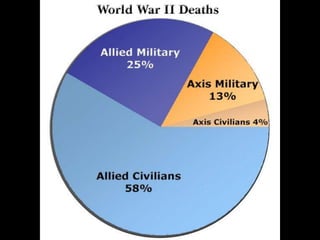
• 70 m. killed
• 2/3 civilians
Total war:
• 100 m. military personnel
• TOTAL war
Two separate theatres of conflict:
• Asia & Pacific (1931-1945)
• Europe & N. Africa (1935-1945)
Nuclear War
• Only war in which nuclear weapons of mass
destruction have been used in combat (so far):
• Hiroshima, Japan, August 6, 1945
• Nagasaki, Japan, August 9, 1945
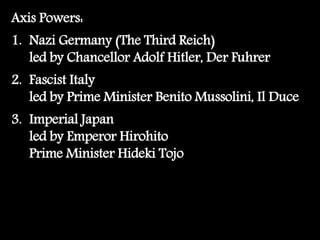
Axis Powers:
1. Nazi Germany (The Third Reich)
led by Chancellor Adolf Hitler, Der Fuhrer
2. Fascist Italy
led by Prime Minister Benito Mussolini, Il Duce
3. Imperial Japan
led by Emperor Hirohito
Prime Minister Hideki Tojo
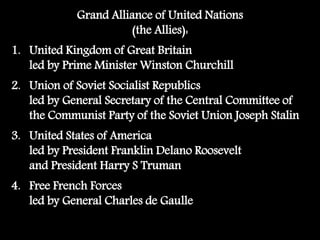
Grand Alliance of United Nations
(the Allies):
1. United Kingdom of Great Britain
led by Prime Minister Winston Churchill
2. Union of Soviet Socialist Republics
led by General Secretary of the Central Committee of
the Communist Party of the Soviet Union Joseph Stalin
3. United States of America
led by President Franklin Delano Roosevelt
and President Harry S Truman
4. Free French Forces
led by General Charles de Gaulle
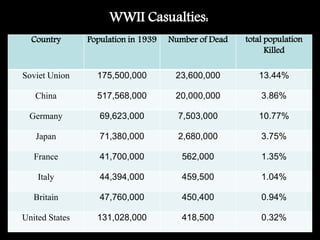
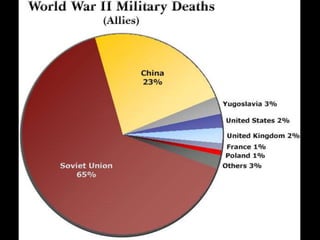
Country Population in 1939 Number of Dead total population
Killed
Soviet Union 175,500,000 23,600,000 13.44%
China 517,568,000 20,000,000 3.86%
Germany 69,623,000 7,503,000 10.77%
Japan 71,380,000 2,680,000 3.75%
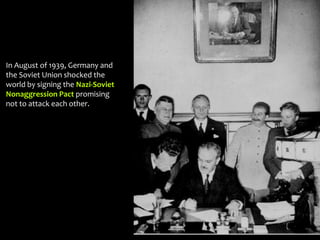
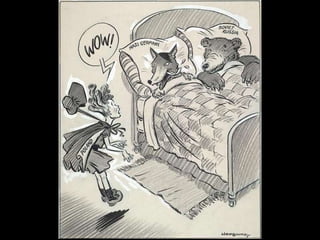
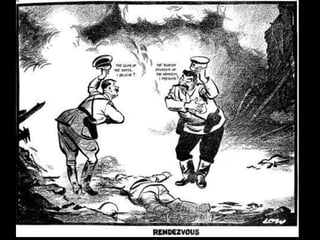
France 41,700,000 562,000 1.35%
Italy 44,394,000 459,500 1.04%
Britain 47,760,000 450,400 0.94%
United States 131,028,000 418,500 0.32%
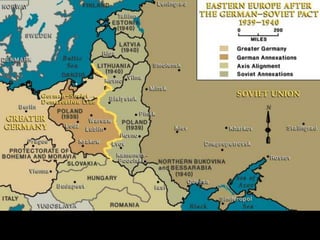
WWII Casualties:
Prelude:
Japanese Aggression in Asia
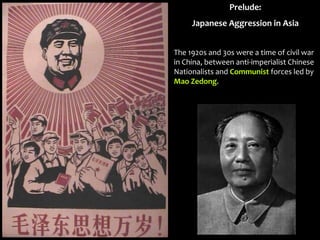
The 1920s and 30s were a time of civil war
in China, between anti-imperialist Chinese
Nationalists and Communist forces led by
Mao Zedong.
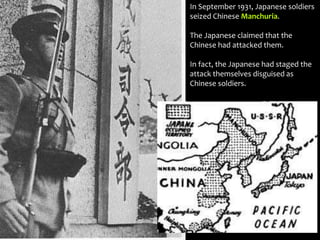
In September 1931, Japanese soldiers
seized Chinese Manchuria.
The Japanese claimed that the
Chinese had attacked them.
In fact, the Japanese had staged the
attack themselves disguised as
Chinese soldiers.
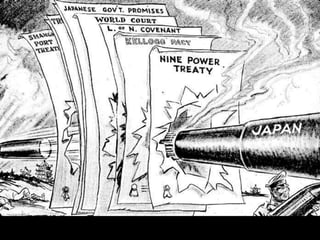
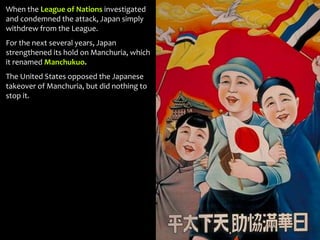
When the League of Nations investigated
and condemned the attack, Japan simply
withdrew from the League.
For the next several years, Japan
strengthened its hold on Manchuria, which
it renamed Manchukuo.
The United States opposed the Japanese
takeover of Manchuria, but did nothing to
stop it.
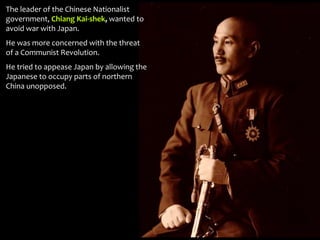
The leader of the Chinese Nationalist
government, Chiang Kai-shek, wanted to
avoid war with Japan.
He was more concerned with the threat
of a Communist Revolution.
He tried to appease Japan by allowing the
Japanese to occupy parts of northern
China unopposed.
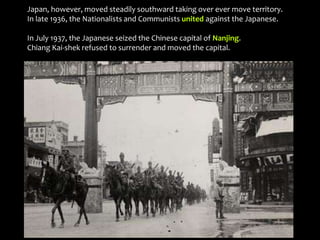
Japan, however, moved steadily southward taking over ever move territory.
In late 1936, the Nationalists and Communists united against the Japanese.
In July 1937, the Japanese seized the Chinese capital of Nanjing.
Chiang Kai-shek refused to surrender and moved the capital.
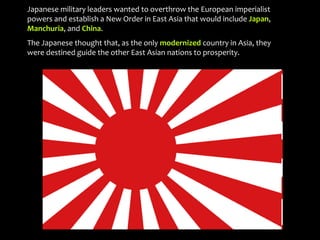
Japanese military leaders wanted to overthrow the European imperialist
powers and establish a New Order in East Asia that would include Japan,
Manchuria, and China.
The Japanese thought that, as the only modernized country in Asia, they
were destined guide the other East Asian nations to prosperity.
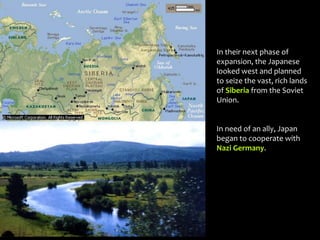
In their next phase of
expansion, the Japanese
looked west and planned
to seize the vast, rich lands
of Siberia from the Soviet
Union.
In need of an ally, Japan
began to cooperate with
Nazi Germany.
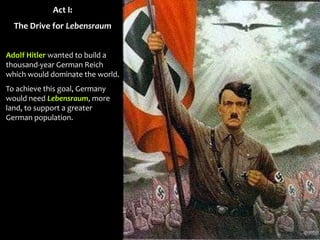
Act I:
The Drive for Lebensraum
Adolf Hitler wanted to build a
thousand-year German Reich
which would dominate the world.
To achieve this goal, Germany
would need Lebensraum, more
land, to support a greater
German population.
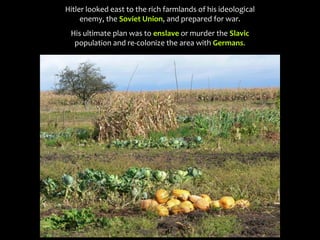
Hitler looked east to the rich farmlands of his ideological
enemy, the Soviet Union, and prepared for war.
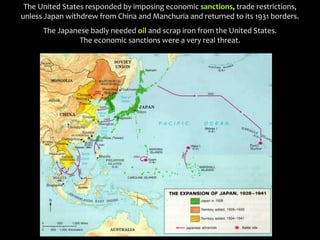
His ultimate plan was to enslave or murder the Slavic
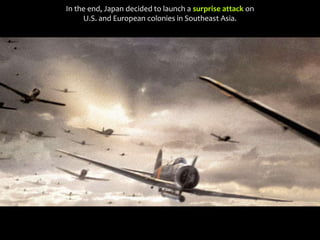
population and re-colonize the area with Germans.
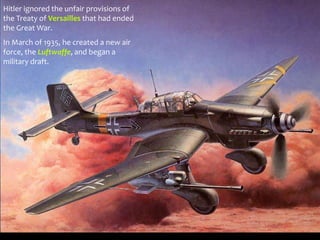
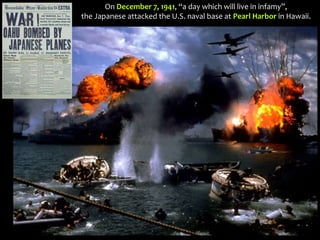
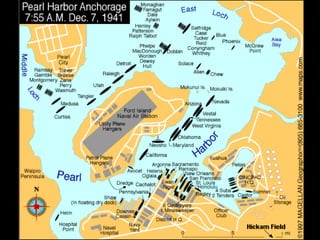
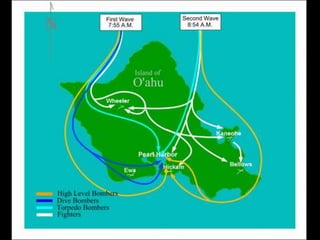
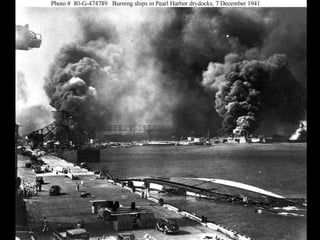
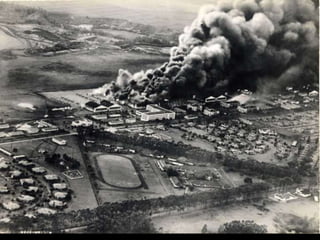
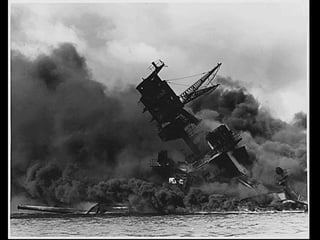
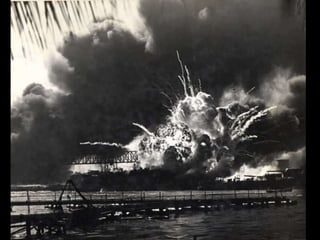
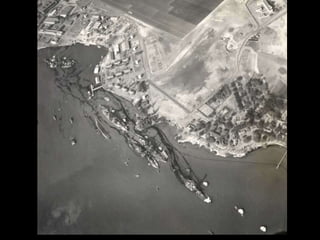
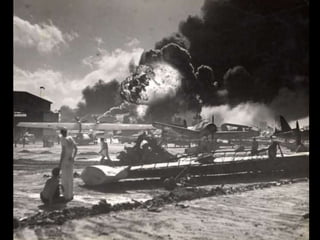
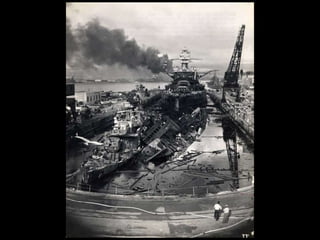
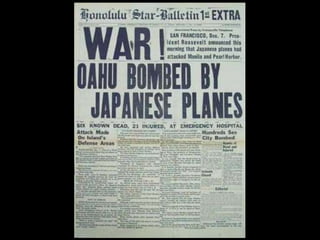
Hitler ignored the unfair provisions of
the Treaty of Versailles that had ended
the Great War.
In March of 1935, he created a new air
force, the Luftwaffe, and began a
military draft.
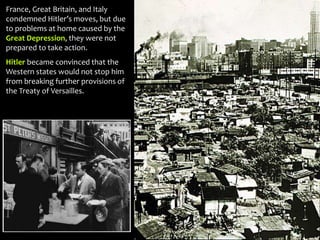
France, Great Britain, and Italy
condemned Hitler’s moves, but due
to problems at home caused by the
Great Depression, they were not
prepared to take action.
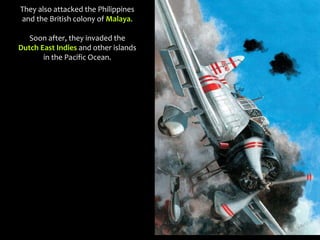
Hitler became convinced that the
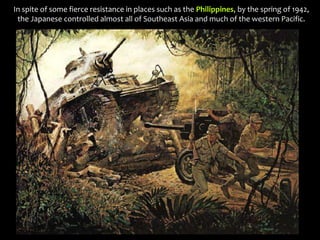
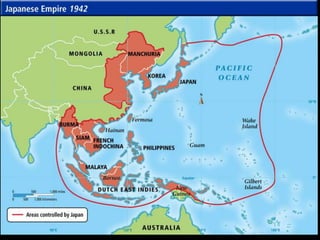
Western states would not stop him
from breaking further provisions of
the Treaty of Versailles.
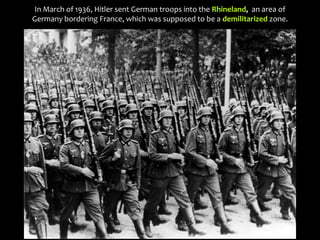
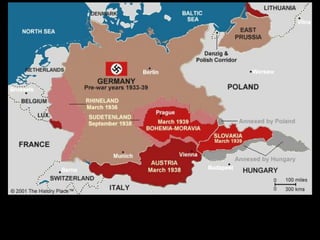
In March of 1936, Hitler sent German troops into the Rhineland, an area of
Germany bordering France, which was supposed to be a demilitarized zone.
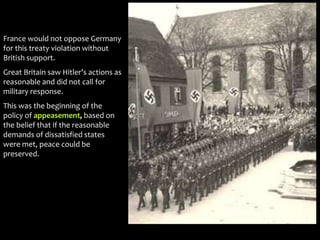
France would not oppose Germany
for this treaty violation without
British support.
Great Britain saw Hitler’s actions as
reasonable and did not call for
military response.
This was the beginning of the
policy of appeasement, based on
the belief that if the reasonable
demands of dissatisfied states
were met, peace could be
preserved.
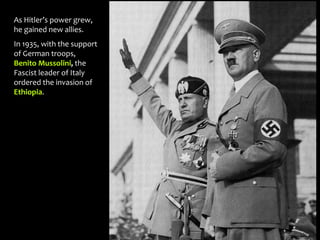
As Hitler’s power grew,
he gained new allies.
In 1935, with the support
of German troops,
Benito Mussolini, the
Fascist leader of Italy
ordered the invasion of
Ethiopia.
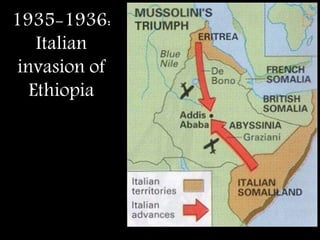
1935-1936:
Italian
invasion of
Ethiopia
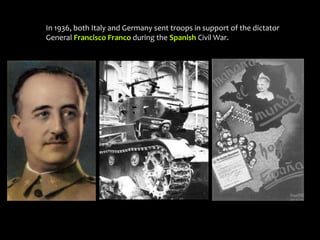
In 1936, both Italy and Germany sent troops in support of the dictator
General Francisco Franco during the Spanish Civil War.
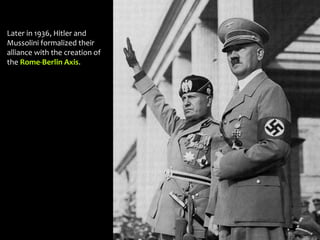
Later in 1936, Hitler and
Mussolini formalized their
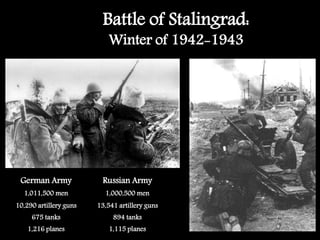
alliance with the creation of
the Rome-Berlin Axis.
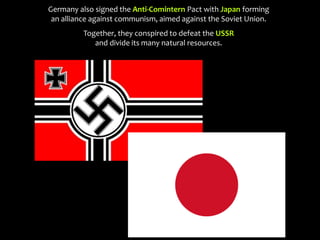
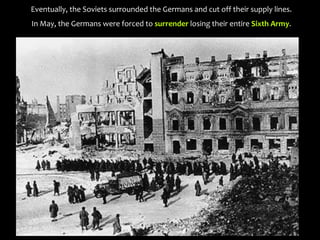
Germany also signed the Anti-Comintern Pact with Japan forming
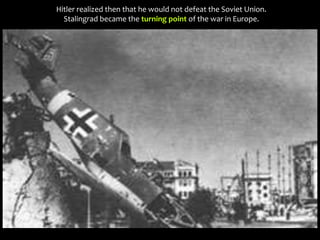
an alliance against communism, aimed against the Soviet Union.
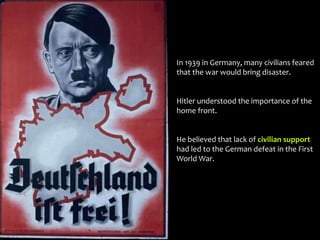
Together, they conspired to defeat the USSR
and divide its many natural resources.
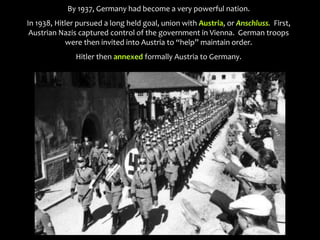
By 1937, Germany had become a very powerful nation.
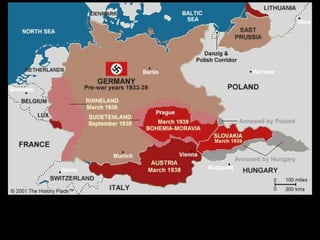
In 1938, Hitler pursued a long held goal, union with Austria, or Anschluss. First,
Austrian Nazis captured control of the government in Vienna. German troops
were then invited into Austria to “help” maintain order.
Hitler then annexed formally Austria to Germany.
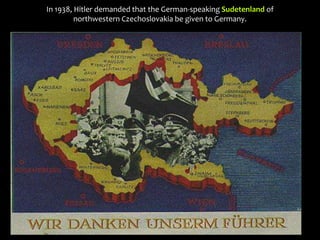
In 1938, Hitler demanded that the German-speaking Sudetenland of
northwestern Czechoslovakia be given to Germany.
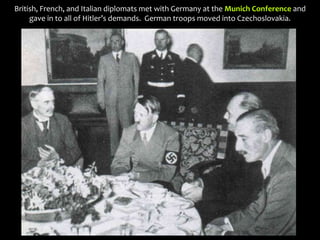
British, French, and Italian diplomats met with Germany at the Munich Conference and
gave in to all of Hitler’s demands. German troops moved into Czechoslovakia.
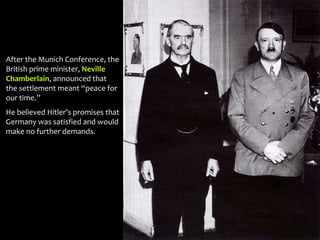
After the Munich Conference, the
British prime minister, Neville
Chamberlain, announced that
the settlement meant “peace for
our time.”
He believed Hitler’s promises that
Germany was satisfied and would
make no further demands.
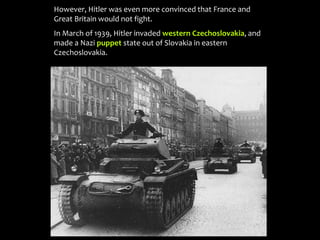
However, Hitler was even more convinced that France and
Great Britain would not fight.
In March of 1939, Hitler invaded western Czechoslovakia, and
made a Nazi puppet state out of Slovakia in eastern
Czechoslovakia.
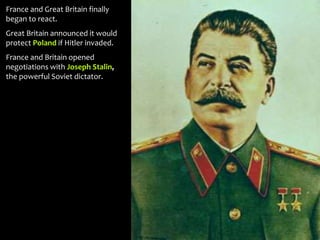
France and Great Britain finally
began to react.
Great Britain announced it would
protect Poland if Hitler invaded.
France and Britain opened
negotiations with Joseph Stalin,
the powerful Soviet dictator.
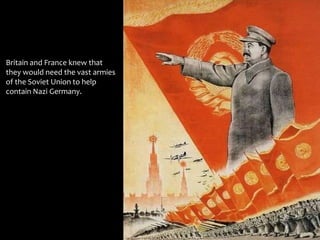
Britain and France knew that
they would need the vast armies
of the Soviet Union to help
contain Nazi Germany.
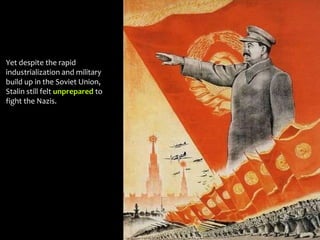
Yet despite the rapid
industrialization and military
build up in the Soviet Union,
Stalin still felt unprepared to
fight the Nazis.
In August of 1939, Germany and
the Soviet Union shocked the
world by signing the Nazi-Soviet
Nonaggression Pact promising
not to attack each other.
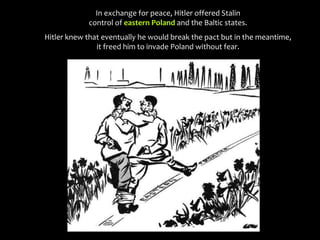
In exchange for peace, Hitler offered Stalin
control of eastern Poland and the Baltic states.
Hitler knew that eventually he would break the pact but in the meantime,
it freed him to invade Poland without fear.
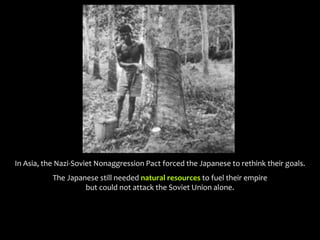
In Asia, the Nazi-Soviet Nonaggression Pact forced the Japanese to rethink their goals.
The Japanese still needed natural resources to fuel their empire
but could not attack the Soviet Union alone.
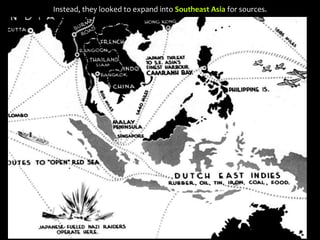
Instead, they looked to expand into Southeast Asia for sources.
Knowing they risked strong response
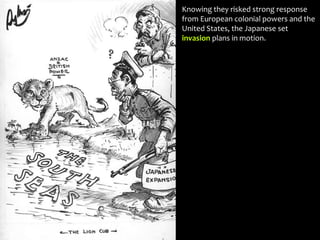
from European colonial powers and the
United States, the Japanese set
invasion plans in motion.
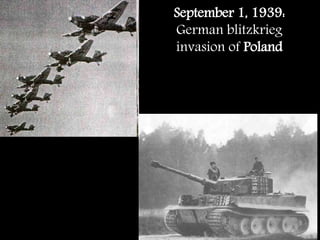
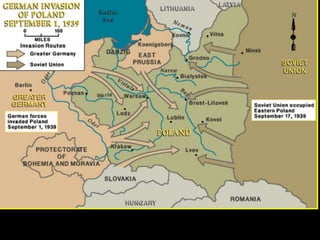
September 1, 1939:
German blitzkrieg
invasion of Poland
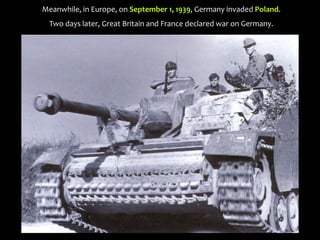
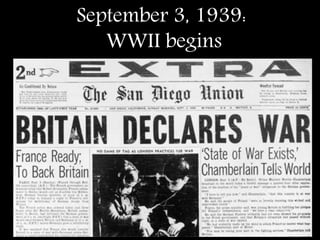
Meanwhile, in Europe, on September 1, 1939, Germany invaded Poland.
Two days later, Great Britain and France declared war on Germany.
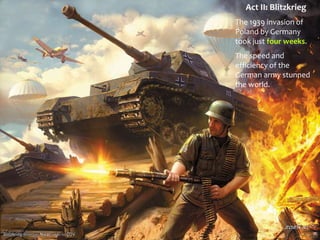
Act II: Blitzkrieg
The 1939 invasion of
Poland by Germany
took just four weeks.
The speed and
efficiency of the
German army stunned
the world.
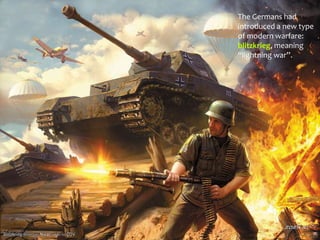
The Germans had
introduced a new type
of modern warfare:
blitzkrieg, meaning
“lightning war”.
September 3, 1939:
WWII begins
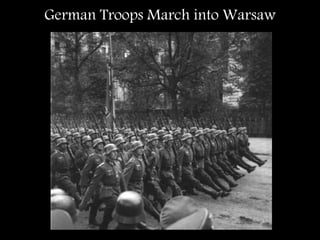
German Troops March into Warsaw
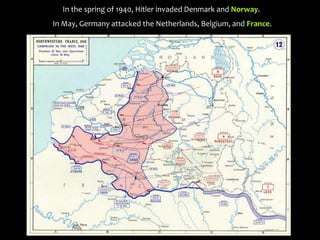
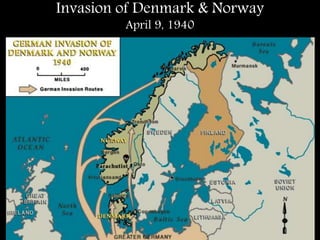
In the spring of 1940, Hitler invaded Denmark and Norway.
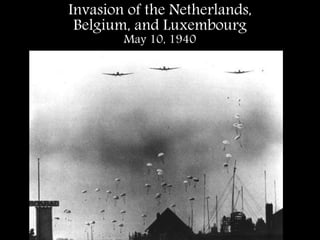
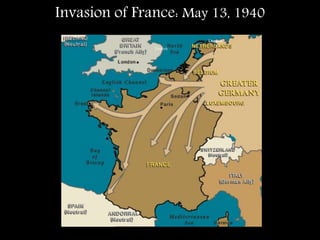
In May, Germany attacked the Netherlands, Belgium, and France.
Invasion of Denmark & Norway
April 9, 1940
Invasion of the Netherlands,
Belgium, and Luxembourg
May 10, 1940
Invasion of France: May 13, 1940
Dunkirk
Dunkirk
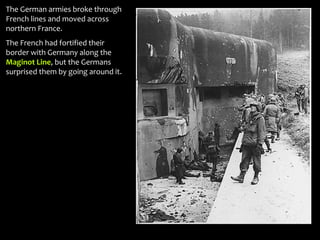
The German armies broke through
French lines and moved across
northern France.
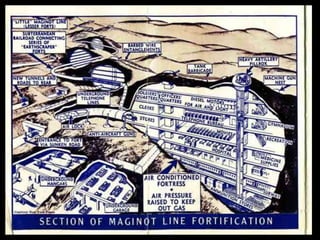
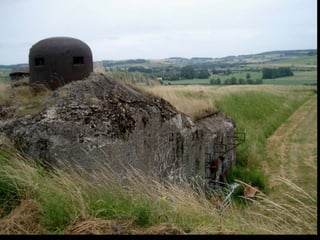
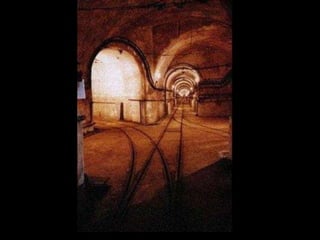
The French had fortified their
border with Germany along the
Maginot Line, but the Germans
surprised them by going around it.
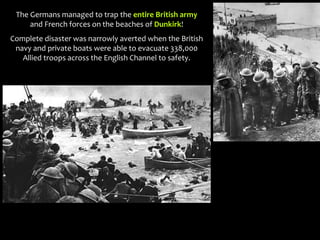
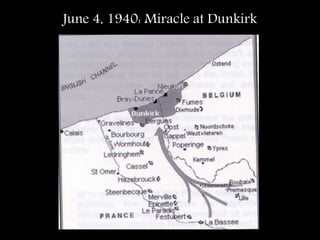
The Germans managed to trap the entire British army
and French forces on the beaches of Dunkirk!
Complete disaster was narrowly averted when the British
navy and private boats were able to evacuate 338,000
Allied troops across the English Channel to safety.
June 4, 1940: Miracle at Dunkirk
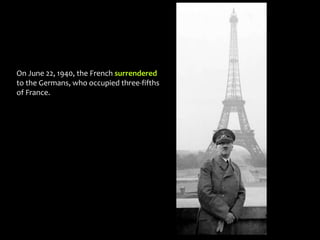
On June 22, 1940, the French surrendered
to the Germans, who occupied three-fifths
of France.
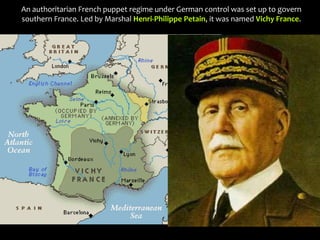
An authoritarian French puppet regime under German control was set up to govern
southern France. Led by Marshal Henri-Philippe Petain, it was named Vichy France.
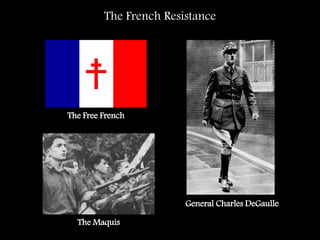
The French Resistance
The Free French
General Charles DeGaulle
The Maquis
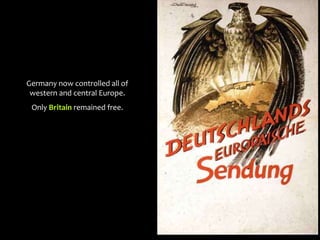
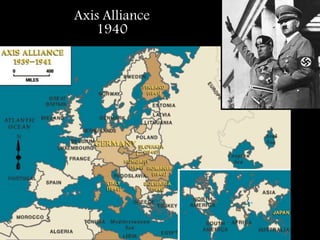
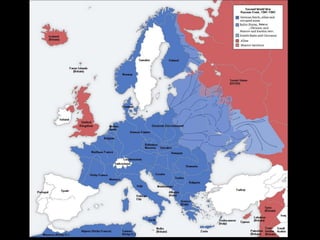
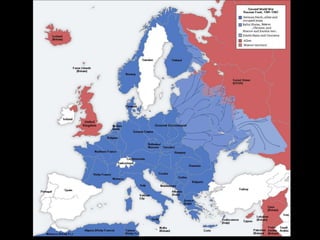
Germany now controlled all of
western and central Europe.
Only Britain remained free.
Axis Alliance
1940
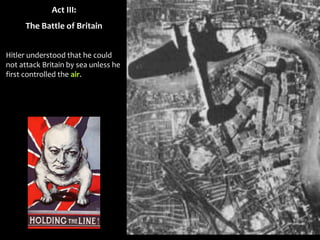
Act III:
The Battle of Britain
Hitler understood that he could
not attack Britain by sea unless he
first controlled the air.
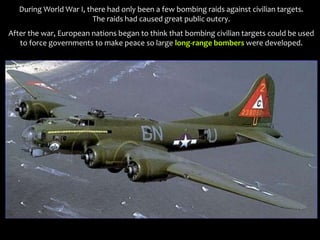
During World War I, there had only been a few bombing raids against civilian targets.
The raids had caused great public outcry.
After the war, European nations began to think that bombing civilian targets could be used
to force governments to make peace so large long-range bombers were developed.
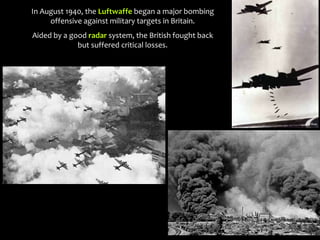
In August 1940, the Luftwaffe began a major bombing
offensive against military targets in Britain.
Aided by a good radar system, the British fought back
but suffered critical losses.
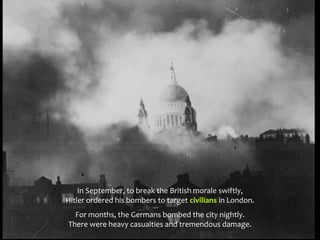
In September, to break the British morale swiftly,
Hitler ordered his bombers to target civilians in London.
For months, the Germans bombed the city nightly.
There were heavy casualties and tremendous damage.
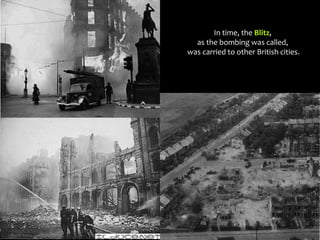
In time, the Blitz,
as the bombing was called,
was carried to other British cities.
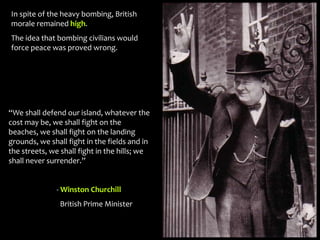
In spite of the heavy bombing, British
morale remained high.
The idea that bombing civilians would
force peace was proved wrong.
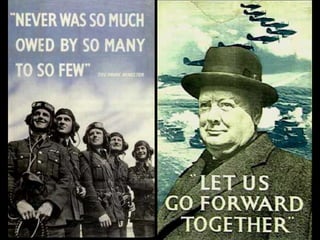
“We shall defend our island, whatever the
cost may be, we shall fight on the
beaches, we shall fight on the landing
grounds, we shall fight in the fields and in
the streets, we shall fight in the hills; we
shall never surrender.”
- Winston Churchill
British Prime Minister
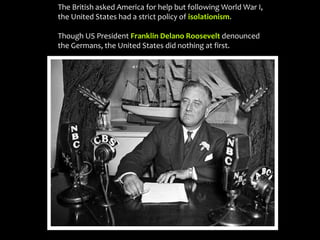
The British asked America for help but following World War I,
the United States had a strict policy of isolationism.
Though US President Franklin Delano Roosevelt denounced
the Germans, the United States did nothing at first.
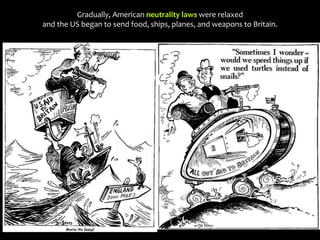
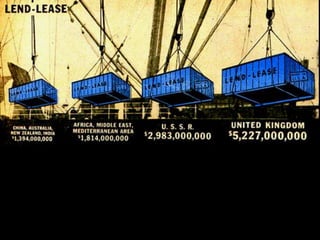
Gradually, American neutrality laws were relaxed
and the US began to send food, ships, planes, and weapons to Britain.
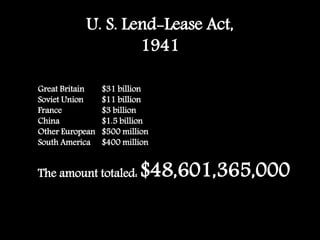
Great Britain $31 billion
Soviet Union $11 billion
France $3 billion
China $1.5 billion
Other European $500 million
South America $400 million
The amount totaled: $48,601,365,000
U. S. Lend-Lease Act,
1941
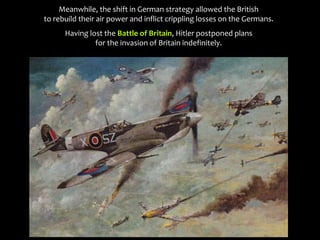
Meanwhile, the shift in German strategy allowed the British
to rebuild their air power and inflict crippling losses on the Germans.
Having lost the Battle of Britain, Hitler postponed plans
for the invasion of Britain indefinitely.
Act IV:
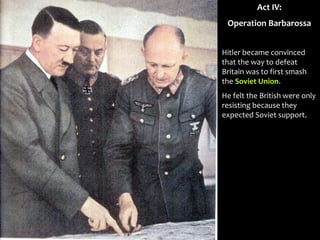
Operation Barbarossa
Hitler became convinced
that the way to defeat
Britain was to first smash
the Soviet Union.
He felt the British were only
resisting because they
expected Soviet support.
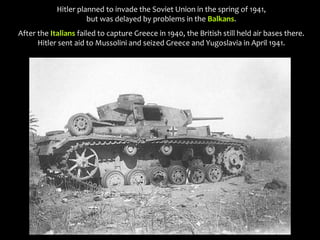
Hitler planned to invade the Soviet Union in the spring of 1941,
but was delayed by problems in the Balkans.
After the Italians failed to capture Greece in 1940, the British still held air bases there.
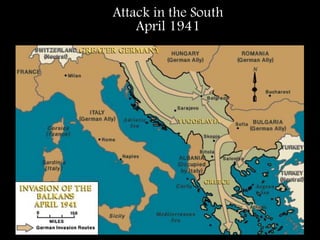
Hitler sent aid to Mussolini and seized Greece and Yugoslavia in April 1941.
Attack in the South
April 1941
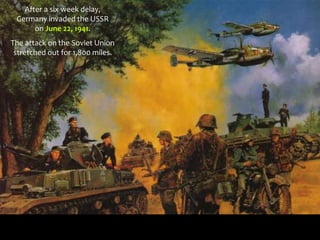
After a six week delay,
Germany invaded the USSR
on June 22, 1941.
The attack on the Soviet Union
stretched out for 1,800 miles.
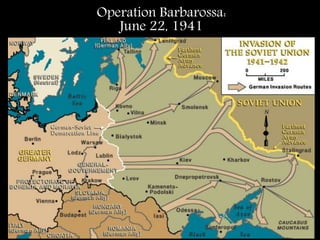
Operation Barbarossa:
June 22, 1941
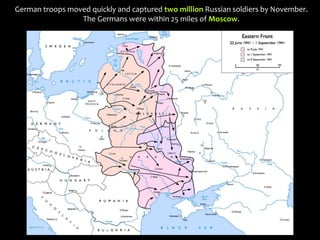
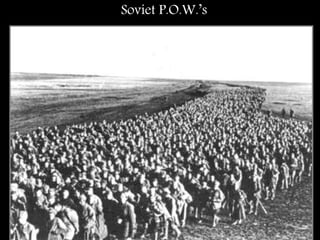
German troops moved quickly and captured two million Russian soldiers by November.
The Germans were within 25 miles of Moscow.
Soviet P.O.W.’s
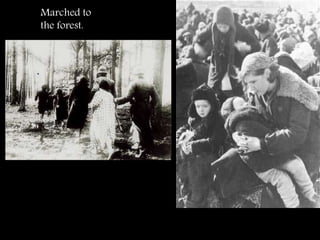
Marched to
the forest.
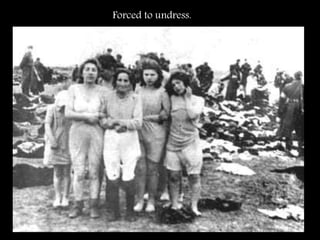
Forced to undress.
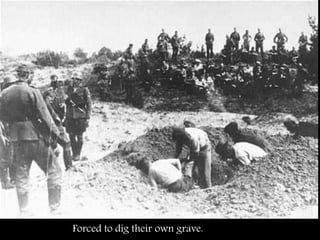
Forced to dig their own grave.
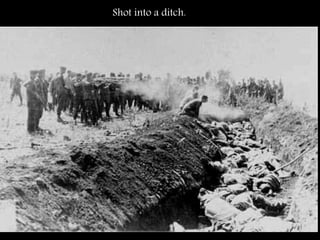
Shot into a ditch.
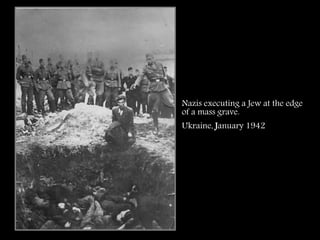
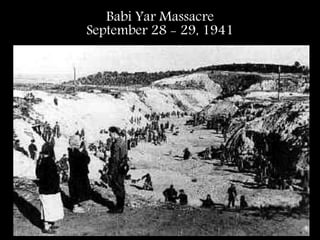
Nazis executing a Jew at the edge
of a mass grave.
Ukraine, January 1942
Babi Yar Massacre
September 28 - 29, 1941
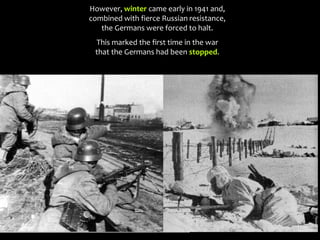
However, winter came early in 1941 and,
combined with fierce Russian resistance,
the Germans were forced to halt.
This marked the first time in the war
that the Germans had been stopped.
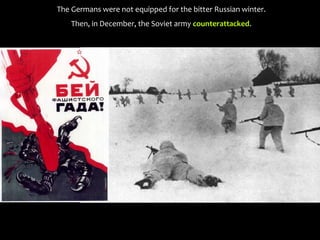
The Germans were not equipped for the bitter Russian winter.
Then, in December, the Soviet army counterattacked.
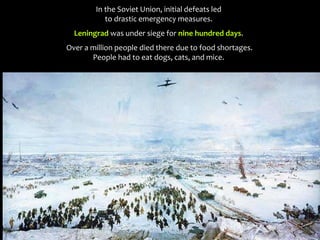
In the Soviet Union, initial defeats led
to drastic emergency measures.
Leningrad was under siege for nine hundred days.
Over a million people died there due to food shortages.
People had to eat dogs, cats, and mice.
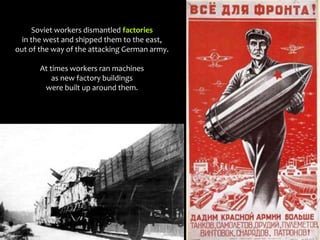
Soviet workers dismantled factories
in the west and shipped them to the east,
out of the way of the attacking German army.
At times workers ran machines
as new factory buildings
were built up around them.
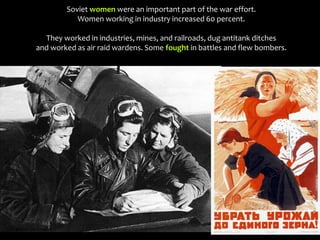
Soviet women were an important part of the war effort.
Women working in industry increased 60 percent.
They worked in industries, mines, and railroads, dug antitank ditches
and worked as air raid wardens. Some fought in battles and flew bombers.
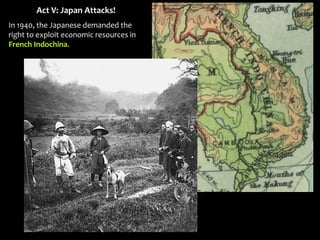
Act V: Japan Attacks!
In 1940, the Japanese demanded the
right to exploit economic resources in
French Indochina.
The United States responded by imposing economic sanctions, trade restrictions,
unless Japan withdrew from China and Manchuria and returned to its 1931 borders.
The Japanese badly needed oil and scrap iron from the United States.
The economic sanctions were a very real threat.
In the end, Japan decided to launch a surprise attack on
U.S. and European colonies in Southeast Asia.
On December 7, 1941, “a day which will live in infamy”,
the Japanese attacked the U.S. naval base at Pearl Harbor in Hawaii.
They also attacked the Philippines
and the British colony of Malaya.
Soon after, they invaded the
Dutch East Indies and other islands
in the Pacific Ocean.
In spite of some fierce resistance in places such as the Philippines, by the spring of 1942,
the Japanese controlled almost all of Southeast Asia and much of the western Pacific.
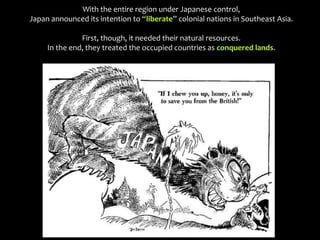
With the entire region under Japanese control,
Japan announced its intention to “liberate” colonial nations in Southeast Asia.
First, though, it needed their natural resources.
In the end, they treated the occupied countries as conquered lands.
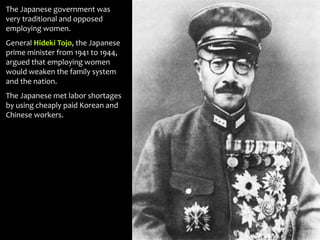
The Japanese government was
very traditional and opposed
employing women.
General Hideki Tojo, the Japanese
prime minister from 1941 to 1944,
argued that employing women
would weaken the family system
and the nation.
The Japanese met labor shortages
by using cheaply paid Korean and
Chinese workers.
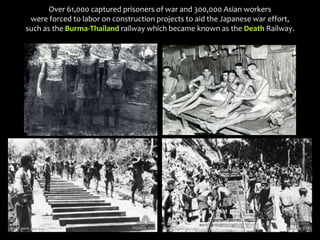
Over 61,000 captured prisoners of war and 300,000 Asian workers
were forced to labor on construction projects to aid the Japanese war effort,
such as the Burma-Thailand railway which became known as the Death Railway.
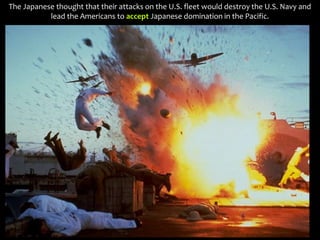
The Japanese thought that their attacks on the U.S. fleet would destroy the U.S. Navy and
lead the Americans to accept Japanese domination in the Pacific.
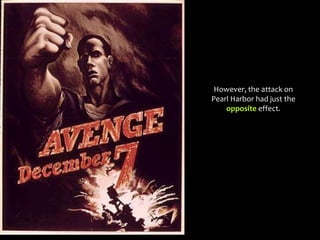
However, the attack on
Pearl Harbor had just the
opposite effect.
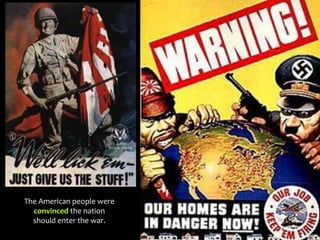
The American people were
convinced the nation
should enter the war.
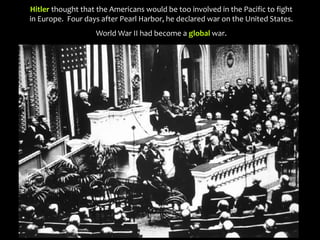
Hitler thought that the Americans would be too involved in the Pacific to fight
in Europe. Four days after Pearl Harbor, he declared war on the United States.
World War II had become a global war.
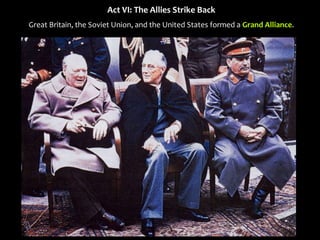
Act VI: The Allies Strike Back
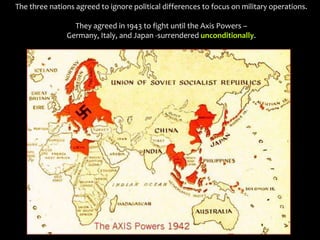
Great Britain, the Soviet Union, and the United States formed a Grand Alliance.
The three nations agreed to ignore political differences to focus on military operations.
They agreed in 1943 to fight until the Axis Powers –
Germany, Italy, and Japan -surrendered unconditionally.
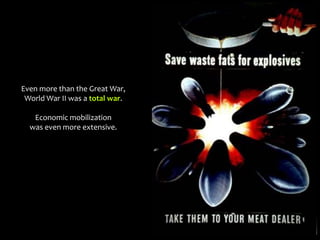
Even more than the Great War,
World War II was a total war.
Economic mobilization
was even more extensive.
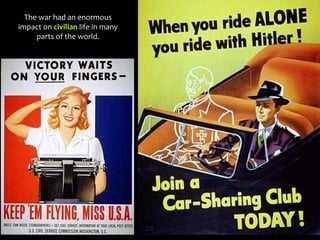
The war had an enormous
impact on civilian life in many
parts of the world.
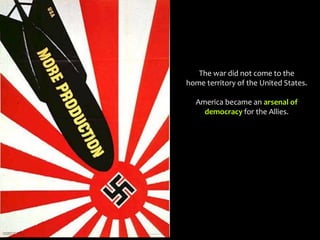
The war did not come to the
home territory of the United States.
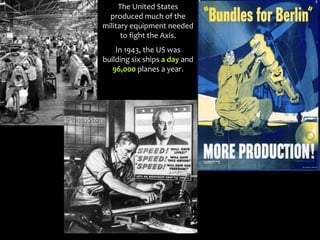
America became an arsenal of
democracy for the Allies.
The United States
produced much of the
military equipment needed
to fight the Axis.
In 1943, the US was
building six ships a day and
96,000 planes a year.
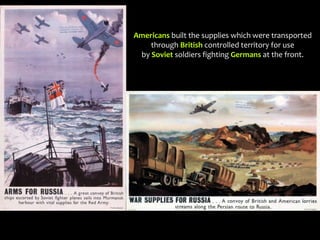
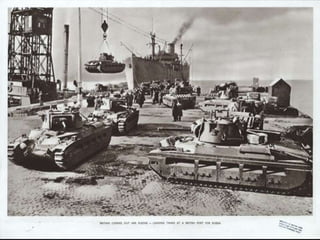
Americans built the supplies which were transported
through British controlled territory for use
by Soviet soldiers fighting Germans at the front.
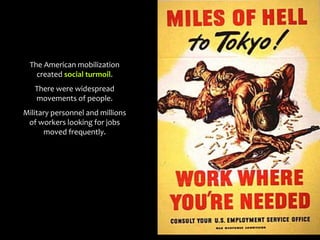
The American mobilization
created social turmoil.
There were widespread
movements of people.
Military personnel and millions
of workers looking for jobs
moved frequently.
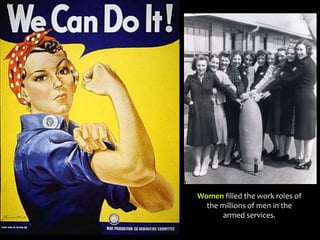
Women filled the work roles of
the millions of men in the
armed services.
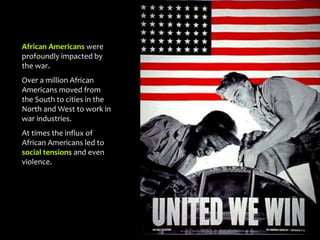
African Americans were
profoundly impacted by
the war.
Over a million African
Americans moved from
the South to cities in the
North and West to work in
war industries.
At times the influx of
African Americans led to
social tensions and even
violence.
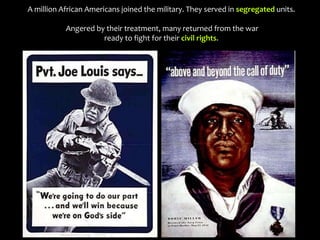
A million African Americans joined the military. They served in segregated units.
Angered by their treatment, many returned from the war
ready to fight for their civil rights.
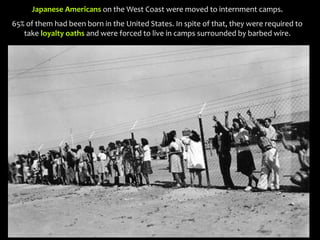
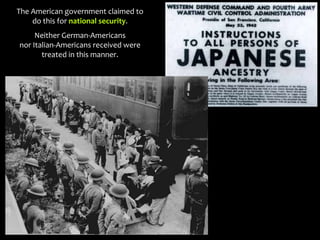
Japanese Americans on the West Coast were moved to internment camps.
65% of them had been born in the United States. In spite of that, they were required to
take loyalty oaths and were forced to live in camps surrounded by barbed wire.
The American government claimed to
do this for national security.
Neither German-Americans
nor Italian-Americans received were
treated in this manner.
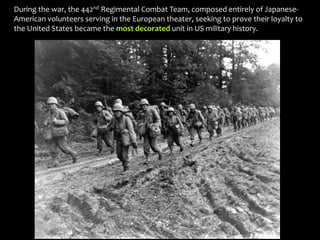
During the war, the 442nd Regimental Combat Team, composed entirely of Japanese-
American volunteers serving in the European theater, seeking to prove their loyalty to
the United States became the most decorated unit in US military history.
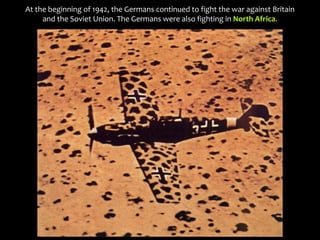
At the beginning of 1942, the Germans continued to fight the war against Britain
and the Soviet Union. The Germans were also fighting in North Africa.
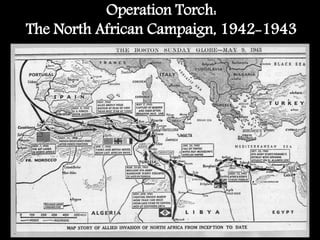
Operation Torch:
The North African Campaign, 1942-1943
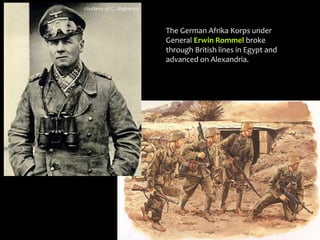
The German Afrika Korps under
General Erwin Rommel broke
through British lines in Egypt and
advanced on Alexandria.
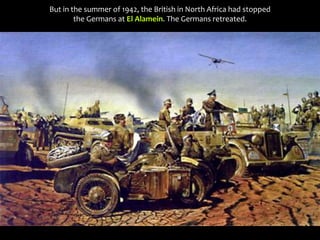
But in the summer of 1942, the British in North Africa had stopped
the Germans at El Alamein. The Germans retreated.
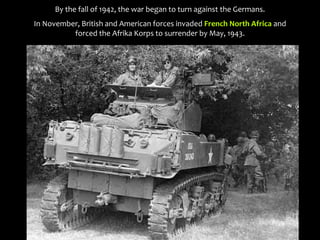
By the fall of 1942, the war began to turn against the Germans.
In November, British and American forces invaded French North Africa and
forced the Afrika Korps to surrender by May, 1943.
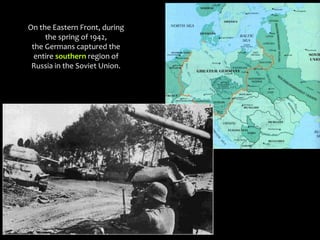
On the Eastern Front, during
the spring of 1942,
the Germans captured the
entire southern region of
Russia in the Soviet Union.
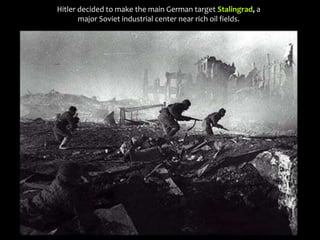
Hitler decided to make the main German target Stalingrad, a
major Soviet industrial center near rich oil fields.
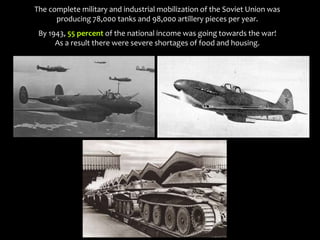
The complete military and industrial mobilization of the Soviet Union was
producing 78,000 tanks and 98,000 artillery pieces per year.
By 1943, 55 percent of the national income was going towards the war!
As a result there were severe shortages of food and housing.
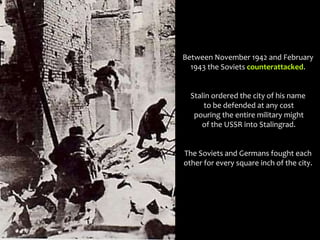
Between November 1942 and February
1943 the Soviets counterattacked.
Stalin ordered the city of his name
to be defended at any cost
pouring the entire military might
of the USSR into Stalingrad.
The Soviets and Germans fought each
other for every square inch of the city.
Battle of Stalingrad:
Winter of 1942-1943
German Army Russian Army
1,011,500 men 1,000,500 men
10,290 artillery guns 13,541 artillery guns
675 tanks 894 tanks
1,216 planes 1,115 planes
Eventually, the Soviets surrounded the Germans and cut off their supply lines.
In May, the Germans were forced to surrender losing their entire Sixth Army.
Hitler realized then that he would not defeat the Soviet Union.
Stalingrad became the turning point of the war in Europe.
In 1939 in Germany, many civilians feared
that the war would bring disaster.
Hitler understood the importance of the
home front.
He believed that lack of civilian support
had led to the German defeat in the First
World War.
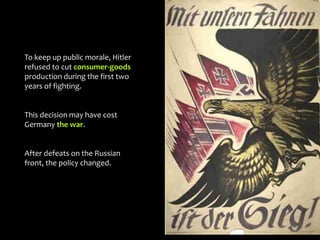
To keep up public morale, Hitler
refused to cut consumer-goods
production during the first two
years of fighting.
This decision may have cost
Germany the war.
After defeats on the Russian
front, the policy changed.
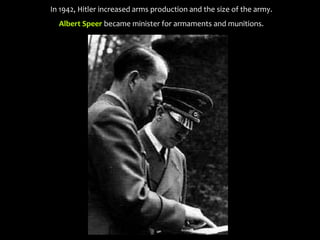
In 1942, Hitler increased arms production and the size of the army.
Albert Speer became minister for armaments and munitions.
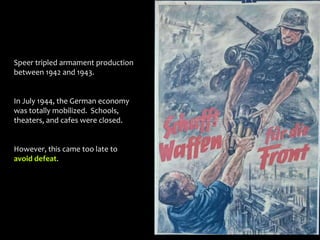
Speer tripled armament production
between 1942 and 1943.
In July 1944, the German economy
was totally mobilized. Schools,
theaters, and cafes were closed.
However, this came too late to
avoid defeat.
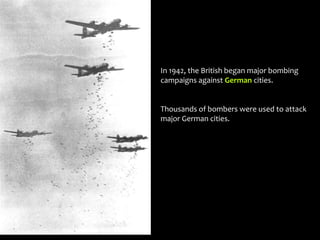
In 1942, the British began major bombing
campaigns against German cities.
Thousands of bombers were used to attack
major German cities.
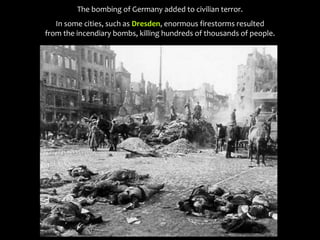
The bombing of Germany added to civilian terror.
In some cities, such as Dresden, enormous firestorms resulted
from the incendiary bombs, killing hundreds of thousands of people.
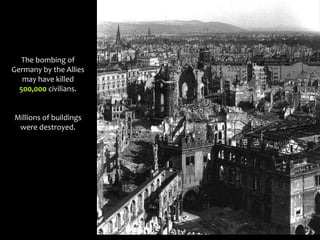
The bombing of
Germany by the Allies
may have killed
500,000 civilians.
Millions of buildings
were destroyed.
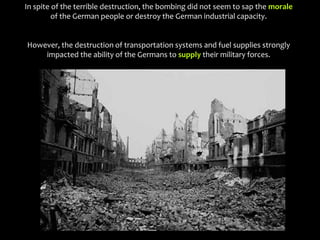
In spite of the terrible destruction, the bombing did not seem to sap the morale
of the German people or destroy the German industrial capacity.
However, the destruction of transportation systems and fuel supplies strongly
impacted the ability of the Germans to supply their military forces.
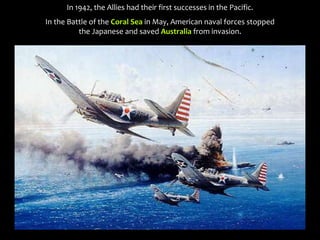
In 1942, the Allies had their first successes in the Pacific.
In the Battle of the Coral Sea in May, American naval forces stopped
the Japanese and saved Australia from invasion.
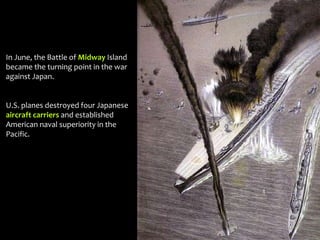
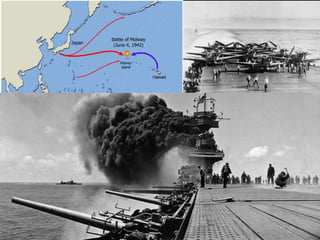
In June, the Battle of Midway Island
became the turning point in the war
against Japan.
U.S. planes destroyed four Japanese
aircraft carriers and established
American naval superiority in the
Pacific.
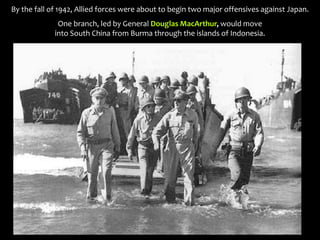
By the fall of 1942, Allied forces were about to begin two major offensives against Japan.
One branch, led by General Douglas MacArthur, would move
into South China from Burma through the islands of Indonesia.
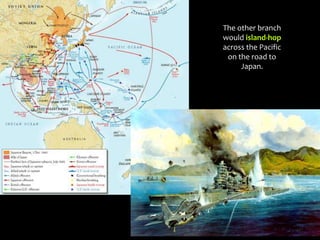
The other branch
would island-hop
across the Pacific
on the road to
Japan.
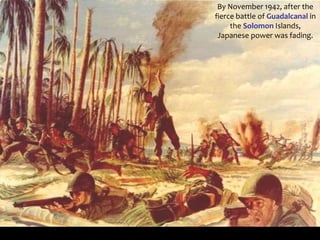
By November 1942, after the
fierce battle of Guadalcanal in
the Solomon Islands,
Japanese power was fading.
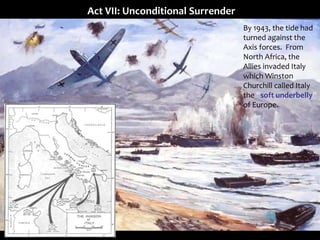
Act VII: Unconditional Surrender
By 1943, the tide had
turned against the
Axis forces. From
North Africa, the
Allies invaded Italy
which Winston
Churchill called Italy
the “soft underbelly”
of Europe.
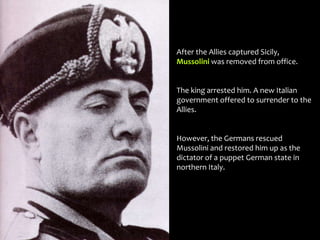
After the Allies captured Sicily,
Mussolini was removed from office.
The king arrested him. A new Italian
government offered to surrender to the
Allies.
However, the Germans rescued
Mussolini and restored him up as the
dictator of a puppet German state in
northern Italy.
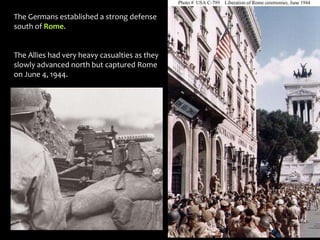
The Germans established a strong defense
south of Rome.
The Allies had very heavy casualties as they
slowly advanced north but captured Rome
on June 4, 1944.
The Allies had long been planning a “second front” in
western Europe. They planned to invade France from Great
Britain across the English Channel.
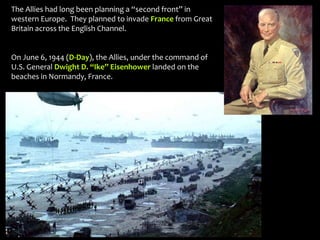
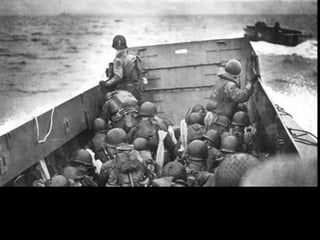
On June 6, 1944 (D-Day), the Allies, under the command of
U.S. General Dwight D. “Ike” Eisenhower landed on the
beaches in Normandy, France.
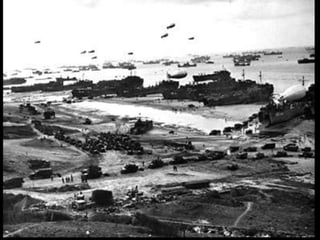
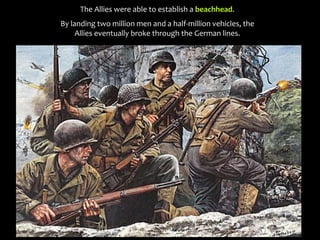
The Allies were able to establish a beachhead.
By landing two million men and a half-million vehicles, the
Allies eventually broke through the German lines.
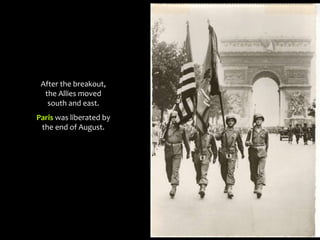
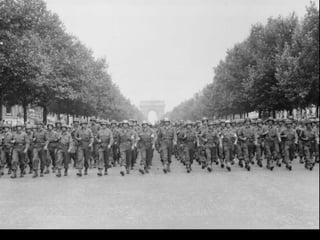
After the breakout,
the Allies moved
south and east.
Paris was liberated by
the end of August.
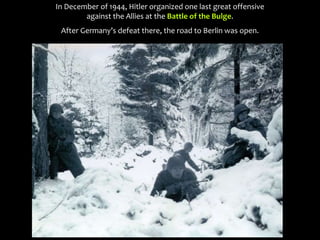
In December of 1944, Hitler organized one last great offensive
against the Allies at the Battle of the Bulge.
After Germany’s defeat there, the road to Berlin was open.
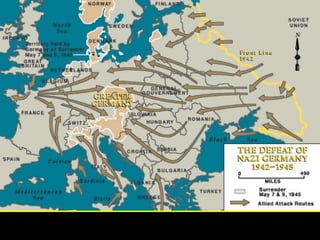
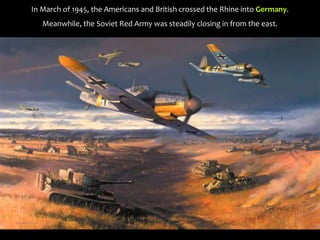
In March of 1945, the Americans and British crossed the Rhine into Germany.
Meanwhile, the Soviet Red Army was steadily closing in from the east.
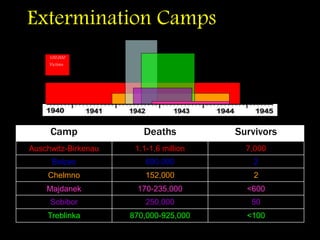
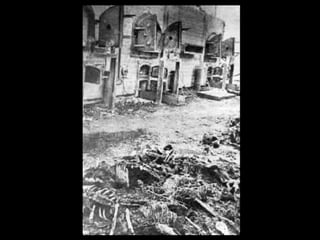
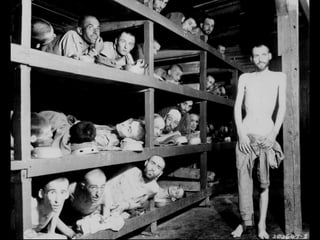
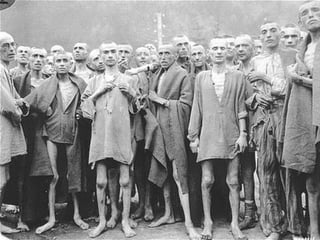
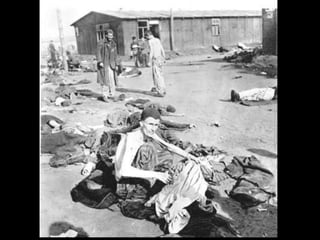
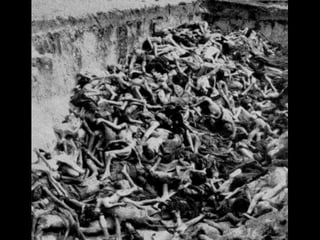
100,000
Victims
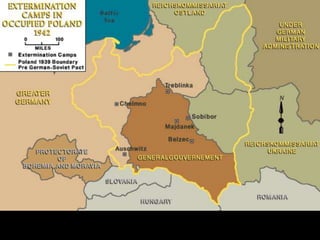
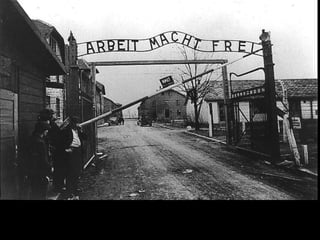
Extermination Camps
Camp Deaths Survivors
Auschwitz-Birkenau 1.1-1.6 million 7,000
Belzec 600,000 2
Chelmno 152,000 2
Majdanek 170-235,000 <600
Sobibor 250,000 50
Treblinka 870,000-925,000 <100
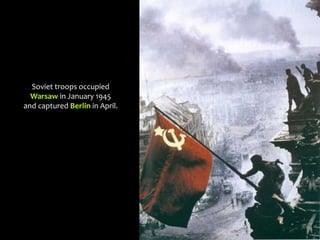
Soviet troops occupied
Warsaw in January 1945
and captured Berlin in April.
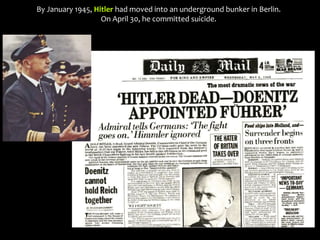
By January 1945, Hitler had moved into an underground bunker in Berlin.
On April 30, he committed suicide.
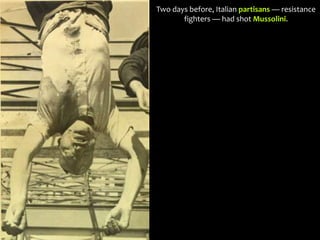
Two days before, Italian partisans — resistance
fighters — had shot Mussolini.
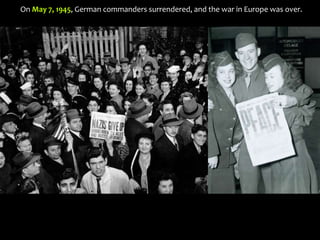
On May 7, 1945, German commanders surrendered, and the war in Europe was over.
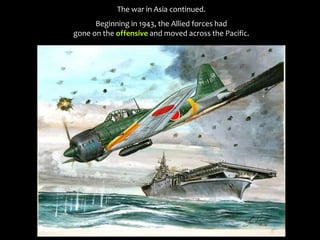
The war in Asia continued.
Beginning in 1943, the Allied forces had
gone on the offensive and moved across the Pacific.
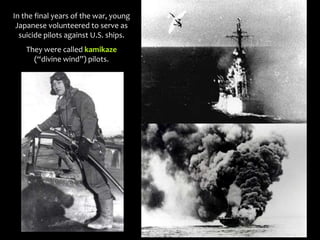
In the final years of the war, young
Japanese volunteered to serve as
suicide pilots against U.S. ships.
They were called kamikaze
(“divine wind”) pilots.
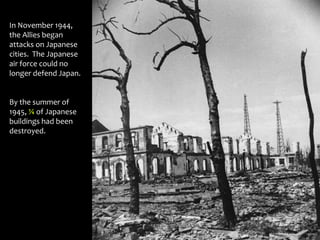
In November 1944,
the Allies began
attacks on Japanese
cities. The Japanese
air force could no
longer defend Japan.
By the summer of
1945, ¼ of Japanese
buildings had been
destroyed.
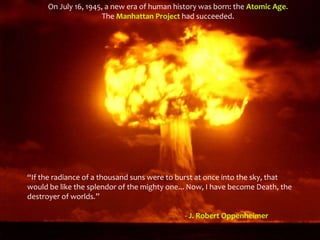
“If the radiance of a thousand suns were to burst at once into the sky, that
would be like the splendor of the mighty one... Now, I have become Death, the
destroyer of worlds.”
- J. Robert Oppenheimer
On July 16, 1945, a new era of human history was born: the Atomic Age.
The Manhattan Project had succeeded.
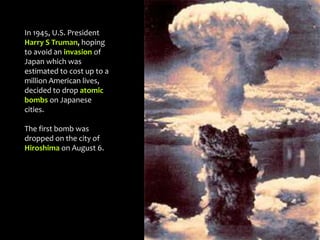
In 1945, U.S. President
Harry S Truman, hoping
to avoid an invasion of
Japan which was
estimated to cost up to a
million American lives,
decided to drop atomic
bombs on Japanese
cities.
The first bomb was
dropped on the city of
Hiroshima on August 6.
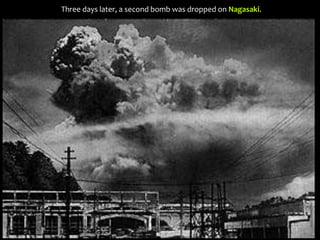
Three days later, a second bomb was dropped on Nagasaki.
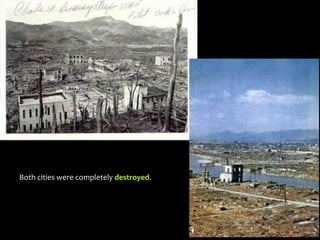
Both cities were completely destroyed.
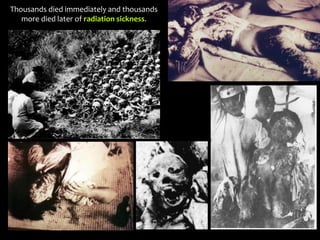
Thousands died immediately and thousands
more died later of radiation sickness.
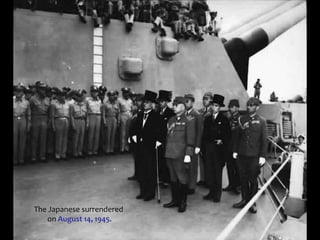
The Japanese surrendered
on August 14, 1945.
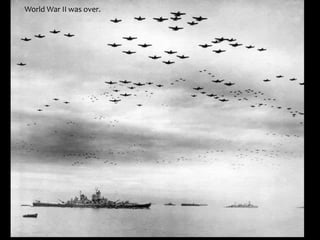
World War II was over.
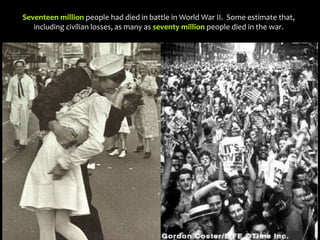
Seventeen million people had died in battle in World War II. Some estimate that,
including civilian losses, as many as seventy million people died in the war.
Epilogue: The Curtain Descends
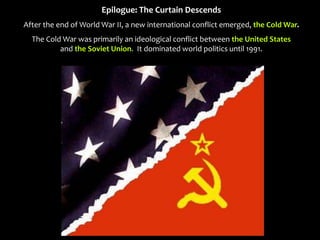
After the end of World War II, a new international conflict emerged, the Cold War.
The Cold War was primarily an ideological conflict between the United States
and the Soviet Union. It dominated world politics until 1991.
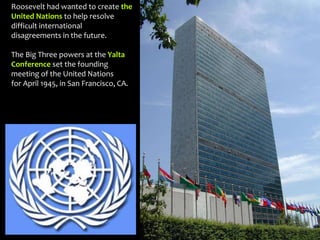
Roosevelt had wanted to create the
United Nations to help resolve
difficult international
disagreements in the future.
The Big Three powers at the Yalta
Conference set the founding
meeting of the United Nations
for April 1945, in San Francisco, CA.
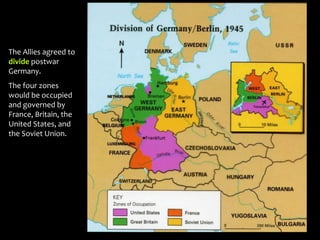
The Allies agreed to
divide postwar
Germany.
The four zones
would be occupied
and governed by
France, Britain, the
United States, and
the Soviet Union.
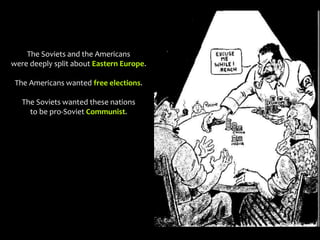
The Soviets and the Americans
were deeply split about Eastern Europe.
The Americans wanted free elections.
The Soviets wanted these nations
to be pro-Soviet Communist.
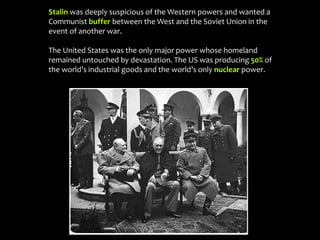
Stalin was deeply suspicious of the Western powers and wanted a
Communist buffer between the West and the Soviet Union in the
event of another war.
The United States was the only major power whose homeland
remained untouched by devastation. The US was producing 50% of
the world’s industrial goods and the world’s only nuclear power.
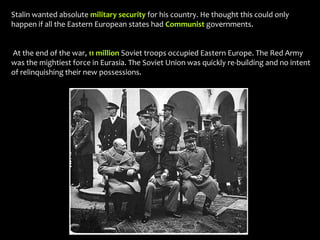
Stalin wanted absolute military security for his country. He thought this could only
happen if all the Eastern European states had Communist governments.
At the end of the war, 11 million Soviet troops occupied Eastern Europe. The Red Army
was the mightiest force in Eurasia. The Soviet Union was quickly re-building and no intent
of relinquishing their new possessions.
Many Western leaders thought that the Soviets
intended to spread communism throughout the world.
The Soviets saw Western policy, particularly that of the United States,
as global capitalist expansionism.
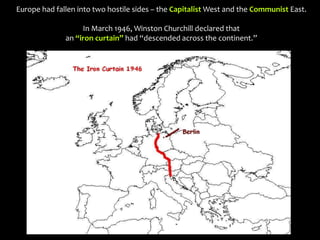
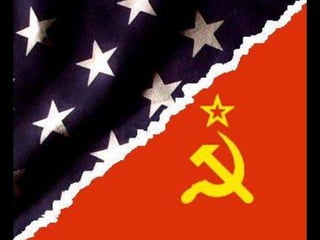
Europe had fallen into two hostile sides – the Capitalist West and the Communist East.
In March 1946, Winston Churchill declared that
an “iron curtain” had “descended across the continent.”
Stalin responded by calling Churchill’s speech a “call to war with the Soviet
Union.”
The world was on the brink of war once again.

World War II

  • 2.
    World War IISnapshot Deadliest conflict in human history: • 70 m. killed • 2/3 civilians Total war: • 100 m. military personnel • TOTAL war
  • 3.
    Two separate theatresof conflict: • Asia & Pacific (1931-1945) • Europe & N. Africa (1935-1945)
  • 4.
    Nuclear War • Onlywar in which nuclear weapons of mass destruction have been used in combat (so far): • Hiroshima, Japan, August 6, 1945 • Nagasaki, Japan, August 9, 1945
  • 5.
    Axis Powers: 1. NaziGermany (The Third Reich) led by Chancellor Adolf Hitler, Der Fuhrer 2. Fascist Italy led by Prime Minister Benito Mussolini, Il Duce 3. Imperial Japan led by Emperor Hirohito Prime Minister Hideki Tojo
  • 6.
    Grand Alliance ofUnited Nations (the Allies): 1. United Kingdom of Great Britain led by Prime Minister Winston Churchill 2. Union of Soviet Socialist Republics led by General Secretary of the Central Committee of the Communist Party of the Soviet Union Joseph Stalin 3. United States of America led by President Franklin Delano Roosevelt and President Harry S Truman 4. Free French Forces led by General Charles de Gaulle
  • 7.
    Country Population in1939 Number of Dead total population Killed Soviet Union 175,500,000 23,600,000 13.44% China 517,568,000 20,000,000 3.86% Germany 69,623,000 7,503,000 10.77% Japan 71,380,000 2,680,000 3.75% France 41,700,000 562,000 1.35% Italy 44,394,000 459,500 1.04% Britain 47,760,000 450,400 0.94% United States 131,028,000 418,500 0.32% WWII Casualties:
  • 10.
    Prelude: Japanese Aggression inAsia The 1920s and 30s were a time of civil war in China, between anti-imperialist Chinese Nationalists and Communist forces led by Mao Zedong.
  • 11.
    In September 1931,Japanese soldiers seized Chinese Manchuria. The Japanese claimed that the Chinese had attacked them. In fact, the Japanese had staged the attack themselves disguised as Chinese soldiers.
  • 13.
    When the Leagueof Nations investigated and condemned the attack, Japan simply withdrew from the League. For the next several years, Japan strengthened its hold on Manchuria, which it renamed Manchukuo. The United States opposed the Japanese takeover of Manchuria, but did nothing to stop it.
  • 14.
    The leader ofthe Chinese Nationalist government, Chiang Kai-shek, wanted to avoid war with Japan. He was more concerned with the threat of a Communist Revolution. He tried to appease Japan by allowing the Japanese to occupy parts of northern China unopposed.
  • 15.
    Japan, however, movedsteadily southward taking over ever move territory. In late 1936, the Nationalists and Communists united against the Japanese. In July 1937, the Japanese seized the Chinese capital of Nanjing. Chiang Kai-shek refused to surrender and moved the capital.
  • 18.
    Japanese military leaderswanted to overthrow the European imperialist powers and establish a New Order in East Asia that would include Japan, Manchuria, and China. The Japanese thought that, as the only modernized country in Asia, they were destined guide the other East Asian nations to prosperity.
  • 19.
    In their nextphase of expansion, the Japanese looked west and planned to seize the vast, rich lands of Siberia from the Soviet Union. In need of an ally, Japan began to cooperate with Nazi Germany.
  • 20.
    Act I: The Drivefor Lebensraum Adolf Hitler wanted to build a thousand-year German Reich which would dominate the world. To achieve this goal, Germany would need Lebensraum, more land, to support a greater German population.
  • 21.
    Hitler looked eastto the rich farmlands of his ideological enemy, the Soviet Union, and prepared for war. His ultimate plan was to enslave or murder the Slavic population and re-colonize the area with Germans.
  • 22.
    Hitler ignored theunfair provisions of the Treaty of Versailles that had ended the Great War. In March of 1935, he created a new air force, the Luftwaffe, and began a military draft.
  • 23.
    France, Great Britain,and Italy condemned Hitler’s moves, but due to problems at home caused by the Great Depression, they were not prepared to take action. Hitler became convinced that the Western states would not stop him from breaking further provisions of the Treaty of Versailles.
  • 24.
    In March of1936, Hitler sent German troops into the Rhineland, an area of Germany bordering France, which was supposed to be a demilitarized zone.
  • 25.
    France would notoppose Germany for this treaty violation without British support. Great Britain saw Hitler’s actions as reasonable and did not call for military response. This was the beginning of the policy of appeasement, based on the belief that if the reasonable demands of dissatisfied states were met, peace could be preserved.
  • 27.
    As Hitler’s powergrew, he gained new allies. In 1935, with the support of German troops, Benito Mussolini, the Fascist leader of Italy ordered the invasion of Ethiopia.
  • 28.
  • 29.
    In 1936, bothItaly and Germany sent troops in support of the dictator General Francisco Franco during the Spanish Civil War.
  • 30.
    Later in 1936,Hitler and Mussolini formalized their alliance with the creation of the Rome-Berlin Axis.
  • 31.
    Germany also signedthe Anti-Comintern Pact with Japan forming an alliance against communism, aimed against the Soviet Union. Together, they conspired to defeat the USSR and divide its many natural resources.
  • 32.
    By 1937, Germanyhad become a very powerful nation. In 1938, Hitler pursued a long held goal, union with Austria, or Anschluss. First, Austrian Nazis captured control of the government in Vienna. German troops were then invited into Austria to “help” maintain order. Hitler then annexed formally Austria to Germany.
  • 33.
    In 1938, Hitlerdemanded that the German-speaking Sudetenland of northwestern Czechoslovakia be given to Germany.
  • 34.
    British, French, andItalian diplomats met with Germany at the Munich Conference and gave in to all of Hitler’s demands. German troops moved into Czechoslovakia.
  • 35.
    After the MunichConference, the British prime minister, Neville Chamberlain, announced that the settlement meant “peace for our time.” He believed Hitler’s promises that Germany was satisfied and would make no further demands.
  • 36.
    However, Hitler waseven more convinced that France and Great Britain would not fight. In March of 1939, Hitler invaded western Czechoslovakia, and made a Nazi puppet state out of Slovakia in eastern Czechoslovakia.
  • 38.
    France and GreatBritain finally began to react. Great Britain announced it would protect Poland if Hitler invaded. France and Britain opened negotiations with Joseph Stalin, the powerful Soviet dictator.
  • 39.
    Britain and Franceknew that they would need the vast armies of the Soviet Union to help contain Nazi Germany.
  • 40.
    Yet despite therapid industrialization and military build up in the Soviet Union, Stalin still felt unprepared to fight the Nazis.
  • 41.
    In August of1939, Germany and the Soviet Union shocked the world by signing the Nazi-Soviet Nonaggression Pact promising not to attack each other.
  • 45.
    In exchange forpeace, Hitler offered Stalin control of eastern Poland and the Baltic states. Hitler knew that eventually he would break the pact but in the meantime, it freed him to invade Poland without fear.
  • 46.
    In Asia, theNazi-Soviet Nonaggression Pact forced the Japanese to rethink their goals. The Japanese still needed natural resources to fuel their empire but could not attack the Soviet Union alone.
  • 47.
    Instead, they lookedto expand into Southeast Asia for sources.
  • 48.
    Knowing they riskedstrong response from European colonial powers and the United States, the Japanese set invasion plans in motion.
  • 49.
    September 1, 1939: Germanblitzkrieg invasion of Poland
  • 50.
    Meanwhile, in Europe,on September 1, 1939, Germany invaded Poland. Two days later, Great Britain and France declared war on Germany.
  • 51.
    Act II: Blitzkrieg The1939 invasion of Poland by Germany took just four weeks. The speed and efficiency of the German army stunned the world.
  • 52.
    The Germans had introduceda new type of modern warfare: blitzkrieg, meaning “lightning war”.
  • 54.
  • 55.
  • 56.
    In the springof 1940, Hitler invaded Denmark and Norway. In May, Germany attacked the Netherlands, Belgium, and France.
  • 57.
    Invasion of Denmark& Norway April 9, 1940
  • 58.
    Invasion of theNetherlands, Belgium, and Luxembourg May 10, 1940
  • 59.
    Invasion of France:May 13, 1940 Dunkirk Dunkirk
  • 60.
    The German armiesbroke through French lines and moved across northern France. The French had fortified their border with Germany along the Maginot Line, but the Germans surprised them by going around it.
  • 64.
    The Germans managedto trap the entire British army and French forces on the beaches of Dunkirk! Complete disaster was narrowly averted when the British navy and private boats were able to evacuate 338,000 Allied troops across the English Channel to safety.
  • 65.
    June 4, 1940:Miracle at Dunkirk
  • 66.
    On June 22,1940, the French surrendered to the Germans, who occupied three-fifths of France.
  • 67.
    An authoritarian Frenchpuppet regime under German control was set up to govern southern France. Led by Marshal Henri-Philippe Petain, it was named Vichy France.
  • 68.
    The French Resistance TheFree French General Charles DeGaulle The Maquis
  • 69.
    Germany now controlledall of western and central Europe. Only Britain remained free.
  • 70.
  • 71.
    Act III: The Battleof Britain Hitler understood that he could not attack Britain by sea unless he first controlled the air.
  • 72.
    During World WarI, there had only been a few bombing raids against civilian targets. The raids had caused great public outcry. After the war, European nations began to think that bombing civilian targets could be used to force governments to make peace so large long-range bombers were developed.
  • 73.
    In August 1940,the Luftwaffe began a major bombing offensive against military targets in Britain. Aided by a good radar system, the British fought back but suffered critical losses.
  • 74.
    In September, tobreak the British morale swiftly, Hitler ordered his bombers to target civilians in London. For months, the Germans bombed the city nightly. There were heavy casualties and tremendous damage.
  • 75.
    In time, theBlitz, as the bombing was called, was carried to other British cities.
  • 76.
    In spite ofthe heavy bombing, British morale remained high. The idea that bombing civilians would force peace was proved wrong. “We shall defend our island, whatever the cost may be, we shall fight on the beaches, we shall fight on the landing grounds, we shall fight in the fields and in the streets, we shall fight in the hills; we shall never surrender.” - Winston Churchill British Prime Minister
  • 77.
    The British askedAmerica for help but following World War I, the United States had a strict policy of isolationism. Though US President Franklin Delano Roosevelt denounced the Germans, the United States did nothing at first.
  • 78.
    Gradually, American neutralitylaws were relaxed and the US began to send food, ships, planes, and weapons to Britain.
  • 79.
    Great Britain $31billion Soviet Union $11 billion France $3 billion China $1.5 billion Other European $500 million South America $400 million The amount totaled: $48,601,365,000 U. S. Lend-Lease Act, 1941
  • 81.
    Meanwhile, the shiftin German strategy allowed the British to rebuild their air power and inflict crippling losses on the Germans. Having lost the Battle of Britain, Hitler postponed plans for the invasion of Britain indefinitely.
  • 84.
    Act IV: Operation Barbarossa Hitlerbecame convinced that the way to defeat Britain was to first smash the Soviet Union. He felt the British were only resisting because they expected Soviet support.
  • 85.
    Hitler planned toinvade the Soviet Union in the spring of 1941, but was delayed by problems in the Balkans. After the Italians failed to capture Greece in 1940, the British still held air bases there. Hitler sent aid to Mussolini and seized Greece and Yugoslavia in April 1941.
  • 86.
    Attack in theSouth April 1941
  • 87.
    After a sixweek delay, Germany invaded the USSR on June 22, 1941. The attack on the Soviet Union stretched out for 1,800 miles.
  • 88.
  • 89.
    German troops movedquickly and captured two million Russian soldiers by November. The Germans were within 25 miles of Moscow.
  • 90.
  • 92.
  • 93.
  • 94.
    Forced to digtheir own grave.
  • 95.
  • 96.
    Nazis executing aJew at the edge of a mass grave. Ukraine, January 1942
  • 97.
  • 98.
    However, winter cameearly in 1941 and, combined with fierce Russian resistance, the Germans were forced to halt. This marked the first time in the war that the Germans had been stopped.
  • 99.
    The Germans werenot equipped for the bitter Russian winter. Then, in December, the Soviet army counterattacked.
  • 100.
    In the SovietUnion, initial defeats led to drastic emergency measures. Leningrad was under siege for nine hundred days. Over a million people died there due to food shortages. People had to eat dogs, cats, and mice.
  • 101.
    Soviet workers dismantledfactories in the west and shipped them to the east, out of the way of the attacking German army. At times workers ran machines as new factory buildings were built up around them.
  • 102.
    Soviet women werean important part of the war effort. Women working in industry increased 60 percent. They worked in industries, mines, and railroads, dug antitank ditches and worked as air raid wardens. Some fought in battles and flew bombers.
  • 104.
    Act V: JapanAttacks! In 1940, the Japanese demanded the right to exploit economic resources in French Indochina.
  • 105.
    The United Statesresponded by imposing economic sanctions, trade restrictions, unless Japan withdrew from China and Manchuria and returned to its 1931 borders. The Japanese badly needed oil and scrap iron from the United States. The economic sanctions were a very real threat.
  • 106.
    In the end,Japan decided to launch a surprise attack on U.S. and European colonies in Southeast Asia.
  • 107.
    On December 7,1941, “a day which will live in infamy”, the Japanese attacked the U.S. naval base at Pearl Harbor in Hawaii.
  • 118.
    They also attackedthe Philippines and the British colony of Malaya. Soon after, they invaded the Dutch East Indies and other islands in the Pacific Ocean.
  • 119.
    In spite ofsome fierce resistance in places such as the Philippines, by the spring of 1942, the Japanese controlled almost all of Southeast Asia and much of the western Pacific.
  • 121.
    With the entireregion under Japanese control, Japan announced its intention to “liberate” colonial nations in Southeast Asia. First, though, it needed their natural resources. In the end, they treated the occupied countries as conquered lands.
  • 122.
    The Japanese governmentwas very traditional and opposed employing women. General Hideki Tojo, the Japanese prime minister from 1941 to 1944, argued that employing women would weaken the family system and the nation. The Japanese met labor shortages by using cheaply paid Korean and Chinese workers.
  • 123.
    Over 61,000 capturedprisoners of war and 300,000 Asian workers were forced to labor on construction projects to aid the Japanese war effort, such as the Burma-Thailand railway which became known as the Death Railway.
  • 124.
    The Japanese thoughtthat their attacks on the U.S. fleet would destroy the U.S. Navy and lead the Americans to accept Japanese domination in the Pacific.
  • 125.
    However, the attackon Pearl Harbor had just the opposite effect.
  • 126.
    The American peoplewere convinced the nation should enter the war.
  • 127.
    Hitler thought thatthe Americans would be too involved in the Pacific to fight in Europe. Four days after Pearl Harbor, he declared war on the United States. World War II had become a global war.
  • 128.
    Act VI: TheAllies Strike Back Great Britain, the Soviet Union, and the United States formed a Grand Alliance.
  • 129.
    The three nationsagreed to ignore political differences to focus on military operations. They agreed in 1943 to fight until the Axis Powers – Germany, Italy, and Japan -surrendered unconditionally.
  • 130.
    Even more thanthe Great War, World War II was a total war. Economic mobilization was even more extensive.
  • 131.
    The war hadan enormous impact on civilian life in many parts of the world.
  • 132.
    The war didnot come to the home territory of the United States. America became an arsenal of democracy for the Allies.
  • 133.
    The United States producedmuch of the military equipment needed to fight the Axis. In 1943, the US was building six ships a day and 96,000 planes a year.
  • 134.
    Americans built thesupplies which were transported through British controlled territory for use by Soviet soldiers fighting Germans at the front.
  • 136.
    The American mobilization createdsocial turmoil. There were widespread movements of people. Military personnel and millions of workers looking for jobs moved frequently.
  • 137.
    Women filled thework roles of the millions of men in the armed services.
  • 138.
    African Americans were profoundlyimpacted by the war. Over a million African Americans moved from the South to cities in the North and West to work in war industries. At times the influx of African Americans led to social tensions and even violence.
  • 139.
    A million AfricanAmericans joined the military. They served in segregated units. Angered by their treatment, many returned from the war ready to fight for their civil rights.
  • 140.
    Japanese Americans onthe West Coast were moved to internment camps. 65% of them had been born in the United States. In spite of that, they were required to take loyalty oaths and were forced to live in camps surrounded by barbed wire.
  • 141.
    The American governmentclaimed to do this for national security. Neither German-Americans nor Italian-Americans received were treated in this manner.
  • 142.
    During the war,the 442nd Regimental Combat Team, composed entirely of Japanese- American volunteers serving in the European theater, seeking to prove their loyalty to the United States became the most decorated unit in US military history.
  • 143.
    At the beginningof 1942, the Germans continued to fight the war against Britain and the Soviet Union. The Germans were also fighting in North Africa.
  • 144.
    Operation Torch: The NorthAfrican Campaign, 1942-1943
  • 145.
    The German AfrikaKorps under General Erwin Rommel broke through British lines in Egypt and advanced on Alexandria.
  • 146.
    But in thesummer of 1942, the British in North Africa had stopped the Germans at El Alamein. The Germans retreated.
  • 147.
    By the fallof 1942, the war began to turn against the Germans. In November, British and American forces invaded French North Africa and forced the Afrika Korps to surrender by May, 1943.
  • 148.
    On the EasternFront, during the spring of 1942, the Germans captured the entire southern region of Russia in the Soviet Union.
  • 150.
    Hitler decided tomake the main German target Stalingrad, a major Soviet industrial center near rich oil fields.
  • 151.
    The complete militaryand industrial mobilization of the Soviet Union was producing 78,000 tanks and 98,000 artillery pieces per year. By 1943, 55 percent of the national income was going towards the war! As a result there were severe shortages of food and housing.
  • 152.
    Between November 1942and February 1943 the Soviets counterattacked. Stalin ordered the city of his name to be defended at any cost pouring the entire military might of the USSR into Stalingrad. The Soviets and Germans fought each other for every square inch of the city.
  • 153.
    Battle of Stalingrad: Winterof 1942-1943 German Army Russian Army 1,011,500 men 1,000,500 men 10,290 artillery guns 13,541 artillery guns 675 tanks 894 tanks 1,216 planes 1,115 planes
  • 154.
    Eventually, the Sovietssurrounded the Germans and cut off their supply lines. In May, the Germans were forced to surrender losing their entire Sixth Army.
  • 155.
    Hitler realized thenthat he would not defeat the Soviet Union. Stalingrad became the turning point of the war in Europe.
  • 156.
    In 1939 inGermany, many civilians feared that the war would bring disaster. Hitler understood the importance of the home front. He believed that lack of civilian support had led to the German defeat in the First World War.
  • 157.
    To keep uppublic morale, Hitler refused to cut consumer-goods production during the first two years of fighting. This decision may have cost Germany the war. After defeats on the Russian front, the policy changed.
  • 158.
    In 1942, Hitlerincreased arms production and the size of the army. Albert Speer became minister for armaments and munitions.
  • 159.
    Speer tripled armamentproduction between 1942 and 1943. In July 1944, the German economy was totally mobilized. Schools, theaters, and cafes were closed. However, this came too late to avoid defeat.
  • 160.
    In 1942, theBritish began major bombing campaigns against German cities. Thousands of bombers were used to attack major German cities.
  • 161.
    The bombing ofGermany added to civilian terror. In some cities, such as Dresden, enormous firestorms resulted from the incendiary bombs, killing hundreds of thousands of people.
  • 162.
    The bombing of Germanyby the Allies may have killed 500,000 civilians. Millions of buildings were destroyed.
  • 163.
    In spite ofthe terrible destruction, the bombing did not seem to sap the morale of the German people or destroy the German industrial capacity. However, the destruction of transportation systems and fuel supplies strongly impacted the ability of the Germans to supply their military forces.
  • 164.
    In 1942, theAllies had their first successes in the Pacific. In the Battle of the Coral Sea in May, American naval forces stopped the Japanese and saved Australia from invasion.
  • 165.
    In June, theBattle of Midway Island became the turning point in the war against Japan. U.S. planes destroyed four Japanese aircraft carriers and established American naval superiority in the Pacific.
  • 167.
    By the fallof 1942, Allied forces were about to begin two major offensives against Japan. One branch, led by General Douglas MacArthur, would move into South China from Burma through the islands of Indonesia.
  • 168.
    The other branch wouldisland-hop across the Pacific on the road to Japan.
  • 169.
    By November 1942,after the fierce battle of Guadalcanal in the Solomon Islands, Japanese power was fading.
  • 170.
    Act VII: UnconditionalSurrender By 1943, the tide had turned against the Axis forces. From North Africa, the Allies invaded Italy which Winston Churchill called Italy the “soft underbelly” of Europe.
  • 171.
    After the Alliescaptured Sicily, Mussolini was removed from office. The king arrested him. A new Italian government offered to surrender to the Allies. However, the Germans rescued Mussolini and restored him up as the dictator of a puppet German state in northern Italy.
  • 172.
    The Germans establisheda strong defense south of Rome. The Allies had very heavy casualties as they slowly advanced north but captured Rome on June 4, 1944.
  • 173.
    The Allies hadlong been planning a “second front” in western Europe. They planned to invade France from Great Britain across the English Channel. On June 6, 1944 (D-Day), the Allies, under the command of U.S. General Dwight D. “Ike” Eisenhower landed on the beaches in Normandy, France.
  • 176.
    The Allies wereable to establish a beachhead. By landing two million men and a half-million vehicles, the Allies eventually broke through the German lines.
  • 177.
    After the breakout, theAllies moved south and east. Paris was liberated by the end of August.
  • 179.
    In December of1944, Hitler organized one last great offensive against the Allies at the Battle of the Bulge. After Germany’s defeat there, the road to Berlin was open.
  • 181.
    In March of1945, the Americans and British crossed the Rhine into Germany. Meanwhile, the Soviet Red Army was steadily closing in from the east.
  • 183.
    100,000 Victims Extermination Camps Camp DeathsSurvivors Auschwitz-Birkenau 1.1-1.6 million 7,000 Belzec 600,000 2 Chelmno 152,000 2 Majdanek 170-235,000 <600 Sobibor 250,000 50 Treblinka 870,000-925,000 <100
  • 190.
    Soviet troops occupied Warsawin January 1945 and captured Berlin in April.
  • 192.
    By January 1945,Hitler had moved into an underground bunker in Berlin. On April 30, he committed suicide.
  • 193.
    Two days before,Italian partisans — resistance fighters — had shot Mussolini.
  • 194.
    On May 7,1945, German commanders surrendered, and the war in Europe was over.
  • 195.
    The war inAsia continued. Beginning in 1943, the Allied forces had gone on the offensive and moved across the Pacific.
  • 196.
    In the finalyears of the war, young Japanese volunteered to serve as suicide pilots against U.S. ships. They were called kamikaze (“divine wind”) pilots.
  • 197.
    In November 1944, theAllies began attacks on Japanese cities. The Japanese air force could no longer defend Japan. By the summer of 1945, ¼ of Japanese buildings had been destroyed.
  • 198.
    “If the radianceof a thousand suns were to burst at once into the sky, that would be like the splendor of the mighty one... Now, I have become Death, the destroyer of worlds.” - J. Robert Oppenheimer On July 16, 1945, a new era of human history was born: the Atomic Age. The Manhattan Project had succeeded.
  • 199.
    In 1945, U.S.President Harry S Truman, hoping to avoid an invasion of Japan which was estimated to cost up to a million American lives, decided to drop atomic bombs on Japanese cities. The first bomb was dropped on the city of Hiroshima on August 6.
  • 200.
    Three days later,a second bomb was dropped on Nagasaki.
  • 201.
    Both cities werecompletely destroyed.
  • 202.
    Thousands died immediatelyand thousands more died later of radiation sickness.
  • 203.
  • 204.
    World War IIwas over.
  • 205.
    Seventeen million peoplehad died in battle in World War II. Some estimate that, including civilian losses, as many as seventy million people died in the war.
  • 206.
    Epilogue: The CurtainDescends After the end of World War II, a new international conflict emerged, the Cold War. The Cold War was primarily an ideological conflict between the United States and the Soviet Union. It dominated world politics until 1991.
  • 207.
    Roosevelt had wantedto create the United Nations to help resolve difficult international disagreements in the future. The Big Three powers at the Yalta Conference set the founding meeting of the United Nations for April 1945, in San Francisco, CA.
  • 208.
    The Allies agreedto divide postwar Germany. The four zones would be occupied and governed by France, Britain, the United States, and the Soviet Union.
  • 210.
    The Soviets andthe Americans were deeply split about Eastern Europe. The Americans wanted free elections. The Soviets wanted these nations to be pro-Soviet Communist.
  • 211.
    Stalin was deeplysuspicious of the Western powers and wanted a Communist buffer between the West and the Soviet Union in the event of another war. The United States was the only major power whose homeland remained untouched by devastation. The US was producing 50% of the world’s industrial goods and the world’s only nuclear power.
  • 212.
    Stalin wanted absolutemilitary security for his country. He thought this could only happen if all the Eastern European states had Communist governments. At the end of the war, 11 million Soviet troops occupied Eastern Europe. The Red Army was the mightiest force in Eurasia. The Soviet Union was quickly re-building and no intent of relinquishing their new possessions.
  • 213.
    Many Western leadersthought that the Soviets intended to spread communism throughout the world. The Soviets saw Western policy, particularly that of the United States, as global capitalist expansionism.
  • 214.
    Europe had falleninto two hostile sides – the Capitalist West and the Communist East. In March 1946, Winston Churchill declared that an “iron curtain” had “descended across the continent.”
  • 215.
    Stalin responded bycalling Churchill’s speech a “call to war with the Soviet Union.” The world was on the brink of war once again.