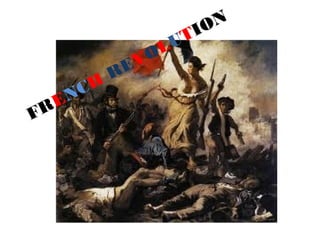
FRENCH REVOLUTION
Reasons for the French Revolution 
In the 1700s, France was 
the cultural capital of 
Europe, home to 
numerous Enlightenment 
thinkers, & had wealth 
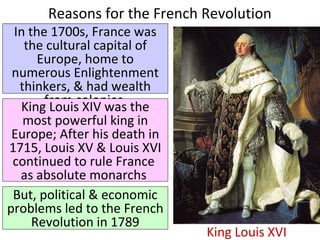
Kingf rLoomui sc oXlIoVn wieass the 
most powerful king in 
Europe; After his death in 
1715, Louis XV & Louis XVI 
continued to rule France 
as absolute monarchs 
KKiinngg LLoouuiiss XXIVVI 
But, political & economic 
problems led to the French 
Revolution in 1789
One problem was France’s unequal social 
hierarchy that was made up of three classes 
(called estates) 
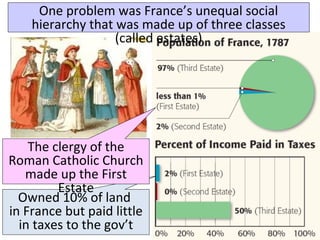
The clergy of the 
Roman Catholic Church 
made up the First 
Estate 
Owned 10% of land 
in France but paid little 
in taxes to the gov’t
One problem was France’s unequal social 
hierarchy that was made up of three classes 
(called estates) 
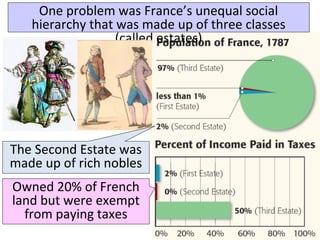
The Second Estate was 
made up of rich nobles 
Owned 20% of French 
land but were exempt 
from paying taxes
One problem was France’s unequal social 
hierarchy that was made up of three classes 
(called estates) 
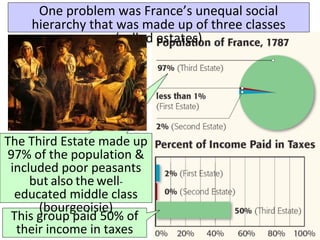
The Third Estate made up 
97% of the population & 
included poor peasants 
but also the well-educated 
middle class 
(bourgeoisie) 
This group paid 50% of 
their income in taxes
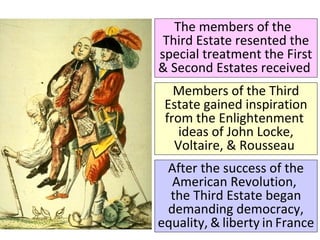
The members of the 
Third Estate resented the 
special treatment the First 
& Second Estates received 
Members of the Third 
Estate gained inspiration 
from the Enlightenment 
ideas of John Locke, 
Voltaire, & Rousseau 
After the success of the 
American Revolution, 
the Third Estate began 
demanding democracy, 
equality, & liberty in France
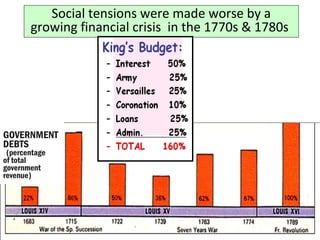
Social tensions were made worse by a 
growing financial crisis in the 1770s & 1780s 
GOVERNMENT 
DEBTS 
(percentage 
of total 
government 
revenue)
Social tensions were made worse by a 
growing financial crisis in the 1770s & 1780s 
The French government 
faced massive debts due 
to decades of lavish 
spending, expensive wars, 
& poor economic planning 
By 1789, half the budget 
went towards iinntteerreesstt on 
the national debt; 25% of 
people were unemployed 
The excessive spending by 
King Louis XVI & his wife 
Marie Antoinette angered 
GOVERNMENT 
DEBTS 
(percentage 
of total 
government 
revenue) 
French citizens 
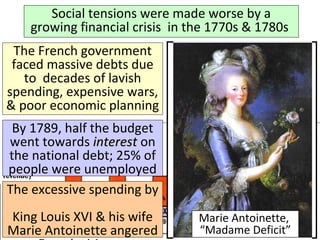
Marie Antoinette, 
“Madame Deficit”
Role Play Class Activity: 
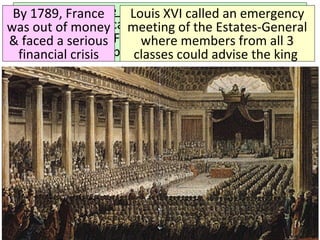
By 1789, France 
was out of money 
& faced a serious 
financial crisis 
Louis XVI called an emergency 
meeting of the Estates-General 
where members from all 3 
classes could advise the king 
From your role card perspective, develop a plan 
that could save France, decide to vote by order 
or by head, & present your ideas to the king
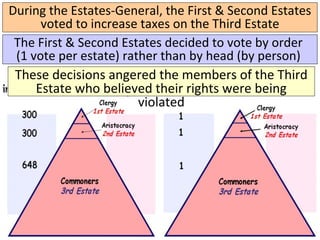
During the Estates-General, the First & Second Estates 
voted to increase taxes on the Third Estate 
The First & Second Estates decided to vote by order 
(1 vote per estate) rather than by head (by person) 
These decisions angered the members of the Third 
Estate who believed their rights were being 
violated
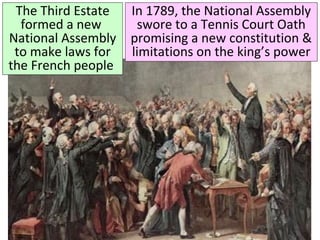
The Third Estate 
formed a new 
National Assembly 
to make laws for 
the French people 
In 1789, the National Assembly 
swore to a Tennis Court Oath 
promising a new constitution & 
limitations on the king’s power
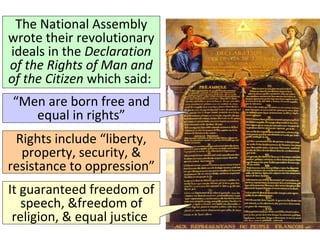
The National Assembly 
wrote their revolutionary 
ideals in the Declaration 
of the Rights of Man and 
of the Citizen which said: 
“Men are born free and 
equal in rights” 
Rights include “liberty, 
property, security, & 
resistance to oppression” 
It guaranteed freedom of 
speech, &freedom of 
religion, & equal justice
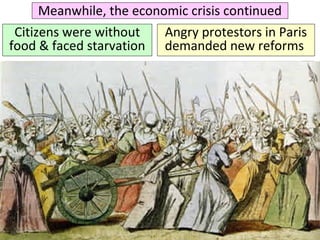
Meanwhile, the economic crisis continued 
Angry protestors in Paris 
demanded new reforms 
Citizens were without 
food & faced starvation
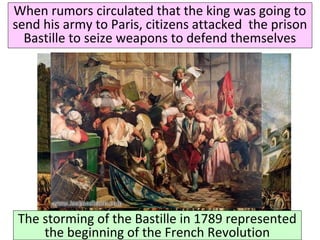
When rumors circulated that the king was going to 
send his army to Paris, citizens attacked the prison 
Bastille to seize weapons to defend themselves 
The storming of the Bastille in 1789 represented 
the beginning of the French Revolution
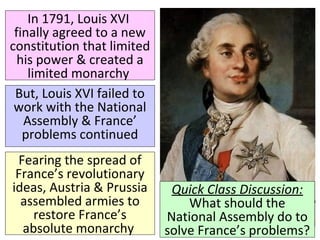
In 1791, Louis XVI 
finally agreed to a new 
constitution that limited 
his power & created a 
limited monarchy 
But, Louis XVI failed to 
work with the National 
Assembly & France’ 
problems continued 
Quick Class Discussion: 
What should the 
National Assembly do to 
solve France’s problems? 
Fearing the spread of 
France’s revolutionary 
ideas, Austria & Prussia 
assembled armies to 
restore France’s 
absolute monarchy
In 1792, radicals took 
control of France & made 
important decisions: 
War was declared 
against Austria & Prussia 
and 300,000 French 
soldiers were drafted 
into a national army in 
order to defend France 
The French monarchy 
was overthrown & 
democratic republic 
was created called the 
National Convention 
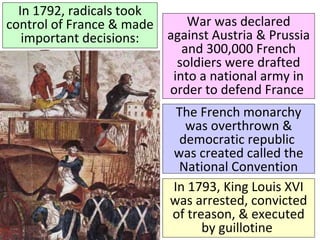
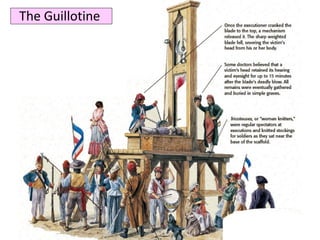
In 1793, King Louis XVI 
was arrested, convicted 
of treason, & executed 
by guillotine 
The slogan of the French 
Revolution became: 
“Liberty, Equality, 
Fraternity”
The Guillotine
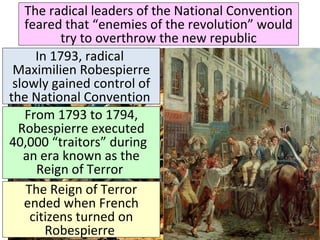
The radical leaders of the National Convention 
feared that “enemies of the revolution” would 
try to overthrow the new republic 
In 1793, radical 
Maximilien Robespierre 
slowly gained control of 
the National Convention 
From 1793 to 1794, 
Robespierre executed 
40,000 “traitors” during 
an era known as the 
Reign of Terror 
The Reign of Terror 
ended when French 
citizens turned on 
Robespierre 
& executed him
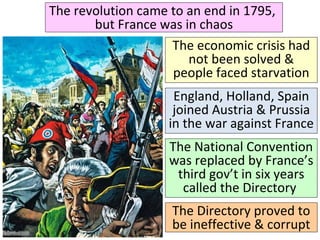
The revolution came to an end in 1795, 
but France was in chaos 
The economic crisis had 
not been solved & 
people faced starvation 
England, Holland, Spain 
joined Austria & Prussia 
in the war against France 
The National Convention 
was replaced by France’s 
third gov’t in six years 
called the Directory 
The Directory proved to 
be ineffective & corrupt
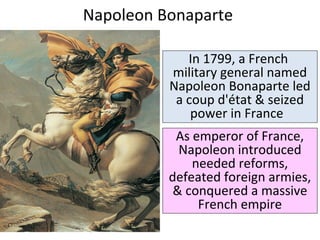
Napoleon Bonaparte 
In 1799, a French 
military general named 
Napoleon Bonaparte led 
a coup d'état & seized 
power in France 
As emperor of France, 
Napoleon introduced 
needed reforms, 
defeated foreign armies, 
& conquered a massive 
French empire
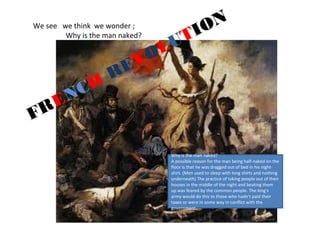
We see we think we wonder ; 
Why is the man REVOLUTION 
naked? 
FRENCH Why is the man naked? 
A possible reason for the man being half-naked on the 
floor is that he was dragged out of bed in his night-shirt. 
(Men used to sleep with long shirts and nothing 
underneath) The practice of taking people out of their 
houses in the middle of the night and beating them 
up was feared by the common people. The king's 
army would do this to those who hadn't paid their 
taxes or were in some way in conflict with the 
government.

4 french revolution ppt

  • 1.
  • 2.
    Reasons for theFrench Revolution In the 1700s, France was the cultural capital of Europe, home to numerous Enlightenment thinkers, & had wealth Kingf rLoomui sc oXlIoVn wieass the most powerful king in Europe; After his death in 1715, Louis XV & Louis XVI continued to rule France as absolute monarchs KKiinngg LLoouuiiss XXIVVI But, political & economic problems led to the French Revolution in 1789
  • 3.
    One problem wasFrance’s unequal social hierarchy that was made up of three classes (called estates) The clergy of the Roman Catholic Church made up the First Estate Owned 10% of land in France but paid little in taxes to the gov’t
  • 4.
    One problem wasFrance’s unequal social hierarchy that was made up of three classes (called estates) The Second Estate was made up of rich nobles Owned 20% of French land but were exempt from paying taxes
  • 5.
    One problem wasFrance’s unequal social hierarchy that was made up of three classes (called estates) The Third Estate made up 97% of the population & included poor peasants but also the well-educated middle class (bourgeoisie) This group paid 50% of their income in taxes
  • 6.
    The members ofthe Third Estate resented the special treatment the First & Second Estates received Members of the Third Estate gained inspiration from the Enlightenment ideas of John Locke, Voltaire, & Rousseau After the success of the American Revolution, the Third Estate began demanding democracy, equality, & liberty in France
  • 7.
    Social tensions weremade worse by a growing financial crisis in the 1770s & 1780s GOVERNMENT DEBTS (percentage of total government revenue)
  • 8.
    Social tensions weremade worse by a growing financial crisis in the 1770s & 1780s The French government faced massive debts due to decades of lavish spending, expensive wars, & poor economic planning By 1789, half the budget went towards iinntteerreesstt on the national debt; 25% of people were unemployed The excessive spending by King Louis XVI & his wife Marie Antoinette angered GOVERNMENT DEBTS (percentage of total government revenue) French citizens Marie Antoinette, “Madame Deficit”
  • 9.
    Role Play ClassActivity: By 1789, France was out of money & faced a serious financial crisis Louis XVI called an emergency meeting of the Estates-General where members from all 3 classes could advise the king From your role card perspective, develop a plan that could save France, decide to vote by order or by head, & present your ideas to the king
  • 10.
    During the Estates-General,the First & Second Estates voted to increase taxes on the Third Estate The First & Second Estates decided to vote by order (1 vote per estate) rather than by head (by person) These decisions angered the members of the Third Estate who believed their rights were being violated
  • 11.
    The Third Estate formed a new National Assembly to make laws for the French people In 1789, the National Assembly swore to a Tennis Court Oath promising a new constitution & limitations on the king’s power
  • 12.
    The National Assembly wrote their revolutionary ideals in the Declaration of the Rights of Man and of the Citizen which said: “Men are born free and equal in rights” Rights include “liberty, property, security, & resistance to oppression” It guaranteed freedom of speech, &freedom of religion, & equal justice
  • 13.
    Meanwhile, the economiccrisis continued Angry protestors in Paris demanded new reforms Citizens were without food & faced starvation
  • 14.
    When rumors circulatedthat the king was going to send his army to Paris, citizens attacked the prison Bastille to seize weapons to defend themselves The storming of the Bastille in 1789 represented the beginning of the French Revolution
  • 15.
    In 1791, LouisXVI finally agreed to a new constitution that limited his power & created a limited monarchy But, Louis XVI failed to work with the National Assembly & France’ problems continued Quick Class Discussion: What should the National Assembly do to solve France’s problems? Fearing the spread of France’s revolutionary ideas, Austria & Prussia assembled armies to restore France’s absolute monarchy
  • 16.
    In 1792, radicalstook control of France & made important decisions: War was declared against Austria & Prussia and 300,000 French soldiers were drafted into a national army in order to defend France The French monarchy was overthrown & democratic republic was created called the National Convention In 1793, King Louis XVI was arrested, convicted of treason, & executed by guillotine The slogan of the French Revolution became: “Liberty, Equality, Fraternity”
  • 17.
  • 18.
    The radical leadersof the National Convention feared that “enemies of the revolution” would try to overthrow the new republic In 1793, radical Maximilien Robespierre slowly gained control of the National Convention From 1793 to 1794, Robespierre executed 40,000 “traitors” during an era known as the Reign of Terror The Reign of Terror ended when French citizens turned on Robespierre & executed him
  • 19.
    The revolution cameto an end in 1795, but France was in chaos The economic crisis had not been solved & people faced starvation England, Holland, Spain joined Austria & Prussia in the war against France The National Convention was replaced by France’s third gov’t in six years called the Directory The Directory proved to be ineffective & corrupt
  • 20.
    Napoleon Bonaparte In1799, a French military general named Napoleon Bonaparte led a coup d'état & seized power in France As emperor of France, Napoleon introduced needed reforms, defeated foreign armies, & conquered a massive French empire
  • 21.
    We see wethink we wonder ; Why is the man REVOLUTION naked? FRENCH Why is the man naked? A possible reason for the man being half-naked on the floor is that he was dragged out of bed in his night-shirt. (Men used to sleep with long shirts and nothing underneath) The practice of taking people out of their houses in the middle of the night and beating them up was feared by the common people. The king's army would do this to those who hadn't paid their taxes or were in some way in conflict with the government.

Editor's Notes

  • #3 BOURBON DYNASTY HENRY IV of France, 1553-1610, king of France (1589-1610) Edict of Nantes 1598LOUIS XIII, 1601-1643, king of France (1610 - 1643), son of Henry IVLOUIS XIV, 1638–1715, king of France (1643–1715), son of Louis XIII, personal rule after 1661LOUIS XV, 1710–74, king of France (1715–74), great-grandson of King Louis XIVLOUIS XVI, 1754–93, king of France (1774–92), third son of the dauphin (Louis) and Marie Josèphe of Saxony, grandson and successor of King Louis XV. Executed in 1792.
  • #7 BOURBON DYNASTY HENRY IV of France, 1553-1610, king of France (1589-1610) Edict of Nantes 1598LOUIS XIII, 1601-1643, king of France (1610 - 1643), son of Henry IVLOUIS XIV, 1638–1715, king of France (1643–1715), son of Louis XIII, personal rule after 1661LOUIS XV, 1710–74, king of France (1715–74), great-grandson of King Louis XIVLOUIS XVI, 1754–93, king of France (1774–92), third son of the dauphin (Louis) and Marie Josèphe of Saxony, grandson and successor of King Louis XV. Executed in 1792.