The Working Environment Mail Handling Standard Grade Administration
How is mail dealt with? The way in which mail is dealt is dependent on many things including: The SIZE of the organisation The number of STAFF involved The VOLUME of mail received and despatched In a SMALL organisation, the manager or secretary will open all the mail and probably deal with most of it personally. In a LARGE organisation, there is likely to be a special mailroom, staffed by people whose main job it is to receive incoming and despatch outgoing mail.
The Mail Room A well organised mailroom will contain the following pieces of equipment: Scales – to weigh letters and parcels. Franking machine – used instead of stamps.  It  prints the postage payable on the envelope. Photocopier – to photocopy documents if more  than one person is to get a copy. Fax machine – used to receive faxes. Date stamp – to stamp mail with the date of  arrival
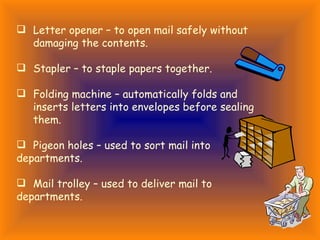
Letter opener – to open mail safely without  damaging the contents. Stapler – to staple papers together. Folding machine – automatically folds and  inserts letters into envelopes before sealing  them. Pigeon holes – used to sort mail into  departments. Mail trolley – used to deliver mail to  departments.                                       
The Franking Machine The Franking Machine is a piece of equipment used in the mail room.    Instead of sticking stamps on to envelopes, it prints a postal impression on to the envelope of outgoing mail.  The postal impression may include an advertising slogan.   The machine may be purchased, leased or rented from the manufacturers.   ADVANTAGES   It is faster than sticking stamps on to envelopes It avoids having to buy stamps – less of a security risk The franking machine is lockable – less chance of being used for personal use No chance of stamps falling off More efficient when dealing with large amounts of mail More hygienic  
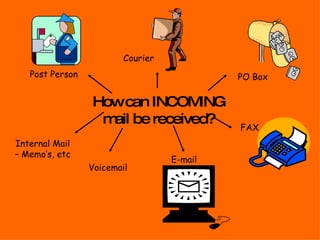
How can INCOMING mail be received? Post Person Courier PO Box FAX E-mail Voicemail Internal Mail – Memo’s, etc
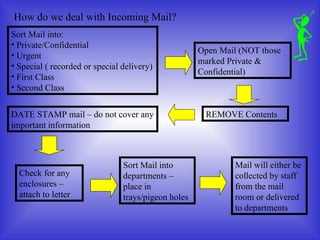
How do we deal with Incoming Mail? Sort Mail into: Private/Confidential Urgent Special ( recorded or special delivery) First Class Second Class Open Mail (NOT those marked Private & Confidential) REMOVE Contents DATE STAMP mail – do not cover any important information Check for any enclosures – attach to letter Sort Mail into departments – place in trays/pigeon holes Mail will either be collected by staff  from the mail room or delivered to departments
Incoming Mail - Procedures ENCLOSURES  –  An enclosure is any item enclosed in the envelope in addition to the letter itself, eg, Tickets, Forms etc When the envelope has been opened, look for any enclosures Staple/Clip the enclosure to the letter If the enclosure is missing write ‘ITEM MISSING’ at the top of the letter Take all ‘Item Missing’ mail to supervisor once all mail has been opened and sorted CIRCULATING MAIL  –  Occasionally a letter/document may need to be seen by more than one department/person.  In this situation there are 3 things that can be done: Photocopy it and give one copy to each person.  This is the quickest but the most  expensive way. Send a messenger to the various people who have to see the letter.  This is not as  quick as photocopying and the messenger will need to wait while people read the  letter. Attach a circulation slip, which shows the names of the people to  see the letter.  Once  someone has read the letter, they initial the slip and pass it onto the next person on the  list.  This is probably the slowest method.
REMITTANCES –  A Remittance is any money received in the post. When the envelope has been opened, record any remittances in the Remittances Book.  Check that the amount indicated in the letter matches the actual amount received. Any discrepancy should be reported to the Mail Room supervisor Pass the remittance and the remittance book to the Chief Cashier who will be  responsible for any further action
Suspicious Letters and Packages Some organisations are potential targets for this type of mail.  Staff working in such places are specifically instructed to  take extra care and to be diligent at all times. The Royal Mail letter and parcels offices have special  screening equipment that scans mail If you receive a letter or package that causes concern, inform  your supervisor or a senior person immediately. DO NOT ATTEMPT TO OPEN THE PACKAGE
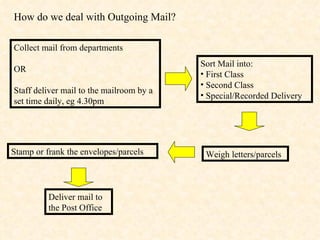
How do we deal with Outgoing Mail? Collect mail from departments OR Staff deliver mail to the mailroom by a set time daily, eg 4.30pm Sort Mail into: First Class Second Class Special/Recorded Delivery Weigh letters/parcels Stamp or frank the envelopes/parcels Deliver mail to the Post Office
Post Office Services Recorded Delivery The Post Office issues a receipt to the person posting the letter/package as  proof of posting The post person is then authorised to collect a signature from the recipient so  that there is also proof of delivery Recorded Delivery is suitable for sending important paper and documents, eg  passports, birth certificates, exam papers and legal documents Registered Post If you are sending something valuable you should send it by Registered Post Compensation is paid according to the amount of fee paid if the letter/parcel  becomes lost in the post Letters and packages sent by Registered Post are handled with special security  measures by the Post Office and separately from ordinary mail
Post Office Services  (cont) Business Reply Service This service is used by firms who wish to obtain replies from customers without  the customers being put to the expense of postage Business Reply forms may be postcards, envelopes or gummed labels The envelope is posted in the normal way but without a stamp Freepost A firm who wishes to obtain a reply from a customer without putting them to  the expense of paying postage may include in their address “FREEPOST” The reply bearing this word is then posted in the normal way but will be sent  by 2 nd  class post only Special Delivery Royal Mail Special Delivery ensures that a 1 st  class letter/package will be  delivered by first post the following morning (except Sunday) without fail
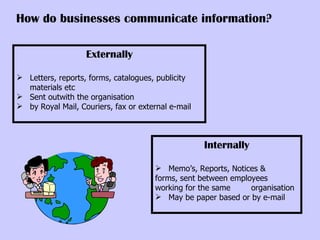
How do businesses communicate information? Internally Memo’s, Reports, Notices &  forms, sent between employees  working for the same  organisation May be paper based or by e-mail Externally Letters, reports, forms, catalogues, publicity  materials etc Sent outwith the organisation by Royal Mail, Couriers, fax or external e-mail
Which method should be used when sending Internal or external mail? The method used will depend upon the: Size of the organisation  Technology used within the organisation – ie are e-mail facilities available? Cost of the alternative methods – sending a 25 page document as an  attachment by e-mail to every employee will be cheaper than photocopying  the document and posting it to them Urgency – how quickly is the information required?  If it is urgent then  sending by fax or e-mail is the best option.  Alternatively, Special delivery  could be used. Importance of the document – you are likely to send a passport by Recorded  Delivery to ensure it is delivered safely. Confidentiality – does the document contain private or sensitive information if  so then it shouldn’t be sent by fax.

Standard Grade Administration - The Mail Room

  • 1.
    The Working EnvironmentMail Handling Standard Grade Administration
  • 2.
    How is maildealt with? The way in which mail is dealt is dependent on many things including: The SIZE of the organisation The number of STAFF involved The VOLUME of mail received and despatched In a SMALL organisation, the manager or secretary will open all the mail and probably deal with most of it personally. In a LARGE organisation, there is likely to be a special mailroom, staffed by people whose main job it is to receive incoming and despatch outgoing mail.
  • 3.
    The Mail RoomA well organised mailroom will contain the following pieces of equipment: Scales – to weigh letters and parcels. Franking machine – used instead of stamps. It prints the postage payable on the envelope. Photocopier – to photocopy documents if more than one person is to get a copy. Fax machine – used to receive faxes. Date stamp – to stamp mail with the date of arrival
  • 4.
    Letter opener –to open mail safely without damaging the contents. Stapler – to staple papers together. Folding machine – automatically folds and inserts letters into envelopes before sealing them. Pigeon holes – used to sort mail into departments. Mail trolley – used to deliver mail to departments.                                       
  • 5.
    The Franking MachineThe Franking Machine is a piece of equipment used in the mail room.   Instead of sticking stamps on to envelopes, it prints a postal impression on to the envelope of outgoing mail. The postal impression may include an advertising slogan.   The machine may be purchased, leased or rented from the manufacturers. ADVANTAGES   It is faster than sticking stamps on to envelopes It avoids having to buy stamps – less of a security risk The franking machine is lockable – less chance of being used for personal use No chance of stamps falling off More efficient when dealing with large amounts of mail More hygienic  
  • 6.
    How can INCOMINGmail be received? Post Person Courier PO Box FAX E-mail Voicemail Internal Mail – Memo’s, etc
  • 7.
    How do wedeal with Incoming Mail? Sort Mail into: Private/Confidential Urgent Special ( recorded or special delivery) First Class Second Class Open Mail (NOT those marked Private & Confidential) REMOVE Contents DATE STAMP mail – do not cover any important information Check for any enclosures – attach to letter Sort Mail into departments – place in trays/pigeon holes Mail will either be collected by staff from the mail room or delivered to departments
  • 8.
    Incoming Mail -Procedures ENCLOSURES – An enclosure is any item enclosed in the envelope in addition to the letter itself, eg, Tickets, Forms etc When the envelope has been opened, look for any enclosures Staple/Clip the enclosure to the letter If the enclosure is missing write ‘ITEM MISSING’ at the top of the letter Take all ‘Item Missing’ mail to supervisor once all mail has been opened and sorted CIRCULATING MAIL – Occasionally a letter/document may need to be seen by more than one department/person. In this situation there are 3 things that can be done: Photocopy it and give one copy to each person. This is the quickest but the most expensive way. Send a messenger to the various people who have to see the letter. This is not as quick as photocopying and the messenger will need to wait while people read the letter. Attach a circulation slip, which shows the names of the people to see the letter. Once someone has read the letter, they initial the slip and pass it onto the next person on the list. This is probably the slowest method.
  • 9.
    REMITTANCES – A Remittance is any money received in the post. When the envelope has been opened, record any remittances in the Remittances Book. Check that the amount indicated in the letter matches the actual amount received. Any discrepancy should be reported to the Mail Room supervisor Pass the remittance and the remittance book to the Chief Cashier who will be responsible for any further action
  • 10.
    Suspicious Letters andPackages Some organisations are potential targets for this type of mail. Staff working in such places are specifically instructed to take extra care and to be diligent at all times. The Royal Mail letter and parcels offices have special screening equipment that scans mail If you receive a letter or package that causes concern, inform your supervisor or a senior person immediately. DO NOT ATTEMPT TO OPEN THE PACKAGE
  • 11.
    How do wedeal with Outgoing Mail? Collect mail from departments OR Staff deliver mail to the mailroom by a set time daily, eg 4.30pm Sort Mail into: First Class Second Class Special/Recorded Delivery Weigh letters/parcels Stamp or frank the envelopes/parcels Deliver mail to the Post Office
  • 12.
    Post Office ServicesRecorded Delivery The Post Office issues a receipt to the person posting the letter/package as proof of posting The post person is then authorised to collect a signature from the recipient so that there is also proof of delivery Recorded Delivery is suitable for sending important paper and documents, eg passports, birth certificates, exam papers and legal documents Registered Post If you are sending something valuable you should send it by Registered Post Compensation is paid according to the amount of fee paid if the letter/parcel becomes lost in the post Letters and packages sent by Registered Post are handled with special security measures by the Post Office and separately from ordinary mail
  • 13.
    Post Office Services (cont) Business Reply Service This service is used by firms who wish to obtain replies from customers without the customers being put to the expense of postage Business Reply forms may be postcards, envelopes or gummed labels The envelope is posted in the normal way but without a stamp Freepost A firm who wishes to obtain a reply from a customer without putting them to the expense of paying postage may include in their address “FREEPOST” The reply bearing this word is then posted in the normal way but will be sent by 2 nd class post only Special Delivery Royal Mail Special Delivery ensures that a 1 st class letter/package will be delivered by first post the following morning (except Sunday) without fail
  • 14.
    How do businessescommunicate information? Internally Memo’s, Reports, Notices & forms, sent between employees working for the same organisation May be paper based or by e-mail Externally Letters, reports, forms, catalogues, publicity materials etc Sent outwith the organisation by Royal Mail, Couriers, fax or external e-mail
  • 15.
    Which method shouldbe used when sending Internal or external mail? The method used will depend upon the: Size of the organisation Technology used within the organisation – ie are e-mail facilities available? Cost of the alternative methods – sending a 25 page document as an attachment by e-mail to every employee will be cheaper than photocopying the document and posting it to them Urgency – how quickly is the information required? If it is urgent then sending by fax or e-mail is the best option. Alternatively, Special delivery could be used. Importance of the document – you are likely to send a passport by Recorded Delivery to ensure it is delivered safely. Confidentiality – does the document contain private or sensitive information if so then it shouldn’t be sent by fax.