Basics of Adult Learning and Effective Communication

1
Objective: Describe the components of adult learning

Basic adult learning principals

Learning styles

Engaging your audience
Objective: Identify ways to reach your audience
•

Target audience demographics

•

Knowledge and literacy levels

•

Effective communication techniques

2








Identify the Adult learning Principals and
Styles
Tools to Teach
Engage Participants
Know your Audience
Effective Communication

3
Andragogy:


Process of helping adults learn



Focused on the learner, not on the teacher

4


Adults learn differently from children



Adults require different training approaches



Effective instruction = understanding how
adults learn best

5


Self-directed



Have more life experiences and knowledge



Need the material to be relevant



Practical

6
Keep in mind:

Learning is a continual process

People learn at different speeds
Remember to:

Enhance the learning experience

Decrease barriers that keep adults from
learning

7
Principle:
Adults bring a wealth of knowledge and
experience which they want to share.
Technique:
Encourage participants to share their
knowledge and experiences.
Include activities that utilize their expertise.

8
Principle:
Adults are decision makers and self –
directed learners.
Technique:
Include problem solving activities.

9
Principle:
Adults have different learning styles that
must be respected.
Technique:
Provide multiple ways for participants to
learn the material.

10
Principle:
Adults want to participate rather than just
listen to a lecture.
Technique:
Create a participatory learning environment
with various types of activities.

11
Principle:
Adults are motivated by information or
tasks that are meaningful and applicable
to their jobs.

Technique:
Relate the content and skills to the
participants’ jobs.

12
Principle:
Adults prefer training that focuses on reallife problems.
Technique:
Relate content to problems that participants
encounter in their jobs.

13
Principle:
Adults expect their time during the
training to be used carefully.
Technique:
Follow a realistic time schedule.

14
Principle:
Adults feel anxious when participating in a
group that makes them look
uninformed, either professionally or personally.
Technique:
Avoid criticism. Acknowledge all contributions
by participants.

15
Principle:
Adults learn best in a positive environment
where they feel confident and respected.
Technique:
Create a positive environment by providing
positive feedback and showing respect to all
participants.

16
Principle:
Adults come from different cultures, life
styles, religious preferences, and backgrounds.
Technique:
Respect all differences and encourage
participants to respect each other as well.

17
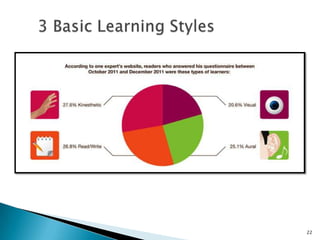
Visual

Auditory

Kinesthetic

Observing

Listening
Speaking

Practicing
Touching

18
19
20
21
22




10% of what we see
30-40% of what we see & hear
90% of what we see, hear & DO!



Everyone learns from all three styles, but one
usually dominates



Training should involve all 3 styles

23
Use a blend of training methods and materials
to reach the greatest number of learners.







Interactive Lectures
Discussions
Exercises
Presentations
Manuals / Handouts
Videos

24
Transference

Motivation

Retention

Reinforcement

25








Create participatory learning situations
Use a variety of presentation styles,
media, exercises and activities to keep
interest
Change pace and / or activity every 30
minutes
Change seating arrangements
Use examples that participants can
relate to their jobs

26






Encourage participants to contribute their
experiences
Use humor when appropriate
Allow for differences of opinion
Keep participants alert

27









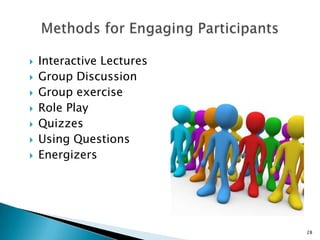
Interactive Lectures
Group Discussion
Group exercise
Role Play
Quizzes
Using Questions
Energizers

28





Participants practice using new
knowledge and skills in simulated
exercise
Exercises can be scripted or improvised
Follow up discussion

29






Use quizzes to reinforce learning
Help to keep participants involved,
engaged and interested
Add variety to presentation
Can be a game or challenge

30
There are 3 types of questions:
Close – ended
Open – ended
Probing

31







Generate short, finite answers (yes / no)
Do not encourage discussion
Limit what participant says
Gain a final answer, conclusion or confirmation
Examples:
◦ Is it X…?
◦ Have you ever…?

32






Generate descriptive answers
Encourage discussion and participation
Promote sharing of experiences and
knowledge
Examples:
◦ How can you…?
◦ What are some ways…?
◦ Why would you want to…?

33





A probing question is an open-ended followup question intended to elicit a thoughtful
answer.
Allows for a deeper dive into the subject.
Examples:
◦ What did you mean by xxx?
◦ Why do you think this is the case?
◦ What would have to change in order for…?

34








Maintain a deliberate silence
Repeat or rephrase the question
Use body language / eye contact
Encourage answers
Give examples
Answer the question yourself

35


Energizer: a short, fun activity that
breaks up periods of concentrated
learning
◦ Can be a physical activity
◦ May not be related to the training topic

36
Type of Energizer

How it Engages Participant

Physical

Maintains energy and
attention (especially after
lunch)

Team Building

Builds rapport

Educational

Reinforce content and assess
learning

Mental

Provides a problem to solve

Fun

Highlights special skill or
talent

37
Consider:

Avoid Energizers that:

Cultural / Organizational
context

Cause embarrassment

Participant backgrounds and
expectations

Provoke disagreement

Training goals

Disrupt flow of learning

Time constraints

Take too long

Room layout / number of
participants

38





Design training to meet participants
needs
Choose the right participants
Omit content not relevant to the
audience
Define technical terms as needed

39









Experience
Skills
Job / Position
Education
Knowledge
New responsibilities
Training needs

40






What are their
goals of
attending?
What are their
learning styles?
What tools do
they need to
succeed?

41






Use a “get-to-knowyou” exercise or ice
breaker
Use a pre-assessment
form or quiz
Ask participants to
share their
expectations of the
course

42





Voice
Eye Contact
Listen
Body Language

43









Sets the tone of the presentation or
training
Shows enthusiasm
Encourages participation
Provides positive reinforcement
Project your voice & vary your pitch
Speak at the audience’s technical level
Use a comfortable and friendly tone

44




Shows you are interested in the topic
and the audience
Find out:
◦ Are participants engaged?
◦ Is there understanding?

45








Use pauses to allow participants to ask
questions and respond with comments
Listen to what participants are saying /
asking
Always repeat questions from
participants for all to hear and for clarity
of the question
Use silence to help manage the training

46






Facial expression should be
warm, friendly and enthusiastic
Use hands naturally while speaking
◦ Keep hands out of pockets
Move around the room
◦ Provides variety
◦ Helps to ease anxiety

47
Basics of Adult Learning and Effective Communication

48

Adult Learning Basics