


The inside out library:
scale, learning, engagement

   Lorcan Dempsey                @LorcanD


   Hacettepe University, Beytepe, Ankara, Turkey
                  Jan 23 2013
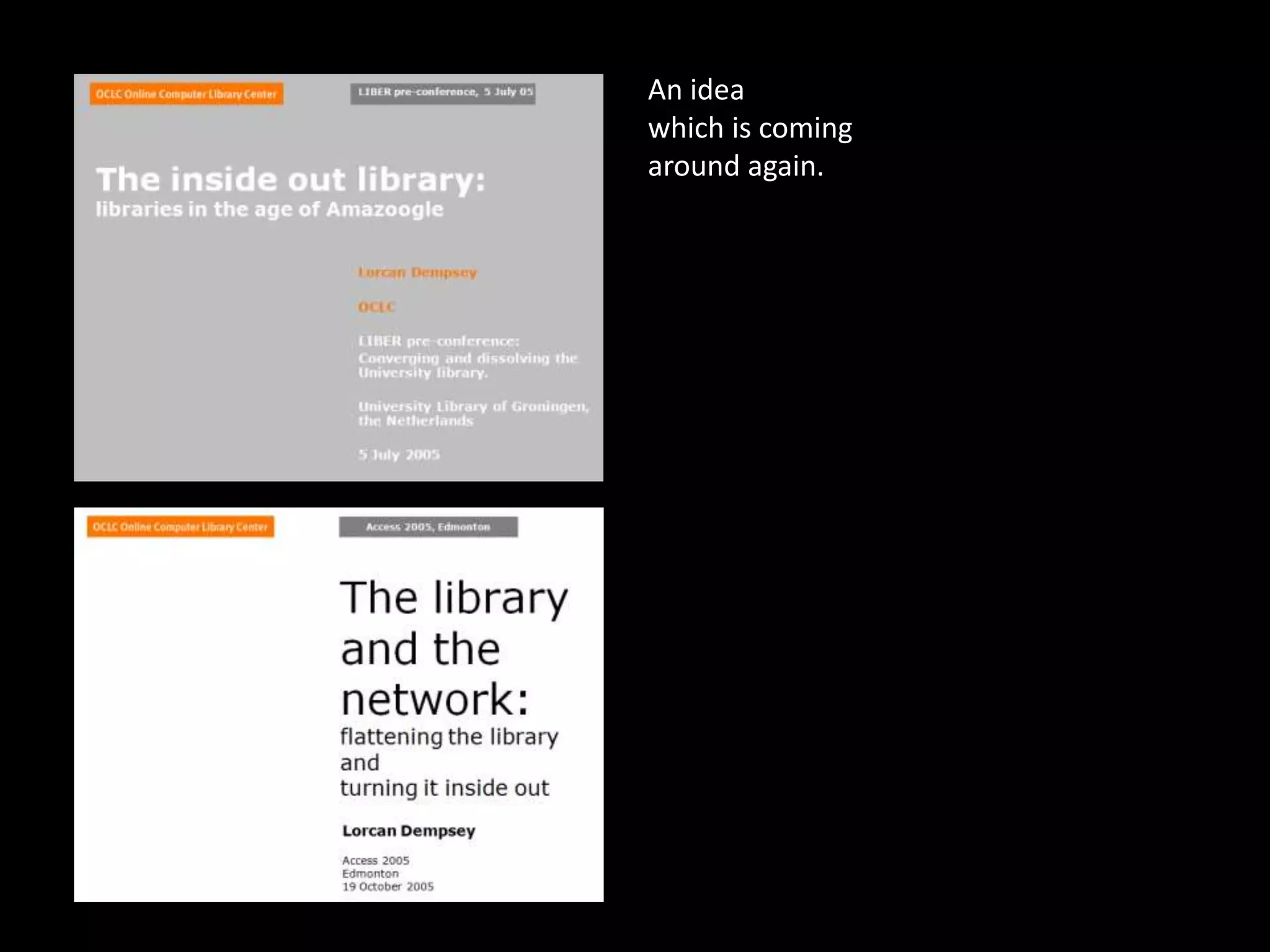
An idea
which is coming
around again.
By Ardfern (Own work) [CC-BY-SA-3.0 (http://creativecommons.org/licenses/by-sa/3.0) via Wikimedia Commons


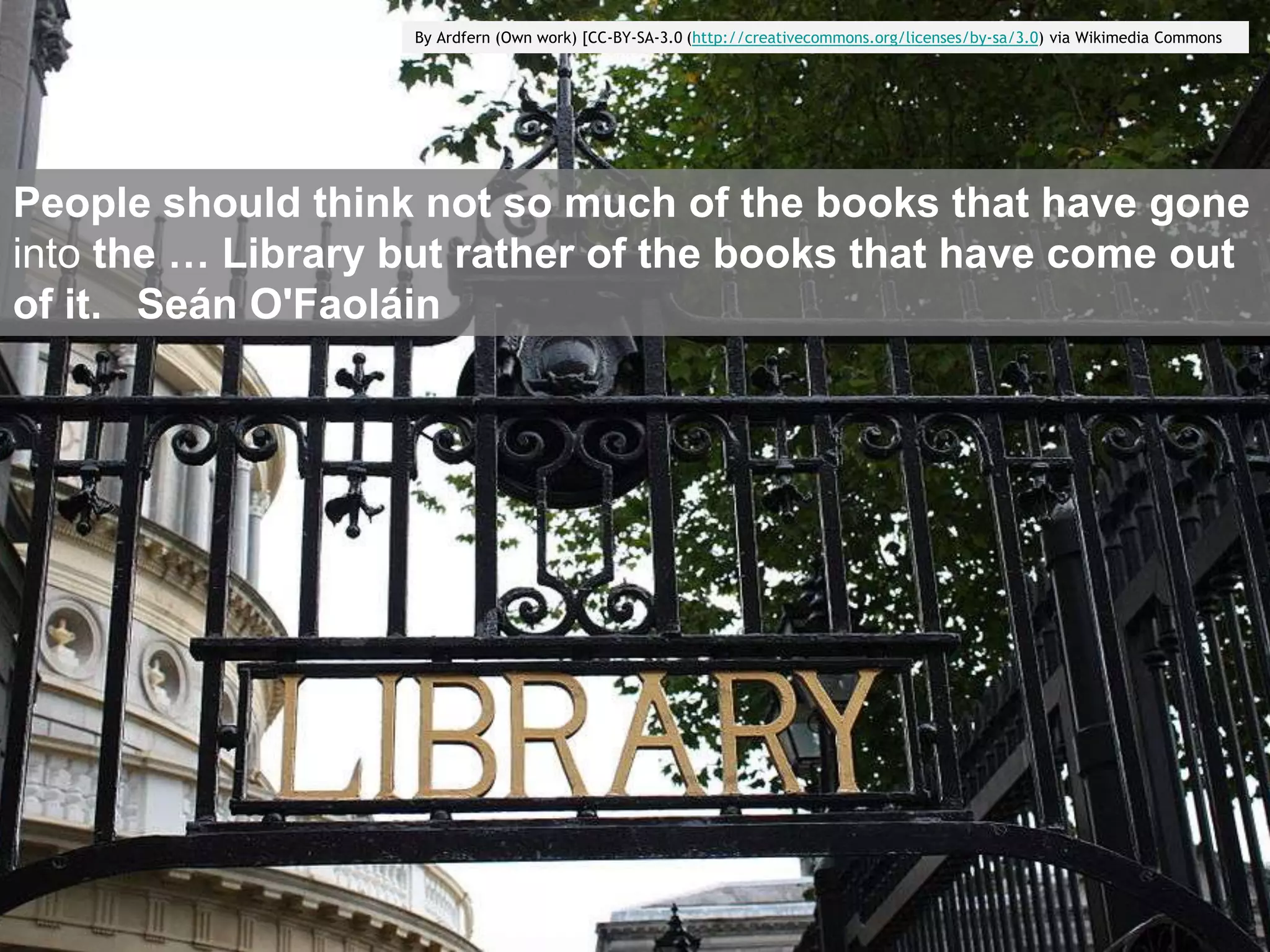
People should think not so much of the books that have gone
into the … Library but rather of the books that have come out
of it. Seán O'Faoláin
prelude
Network and scale
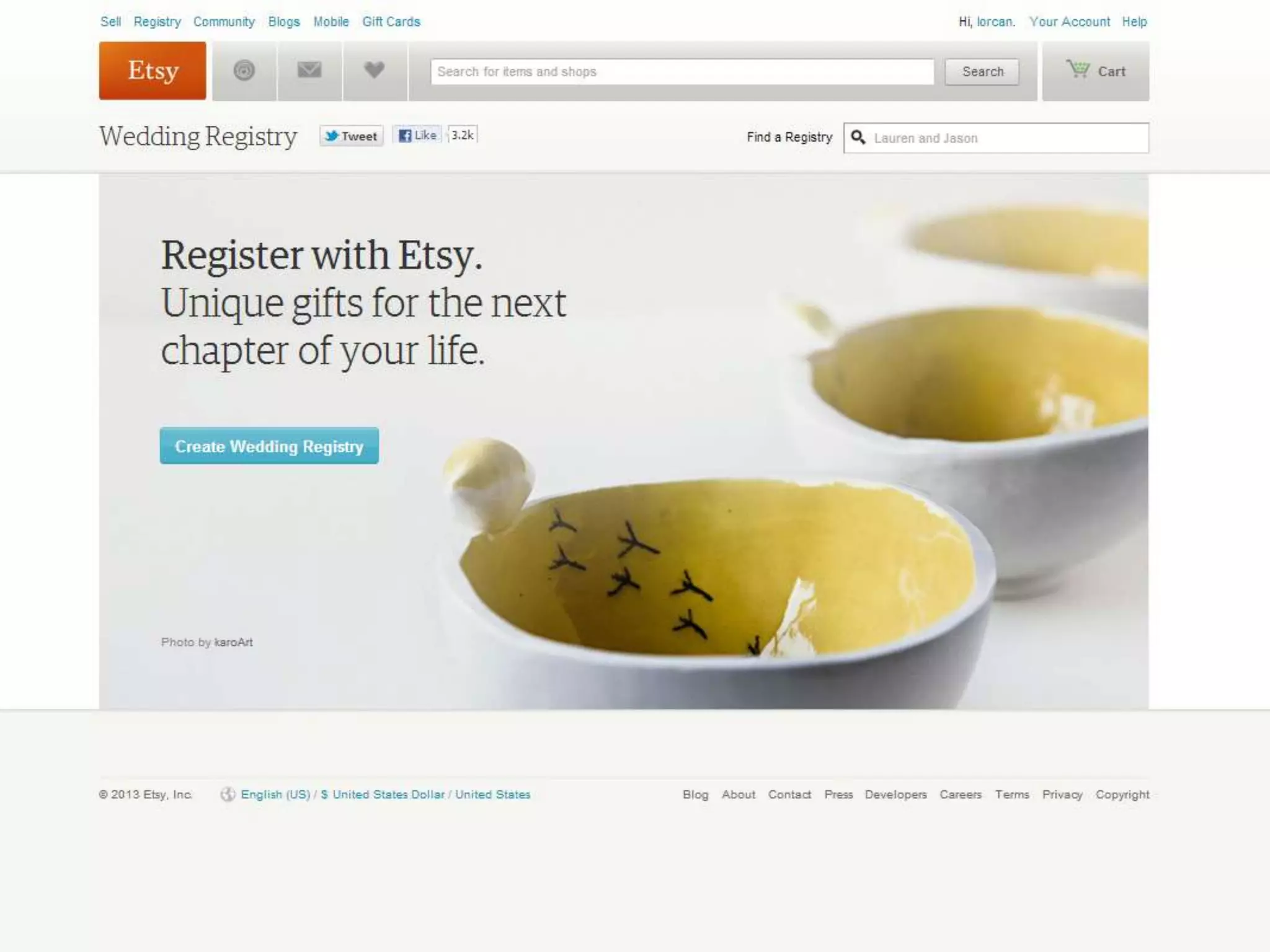
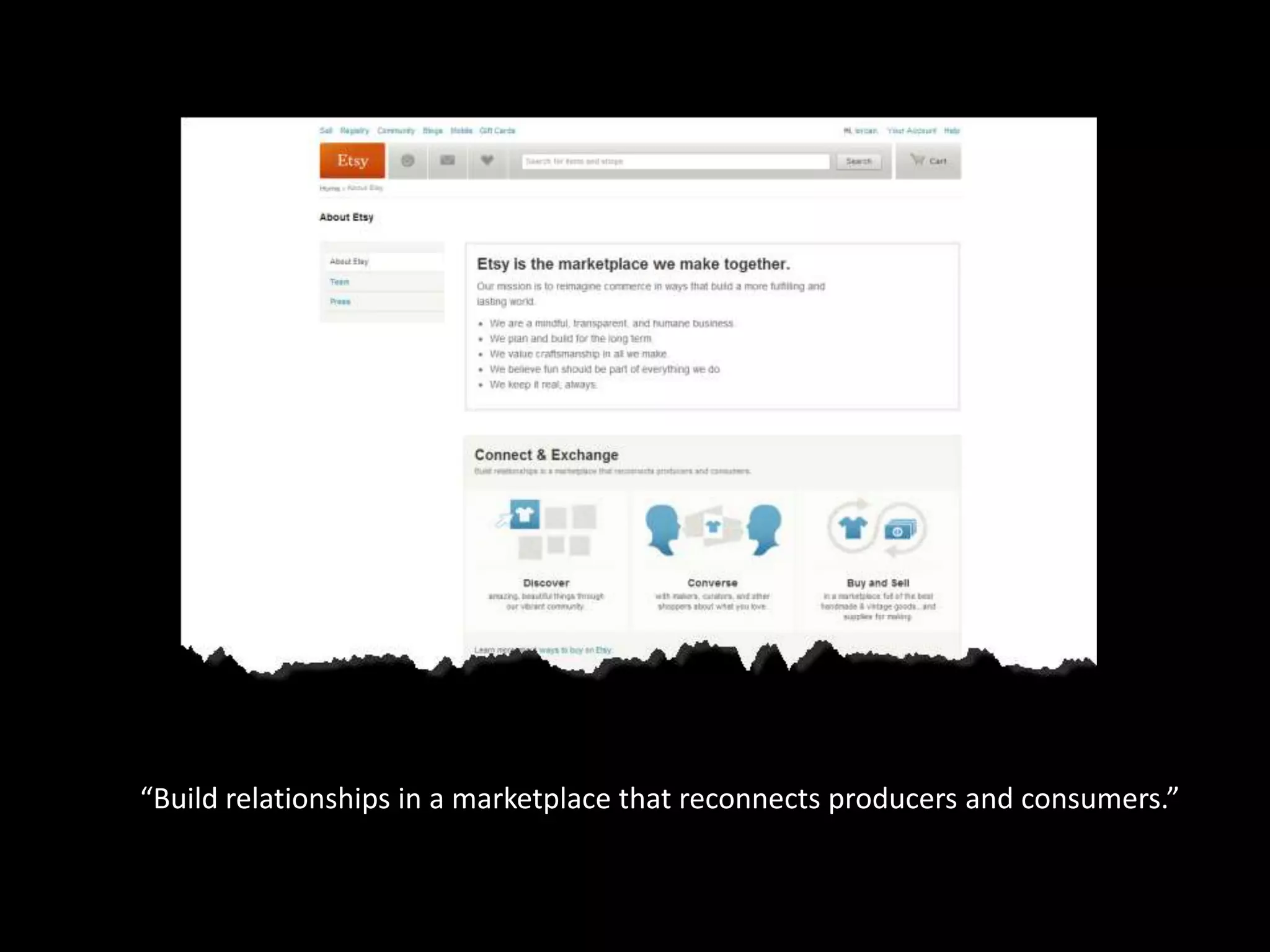
“Build relationships in a marketplace that reconnects producers and consumers.”
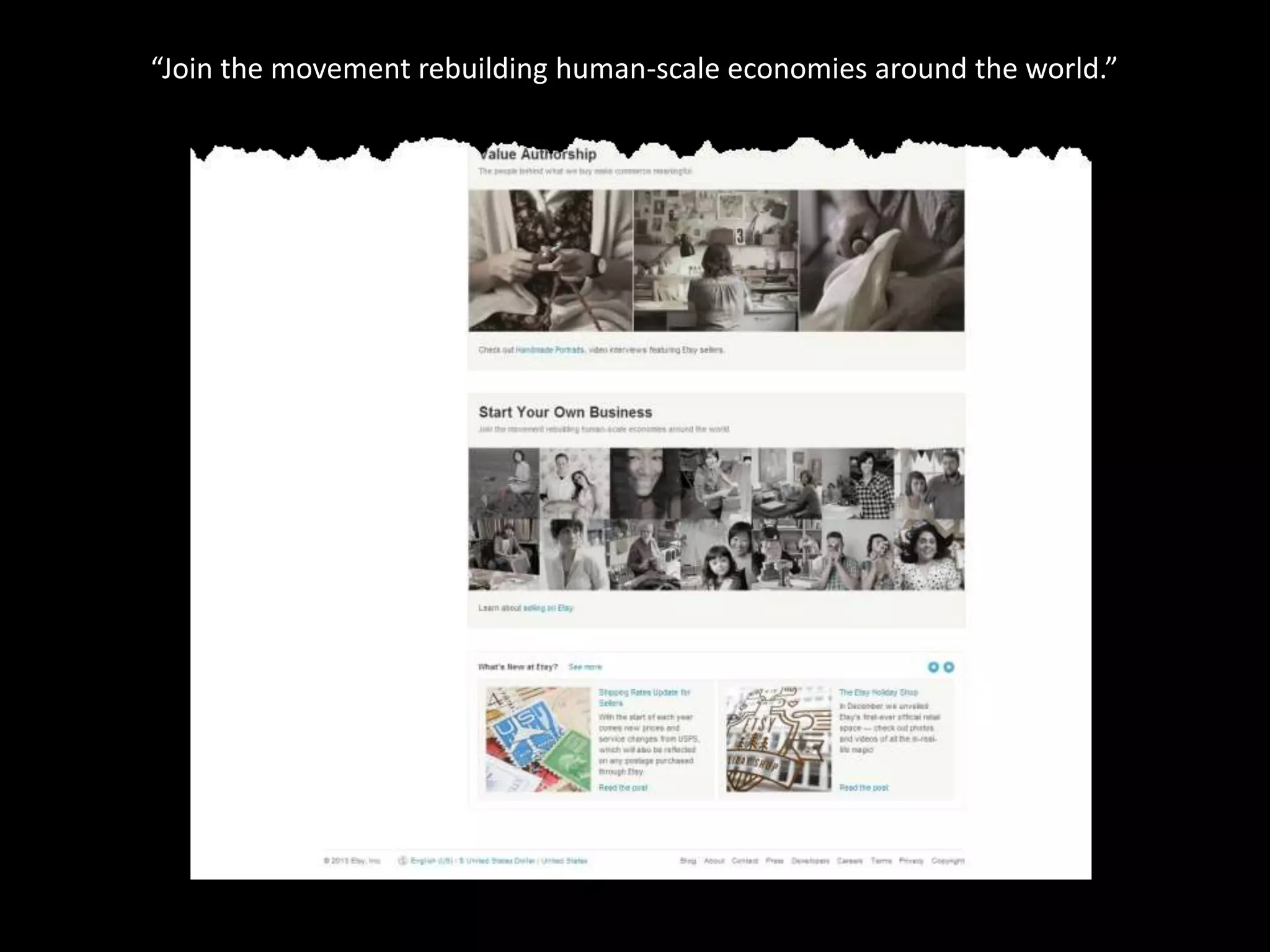
“Join the movement rebuilding human-scale economies around the world.”
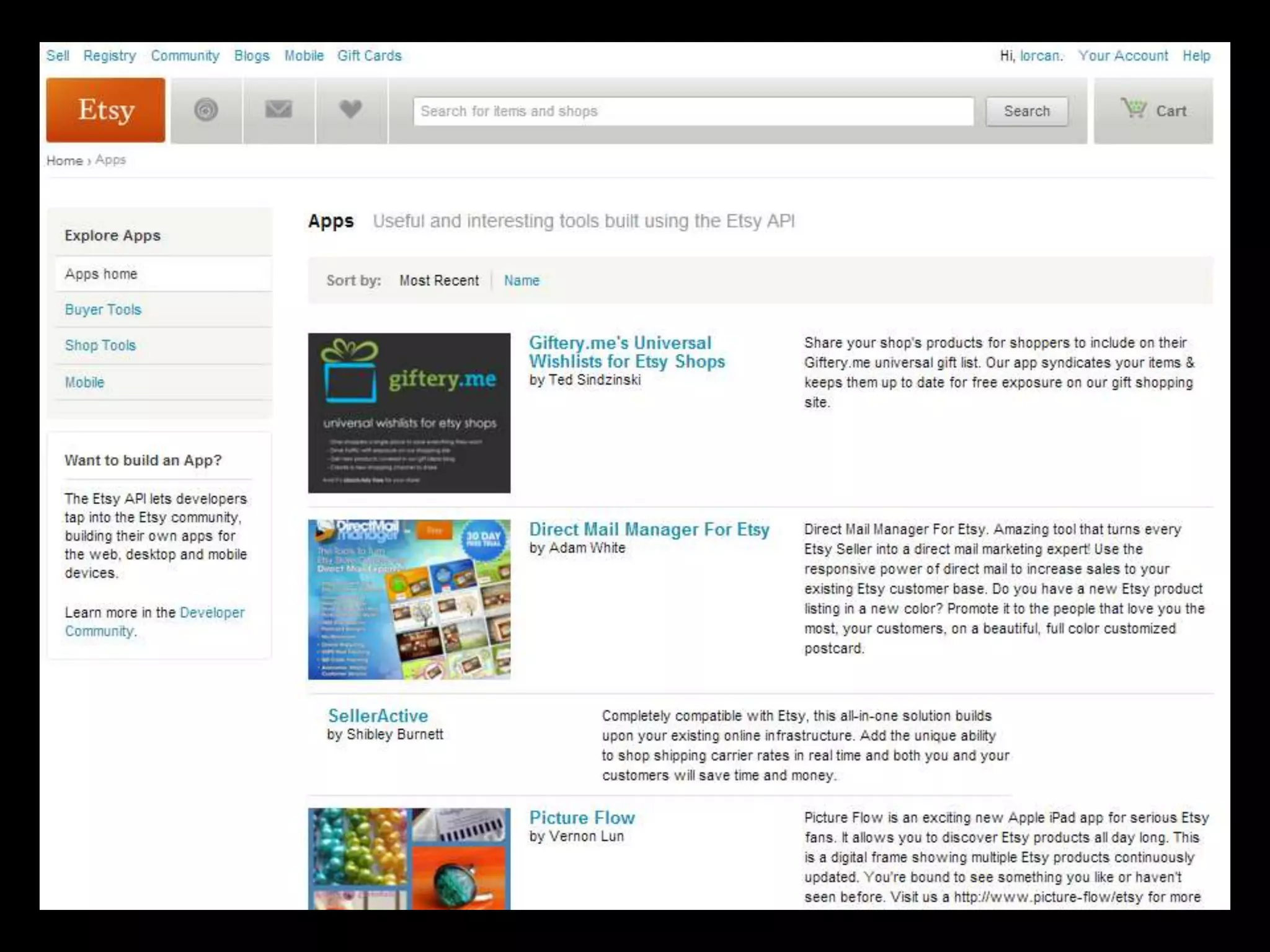
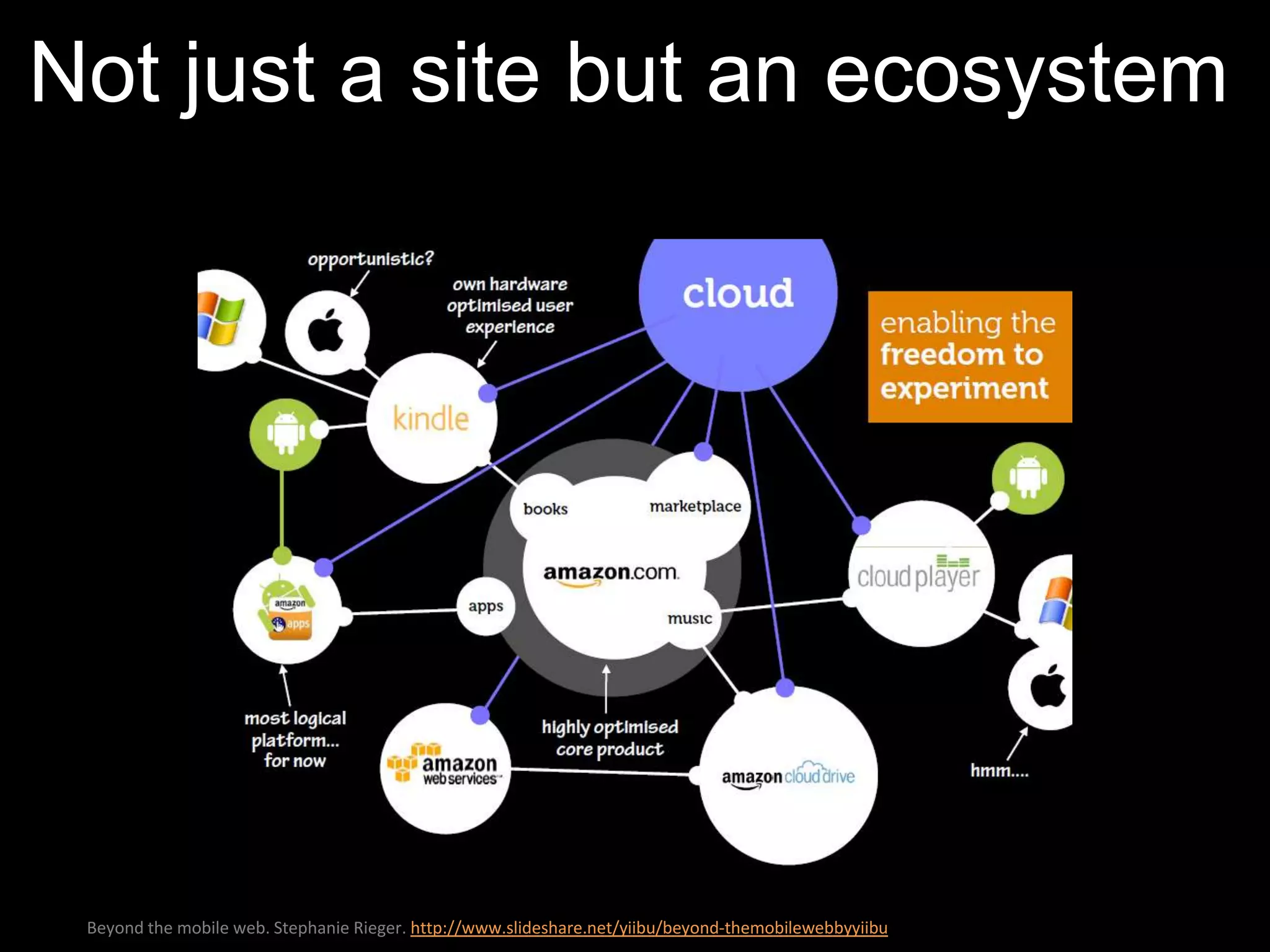
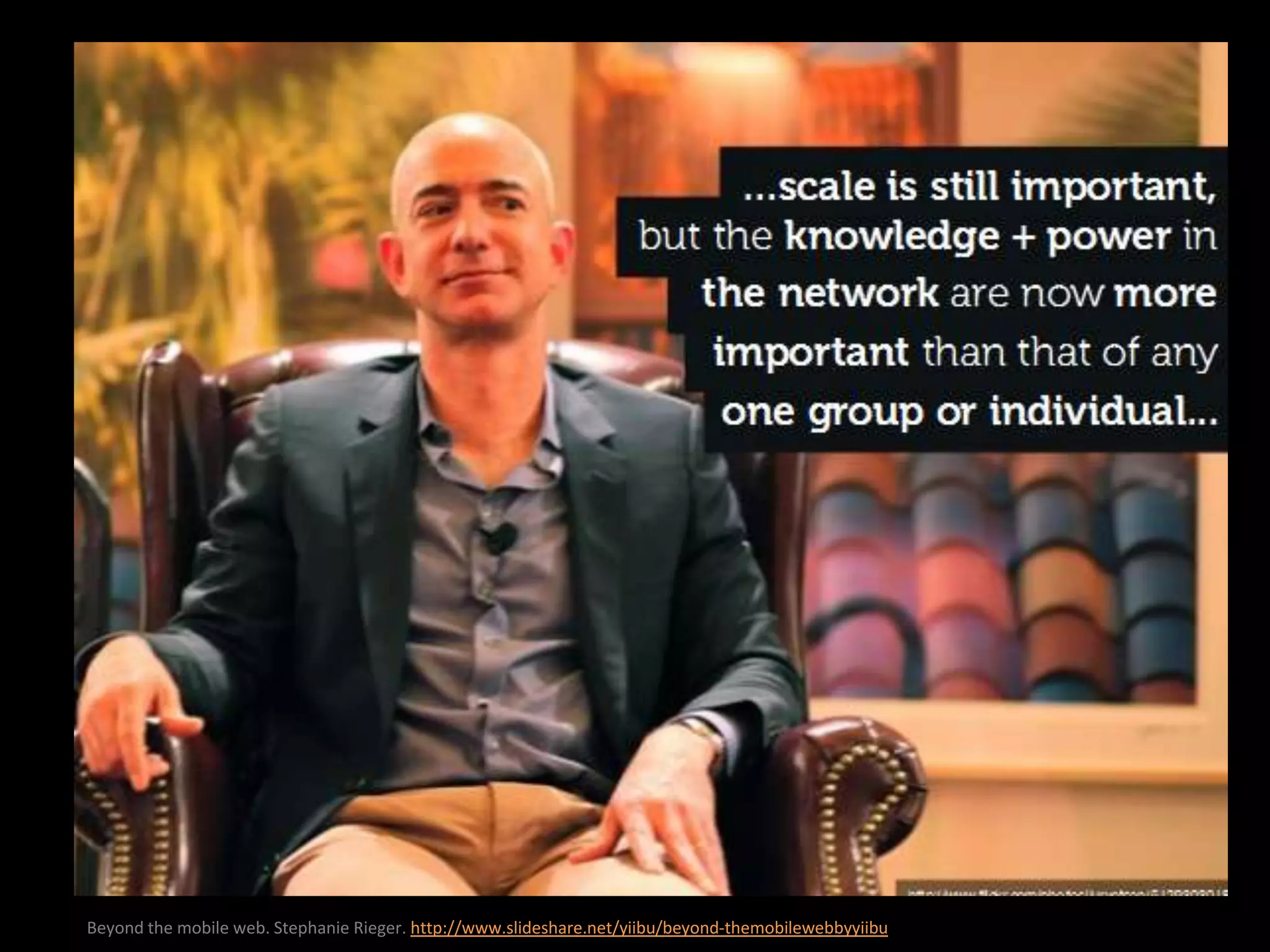
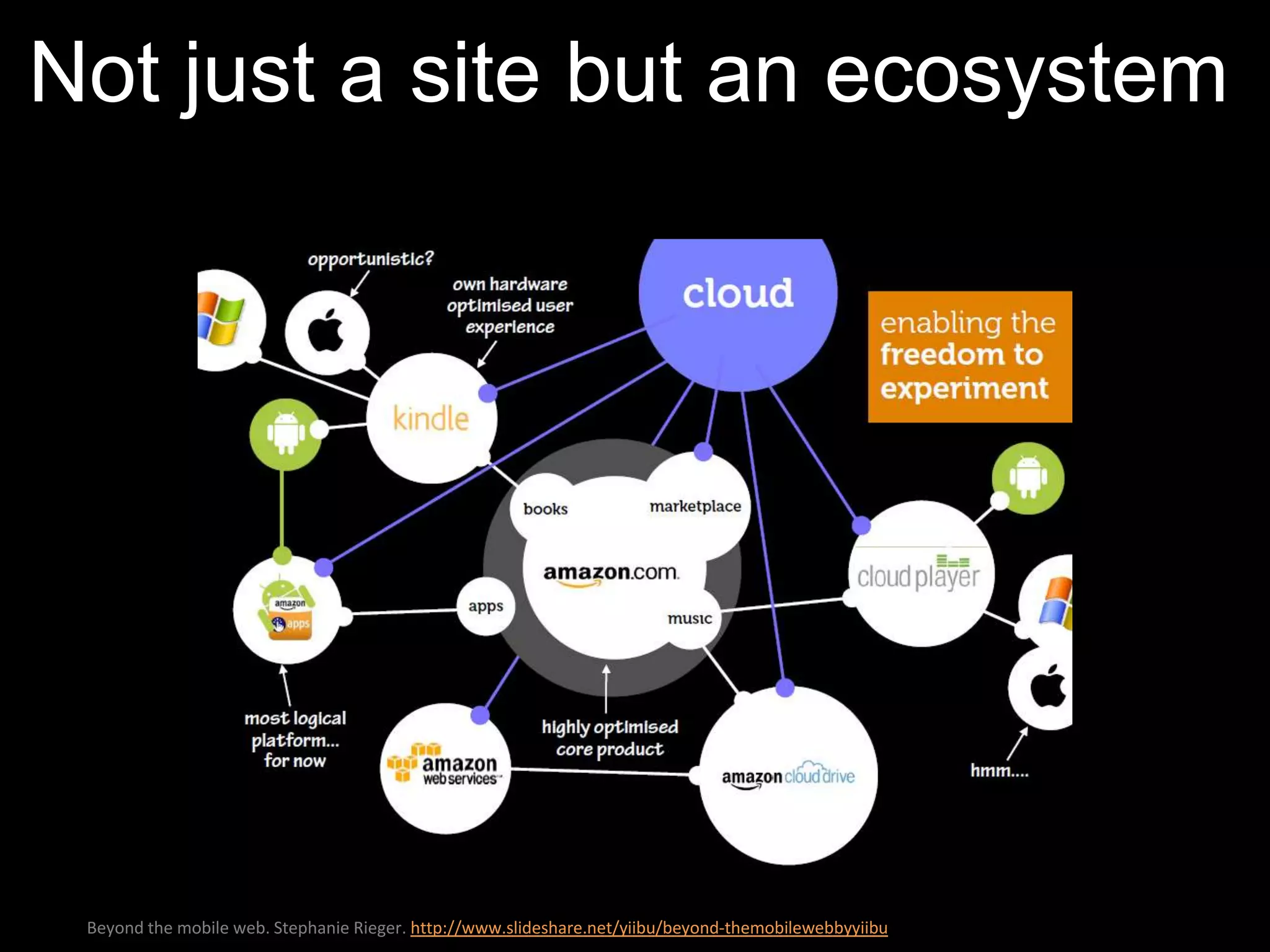
Not just a site but an ecosystem


 Beyond the mobile web. Stephanie Rieger. http://www.slideshare.net/yiibu/beyond-themobilewebbyyiibu
Webscale
• Webscale <> personal
• The rich get richer …
  – Network effects
  – Massive aggregation
  – Gravitational pull
• Data driven engagement
  – Analytics
  – Social
• Platform
  – Leverage for developers …
Beyond the mobile web. Stephanie Rieger. http://www.slideshare.net/yiibu/beyond-themobilewebbyyiibu
“
    Colleges and universities have long competed
    against one another, measuring themselves in
    comparison to each other and holding tightly to
    their idiosyncrasies as defining elements of their
    status. But today, the distribution and reuse of
    information digitally via the Internet is rapidly
    changing the game, rewarding those who
    instead aggregate and scale toward a common
    infrastructure. It is becoming increasingly clear
    that neither the challenges that confront
    colleges and universities nor the solutions to
    those challenges are unique to each institution.


                        Chuck Henry and Brad Wheeler
                        The game has changed
                        Educause Review, March 2012
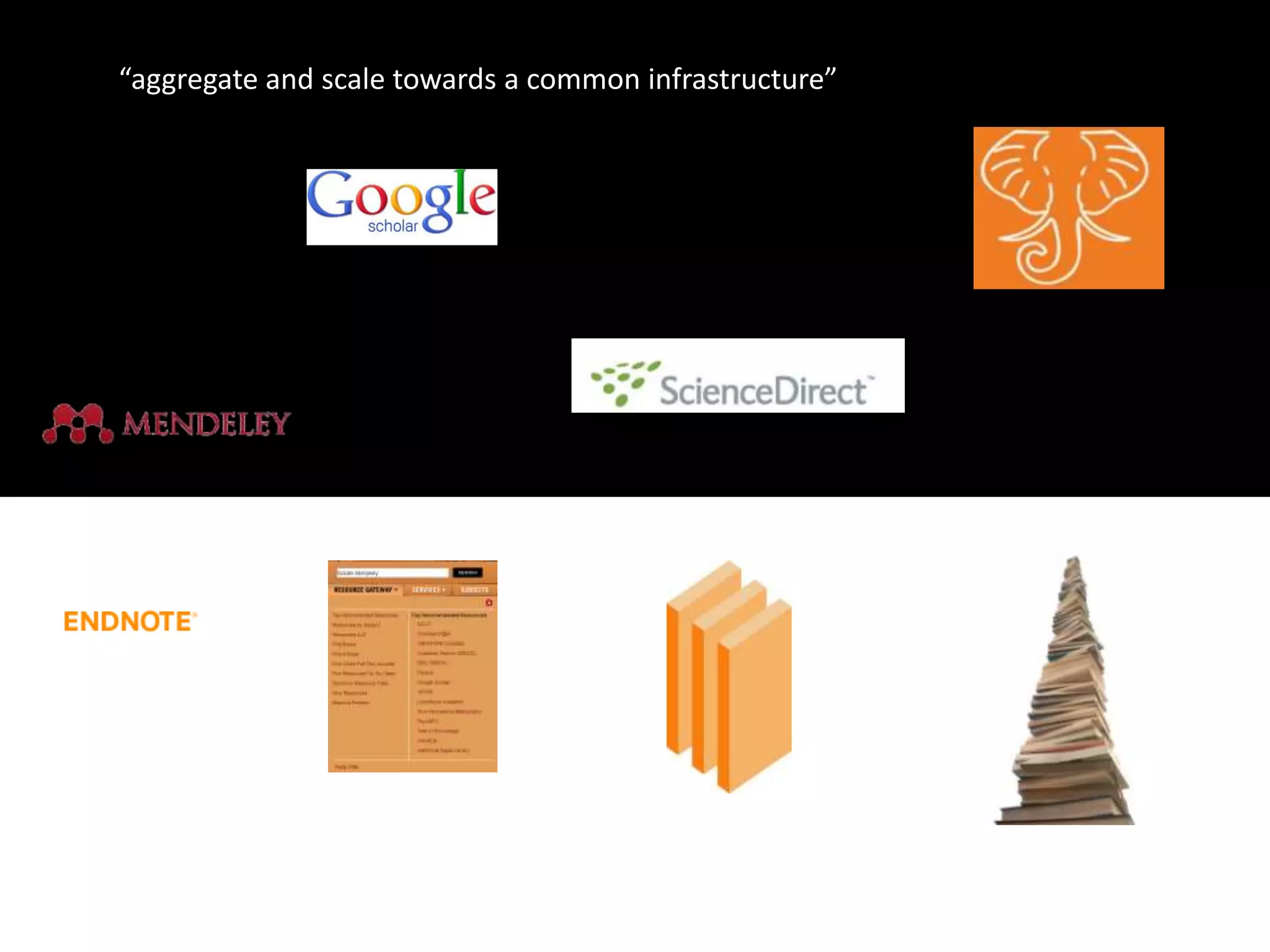
“aggregate and scale towards a common infrastructure”
My professional mission
                   as a librarian is this:
                   Help people build
                   their own libraries.
                   That's it. That's all I care
                   about.


Dan Chudnov
http://onebiglibrary.net/story/because-this-is-the-business-weve-chosen
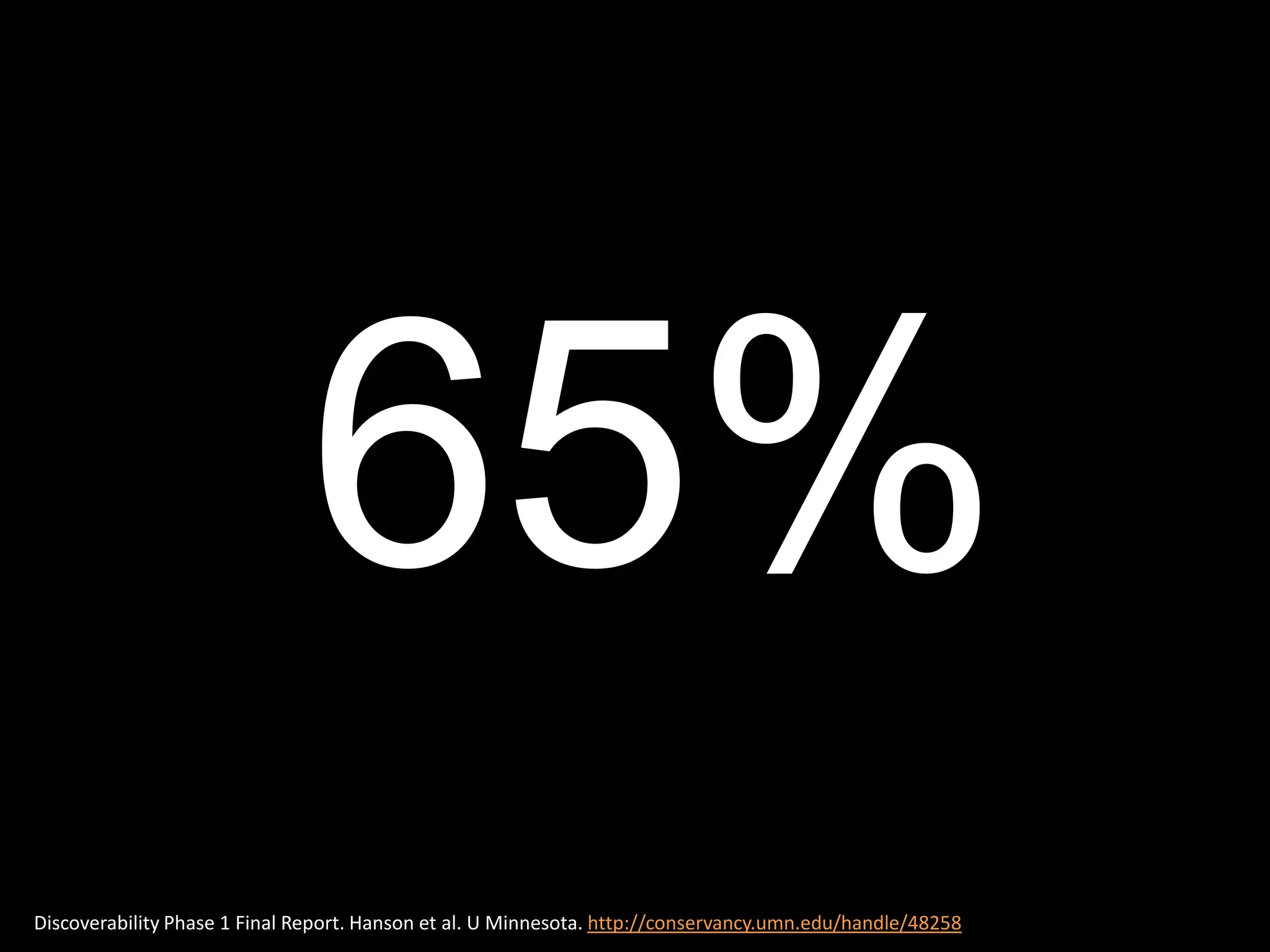
65%
Discoverability Phase 1 Final Report. Hanson et al. U Minnesota. http://conservancy.umn.edu/handle/48258
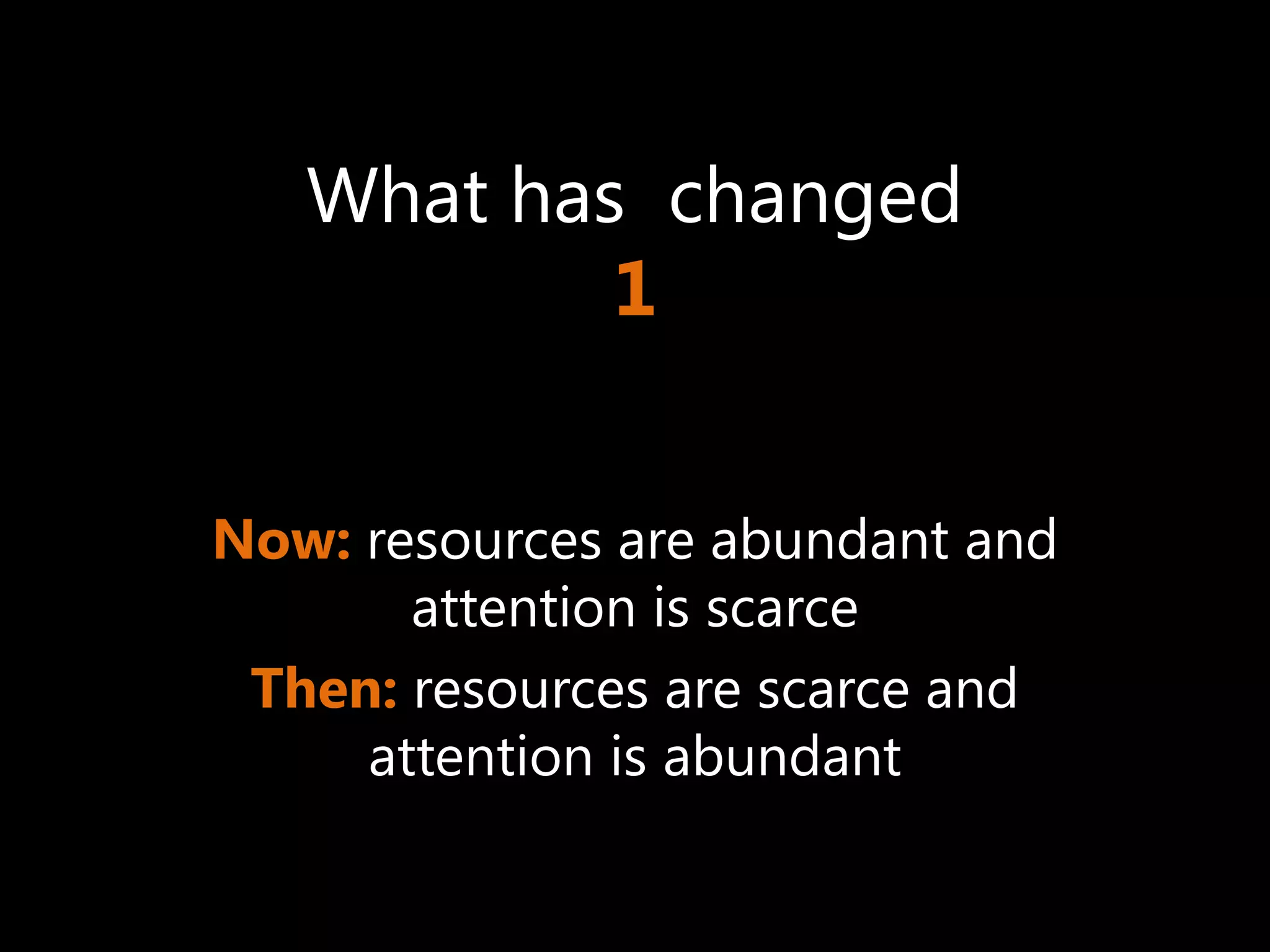
What has changed
           1


Now: resources are abundant and
       attention is scarce
 Then: resources are scarce and
     attention is abundant
What has changed?
          2

The need for local infrastructure or
 local assembly of materials has
            declined.
High transaction
costs led to
locally
assembled
collections.
What has changed?
            3

The library is institution scale where
many of its users operate at network
                 scale
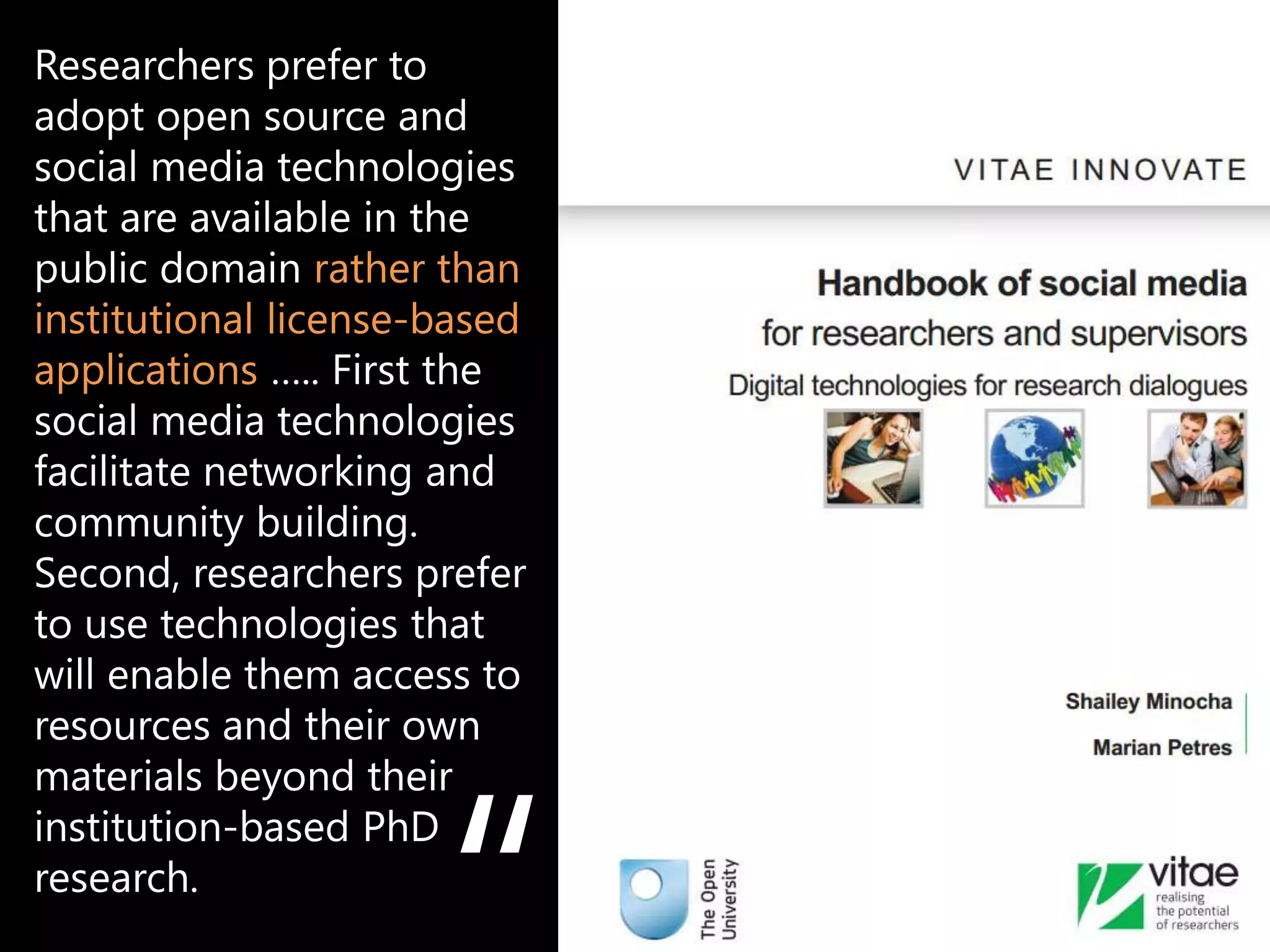
Researchers prefer to
adopt open source and
social media technologies
that are available in the
public domain rather than
institutional license-based
applications ….. First the
social media technologies
facilitate networking and
community building.
Second, researchers prefer
to use technologies that
will enable them access to
resources and their own
materials beyond their
institution-based PhD
research.                     e.g. Mendeley, Zotero, Endnote
What has changed
              4

Now: Library services are built around the
            user’s workflow

Then: User’s workflow built around library
                services
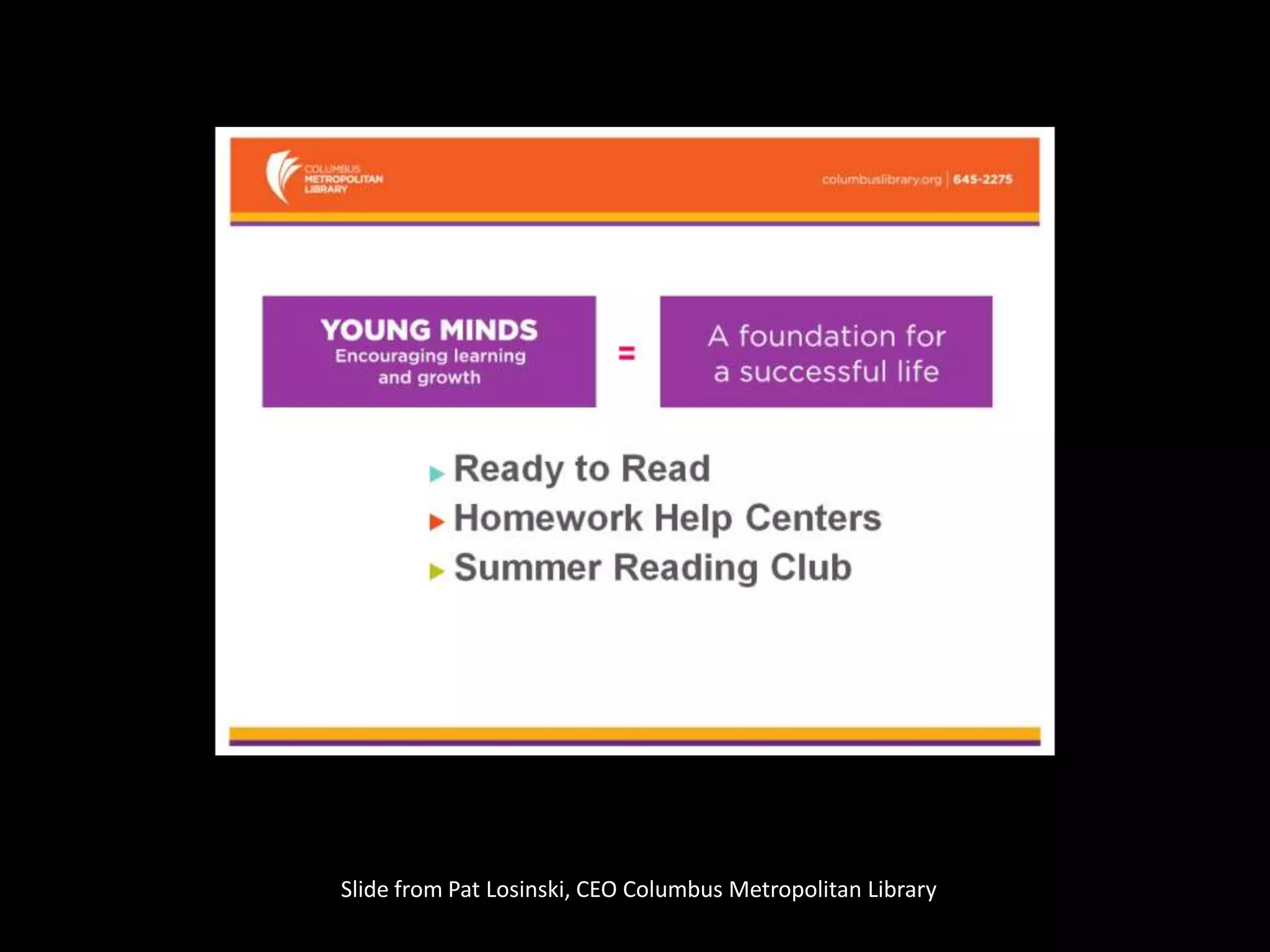
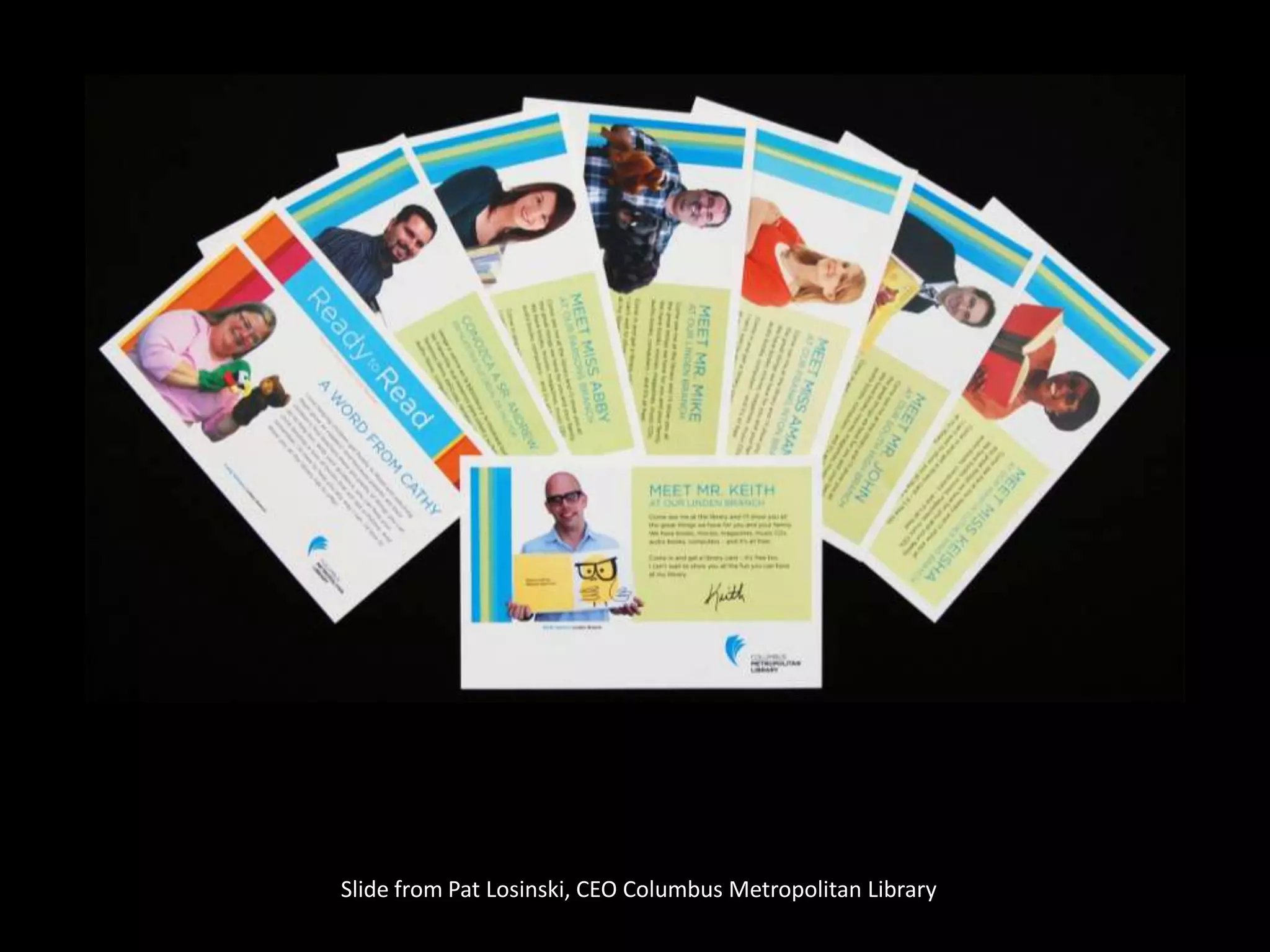
Slide from Pat Losinski, CEO Columbus Metropolitan Library
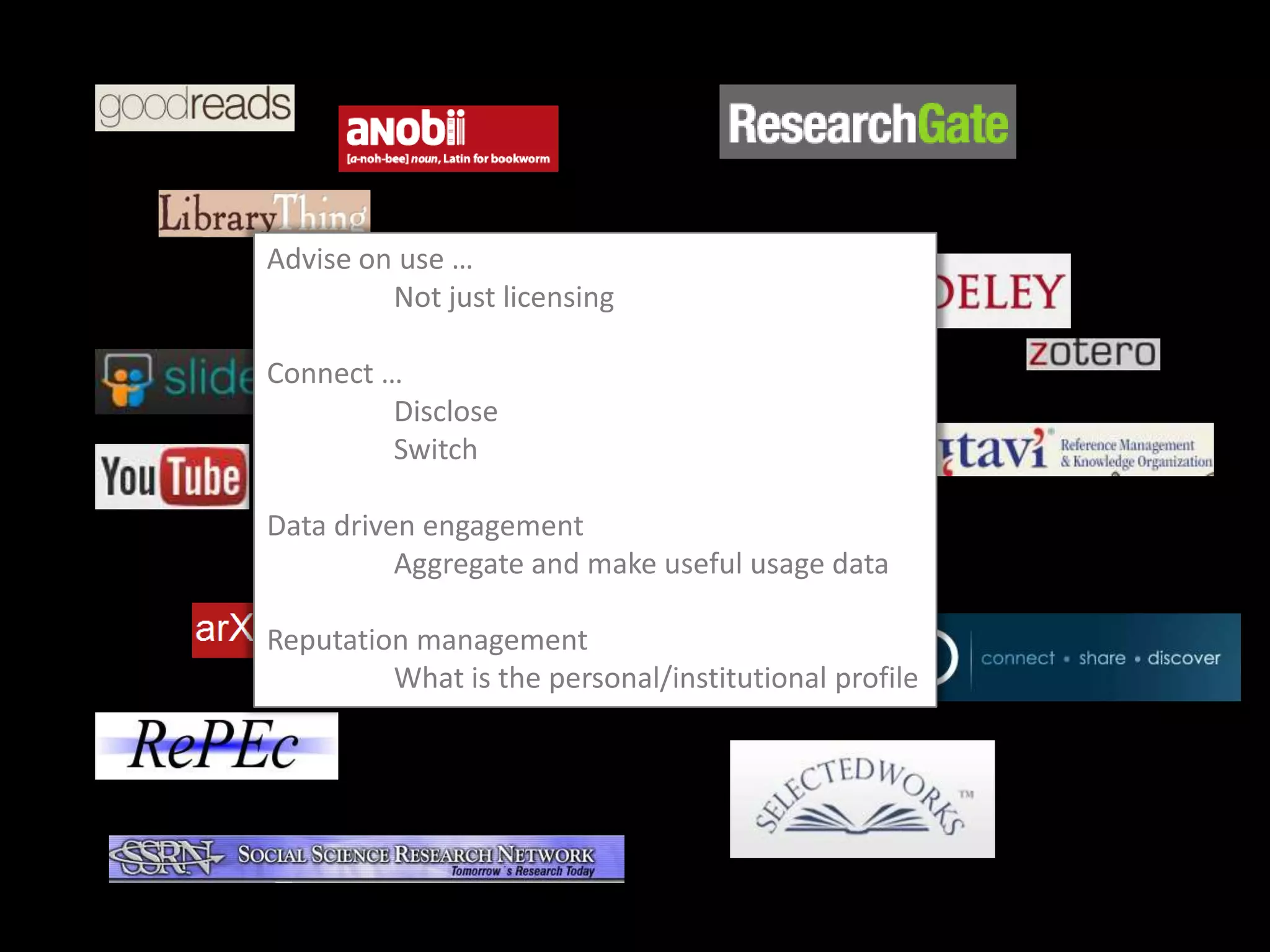
Advise on use …
         Not just licensing

Connect …
         Disclose
         Switch

Data driven engagement
          Aggregate and make useful usage data

Reputation management
         What is the personal/institutional profile
The inside out library ..
the library as an actor in research
 and learning environments of its
               users
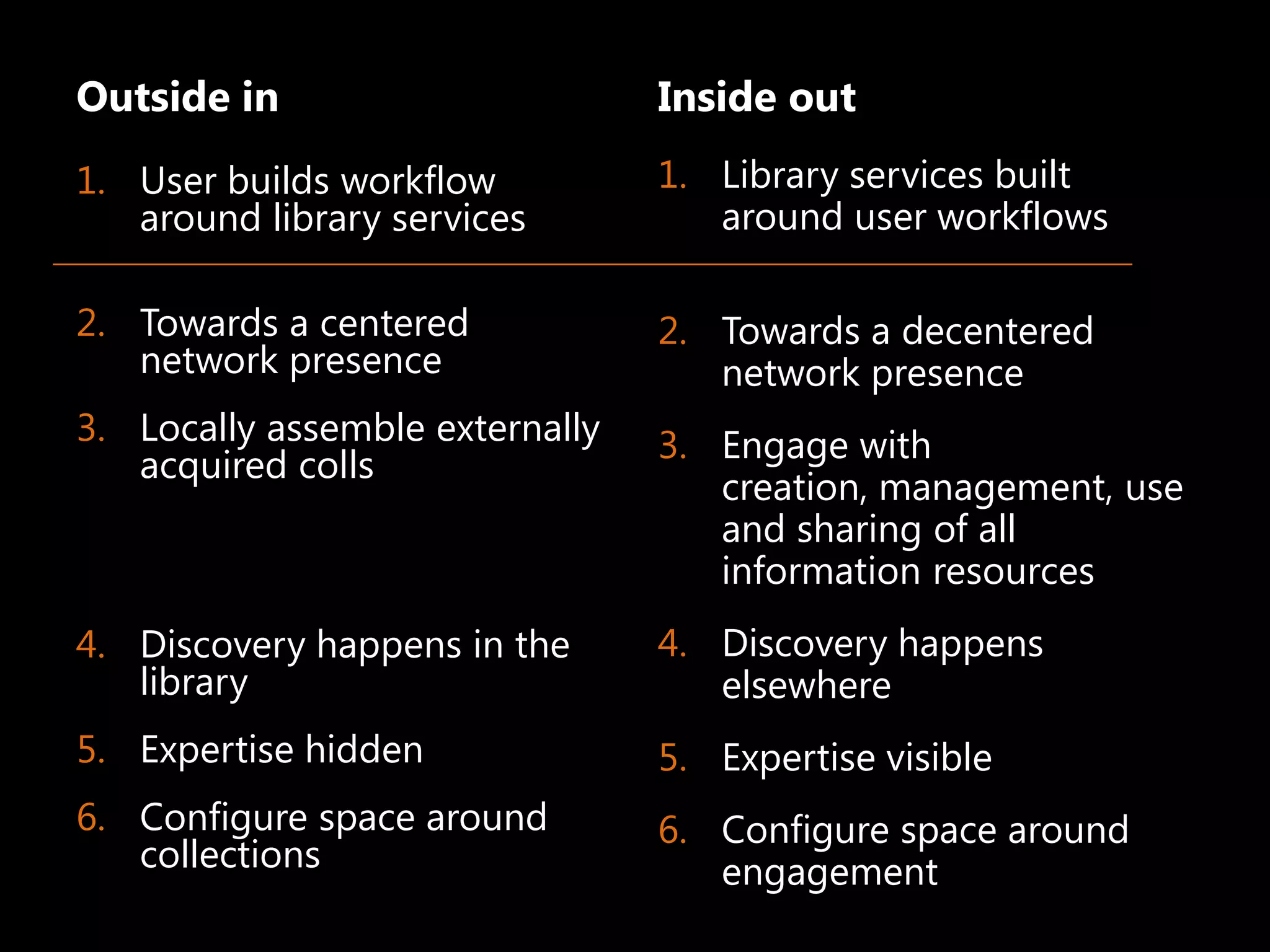
Outside in                       Inside out
1. User builds workflow          1. Library services built
   around library services          around user workflows

2. Towards a centered            2. Towards a decentered
   network presence                 network presence
3. Locally assemble externally   3. Engage with
   acquired colls
                                    creation, management, use
                                    and sharing of all
                                    information resources
4. Discovery happens in the      4. Discovery happens
   library                          elsewhere
5. Expertise hidden              5. Expertise visible
6. Configure space around        6. Configure space around
   collections                      engagement
2

Now: towards the decentered
          library
  Then: towards the centered library


  Thanks to my colleague JD Shipengrover for help with the pictures in this section
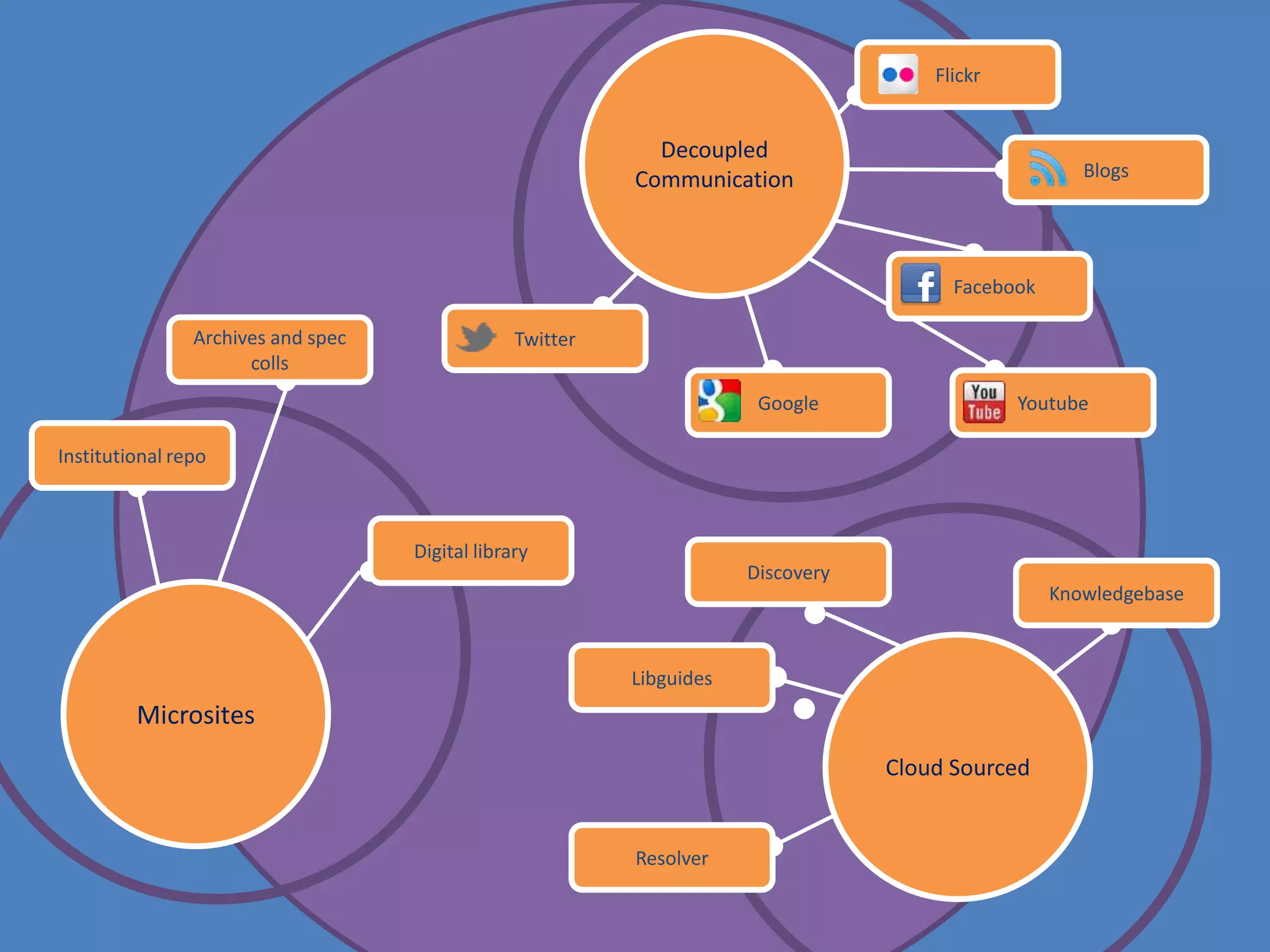
Not just a site but an ecosystem


 Beyond the mobile web. Stephanie Rieger. http://www.slideshare.net/yiibu/beyond-themobilewebbyyiibu
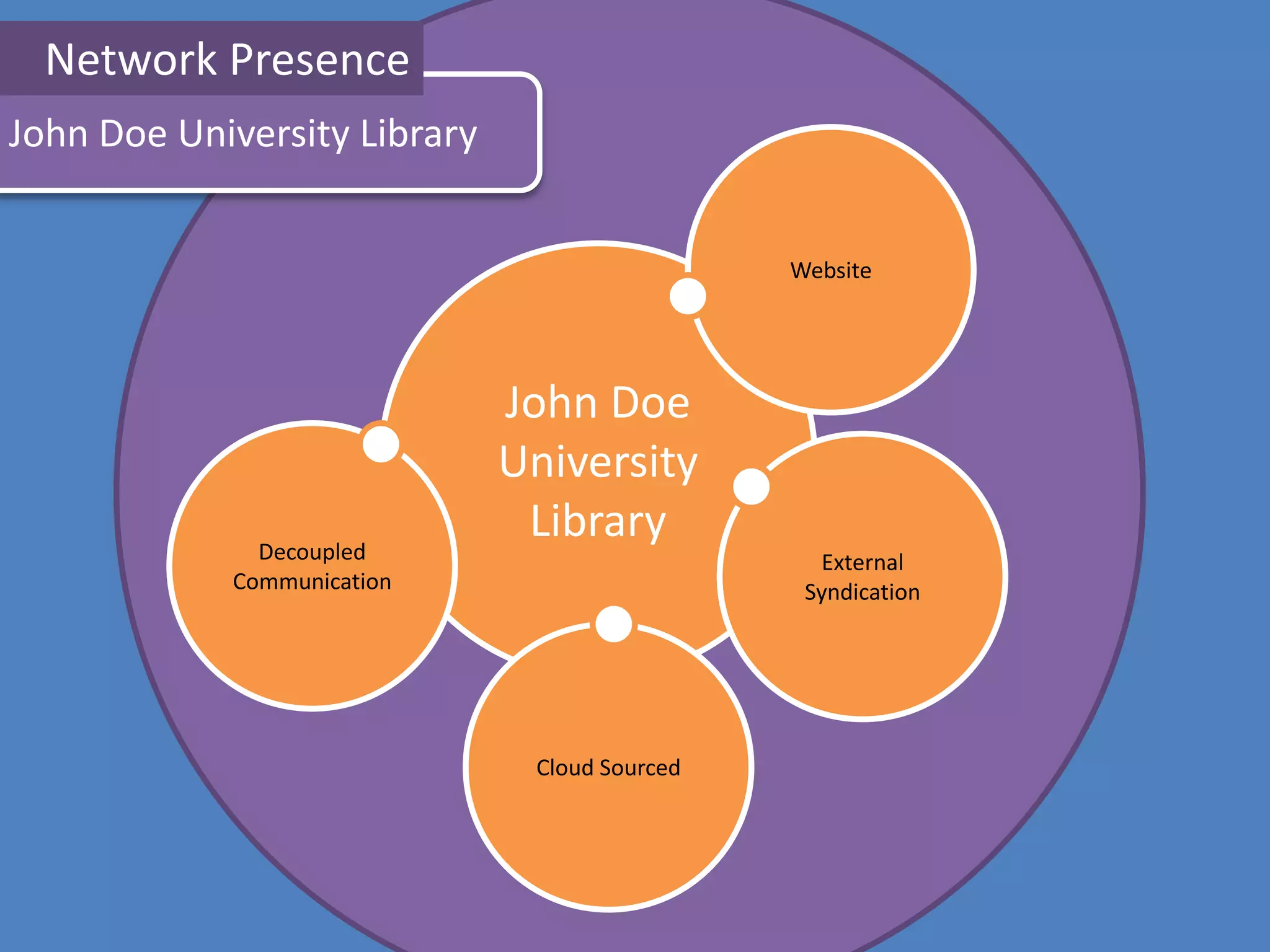
Network Presence
John Doe University Library


                                               Website


                              John Doe
                              University
              Decoupled
                               Library
                                                 External
            Communication                       Syndication


                               Cloud Sourced
Flickr


                                                             Decoupled
                                                           Communication                               Blogs


                                                                                         Facebook

                Archives and spec                Twitter
                      colls
                                                                        Google                  Youtube

Institutional repo


                                    Digital library
                                                                       Discovery
                                                                                                    Knowledgebase


                                                           Libguides
         Microsites
                                                                                   Cloud Sourced


                                                           Resolver
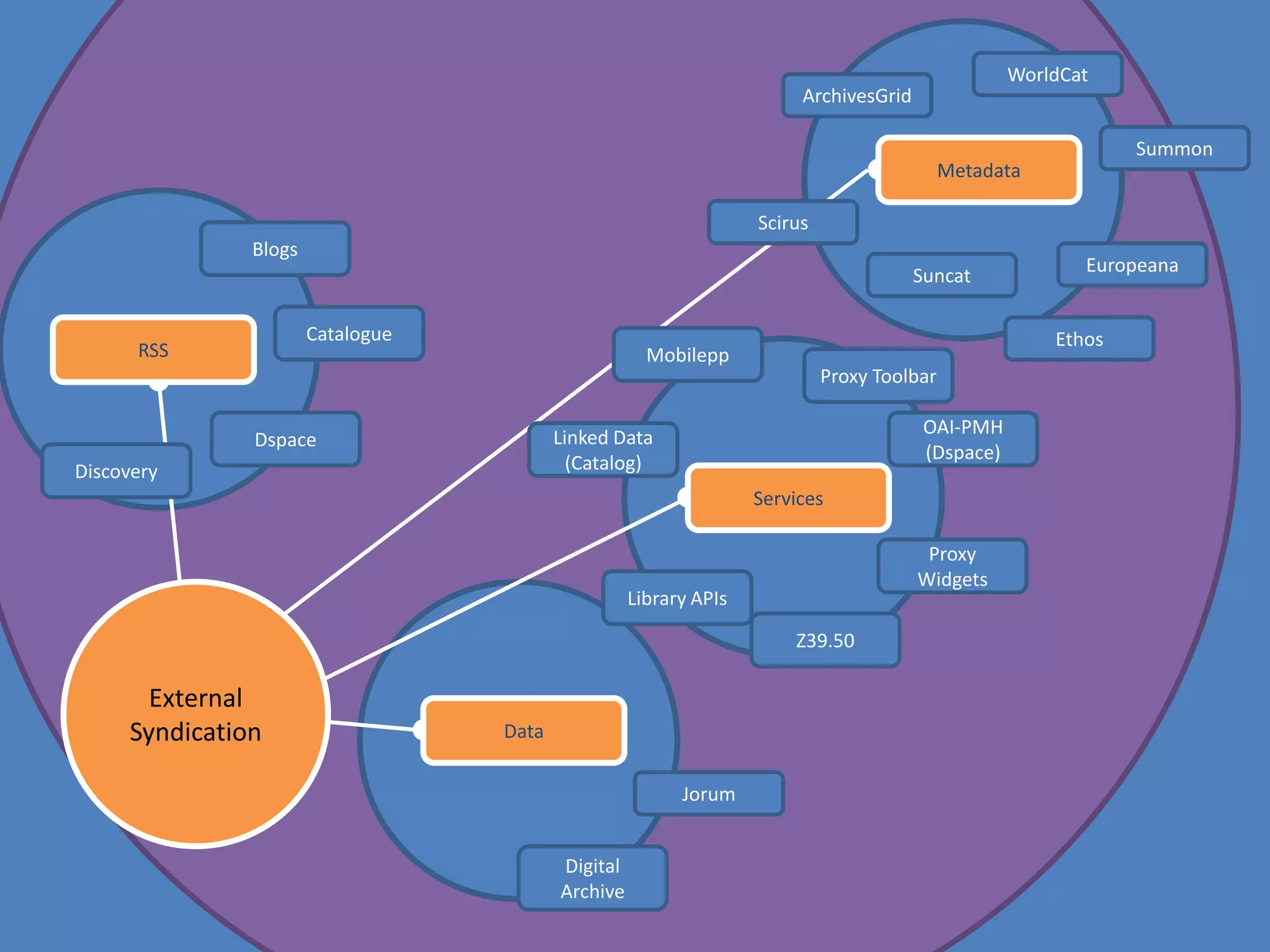
WorldCat
                                                                        ArchivesGrid

                                                                                                               Summon
                                                                                            Metadata

                                                                   Scirus
               Blogs
                                                                                                          Europeana
                                                                                       Suncat

                       Catalogue                                                                       Ethos
      RSS                                             Mobilepp
                                                                            Proxy Toolbar

                                                                                        OAI-PMH
               Dspace                     Linked Data
                                                                                        (Dspace)
Discovery                                   (Catalog)
                                                                   Services

                                                                                        Proxy
                                                                                       Widgets
                                                    Library APIs

                                                                       Z39.50

       External
     Syndication                   Data

                                                          Jorum


                                          Digital
                                          Archive
3
       Now: engage with
creation, management, use and
   sharing of all information
           resources
  Then: acquire external resources
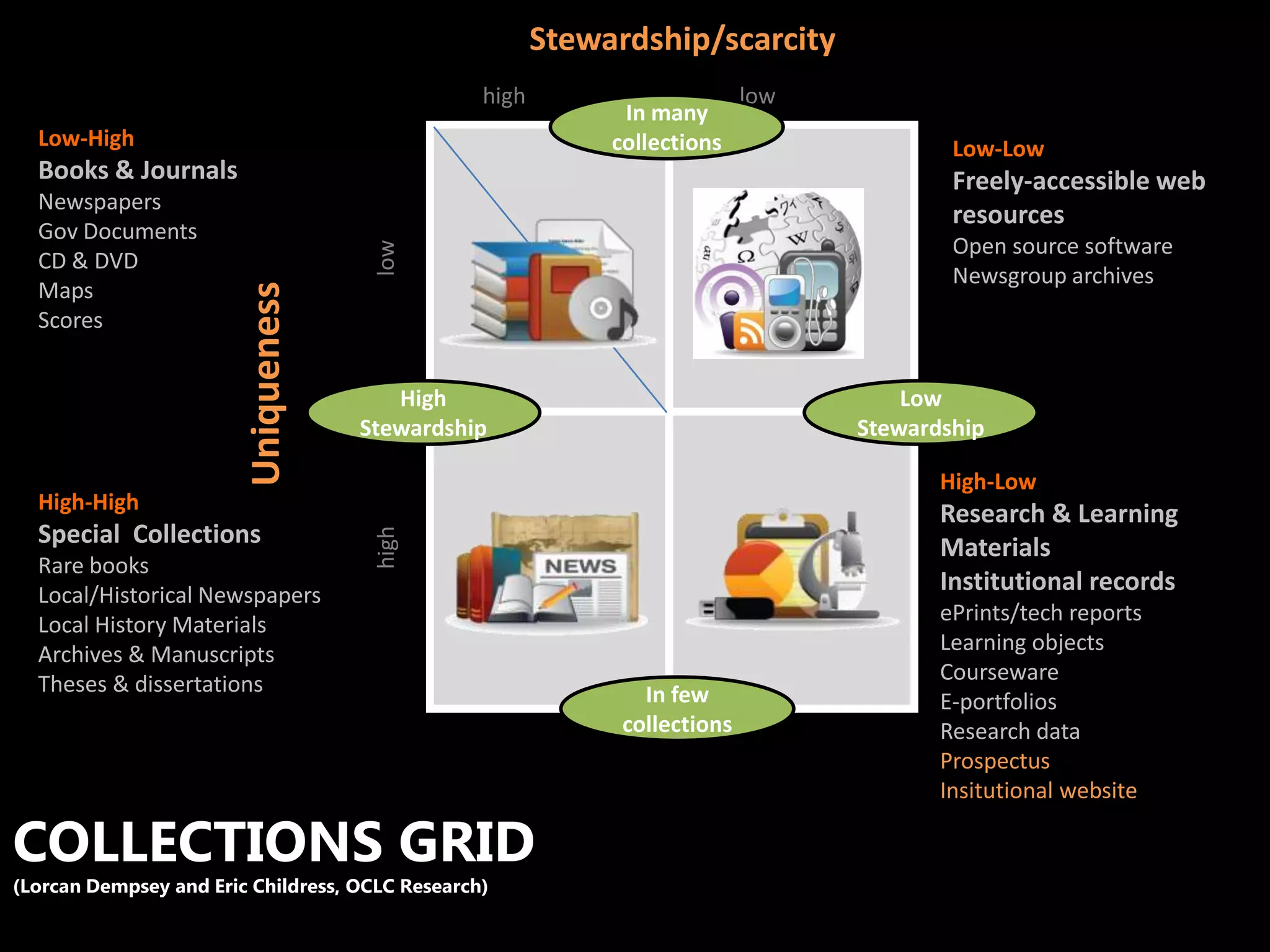
Stewardship/scarcity
                                                 high                       low
                                                              In many
  Low-High                                                   collections                  Low-Low
  Books & Journals                                                                        Freely-accessible web
  Newspapers
                                                                                          resources
  Gov Documents
                                                                                          Open source software


                                      low
  CD & DVD
                                                                                          Newsgroup archives
  Maps
                        Uniqueness
  Scores


                                        High                                          Low
                                     Stewardship                                  Stewardship

                                                                                         High-Low
  High-High
                                                                                         Research & Learning
  Special Collections
                                      high


                                                                                         Materials
  Rare books
  Local/Historical Newspapers
                                                                                         Institutional records
  Local History Materials                                                                ePrints/tech reports
  Archives & Manuscripts                                                                 Learning objects
  Theses & dissertations                                                                 Courseware
                                                                In few                   E-portfolios
                                                              collections                Research data
                                                                                         Prospectus
                                                                                         Insitutional website

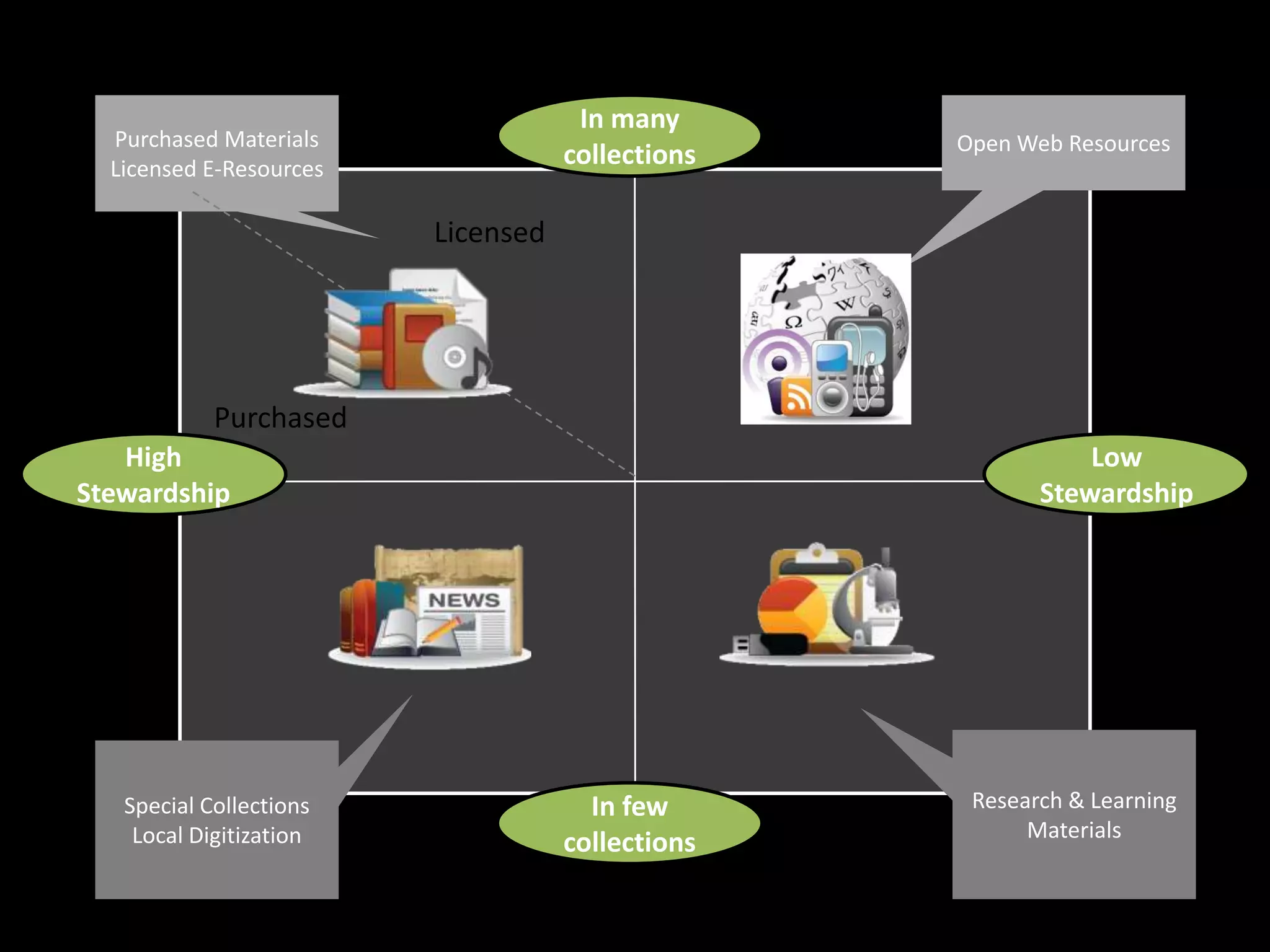
COLLECTIONS GRID
(Lorcan Dempsey and Eric Childress, OCLC Research)
Collections Grid
                                        In many
     Purchased Materials                             Open Web Resources
     Licensed E-Resources
                                       collections

                            Licensed


               Purchased
     High                                                       Low
  Stewardship                                               Stewardship


      Special Collections                In few       Research & Learning
       Local Digitization                                  Materials
                                       collections
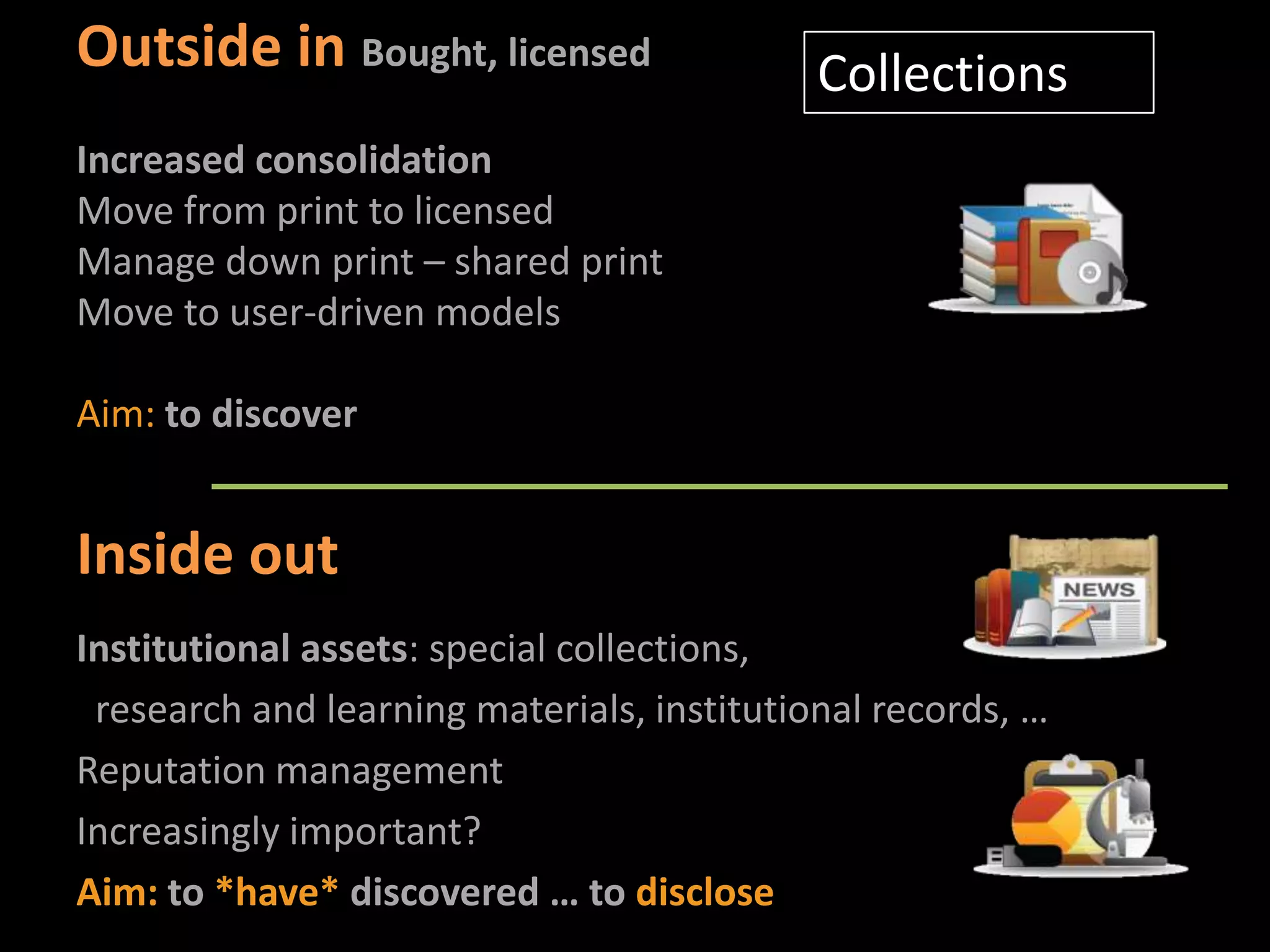
Outside in Bought, licensed                 Collections
Increased consolidation
Move from print to licensed
Manage down print – shared print
Move to user-driven models

Aim: to discover


Inside out
Institutional assets: special collections,
 research and learning materials, institutional records, …
Reputation management
Increasingly important?
Aim: to *have* discovered … to disclose
Outside in collections – increasingly externalised to
collaborative or third party. Reduced local infrastructure.


Inside out collections. Growing engagement around
scholarly communication, data curation, institutional
asset management, reputation/profiles. Leverage internal/
external infrastructure.
4

Now: discovery happens
      elsewhere
Then: discovery happens in the
            library
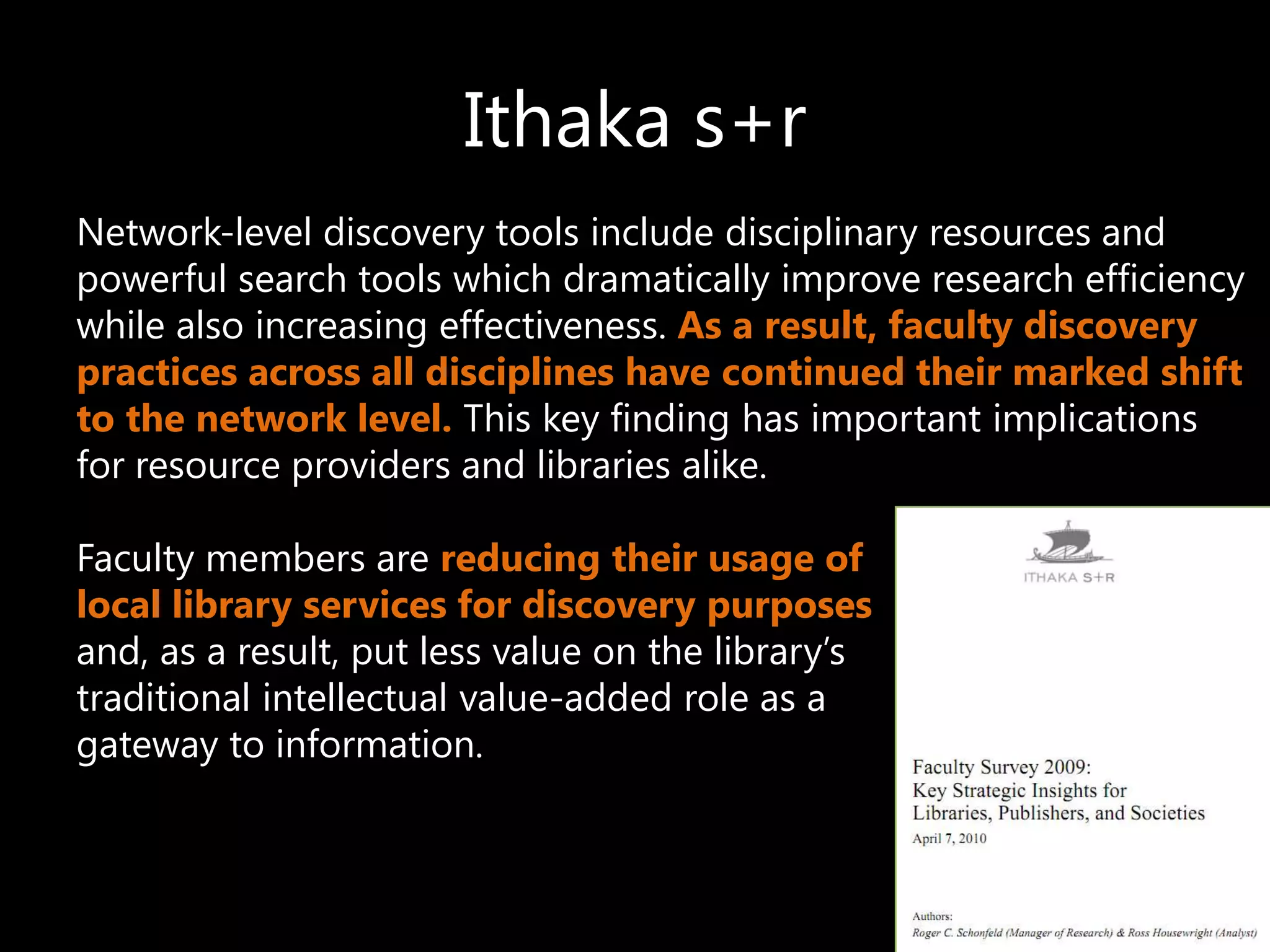
Ithaka s+r
Network-level discovery tools include disciplinary resources and
powerful search tools which dramatically improve research efficiency
while also increasing effectiveness. As a result, faculty discovery
practices across all disciplines have continued their marked shift
to the network level. This key finding has important implications
for resource providers and libraries alike.

Faculty members are reducing their usage of
local library services for discovery purposes
and, as a result, put less value on the library’s
traditional intellectual value-added role as a
gateway to information.
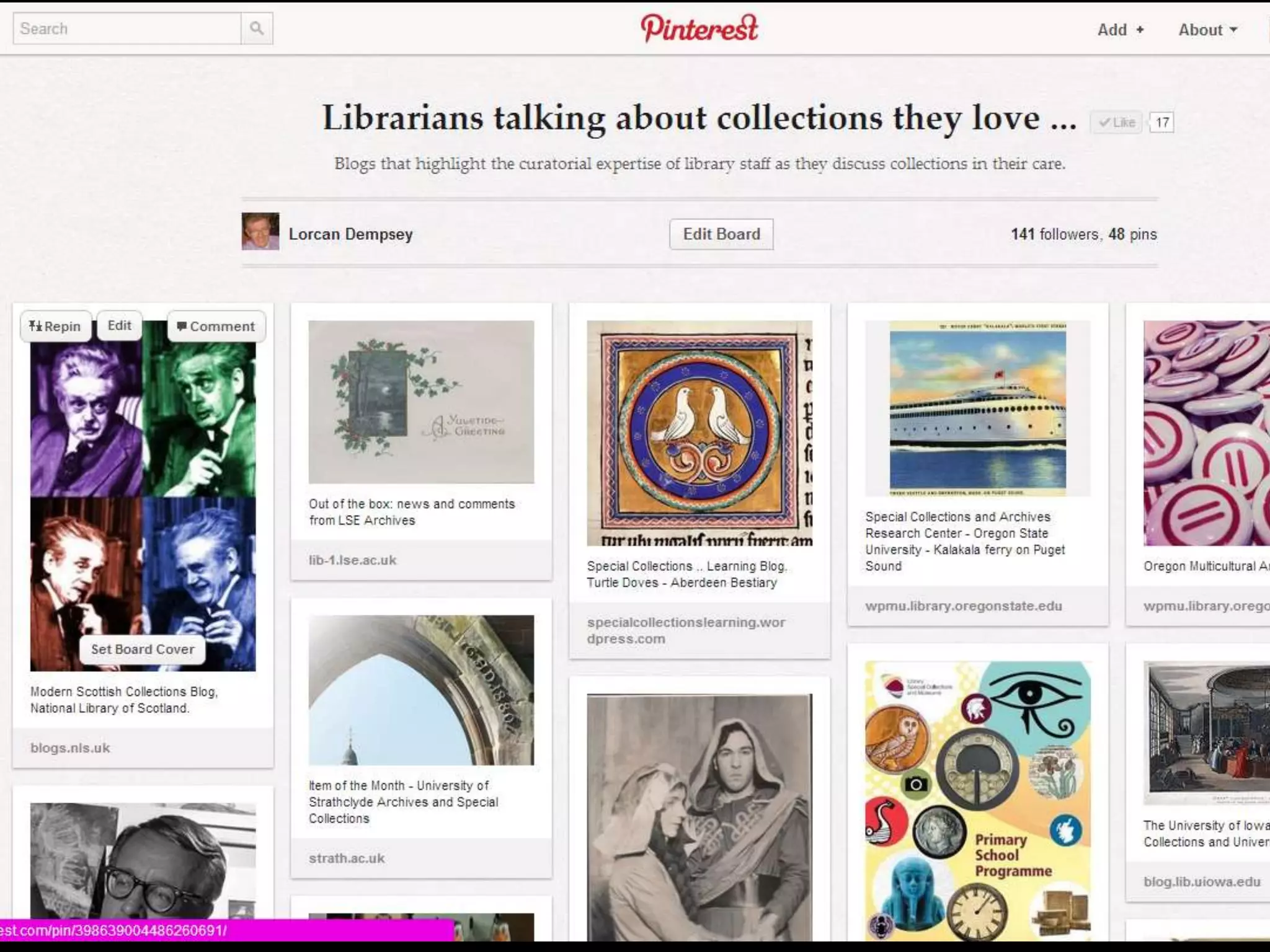
Active promotion
• Interpretation and promotion through
  social media
• Syndication
  – Metadata
  – Links
  – Services
• Search engine optimization
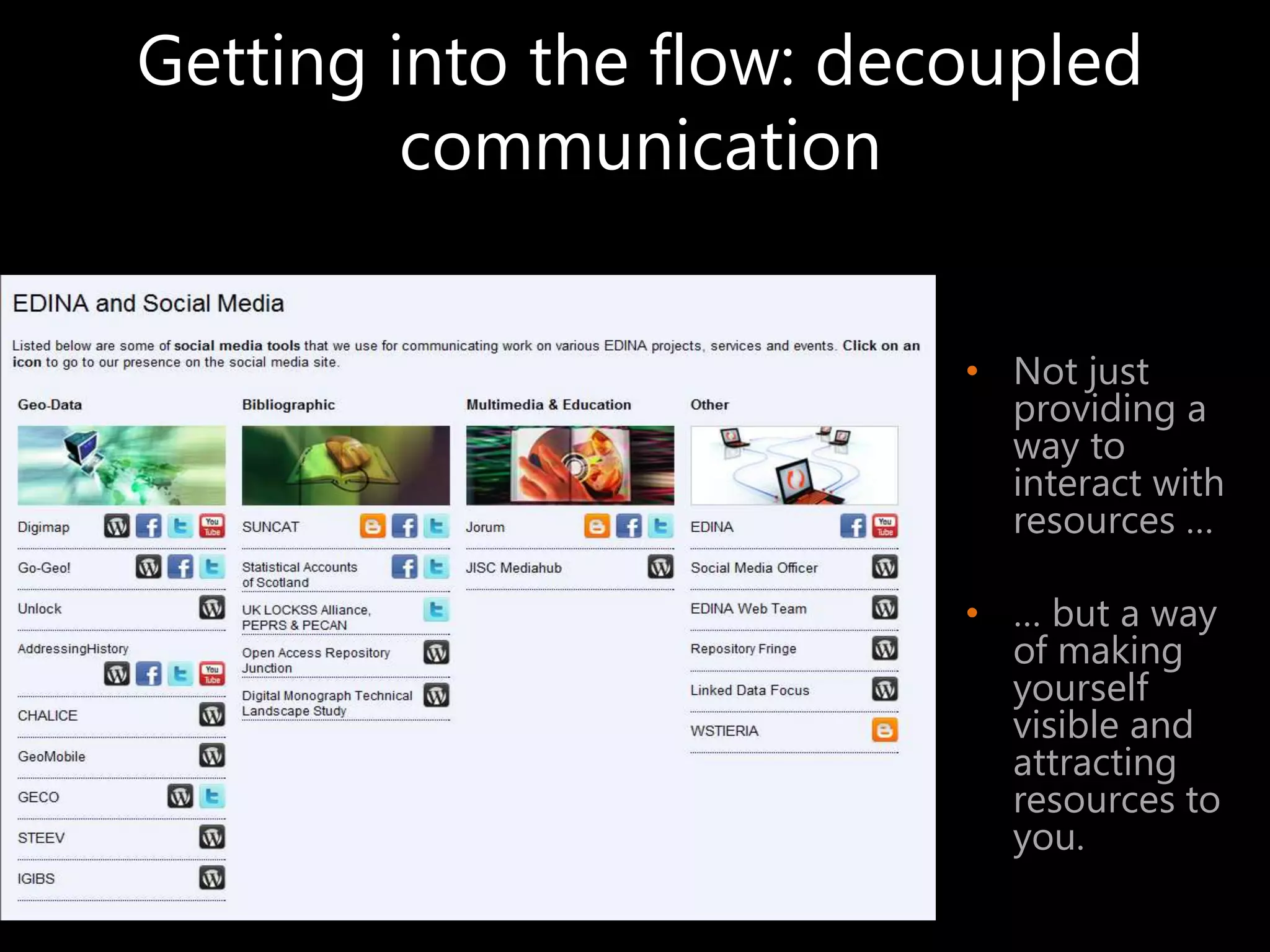
Getting into the flow: decoupled
         communication


                          • Not just
                            providing a
                            way to
                            interact with
                            resources …

                          • … but a way
                            of making
                            yourself
                            visible and
                            attracting
                            resources to
                            you.
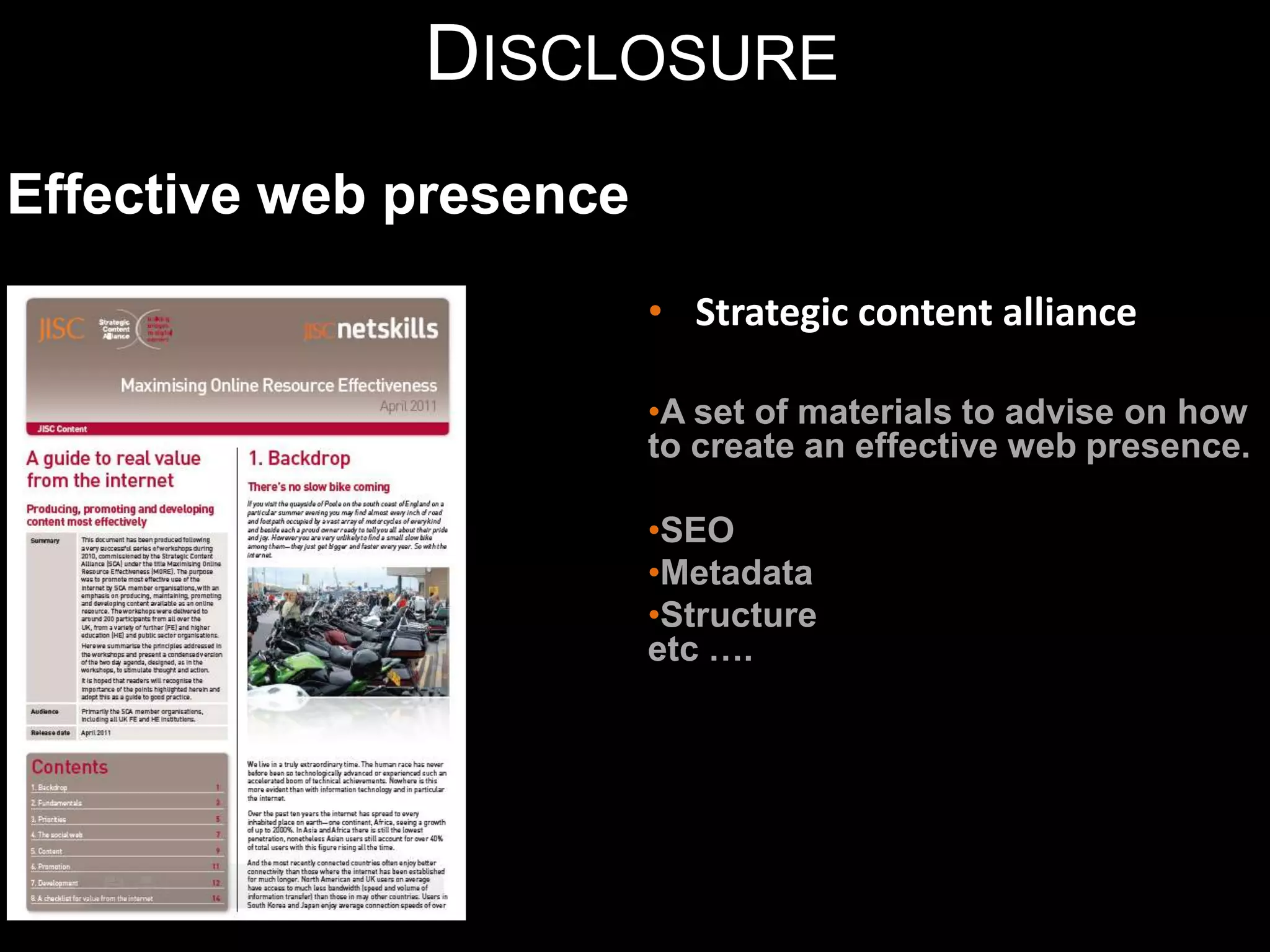
DISCLOSURE
Effective web presence
                         • Strategic content alliance

                         •A set of materials to advise on how
                         to create an effective web presence.

                         •SEO
                         •Metadata
                         •Structure
                         etc ….
5


Now: visible

 Then: hidden
If you want to be seen as expert …

… then your expertise has to be seen.
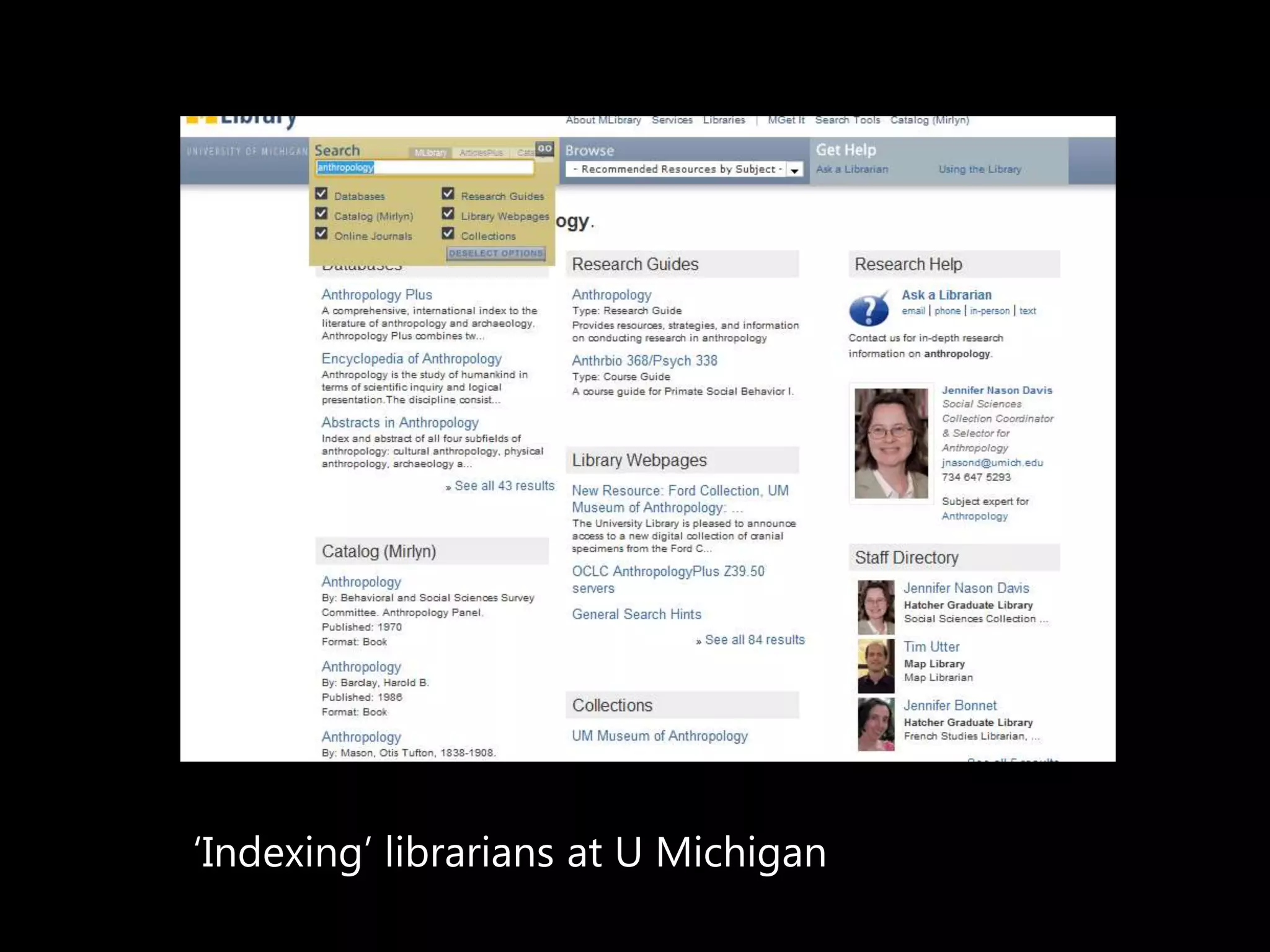
‘Indexing’ librarians at U Michigan
Slide from Pat Losinski, CEO Columbus Metropolitan Library
6

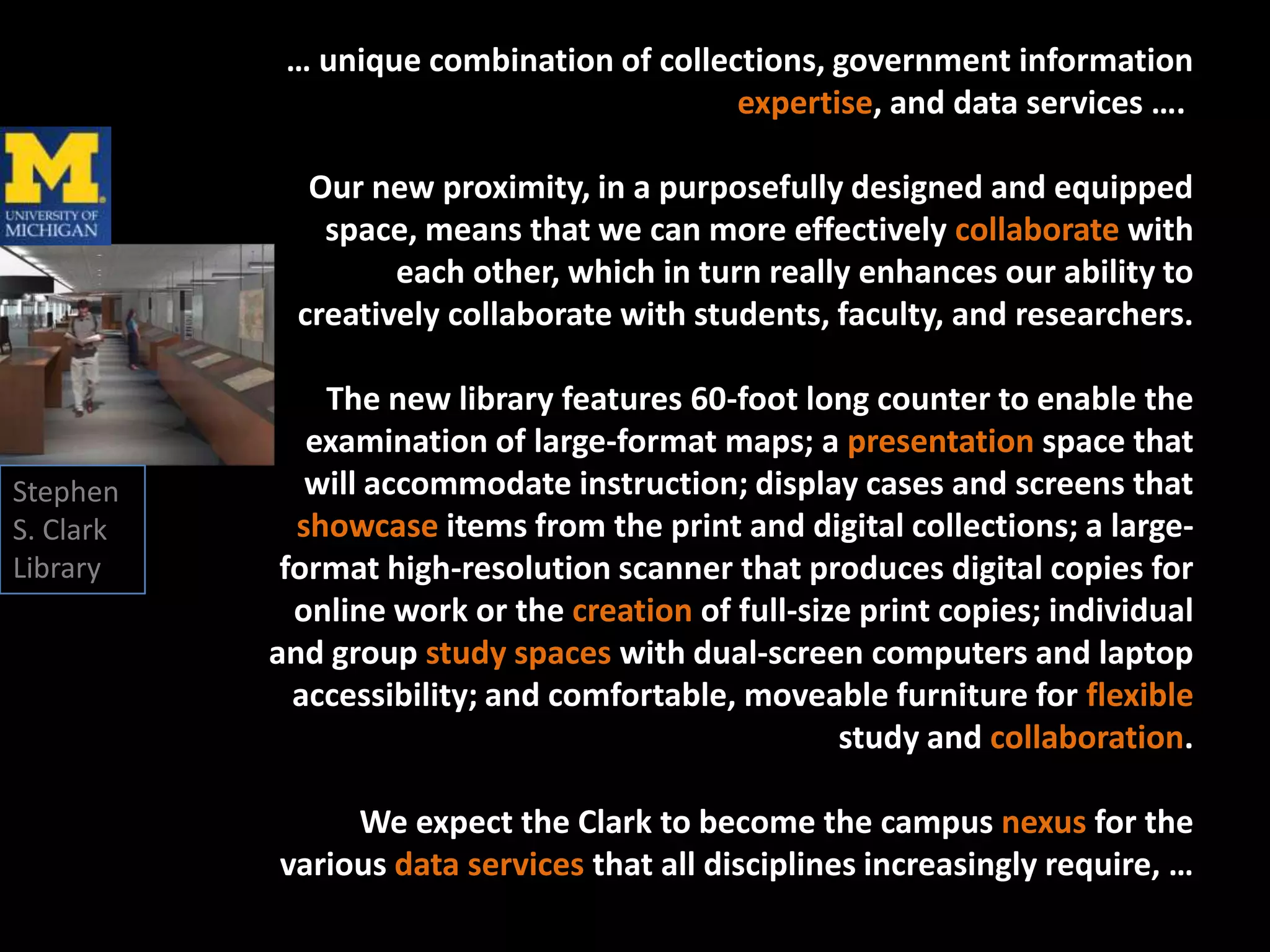
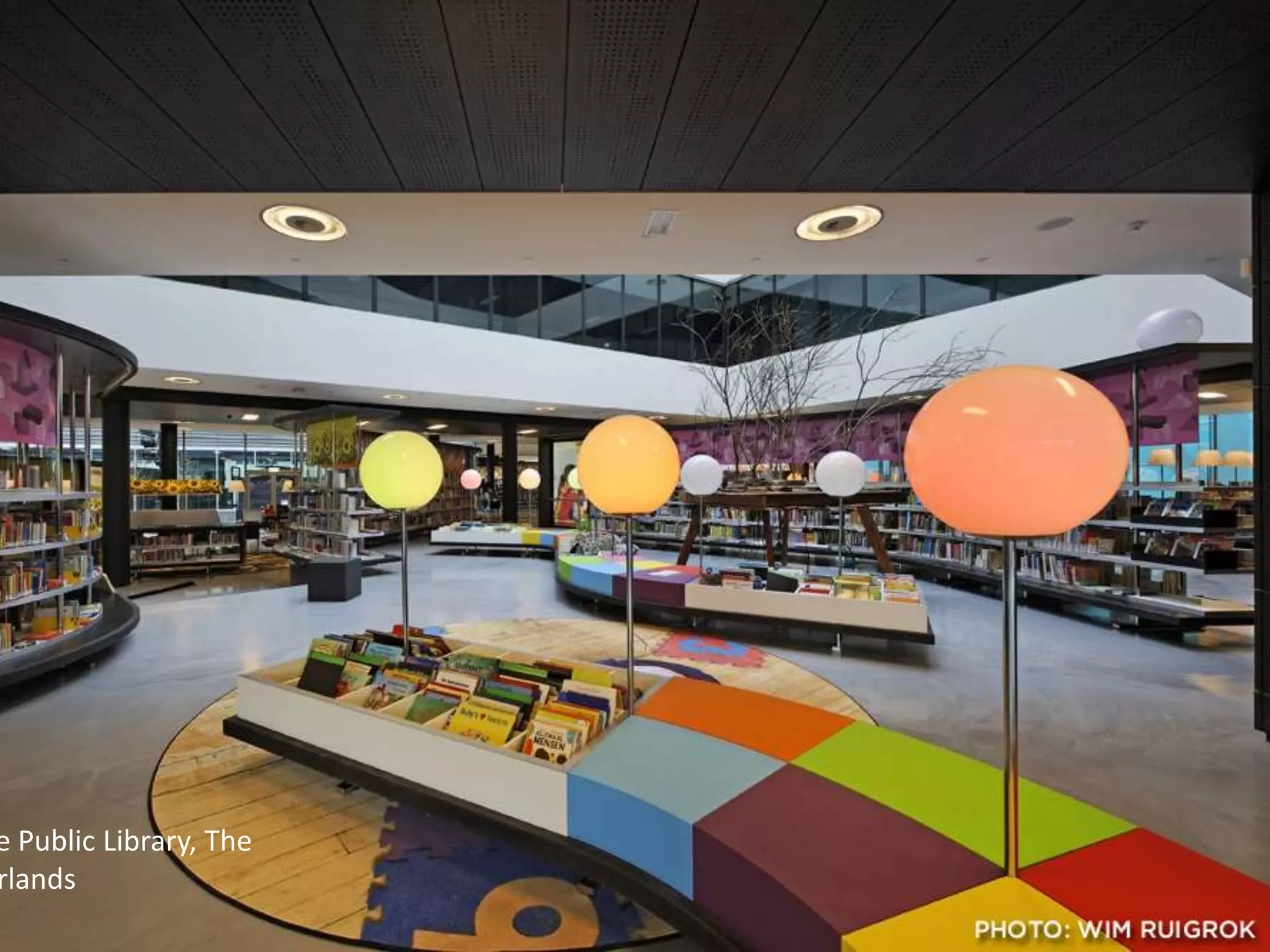
Now: space is configured around
  engagement with the user
  Then: space is configured around
             collections
… unique combination of collections, government information
                                          expertise, and data services ….

              Our new proximity, in a purposefully designed and equipped
               space, means that we can more effectively collaborate with
                    each other, which in turn really enhances our ability to
             creatively collaborate with students, faculty, and researchers.

               The new library features 60-foot long counter to enable the
              examination of large-format maps; a presentation space that
Stephen       will accommodate instruction; display cases and screens that
S. Clark     showcase items from the print and digital collections; a large-
Library     format high-resolution scanner that produces digital copies for
             online work or the creation of full-size print copies; individual
           and group study spaces with dual-screen computers and laptop
             accessibility; and comfortable, moveable furniture for flexible
                                                    study and collaboration.

                We expect the Clark to become the campus nexus for the
           various data services that all disciplines increasingly require, …
e Public Library, The
rlands
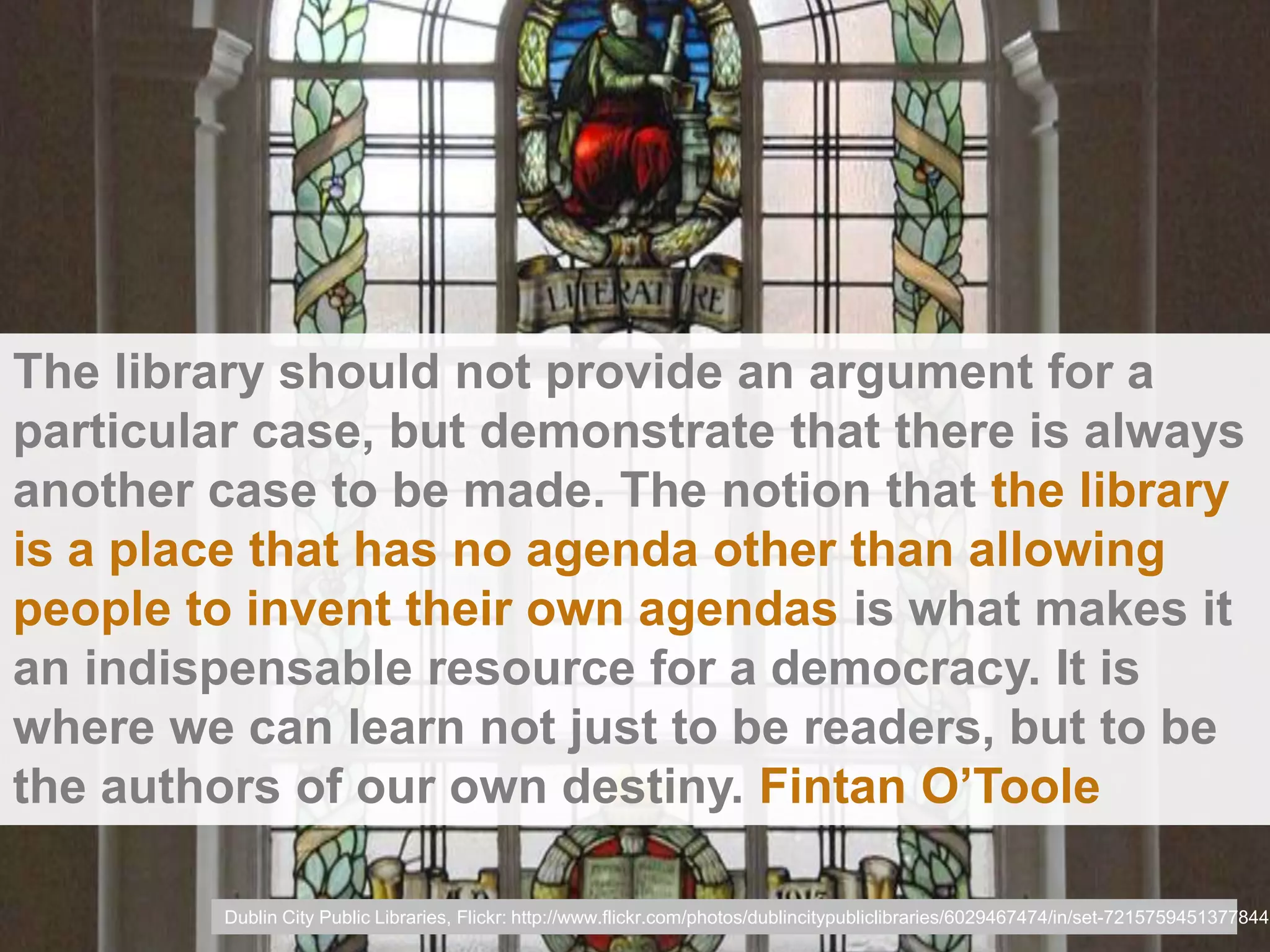
The library should not provide an argument for a
particular case, but demonstrate that there is always
another case to be made. The notion that the library
is a place that has no agenda other than allowing
people to invent their own agendas is what makes it
an indispensable resource for a democracy. It is
where we can learn not just to be readers, but to be
the authors of our own destiny. Fintan O’Toole

         Dublin City Public Libraries, Flickr: http://www.flickr.com/photos/dublincitypubliclibraries/6029467474/in/set-72157594513778442
@LorcanD

The Inside Out Library.

  • 1.
    The inside outlibrary: scale, learning, engagement Lorcan Dempsey @LorcanD Hacettepe University, Beytepe, Ankara, Turkey Jan 23 2013
  • 2.
    An idea which iscoming around again.
  • 3.
    By Ardfern (Ownwork) [CC-BY-SA-3.0 (http://creativecommons.org/licenses/by-sa/3.0) via Wikimedia Commons People should think not so much of the books that have gone into the … Library but rather of the books that have come out of it. Seán O'Faoláin
  • 4.
  • 7.
  • 9.
    “Build relationships ina marketplace that reconnects producers and consumers.”
  • 10.
    “Join the movementrebuilding human-scale economies around the world.”
  • 12.
    Not just asite but an ecosystem Beyond the mobile web. Stephanie Rieger. http://www.slideshare.net/yiibu/beyond-themobilewebbyyiibu
  • 13.
    Webscale • Webscale <>personal • The rich get richer … – Network effects – Massive aggregation – Gravitational pull • Data driven engagement – Analytics – Social • Platform – Leverage for developers …
  • 14.
    Beyond the mobileweb. Stephanie Rieger. http://www.slideshare.net/yiibu/beyond-themobilewebbyyiibu
  • 15.
    Colleges and universities have long competed against one another, measuring themselves in comparison to each other and holding tightly to their idiosyncrasies as defining elements of their status. But today, the distribution and reuse of information digitally via the Internet is rapidly changing the game, rewarding those who instead aggregate and scale toward a common infrastructure. It is becoming increasingly clear that neither the challenges that confront colleges and universities nor the solutions to those challenges are unique to each institution. Chuck Henry and Brad Wheeler The game has changed Educause Review, March 2012
  • 16.
    “aggregate and scaletowards a common infrastructure”
  • 18.
    My professional mission as a librarian is this: Help people build their own libraries. That's it. That's all I care about. Dan Chudnov http://onebiglibrary.net/story/because-this-is-the-business-weve-chosen
  • 19.
    65% Discoverability Phase 1Final Report. Hanson et al. U Minnesota. http://conservancy.umn.edu/handle/48258
  • 20.
    What has changed 1 Now: resources are abundant and attention is scarce Then: resources are scarce and attention is abundant
  • 21.
    What has changed? 2 The need for local infrastructure or local assembly of materials has declined.
  • 23.
    High transaction costs ledto locally assembled collections.
  • 24.
    What has changed? 3 The library is institution scale where many of its users operate at network scale
  • 25.
    Researchers prefer to adoptopen source and social media technologies that are available in the public domain rather than institutional license-based applications ….. First the social media technologies facilitate networking and community building. Second, researchers prefer to use technologies that will enable them access to resources and their own materials beyond their institution-based PhD research. e.g. Mendeley, Zotero, Endnote
  • 27.
    What has changed 4 Now: Library services are built around the user’s workflow Then: User’s workflow built around library services
  • 28.
    Slide from PatLosinski, CEO Columbus Metropolitan Library
  • 29.
    Advise on use… Not just licensing Connect … Disclose Switch Data driven engagement Aggregate and make useful usage data Reputation management What is the personal/institutional profile
  • 30.
    The inside outlibrary .. the library as an actor in research and learning environments of its users
  • 31.
    Outside in Inside out 1. User builds workflow 1. Library services built around library services around user workflows 2. Towards a centered 2. Towards a decentered network presence network presence 3. Locally assemble externally 3. Engage with acquired colls creation, management, use and sharing of all information resources 4. Discovery happens in the 4. Discovery happens library elsewhere 5. Expertise hidden 5. Expertise visible 6. Configure space around 6. Configure space around collections engagement
  • 32.
    2 Now: towards thedecentered library Then: towards the centered library Thanks to my colleague JD Shipengrover for help with the pictures in this section
  • 33.
    Not just asite but an ecosystem Beyond the mobile web. Stephanie Rieger. http://www.slideshare.net/yiibu/beyond-themobilewebbyyiibu
  • 34.
    Network Presence John DoeUniversity Library Website John Doe University Decoupled Library External Communication Syndication Cloud Sourced
  • 35.
    Flickr Decoupled Communication Blogs Facebook Archives and spec Twitter colls Google Youtube Institutional repo Digital library Discovery Knowledgebase Libguides Microsites Cloud Sourced Resolver
  • 36.
    WorldCat ArchivesGrid Summon Metadata Scirus Blogs Europeana Suncat Catalogue Ethos RSS Mobilepp Proxy Toolbar OAI-PMH Dspace Linked Data (Dspace) Discovery (Catalog) Services Proxy Widgets Library APIs Z39.50 External Syndication Data Jorum Digital Archive
  • 37.
    3 Now: engage with creation, management, use and sharing of all information resources Then: acquire external resources
  • 38.
    Stewardship/scarcity high low In many Low-High collections Low-Low Books & Journals Freely-accessible web Newspapers resources Gov Documents Open source software low CD & DVD Newsgroup archives Maps Uniqueness Scores High Low Stewardship Stewardship High-Low High-High Research & Learning Special Collections high Materials Rare books Local/Historical Newspapers Institutional records Local History Materials ePrints/tech reports Archives & Manuscripts Learning objects Theses & dissertations Courseware In few E-portfolios collections Research data Prospectus Insitutional website COLLECTIONS GRID (Lorcan Dempsey and Eric Childress, OCLC Research)
  • 39.
    Collections Grid In many Purchased Materials Open Web Resources Licensed E-Resources collections Licensed Purchased High Low Stewardship Stewardship Special Collections In few Research & Learning Local Digitization Materials collections
  • 40.
    Outside in Bought,licensed Collections Increased consolidation Move from print to licensed Manage down print – shared print Move to user-driven models Aim: to discover Inside out Institutional assets: special collections, research and learning materials, institutional records, … Reputation management Increasingly important? Aim: to *have* discovered … to disclose
  • 41.
    Outside in collections– increasingly externalised to collaborative or third party. Reduced local infrastructure. Inside out collections. Growing engagement around scholarly communication, data curation, institutional asset management, reputation/profiles. Leverage internal/ external infrastructure.
  • 42.
    4 Now: discovery happens elsewhere Then: discovery happens in the library
  • 43.
    Ithaka s+r Network-level discoverytools include disciplinary resources and powerful search tools which dramatically improve research efficiency while also increasing effectiveness. As a result, faculty discovery practices across all disciplines have continued their marked shift to the network level. This key finding has important implications for resource providers and libraries alike. Faculty members are reducing their usage of local library services for discovery purposes and, as a result, put less value on the library’s traditional intellectual value-added role as a gateway to information.
  • 44.
    Active promotion • Interpretationand promotion through social media • Syndication – Metadata – Links – Services • Search engine optimization
  • 46.
    Getting into theflow: decoupled communication • Not just providing a way to interact with resources … • … but a way of making yourself visible and attracting resources to you.
  • 47.
    DISCLOSURE Effective web presence • Strategic content alliance •A set of materials to advise on how to create an effective web presence. •SEO •Metadata •Structure etc ….
  • 48.
  • 49.
    If you wantto be seen as expert … … then your expertise has to be seen.
  • 50.
  • 51.
    Slide from PatLosinski, CEO Columbus Metropolitan Library
  • 52.
    6 Now: space isconfigured around engagement with the user Then: space is configured around collections
  • 53.
    … unique combinationof collections, government information expertise, and data services …. Our new proximity, in a purposefully designed and equipped space, means that we can more effectively collaborate with each other, which in turn really enhances our ability to creatively collaborate with students, faculty, and researchers. The new library features 60-foot long counter to enable the examination of large-format maps; a presentation space that Stephen will accommodate instruction; display cases and screens that S. Clark showcase items from the print and digital collections; a large- Library format high-resolution scanner that produces digital copies for online work or the creation of full-size print copies; individual and group study spaces with dual-screen computers and laptop accessibility; and comfortable, moveable furniture for flexible study and collaboration. We expect the Clark to become the campus nexus for the various data services that all disciplines increasingly require, …
  • 54.
  • 55.
    The library shouldnot provide an argument for a particular case, but demonstrate that there is always another case to be made. The notion that the library is a place that has no agenda other than allowing people to invent their own agendas is what makes it an indispensable resource for a democracy. It is where we can learn not just to be readers, but to be the authors of our own destiny. Fintan O’Toole Dublin City Public Libraries, Flickr: http://www.flickr.com/photos/dublincitypubliclibraries/6029467474/in/set-72157594513778442
  • 56.