



By Francheska Vonne S. Gali, BLIS-III, LIBSCI 36
Planning Models
in Special
Libraries
Need For Planning
• The ability to plan for the future is at the center of management
activities, and it can be seen in every stage of an organization's
development.
• All planning processes revolve around strategy, which typically
includes the organization's purpose, policies, programs, actions,
decisions, and resource allocation.
• The planning process employs a variety of models. Each of the
models mentioned has its own set of advantages and disadvantages.
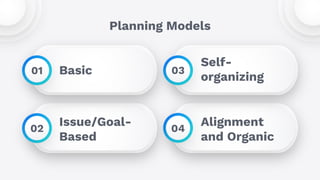
• Basic, issue-based, alignment, scenario, and organic are the five
major models for strategic planning (Evans, G. E., & Greenwell, S.,
2020). A self-organizing model is also involved in strategic planning
(Stueart, R. D., & Moran, B. B., 2007).
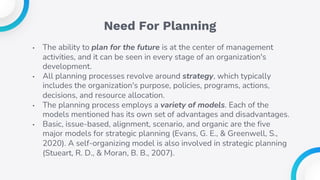
What is a strategic planning model?
● A strategic planning model refers to several
elements that go into the planning process.
● Strategic planning models can be thought of as
"templates" into which you can place your ideas.
Finally, you'll have a well-structured strategic plan that
provides you with a defined set of activities to
accomplish.
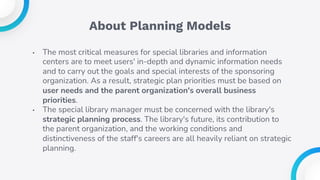
About Planning Models
• The most critical measures for special libraries and information
centers are to meet users' in-depth and dynamic information needs
and to carry out the goals and special interests of the sponsoring
organization. As a result, strategic plan priorities must be based on
user needs and the parent organization's overall business
priorities.
• The special library manager must be concerned with the library's
strategic planning process. The library's future, its contribution to
the parent organization, and the working conditions and
distinctiveness of the staff's careers are all heavily reliant on strategic
planning.
04
Basic
Planning Models
02
03
01
Issue/Goal-
Based
Self-
organizing
Alignment
and Organic
Scenario
Planning Models
05
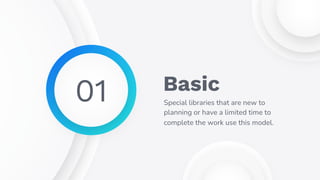
Basic
Special libraries that are new to
planning or have a limited time to
complete the work use this model.
01
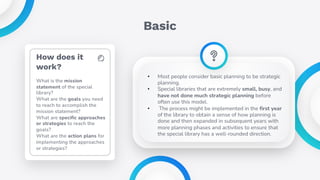
How does it
work?
What is the mission
statement of the special
library?
What are the goals you need
to reach to accomplish the
mission statement?
What are specific approaches
or strategies to reach the
goals?
What are the action plans for
implementing the approaches
or strategies?
Basic
• Most people consider basic planning to be strategic
planning.
• Special libraries that are extremely small, busy, and
have not done much strategic planning before
often use this model.
• The process might be implemented in the first year
of the library to obtain a sense of how planning is
done and then expanded in subsequent years with
more planning phases and activities to ensure that
the special library has a well-rounded direction.
Issue/Goal-Based
Special libraries expand on their basic model to
become more established and comprehensive.
02
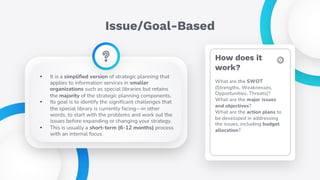
Issue/Goal-Based
• It is a simplified version of strategic planning that
applies to information services in smaller
organizations such as special libraries but retains
the majority of the strategic planning components.
• Its goal is to identify the significant challenges that
the special library is currently facing—in other
words, to start with the problems and work out the
issues before expanding or changing your strategy.
• This is usually a short-term (6-12 months) process
with an internal focus.
How does it
work?
What are the SWOT
(Strengths, Weaknesses,
Opportunities, Threats)?
What are the major issues
and objectives?
What are the action plans to
be developed in addressing
the issues, including budget
allocation?
Self-organizing
Special libraries continuously revisit the
process for currency.
03
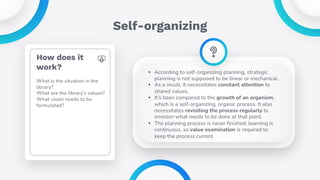
Self-organizing
• According to self-organizing planning, strategic
planning is not supposed to be linear or mechanical.
• As a result, it necessitates constant attention to
shared values.
• It's been compared to the growth of an organism,
which is a self-organizing, organic process. It also
necessitates revisiting the process regularly to
envision what needs to be done at that point.
• The planning process is never finished; learning is
continuous, so value examination is required to
keep the process current.
How does it
work?
What is the situation in the
library?
What are the library’s values?
What vision needs to be
formulated?
Alignment
and Organic
Special libraries use it to ensure that
their activities align with their mission.
04
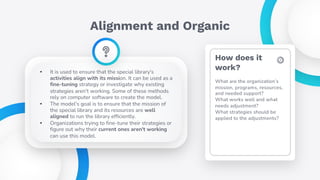
Alignment and Organic
• It is used to ensure that the special library's
activities align with its mission. It can be used as a
fine-tuning strategy or investigate why existing
strategies aren't working. Some of these methods
rely on computer software to create the model.
• The model's goal is to ensure that the mission of
the special library and its resources are well
aligned to run the library efficiently.
• Organizations trying to fine-tune their strategies or
figure out why their current ones aren't working
can use this model.
How does it
work?
What are the organization’s
mission, programs, resources,
and needed support?
What works well and what
needs adjustment?
What strategies should be
applied to the adjustments?
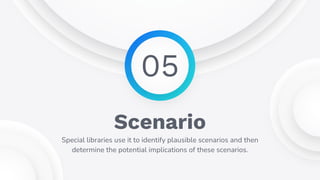
Scenario
Special libraries use it to identify plausible scenarios and then
determine the potential implications of these scenarios.
05
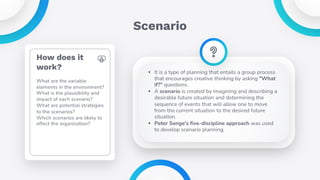
Scenario
• It is a type of planning that entails a group process
that encourages creative thinking by asking "What
if?" questions.
• A scenario is created by imagining and describing a
desirable future situation and determining the
sequence of events that will allow one to move
from the current situation to the desired future
situation.
• Peter Senge's five-discipline approach was used
to develop scenario planning.
How does it
work?
What are the variable
elements in the environment?
What is the plausibility and
impact of each scenario?
What are potential strategies
to the scenarios?
Which scenarios are likely to
effect the organization?
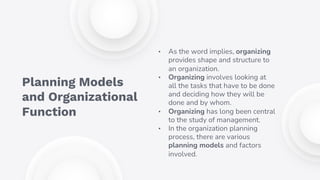
Organizational
Function
How the models apply to the
organizational function of special libraries
• As the word implies, organizing
provides shape and structure to
an organization.
• Organizing involves looking at
all the tasks that have to be done
and deciding how they will be
done and by whom.
• Organizing has long been central
to the study of management.
• In the organization planning
process, there are various
planning models and factors
involved.
Planning Models
and Organizational
Function
• Organizations can use strategic
planning tools, such as models, to
help them develop an action plan
to achieve their objectives.
• Finally, the strategy will act as a
guide for action. There are always
new business needs and new
business models to consider. The
planning models provide a
framework for evaluating new
ideas and allocating resources in
light of strategies to advance the
parent organization's priorities.
Planning Models
and Organizational
Function
Planning models are effective tools for
communicating the value and relevance of
the special library or information center
when a clear set of priorities and objectives
is established.
(Brown & Gonzalez, 2008; Jaehne, 2012).
References
• Basic Overview of Various Strategic Planning Models - Free Management Library. (2022,
January 18). Free Management Library.
https://managementhelp.org/strategicplanning/models.htm
• Caballero, C. (2009). Strategic planning as a prerequisite to strategic marketing action in
libraries and information agencies. The Acquisitions Librarian, 14(28), 22–59.
• Evans, G. E., & Greenwell, S. (2020). Management basics for information professionals.
• Guerriero, D. (1987). Strategic Planning For A Special Library. Nova Southeastern
University. https://nsuworks.nova.edu/gscis_etd/555
• Hobrock, B. G. (2008). Creating your library’s future through effective strategic planning.
Journal of Library Administration, 14(2), 37–57. doi:10.1300/J111v14n02_04
• Jaehne, R. L. (2012). Strategic planning from an organizational perspective. Paper
presentated at the Special Library Administration course at the Graduate of School of
Library and Information Science. Urbana-Champaign, IL.
• Stueart, R. D., & Moran, B. B. (2007). Library and information center management.
Westport, Connecticut: Libraries Unlimited.
CREDITS: This presentation template was created by Slidesgo, including
icons by Flaticon, and infographics & images by Freepik
Thanks!

Planning Models in Special Libraries

  • 1.
    By Francheska VonneS. Gali, BLIS-III, LIBSCI 36 Planning Models in Special Libraries
  • 2.
    Need For Planning •The ability to plan for the future is at the center of management activities, and it can be seen in every stage of an organization's development. • All planning processes revolve around strategy, which typically includes the organization's purpose, policies, programs, actions, decisions, and resource allocation. • The planning process employs a variety of models. Each of the models mentioned has its own set of advantages and disadvantages. • Basic, issue-based, alignment, scenario, and organic are the five major models for strategic planning (Evans, G. E., & Greenwell, S., 2020). A self-organizing model is also involved in strategic planning (Stueart, R. D., & Moran, B. B., 2007).
  • 3.
    What is astrategic planning model? ● A strategic planning model refers to several elements that go into the planning process. ● Strategic planning models can be thought of as "templates" into which you can place your ideas. Finally, you'll have a well-structured strategic plan that provides you with a defined set of activities to accomplish. About Planning Models
  • 4.
    About Planning Models •The most critical measures for special libraries and information centers are to meet users' in-depth and dynamic information needs and to carry out the goals and special interests of the sponsoring organization. As a result, strategic plan priorities must be based on user needs and the parent organization's overall business priorities. • The special library manager must be concerned with the library's strategic planning process. The library's future, its contribution to the parent organization, and the working conditions and distinctiveness of the staff's careers are all heavily reliant on strategic planning.
  • 5.
  • 6.
  • 7.
    Basic Special libraries thatare new to planning or have a limited time to complete the work use this model. 01
  • 8.
    How does it work? Whatis the mission statement of the special library? What are the goals you need to reach to accomplish the mission statement? What are specific approaches or strategies to reach the goals? What are the action plans for implementing the approaches or strategies? Basic • Most people consider basic planning to be strategic planning. • Special libraries that are extremely small, busy, and have not done much strategic planning before often use this model. • The process might be implemented in the first year of the library to obtain a sense of how planning is done and then expanded in subsequent years with more planning phases and activities to ensure that the special library has a well-rounded direction.
  • 9.
    Issue/Goal-Based Special libraries expandon their basic model to become more established and comprehensive. 02
  • 10.
    Issue/Goal-Based • It isa simplified version of strategic planning that applies to information services in smaller organizations such as special libraries but retains the majority of the strategic planning components. • Its goal is to identify the significant challenges that the special library is currently facing—in other words, to start with the problems and work out the issues before expanding or changing your strategy. • This is usually a short-term (6-12 months) process with an internal focus. How does it work? What are the SWOT (Strengths, Weaknesses, Opportunities, Threats)? What are the major issues and objectives? What are the action plans to be developed in addressing the issues, including budget allocation?
  • 11.
    Self-organizing Special libraries continuouslyrevisit the process for currency. 03
  • 12.
    Self-organizing • According toself-organizing planning, strategic planning is not supposed to be linear or mechanical. • As a result, it necessitates constant attention to shared values. • It's been compared to the growth of an organism, which is a self-organizing, organic process. It also necessitates revisiting the process regularly to envision what needs to be done at that point. • The planning process is never finished; learning is continuous, so value examination is required to keep the process current. How does it work? What is the situation in the library? What are the library’s values? What vision needs to be formulated?
  • 13.
    Alignment and Organic Special librariesuse it to ensure that their activities align with their mission. 04
  • 14.
    Alignment and Organic •It is used to ensure that the special library's activities align with its mission. It can be used as a fine-tuning strategy or investigate why existing strategies aren't working. Some of these methods rely on computer software to create the model. • The model's goal is to ensure that the mission of the special library and its resources are well aligned to run the library efficiently. • Organizations trying to fine-tune their strategies or figure out why their current ones aren't working can use this model. How does it work? What are the organization’s mission, programs, resources, and needed support? What works well and what needs adjustment? What strategies should be applied to the adjustments?
  • 15.
    Scenario Special libraries useit to identify plausible scenarios and then determine the potential implications of these scenarios. 05
  • 16.
    Scenario • It isa type of planning that entails a group process that encourages creative thinking by asking "What if?" questions. • A scenario is created by imagining and describing a desirable future situation and determining the sequence of events that will allow one to move from the current situation to the desired future situation. • Peter Senge's five-discipline approach was used to develop scenario planning. How does it work? What are the variable elements in the environment? What is the plausibility and impact of each scenario? What are potential strategies to the scenarios? Which scenarios are likely to effect the organization?
  • 17.
    Organizational Function How the modelsapply to the organizational function of special libraries
  • 18.
    • As theword implies, organizing provides shape and structure to an organization. • Organizing involves looking at all the tasks that have to be done and deciding how they will be done and by whom. • Organizing has long been central to the study of management. • In the organization planning process, there are various planning models and factors involved. Planning Models and Organizational Function
  • 19.
    • Organizations canuse strategic planning tools, such as models, to help them develop an action plan to achieve their objectives. • Finally, the strategy will act as a guide for action. There are always new business needs and new business models to consider. The planning models provide a framework for evaluating new ideas and allocating resources in light of strategies to advance the parent organization's priorities. Planning Models and Organizational Function
  • 20.
    Planning models areeffective tools for communicating the value and relevance of the special library or information center when a clear set of priorities and objectives is established. (Brown & Gonzalez, 2008; Jaehne, 2012).
  • 21.
    References • Basic Overviewof Various Strategic Planning Models - Free Management Library. (2022, January 18). Free Management Library. https://managementhelp.org/strategicplanning/models.htm • Caballero, C. (2009). Strategic planning as a prerequisite to strategic marketing action in libraries and information agencies. The Acquisitions Librarian, 14(28), 22–59. • Evans, G. E., & Greenwell, S. (2020). Management basics for information professionals. • Guerriero, D. (1987). Strategic Planning For A Special Library. Nova Southeastern University. https://nsuworks.nova.edu/gscis_etd/555 • Hobrock, B. G. (2008). Creating your library’s future through effective strategic planning. Journal of Library Administration, 14(2), 37–57. doi:10.1300/J111v14n02_04 • Jaehne, R. L. (2012). Strategic planning from an organizational perspective. Paper presentated at the Special Library Administration course at the Graduate of School of Library and Information Science. Urbana-Champaign, IL. • Stueart, R. D., & Moran, B. B. (2007). Library and information center management. Westport, Connecticut: Libraries Unlimited.
  • 22.
    CREDITS: This presentationtemplate was created by Slidesgo, including icons by Flaticon, and infographics & images by Freepik Thanks!