
Libraries:
from technology artifacts to technology in practice
2015 AJCU-CITM / Library Deans Conference at Loyola
University Maryland, Baltimore, 18 May 15
Lorcan Dempsey
@LorcanD
https://www.flickr.com/photos/michaelfoleyphotography/8673516232
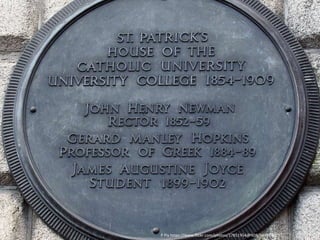
P Pix https://www.flickr.com/photos/27851954@N08/3888840197/
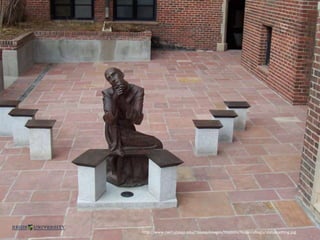
http://www.cwrl.utexas.edu/~bump/images/Hopkins/HopkinsRegis/statuesetting.jpg
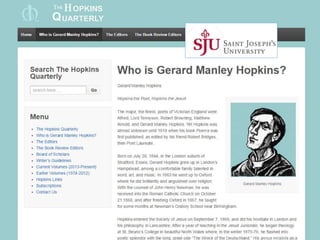
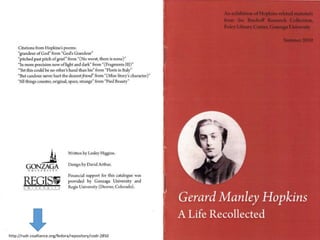
http://rudr.coalliance.org/fedora/repository/codr:2850
2
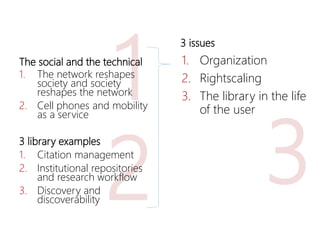
11. The network reshapes
society and society
reshapes the network
2. Cell phones and mobility
as a service
3 library examples
1. Citation management
2. Institutional repositories
and research workflow
3. Discovery and
discoverability
3
The social and the technical 1. Organization
2. Rightscaling
3. The library in the life
of the user
3 issues
Overview
Preamble:
the AJCU collective collection
(thanks to Constance Malpas for the analysis here)
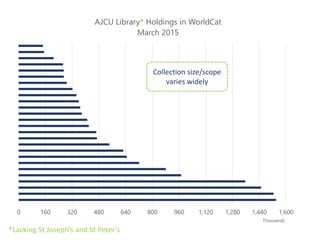
0 160 320 480 640 800 960 1,120 1,280 1,440 1,600
Thousands
AJCU Library* Holdings in WorldCat
March 2015
Collection size/scope
varies widely
*Lacking St Joseph’s and St Peter’s
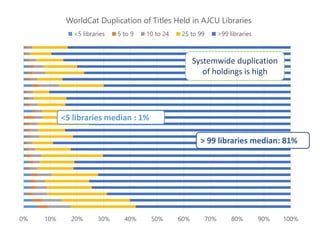
0% 10% 20% 30% 40% 50% 60% 70% 80% 90% 100%
WorldCat Duplication of Titles Held in AJCU Libraries
<5 libraries 5 to 9 10 to 24 25 to 99 >99 libraries
Systemwide duplication
of holdings is high
> 99 libraries median: 81%
<5 libraries median : 1%
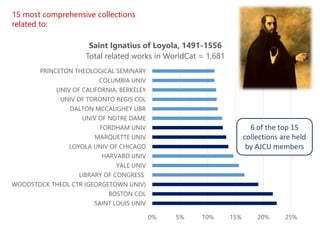
15 most comprehensive collections
related to:
0% 5% 10% 15% 20% 25%
SAINT LOUIS UNIV
BOSTON COL
WOODSTOCK THEOL CTR (GEORGETOWN UNIV)
LIBRARY OF CONGRESS
YALE UNIV
HARVARD UNIV
LOYOLA UNIV OF CHICAGO
MARQUETTE UNIV
FORDHAM UNIV
UNIV OF NOTRE DAME
DALTON MCCAUGHEY LIBR
UNIV OF TORONTO REGIS COL
UNIV OF CALIFORNIA, BERKELEY
COLUMBIA UNIV
PRINCETON THEOLOGICAL SEMINARY
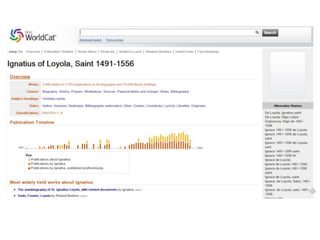
Saint Ignatius of Loyola, 1491-1556
Total related works in WorldCat = 1,681
6 of the top 15
collections are held
by AJCU members
0% 5% 10% 15% 20% 25% 30% 35%
BIBLIOTHEQUE NATIONALE DE FRANCE
BIBLIOTHEQUE NAT & UNIV STRASBOURG
BIBLIOTHEQUE SAINTE-GENEVIEVE
BM LYON
ECOLE NATIONALE DE CHARTES
STATE RES LIBR, OLOMOUC
MADRID-CASA DE VELÁZQUEZ
PARIS-ENS-ULM LSH
RENNES2-BU CENTRALE
BOSTON COL
CLERMONT FD-BCIU-PATRIMOINE
UNIV OF MICHIGAN
COLLEGE OF THE HOLY CROSS
UNIV OF NOTRE DAME
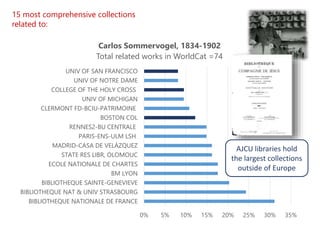
UNIV OF SAN FRANCISCO
Carlos Sommervogel, 1834-1902
Total related works in WorldCat =74
15 most comprehensive collections
related to:
AJCU libraries hold
the largest collections
outside of Europe
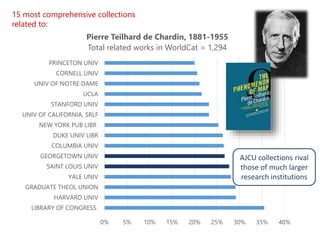
15 most comprehensive collections
related to:
0% 5% 10% 15% 20% 25% 30% 35% 40%
LIBRARY OF CONGRESS
HARVARD UNIV
GRADUATE THEOL UNION
YALE UNIV
SAINT LOUIS UNIV
GEORGETOWN UNIV
COLUMBIA UNIV
DUKE UNIV LIBR
NEW YORK PUB LIBR
UNIV OF CALIFORNIA, SRLF
STANFORD UNIV
UCLA
UNIV OF NOTRE DAME
CORNELL UNIV
PRINCETON UNIV
Pierre Teilhard de Chardin, 1881-1955
Total related works in WorldCat = 1,294
AJCU collections rival
those of much larger
research institutions
0% 10% 20% 30% 40% 50% 60%
GONZAGA UNIV
LIBRARY OF CONGRESS
UNC, CHAPEL HILL
NEW YORK PUB LIBR
BOSTON COL
UNIV OF OXFORD
HARVARD UNIV
CORNELL UNIV
COLUMBIA UNIV
YALE UNIV LIBR
UNIV OF CALIFORNIA, BERKELEY
BAKER & TAYLOR
PRINCETON UNIV
STANFORD UNIV
CAMBRIDGE UNIV
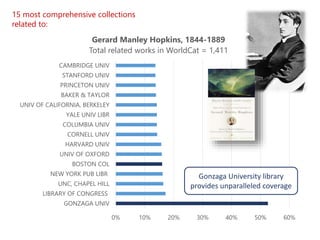
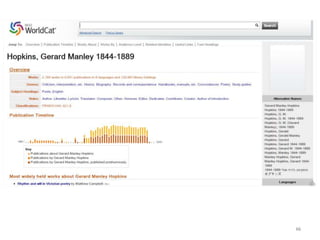
Gerard Manley Hopkins, 1844-1889
Total related works in WorldCat = 1,411
15 most comprehensive collections
related to:
Gonzaga University library
provides unparalleled coverage
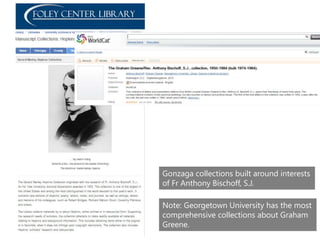
Note: Georgetown University has the most
comprehensive collections about Graham
Greene.
Gonzaga collections built around interests
of Fr Anthony Bischoff, S.J.
The social and the
technical
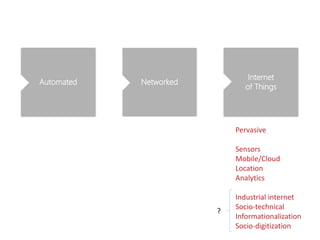
NetworkedAutomated
Internet
of Things
Pervasive
Sensors
Mobile/Cloud
Location
Analytics
Industrial internet
Socio-technical
Informationalization
Socio-digitization
?
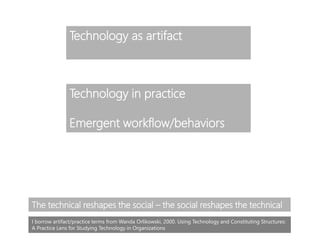
Technology as artifact
Technology in practice
Emergent workflow/behaviors
The technical reshapes the social – the social reshapes the technical
I borrow artifact/practice terms from Wanda Orlikowski, 2000. Using Technology and Constituting Structures:
A Practice Lens for Studying Technology in Organizations
Technology in practice:
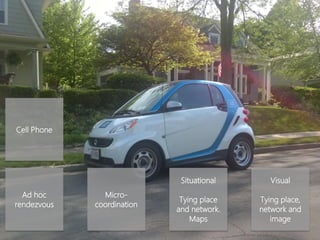
an example
Cell phone and mobility
Micro-
coordination
Ad hoc
rendezvous
Situational
Tying place
and network.
Maps
Visual
Tying place,
network and
image
Cell Phone
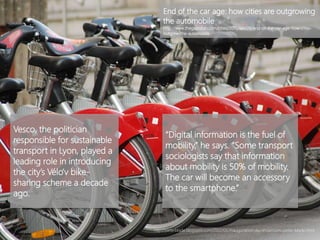
Vesco, the politician
responsible for sustainable
transport in Lyon, played a
leading role in introducing
the city’s Vélo’v bike-
sharing scheme a decade
ago.
“Digital information is the fuel of
mobility,” he says. “Some transport
sociologists say that information
about mobility is 50% of mobility.
The car will become an accessory
to the smartphone.”
End of the car age: how cities are outgrowing
the automobile
http://www.theguardian.com/cities/2015/apr/28/end-of-the-car-age-how-cities-
outgrew-the-automobile
http://peterblade.blogspot.com/2012/05/inauguration-du-showroom-peter-blade.html
22
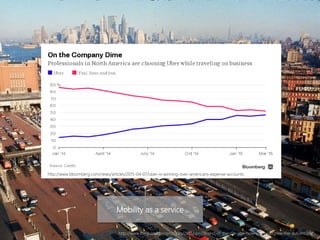
http://www.bloomberg.com/news/articles/2015-04-07/uber-is-winning-over-americans-expense-accounts
Mobility as a service
http://www.theguardian.com/cities/2015/apr/28/end-of-the-car-age-how-cities-outgrew-the-automobile
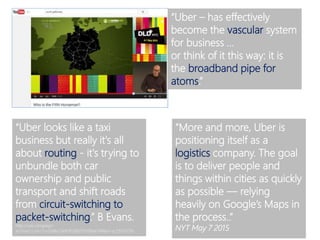
“Uber – has effectively
become the vascular system
for business …
or think of it this way: it is
the broadband pipe for
atoms.”
“Uber looks like a taxi
business but really it's all
about routing - it's trying to
unbundle both car
ownership and public
transport and shift roads
from circuit-switching to
packet-switching.” B Evans.
http://us6.campaign-
archive2.com/?u=b98e2de85f03865f1d38de74f&id=ac5933501b
“More and more, Uber is
positioning itself as a
logistics company. The goal
is to deliver people and
things within cities as quickly
as possible — relying
heavily on Google’s Maps in
the process..”
NYT May 7 2015
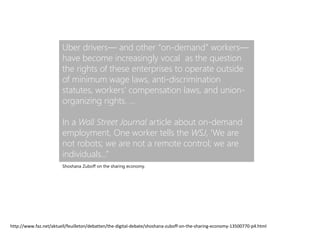
Uber drivers— and other “on-demand” workers—
have become increasingly vocal as the question
the rights of these enterprises to operate outside
of minimum wage laws, anti-discrimination
statutes, workers’ compensation laws, and union-
organizing rights. …
In a Wall Street Journal article about on-demand
employment, One worker tells the WSJ, ‘We are
not robots; we are not a remote control; we are
individuals…”
http://www.faz.net/aktuell/feuilleton/debatten/the-digital-debate/shoshana-zuboff-on-the-sharing-economy-13500770-p4.html
Shoshana Zuboff on the sharing economy.
http://www.log.com.tr/google-akilli-ev-urunleri-firmasi-nesti-satin-aldi/
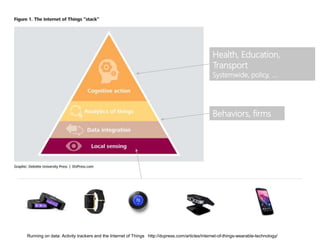
Health, Education,
Transport
Systemwide, policy, ….
Behaviors, firms
Running on data: Activity trackers and the Internet of Things http://dupress.com/articles/internet-of-things-wearable-technology/
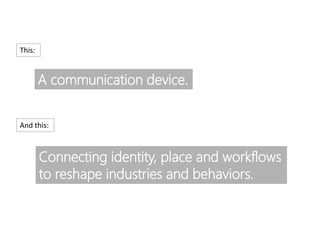
A communication device.
Connecting identity, place and workflows
to reshape industries and behaviors.
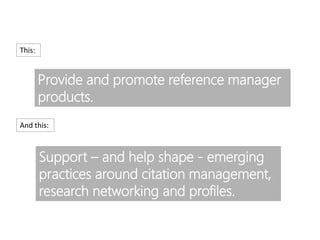
This:
And this:
3 library examples
Citation management
Institutional repository > workflow is the new content
Discovery and discoverability
Technology as practice
Emergent behaviors/workflows
Citation management
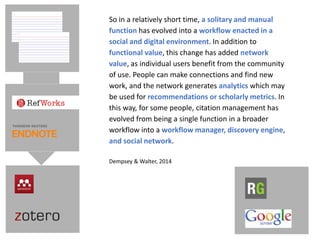
So in a relatively short time, a solitary and manual
function has evolved into a workflow enacted in a
social and digital environment. In addition to
functional value, this change has added network
value, as individual users benefit from the community
of use. People can make connections and find new
work, and the network generates analytics which may
be used for recommendations or scholarly metrics. In
this way, for some people, citation management has
evolved from being a single function in a broader
workflow into a workflow manager, discovery engine,
and social network.
Dempsey & Walter, 2014
Provide and promote reference manager
products.
Support – and help shape - emerging
practices around citation management,
research networking and profiles.
This:
And this:
Technology as practice
Emergent behaviors/workflows
Institutional repository > workflow is the new content
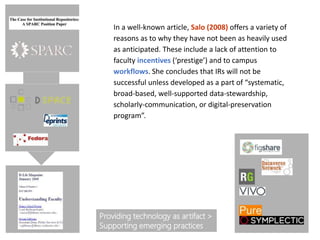
In a well-known article, Salo (2008) offers a variety of
reasons as to why they have not been as heavily used
as anticipated. These include a lack of attention to
faculty incentives (‘prestige’) and to campus
workflows. She concludes that IRs will not be
successful unless developed as a part of “systematic,
broad-based, well-supported data-stewardship,
scholarly-communication, or digital-preservation
program”.
Providing technology as artifact >
Supporting emerging practices
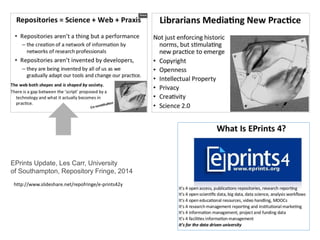
http://www.slideshare.net/repofringe/e-prints42y
EPrints Update, Les Carr, University
of Southampton, Repository Fringe, 2014
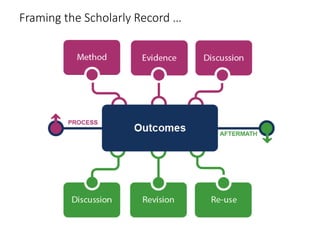
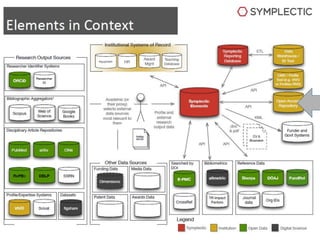
Framing the Scholarly Record …
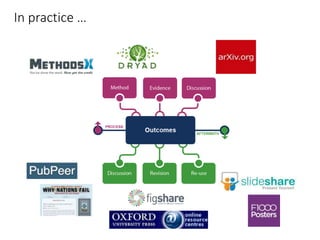
In practice …
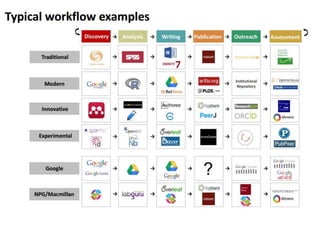
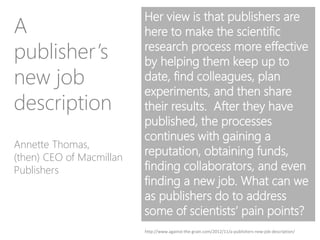
Her view is that publishers are
here to make the scientific
research process more effective
by helping them keep up to
date, find colleagues, plan
experiments, and then share
their results. After they have
published, the processes
continues with gaining a
reputation, obtaining funds,
finding collaborators, and even
finding a new job. What can we
as publishers do to address
some of scientists’ pain points?
Annette Thomas,
(then) CEO of Macmillan
Publishers
A
publisher’s
new job
description
http://www.against-the-grain.com/2012/11/a-publishers-new-job-description/
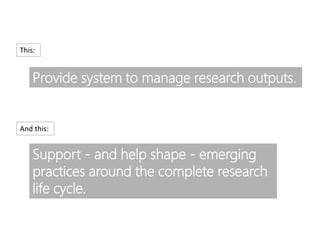
Support - and help shape - emerging
practices around the complete research
life cycle.
Provide system to manage research outputs.
This:
And this:
Technology as practice
Emergent behaviors/workflows
Discovery and discoverability
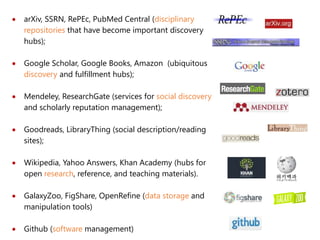
 arXiv, SSRN, RePEc, PubMed Central (disciplinary
repositories that have become important discovery
hubs);
 Google Scholar, Google Books, Amazon (ubiquitous
discovery and fulfillment hubs);
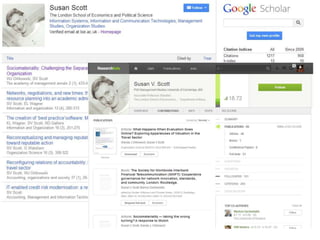
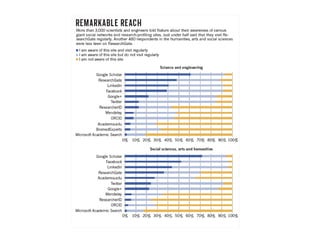
 Mendeley, ResearchGate (services for social discovery
and scholarly reputation management);
 Goodreads, LibraryThing (social description/reading
sites);
 Wikipedia, Yahoo Answers, Khan Academy (hubs for
open research, reference, and teaching materials).
 GalaxyZoo, FigShare, OpenRefine (data storage and
manipulation tools)
 Github (software management)
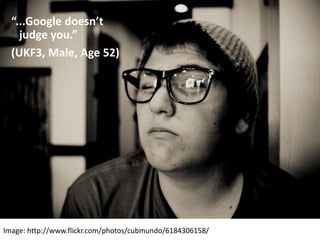
“...Google doesn’t
judge you.”
(UKF3, Male, Age 52)
Image: http://www.flickr.com/photos/cubmundo/6184306158/
“I just type it into Google and see what
comes up.” (UKS2)
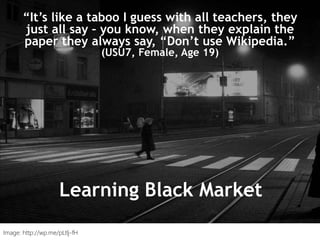
“It’s like a taboo I guess with all teachers, they
just all say – you know, when they explain the
paper they always say, “Don’t use Wikipedia.”
(USU7, Female, Age 19)
Learning Black Market
Image: http://wp.me/pLtlj-fH
Discovery is not just …
the discovery layer
Discovery often happens elsewhere.
Discovery is enacted in emerging
behaviors/workflows.
Put library resources in the workflow
Make institutional resources more discoverable.
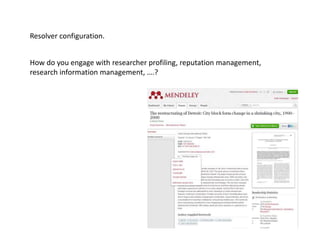
Resolver configuration.
How do you engage with researcher profiling, reputation management,
research information management, ….?
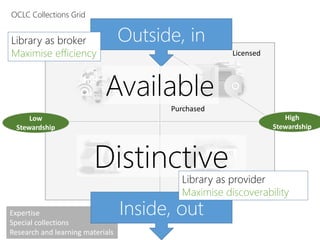
Expertise
Special collections
Research and learning materials
In few
collections
In many
collections
A
Licensed
Purchased
Outside, in
OCLC Collections Grid
Distinctive
Library as broker
Maximise efficiency
Low
Stewardship
High
Stewardship
Available
Inside, out
Library as provider
Maximise discoverability
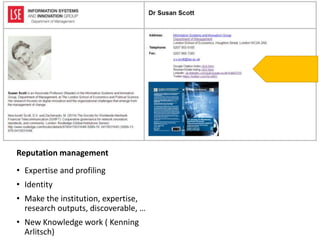
Reputation management
• Expertise and profiling
• Identity
• Make the institution, expertise,
research outputs, discoverable, …
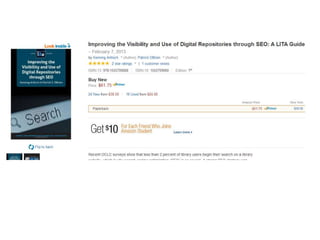
• New Knowledge work ( Kenning
Arlitsch)
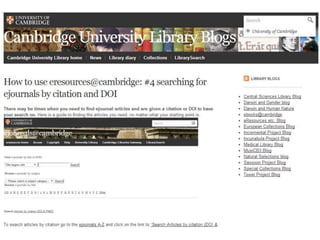
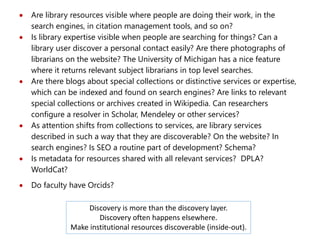
 Are library resources visible where people are doing their work, in the
search engines, in citation management tools, and so on?
 Is library expertise visible when people are searching for things? Can a
library user discover a personal contact easily? Are there photographs of
librarians on the website? The University of Michigan has a nice feature
where it returns relevant subject librarians in top level searches.
 Are there blogs about special collections or distinctive services or expertise,
which can be indexed and found on search engines? Are links to relevant
special collections or archives created in Wikipedia. Can researchers
configure a resolver in Scholar, Mendeley or other services?
 As attention shifts from collections to services, are library services
described in such a way that they are discoverable? On the website? In
search engines? Is SEO a routine part of development? Schema?
 Is metadata for resources shared with all relevant services? DPLA?
WorldCat?
 Do faculty have Orcids?
Discovery is more than the discovery layer.
Discovery often happens elsewhere.
Make institutional resources discoverable (inside-out).
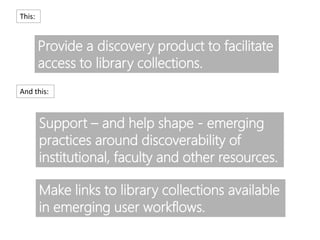
Provide a discovery product to facilitate
access to library collections.
Support – and help shape - emerging
practices around discoverability of
institutional, faculty and other resources.
This:
And this:
Make links to library collections available
in emerging user workflows.
3 interesting issues
Organization
Rightscaling
Users
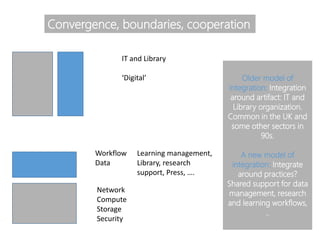
Convergence, boundaries, cooperation
IT and Library
‘Digital’
Network
Compute
Storage
Security
Workflow
Data
Learning management,
Library, research
support, Press, ….
Older model of
integration: Integration
around artifact: IT and
Library organization.
Common in the UK and
some other sectors in
90s.
A new model of
integration: Integrate
around practices?
Shared support for data
management, research
and learning workflows,
..
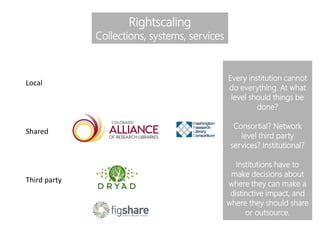
Rightscaling
Collections, systems, services
Local
Shared
Third party
Every institution cannot
do everything. At what
level should things be
done?
Consortial? Network
level third party
services? Institutional?
Institutions have to
make decisions about
where they can make a
distinctive impact, and
where they should share
or outsource.
Our traditional model was
one in which we thought of
the user in the life of the library
… but we are now increasingly
thinking about the library
in the life of the user as they
enact new research and learning
practices.
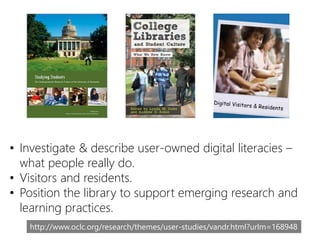
• Investigate & describe user-owned digital literacies –
what people really do.
• Visitors and residents.
• Position the library to support emerging research and
learning practices.
http://www.oclc.org/research/themes/user-studies/vandr.html?urlm=168948
And …
66
Manage systems and services to support
research and learning.
Support – and help shape - emerging
research and learning behaviors enacted
in data-rich network environments.
This:
And this:
Libraries:
from technology artifacts to technology in practice
2015 AJCU-CITM / Library Deans Conference at Loyola
University Maryland, Baltimore, 18 May 15
Lorcan Dempsey
@LorcanD
https://www.flickr.com/photos/michaelfoleyphotography/8673516232

Libraries: technology as artifact and technology in practice

  • 1.
    Libraries: from technology artifactsto technology in practice 2015 AJCU-CITM / Library Deans Conference at Loyola University Maryland, Baltimore, 18 May 15 Lorcan Dempsey @LorcanD https://www.flickr.com/photos/michaelfoleyphotography/8673516232
  • 2.
  • 4.
  • 5.
  • 6.
    2 11. The networkreshapes society and society reshapes the network 2. Cell phones and mobility as a service 3 library examples 1. Citation management 2. Institutional repositories and research workflow 3. Discovery and discoverability 3 The social and the technical 1. Organization 2. Rightscaling 3. The library in the life of the user 3 issues
  • 7.
  • 8.
    Preamble: the AJCU collectivecollection (thanks to Constance Malpas for the analysis here)
  • 9.
    0 160 320480 640 800 960 1,120 1,280 1,440 1,600 Thousands AJCU Library* Holdings in WorldCat March 2015 Collection size/scope varies widely *Lacking St Joseph’s and St Peter’s
  • 10.
    0% 10% 20%30% 40% 50% 60% 70% 80% 90% 100% WorldCat Duplication of Titles Held in AJCU Libraries <5 libraries 5 to 9 10 to 24 25 to 99 >99 libraries Systemwide duplication of holdings is high > 99 libraries median: 81% <5 libraries median : 1%
  • 11.
    15 most comprehensivecollections related to: 0% 5% 10% 15% 20% 25% SAINT LOUIS UNIV BOSTON COL WOODSTOCK THEOL CTR (GEORGETOWN UNIV) LIBRARY OF CONGRESS YALE UNIV HARVARD UNIV LOYOLA UNIV OF CHICAGO MARQUETTE UNIV FORDHAM UNIV UNIV OF NOTRE DAME DALTON MCCAUGHEY LIBR UNIV OF TORONTO REGIS COL UNIV OF CALIFORNIA, BERKELEY COLUMBIA UNIV PRINCETON THEOLOGICAL SEMINARY Saint Ignatius of Loyola, 1491-1556 Total related works in WorldCat = 1,681 6 of the top 15 collections are held by AJCU members
  • 12.
    0% 5% 10%15% 20% 25% 30% 35% BIBLIOTHEQUE NATIONALE DE FRANCE BIBLIOTHEQUE NAT & UNIV STRASBOURG BIBLIOTHEQUE SAINTE-GENEVIEVE BM LYON ECOLE NATIONALE DE CHARTES STATE RES LIBR, OLOMOUC MADRID-CASA DE VELÁZQUEZ PARIS-ENS-ULM LSH RENNES2-BU CENTRALE BOSTON COL CLERMONT FD-BCIU-PATRIMOINE UNIV OF MICHIGAN COLLEGE OF THE HOLY CROSS UNIV OF NOTRE DAME UNIV OF SAN FRANCISCO Carlos Sommervogel, 1834-1902 Total related works in WorldCat =74 15 most comprehensive collections related to: AJCU libraries hold the largest collections outside of Europe
  • 13.
    15 most comprehensivecollections related to: 0% 5% 10% 15% 20% 25% 30% 35% 40% LIBRARY OF CONGRESS HARVARD UNIV GRADUATE THEOL UNION YALE UNIV SAINT LOUIS UNIV GEORGETOWN UNIV COLUMBIA UNIV DUKE UNIV LIBR NEW YORK PUB LIBR UNIV OF CALIFORNIA, SRLF STANFORD UNIV UCLA UNIV OF NOTRE DAME CORNELL UNIV PRINCETON UNIV Pierre Teilhard de Chardin, 1881-1955 Total related works in WorldCat = 1,294 AJCU collections rival those of much larger research institutions
  • 14.
    0% 10% 20%30% 40% 50% 60% GONZAGA UNIV LIBRARY OF CONGRESS UNC, CHAPEL HILL NEW YORK PUB LIBR BOSTON COL UNIV OF OXFORD HARVARD UNIV CORNELL UNIV COLUMBIA UNIV YALE UNIV LIBR UNIV OF CALIFORNIA, BERKELEY BAKER & TAYLOR PRINCETON UNIV STANFORD UNIV CAMBRIDGE UNIV Gerard Manley Hopkins, 1844-1889 Total related works in WorldCat = 1,411 15 most comprehensive collections related to: Gonzaga University library provides unparalleled coverage
  • 15.
    Note: Georgetown Universityhas the most comprehensive collections about Graham Greene. Gonzaga collections built around interests of Fr Anthony Bischoff, S.J.
  • 16.
    The social andthe technical
  • 17.
  • 18.
    Technology as artifact Technologyin practice Emergent workflow/behaviors The technical reshapes the social – the social reshapes the technical I borrow artifact/practice terms from Wanda Orlikowski, 2000. Using Technology and Constituting Structures: A Practice Lens for Studying Technology in Organizations
  • 19.
    Technology in practice: anexample Cell phone and mobility
  • 20.
    Micro- coordination Ad hoc rendezvous Situational Tying place andnetwork. Maps Visual Tying place, network and image Cell Phone
  • 21.
    Vesco, the politician responsiblefor sustainable transport in Lyon, played a leading role in introducing the city’s Vélo’v bike- sharing scheme a decade ago. “Digital information is the fuel of mobility,” he says. “Some transport sociologists say that information about mobility is 50% of mobility. The car will become an accessory to the smartphone.” End of the car age: how cities are outgrowing the automobile http://www.theguardian.com/cities/2015/apr/28/end-of-the-car-age-how-cities- outgrew-the-automobile http://peterblade.blogspot.com/2012/05/inauguration-du-showroom-peter-blade.html
  • 22.
    22 http://www.bloomberg.com/news/articles/2015-04-07/uber-is-winning-over-americans-expense-accounts Mobility as aservice http://www.theguardian.com/cities/2015/apr/28/end-of-the-car-age-how-cities-outgrew-the-automobile
  • 23.
    “Uber – haseffectively become the vascular system for business … or think of it this way: it is the broadband pipe for atoms.” “Uber looks like a taxi business but really it's all about routing - it's trying to unbundle both car ownership and public transport and shift roads from circuit-switching to packet-switching.” B Evans. http://us6.campaign- archive2.com/?u=b98e2de85f03865f1d38de74f&id=ac5933501b “More and more, Uber is positioning itself as a logistics company. The goal is to deliver people and things within cities as quickly as possible — relying heavily on Google’s Maps in the process..” NYT May 7 2015
  • 25.
    Uber drivers— andother “on-demand” workers— have become increasingly vocal as the question the rights of these enterprises to operate outside of minimum wage laws, anti-discrimination statutes, workers’ compensation laws, and union- organizing rights. … In a Wall Street Journal article about on-demand employment, One worker tells the WSJ, ‘We are not robots; we are not a remote control; we are individuals…” http://www.faz.net/aktuell/feuilleton/debatten/the-digital-debate/shoshana-zuboff-on-the-sharing-economy-13500770-p4.html Shoshana Zuboff on the sharing economy.
  • 26.
  • 27.
    Health, Education, Transport Systemwide, policy,…. Behaviors, firms Running on data: Activity trackers and the Internet of Things http://dupress.com/articles/internet-of-things-wearable-technology/
  • 28.
    A communication device. Connectingidentity, place and workflows to reshape industries and behaviors. This: And this:
  • 29.
    3 library examples Citationmanagement Institutional repository > workflow is the new content Discovery and discoverability
  • 30.
    Technology as practice Emergentbehaviors/workflows Citation management
  • 31.
    So in arelatively short time, a solitary and manual function has evolved into a workflow enacted in a social and digital environment. In addition to functional value, this change has added network value, as individual users benefit from the community of use. People can make connections and find new work, and the network generates analytics which may be used for recommendations or scholarly metrics. In this way, for some people, citation management has evolved from being a single function in a broader workflow into a workflow manager, discovery engine, and social network. Dempsey & Walter, 2014
  • 32.
    Provide and promotereference manager products. Support – and help shape - emerging practices around citation management, research networking and profiles. This: And this:
  • 33.
    Technology as practice Emergentbehaviors/workflows Institutional repository > workflow is the new content
  • 34.
    In a well-knownarticle, Salo (2008) offers a variety of reasons as to why they have not been as heavily used as anticipated. These include a lack of attention to faculty incentives (‘prestige’) and to campus workflows. She concludes that IRs will not be successful unless developed as a part of “systematic, broad-based, well-supported data-stewardship, scholarly-communication, or digital-preservation program”. Providing technology as artifact > Supporting emerging practices
  • 35.
    http://www.slideshare.net/repofringe/e-prints42y EPrints Update, LesCarr, University of Southampton, Repository Fringe, 2014
  • 36.
  • 37.
  • 40.
    Her view isthat publishers are here to make the scientific research process more effective by helping them keep up to date, find colleagues, plan experiments, and then share their results. After they have published, the processes continues with gaining a reputation, obtaining funds, finding collaborators, and even finding a new job. What can we as publishers do to address some of scientists’ pain points? Annette Thomas, (then) CEO of Macmillan Publishers A publisher’s new job description http://www.against-the-grain.com/2012/11/a-publishers-new-job-description/
  • 42.
    Support - andhelp shape - emerging practices around the complete research life cycle. Provide system to manage research outputs. This: And this:
  • 43.
    Technology as practice Emergentbehaviors/workflows Discovery and discoverability
  • 45.
     arXiv, SSRN,RePEc, PubMed Central (disciplinary repositories that have become important discovery hubs);  Google Scholar, Google Books, Amazon (ubiquitous discovery and fulfillment hubs);  Mendeley, ResearchGate (services for social discovery and scholarly reputation management);  Goodreads, LibraryThing (social description/reading sites);  Wikipedia, Yahoo Answers, Khan Academy (hubs for open research, reference, and teaching materials).  GalaxyZoo, FigShare, OpenRefine (data storage and manipulation tools)  Github (software management)
  • 47.
    “...Google doesn’t judge you.” (UKF3,Male, Age 52) Image: http://www.flickr.com/photos/cubmundo/6184306158/
  • 48.
    “I just typeit into Google and see what comes up.” (UKS2) “It’s like a taboo I guess with all teachers, they just all say – you know, when they explain the paper they always say, “Don’t use Wikipedia.” (USU7, Female, Age 19) Learning Black Market Image: http://wp.me/pLtlj-fH
  • 49.
    Discovery is notjust … the discovery layer Discovery often happens elsewhere. Discovery is enacted in emerging behaviors/workflows. Put library resources in the workflow Make institutional resources more discoverable.
  • 50.
    Resolver configuration. How doyou engage with researcher profiling, reputation management, research information management, ….?
  • 51.
    Expertise Special collections Research andlearning materials In few collections In many collections A Licensed Purchased Outside, in OCLC Collections Grid Distinctive Library as broker Maximise efficiency Low Stewardship High Stewardship Available Inside, out Library as provider Maximise discoverability
  • 52.
    Reputation management • Expertiseand profiling • Identity • Make the institution, expertise, research outputs, discoverable, … • New Knowledge work ( Kenning Arlitsch)
  • 58.
     Are libraryresources visible where people are doing their work, in the search engines, in citation management tools, and so on?  Is library expertise visible when people are searching for things? Can a library user discover a personal contact easily? Are there photographs of librarians on the website? The University of Michigan has a nice feature where it returns relevant subject librarians in top level searches.  Are there blogs about special collections or distinctive services or expertise, which can be indexed and found on search engines? Are links to relevant special collections or archives created in Wikipedia. Can researchers configure a resolver in Scholar, Mendeley or other services?  As attention shifts from collections to services, are library services described in such a way that they are discoverable? On the website? In search engines? Is SEO a routine part of development? Schema?  Is metadata for resources shared with all relevant services? DPLA? WorldCat?  Do faculty have Orcids? Discovery is more than the discovery layer. Discovery often happens elsewhere. Make institutional resources discoverable (inside-out).
  • 59.
    Provide a discoveryproduct to facilitate access to library collections. Support – and help shape - emerging practices around discoverability of institutional, faculty and other resources. This: And this: Make links to library collections available in emerging user workflows.
  • 60.
  • 61.
    Convergence, boundaries, cooperation ITand Library ‘Digital’ Network Compute Storage Security Workflow Data Learning management, Library, research support, Press, …. Older model of integration: Integration around artifact: IT and Library organization. Common in the UK and some other sectors in 90s. A new model of integration: Integrate around practices? Shared support for data management, research and learning workflows, ..
  • 62.
    Rightscaling Collections, systems, services Local Shared Thirdparty Every institution cannot do everything. At what level should things be done? Consortial? Network level third party services? Institutional? Institutions have to make decisions about where they can make a distinctive impact, and where they should share or outsource.
  • 63.
    Our traditional modelwas one in which we thought of the user in the life of the library … but we are now increasingly thinking about the library in the life of the user as they enact new research and learning practices.
  • 64.
    • Investigate &describe user-owned digital literacies – what people really do. • Visitors and residents. • Position the library to support emerging research and learning practices. http://www.oclc.org/research/themes/user-studies/vandr.html?urlm=168948
  • 65.
  • 66.
  • 68.
    Manage systems andservices to support research and learning. Support – and help shape - emerging research and learning behaviors enacted in data-rich network environments. This: And this:
  • 69.
    Libraries: from technology artifactsto technology in practice 2015 AJCU-CITM / Library Deans Conference at Loyola University Maryland, Baltimore, 18 May 15 Lorcan Dempsey @LorcanD https://www.flickr.com/photos/michaelfoleyphotography/8673516232

Editor's Notes

  • #38 http://global.oup.com/uk/orc/busecon/economics/carlin/
  • #48 “And also the fact that Google doesn’t judge you.” Digital Visitors and Residents (UKF3 0:16:35 Male Age 52) “I don’t know, it’s habit. I know what it looks like and how to use it.” Digital Visitors and Residents (UKU9 0:19:06  Male Age 27) (speaking about Google)   “I find Google a lot easier than going to the library website because I don’t know, it’s just like sometimes so many journals come up and when you look at the first ten and they just don’t make any sense I, kind of, give up.” Digital Visitors and Residents (USU7 0:34:11 Female Age 19)
  • #49 Image: http://wp.me/pLtlj-fH Covert online study habits Wikipedia Don’t cite Widely used Guilt Students & teachers disagree Quality sources There is a “Learning Black Market”: learners use non-traditional sources but feel they cannot talk about them in an institutional context. Wikipedia usage is an example of this. (White & Connaway, 2011) White, D. S., & Le Cornu, A. (2011). Visitors and Residents: A new typology for online engagement. First Monday, 16(9). Retrieved from http://firstmonday.org/htbin/cgiwrap/bin/ojs/index.php/fm/article/viewArticle/3171/3049    “I mean if teachers don’t like using Wikipedia they don’t want you to use Wikipedia. A lot of students will still use Wikipedia and then cite another source. As long as it has the same information and it is not word for word or anything they’ll use Wikipedia because it is the easiest thing to go look up on Wikipedia. It will give you a full in-depth detailed thing about the information. Teachers don’t just like it because it’s not the most reliable source since anyone can post something on there even though the site is monitored, it’s because it’s too easy.” (USU3 0:30:59, Male Age 19)    Students’ Perceptions of Teachers’ opinions of Wikipedia: “Avoid it.” (UKS8 0:28:28.3, Female Age 16)    “They say it’s because anyone can make up – I mean, anyone can add information on there but I mean when I’ve actually looked into information it seemed the same as any information I find anywhere else. I mean, it’s not like if you look up fourth of July, it’s not like it gives you like some weird explanation of aliens or something.” (USU7 0:33:14, Female Age 19)   Students’ on Wikipedia: “I use it, kind of like, I won't cite it on my papers but I, kind of, use it as a like, as a start off line. I go there and look up the general information, kind of, read through it so I get a general idea what it is. Then I start going through my research.” (USU7 0:33:49, Female Age 19)   “Everyone knows that you try not to use Wikipedia as a source because it is a cardinal sin.” (UKU3 0:31:03, Female Age 19)
  • #52 Not just about ‘special’ collections
  • #62 In the UK in the 80s and 90s it was common for Libraries and IT to merge. At one stage over 50% of universities had this model. It was also adopted elsewhere. This belongs to an earlier stage, when it was thought possible to isolate technology-as-artifact – all the ‘digital’ stuff was being put together. As the digital has become more pervasive I had thought we would see a differently structured integration emerge, where the ‘infrastructure’ was managed by one group (network, compute, storage, security, …), and research and learning workflows were managed in a more integrated way in some new organizational contexts. For example, think about learning management, research support, data curation, university press, and so on. In practice we have not see this happened widely. It will be interesting to see how services do emerge to meet the needs of research and learning behaviors increasingly enacted in data-rich, network environments.