Information Resources in
Academic Library
Mary Rose V. Navarro
Discussant
Library
 a collection of sources, resources, and services, and
the structure in which it is housed; it is organized for
use and maintained by a public body, an institution,
or a private individual.
 It can mean the collection itself, the building or room
that houses such a collection, or both.
Academic Library
 comprise of school libraries at the primary and secondary levels,
College libraries, and University libraries whose prime objective is to
meet the academic needs of the particular institution for which it is
created to serve.
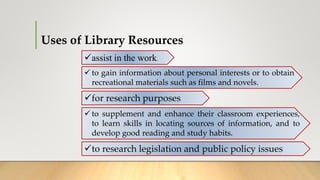
Uses of Library Resources
assist in the work.
 to gain information about personal interests or to obtain
recreational materials such as films and novels.
for research purposes
 to supplement and enhance their classroom experiences,
to learn skills in locating sources of information, and to
develop good reading and study habits.
to research legislation and public policy issues
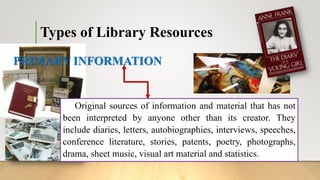
Types of Library Resources
PRIMARY INFORMATION
Original sources of information and material that has not
been interpreted by anyone other than its creator. They
include diaries, letters, autobiographies, interviews, speeches,
conference literature, stories, patents, poetry, photographs,
drama, sheet music, visual art material and statistics.
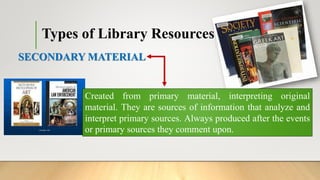
SECONDARY MATERIAL
Created from primary material, interpreting original
material. They are sources of information that analyze and
interpret primary sources. Always produced after the events
or primary sources they comment upon.
Types of Library Resources
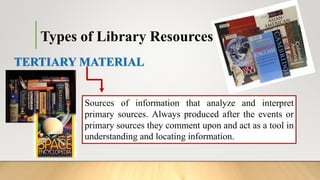
TERTIARY MATERIAL
Types of Library Resources
Sources of information that analyze and interpret
primary sources. Always produced after the events or
primary sources they comment upon and act as a tool in
understanding and locating information.
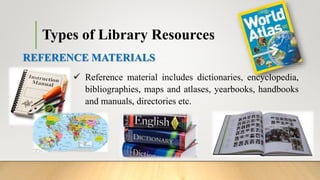
REFERENCE MATERIALS
 Reference material includes dictionaries, encyclopedia,
bibliographies, maps and atlases, yearbooks, handbooks
and manuals, directories etc.
Types of Library Resources
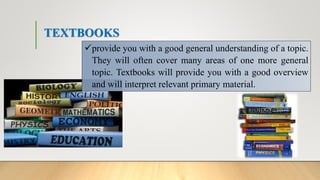
TEXTBOOKS
provide you with a good general understanding of a topic.
They will often cover many areas of one more general
topic. Textbooks will provide you with a good overview
and will interpret relevant primary material.
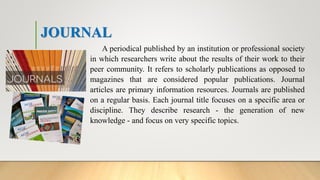
JOURNAL
A periodical published by an institution or professional society
in which researchers write about the results of their work to their
peer community. It refers to scholarly publications as opposed to
magazines that are considered popular publications. Journal
articles are primary information resources. Journals are published
on a regular basis. Each journal title focuses on a specific area or
discipline. They describe research - the generation of new
knowledge - and focus on very specific topics.
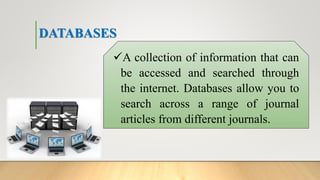
DATABASES
A collection of information that can
be accessed and searched through
the internet. Databases allow you to
search across a range of journal
articles from different journals.
NEWSPAPERS
excellent source when looking for current
and up-to-date information.
Information services in academic libraries

Information services in academic libraries

  • 1.
    Information Resources in AcademicLibrary Mary Rose V. Navarro Discussant
  • 2.
    Library  a collectionof sources, resources, and services, and the structure in which it is housed; it is organized for use and maintained by a public body, an institution, or a private individual.  It can mean the collection itself, the building or room that houses such a collection, or both.
  • 3.
    Academic Library  compriseof school libraries at the primary and secondary levels, College libraries, and University libraries whose prime objective is to meet the academic needs of the particular institution for which it is created to serve.
  • 4.
    Uses of LibraryResources assist in the work.  to gain information about personal interests or to obtain recreational materials such as films and novels. for research purposes  to supplement and enhance their classroom experiences, to learn skills in locating sources of information, and to develop good reading and study habits. to research legislation and public policy issues
  • 5.
    Types of LibraryResources PRIMARY INFORMATION Original sources of information and material that has not been interpreted by anyone other than its creator. They include diaries, letters, autobiographies, interviews, speeches, conference literature, stories, patents, poetry, photographs, drama, sheet music, visual art material and statistics.
  • 6.
    SECONDARY MATERIAL Created fromprimary material, interpreting original material. They are sources of information that analyze and interpret primary sources. Always produced after the events or primary sources they comment upon. Types of Library Resources
  • 7.
    TERTIARY MATERIAL Types ofLibrary Resources Sources of information that analyze and interpret primary sources. Always produced after the events or primary sources they comment upon and act as a tool in understanding and locating information.
  • 8.
    REFERENCE MATERIALS  Referencematerial includes dictionaries, encyclopedia, bibliographies, maps and atlases, yearbooks, handbooks and manuals, directories etc. Types of Library Resources
  • 9.
    TEXTBOOKS provide you witha good general understanding of a topic. They will often cover many areas of one more general topic. Textbooks will provide you with a good overview and will interpret relevant primary material.
  • 10.
    JOURNAL A periodical publishedby an institution or professional society in which researchers write about the results of their work to their peer community. It refers to scholarly publications as opposed to magazines that are considered popular publications. Journal articles are primary information resources. Journals are published on a regular basis. Each journal title focuses on a specific area or discipline. They describe research - the generation of new knowledge - and focus on very specific topics.
  • 11.
    DATABASES A collection ofinformation that can be accessed and searched through the internet. Databases allow you to search across a range of journal articles from different journals.
  • 12.
    NEWSPAPERS excellent source whenlooking for current and up-to-date information.