THE HISTORY OF AMERICAN PUBLIC LIBRARIES
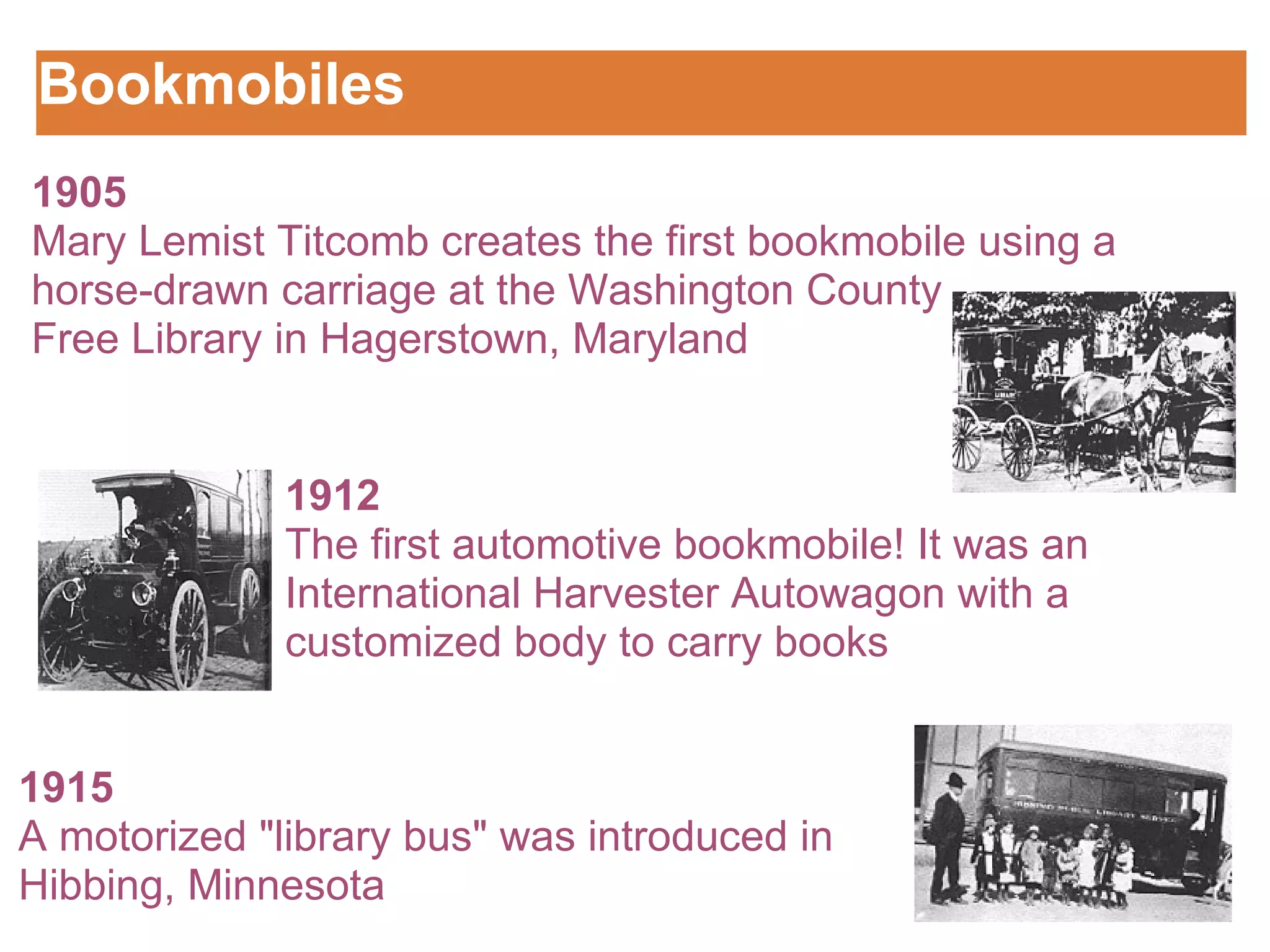
Bookmobiles  1905 Mary Lemist Titcomb creates the first bookmobile using a horse-drawn carriage at the Washington County Free Library in Hagerstown, Maryland  Customizing the Logo 1912 The first automotive bookmobile! It was an International Harvester Autowagon with a customized body to carry books  1915 A motorized "library bus" was introduced in Hibbing, Minnesota
Libraries during Wartime Customizing the Logo    1914  WWI Begins Public libraries saw war as an opportunity to extend their services and to increase their professional authority   While the US remained neutral, libraries attempted to provide materials that offered a fair and balanced reporting of the war abroad   German and British governments vied to influence America's official neutrality through propaganda campaigns conducted through public libraries  Sent unsolicited materials Anonymous donations to be spent on German books  Donated books Sent lists and bulletins recommending German books
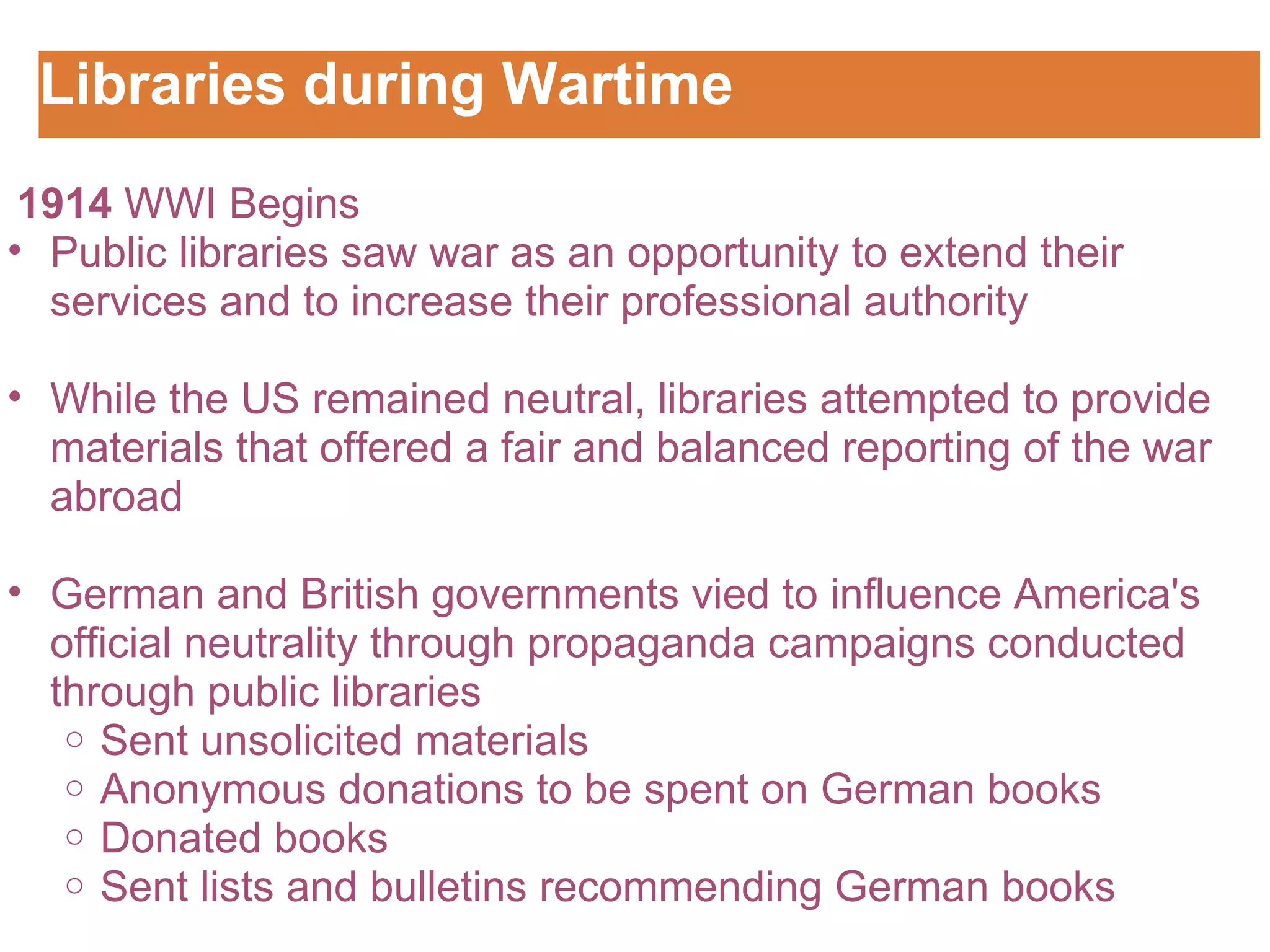
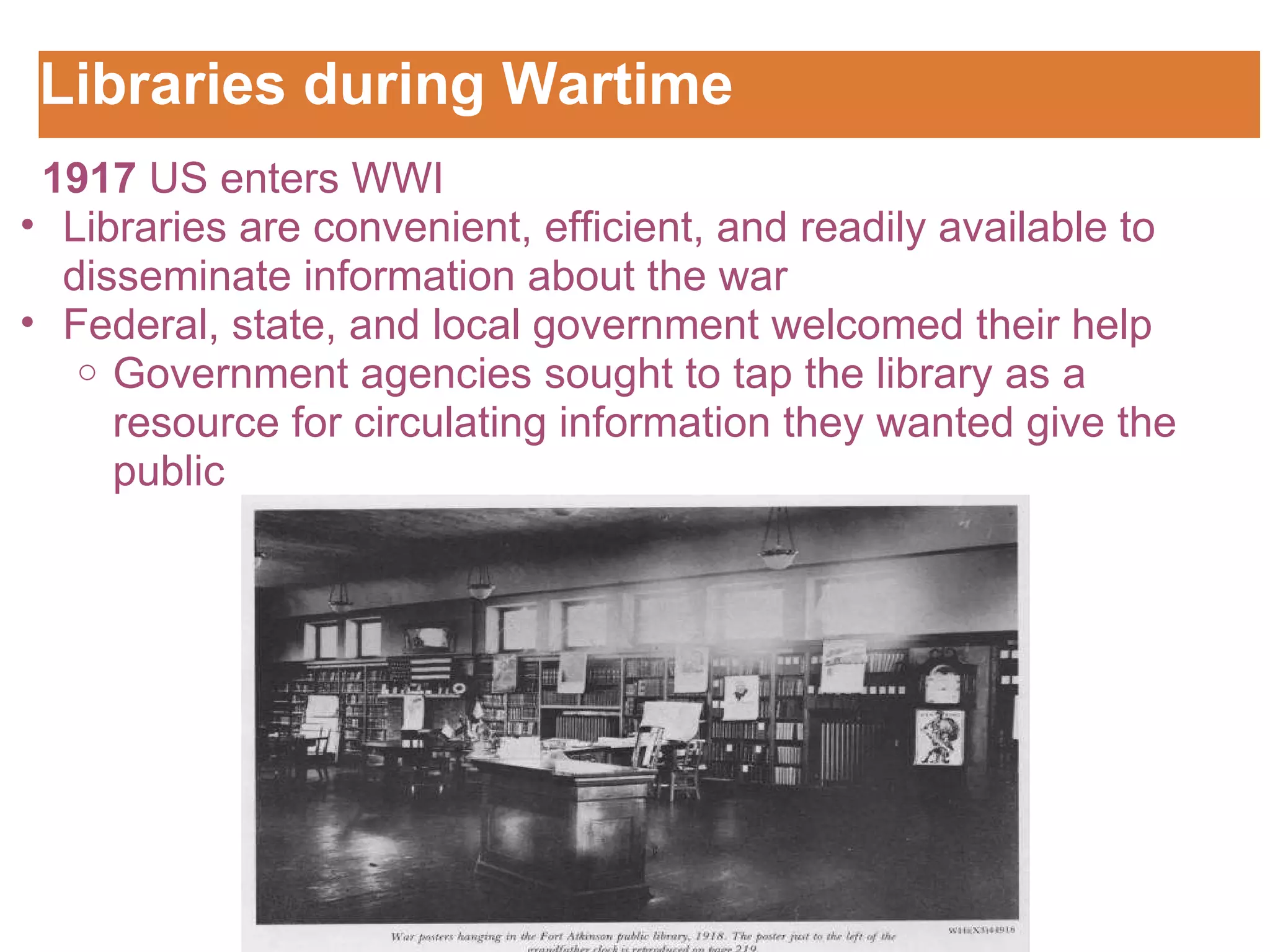
Libraries during Wartime Customizing the Logo     1917  US enters WWI Libraries are convenient, efficient, and readily available to disseminate information about the war  Federal, state, and local government welcomed their help  Government agencies sought to tap the library as a resource for circulating information they wanted give the public
Goals for Libraries during WWI Customizing the Logo "Act as an agency of patriotic publicity" to post and distribute any government war literature President's messages and war proclamations, federal legislation, any state decrees and bulletins concerning the war, and useful information from the Red Cross and other voluntary associations If this information was not freely available, the public library had a responsibility to get it    All public libraries should furnish reading material on patriotism, the flag, military and naval training, and the "truth" about the war   Set up bulletin boards identifying the nearest recruiting station, post lists of opportunities for national service in the armed services, identify members of the national and state councils of defense
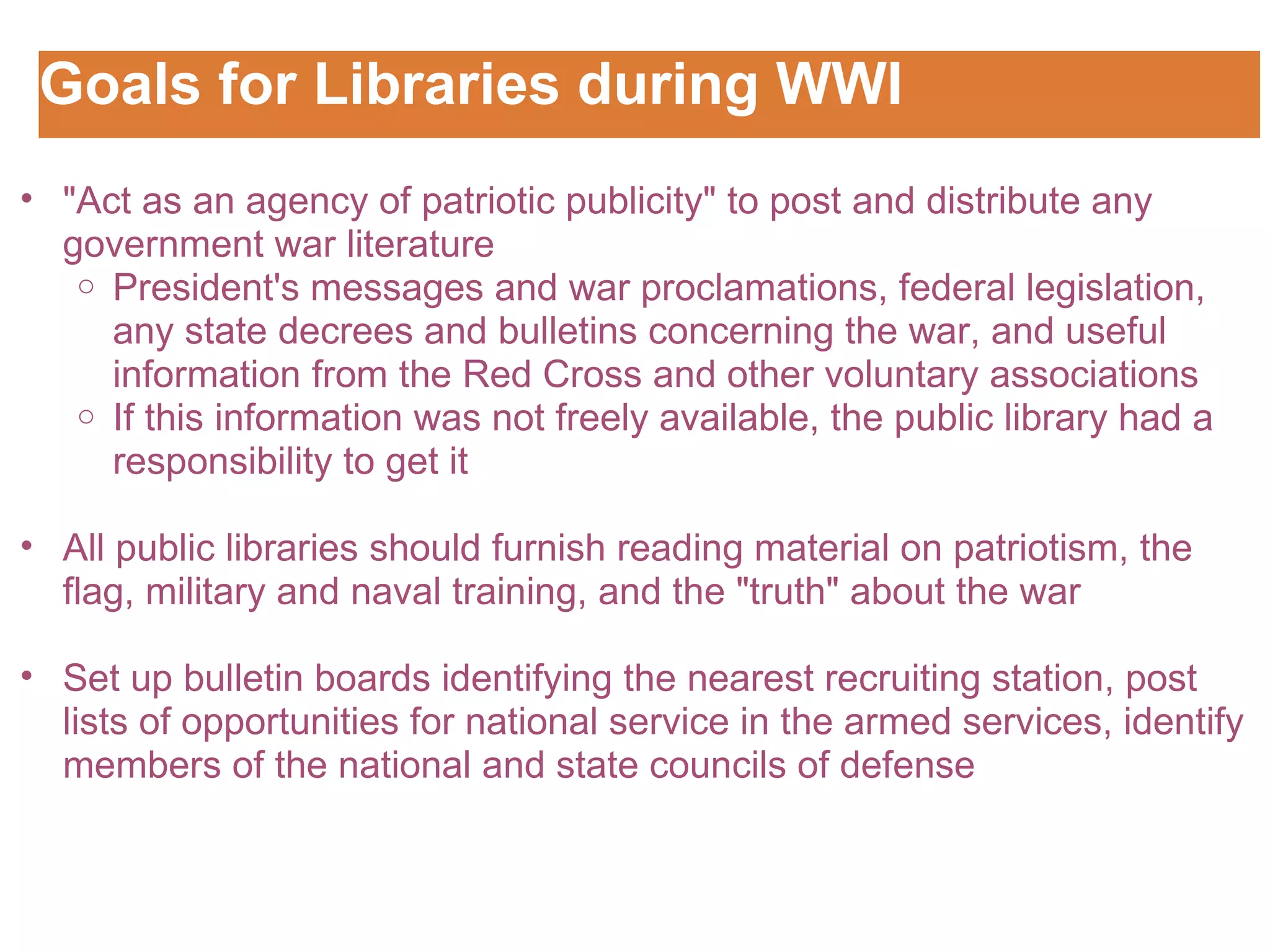
Libraries during Wartime Customizing the Logo Huge increase in circulation of war books    Display areas with maps charting Allied advances   Served as recruiting stations, community spaces 
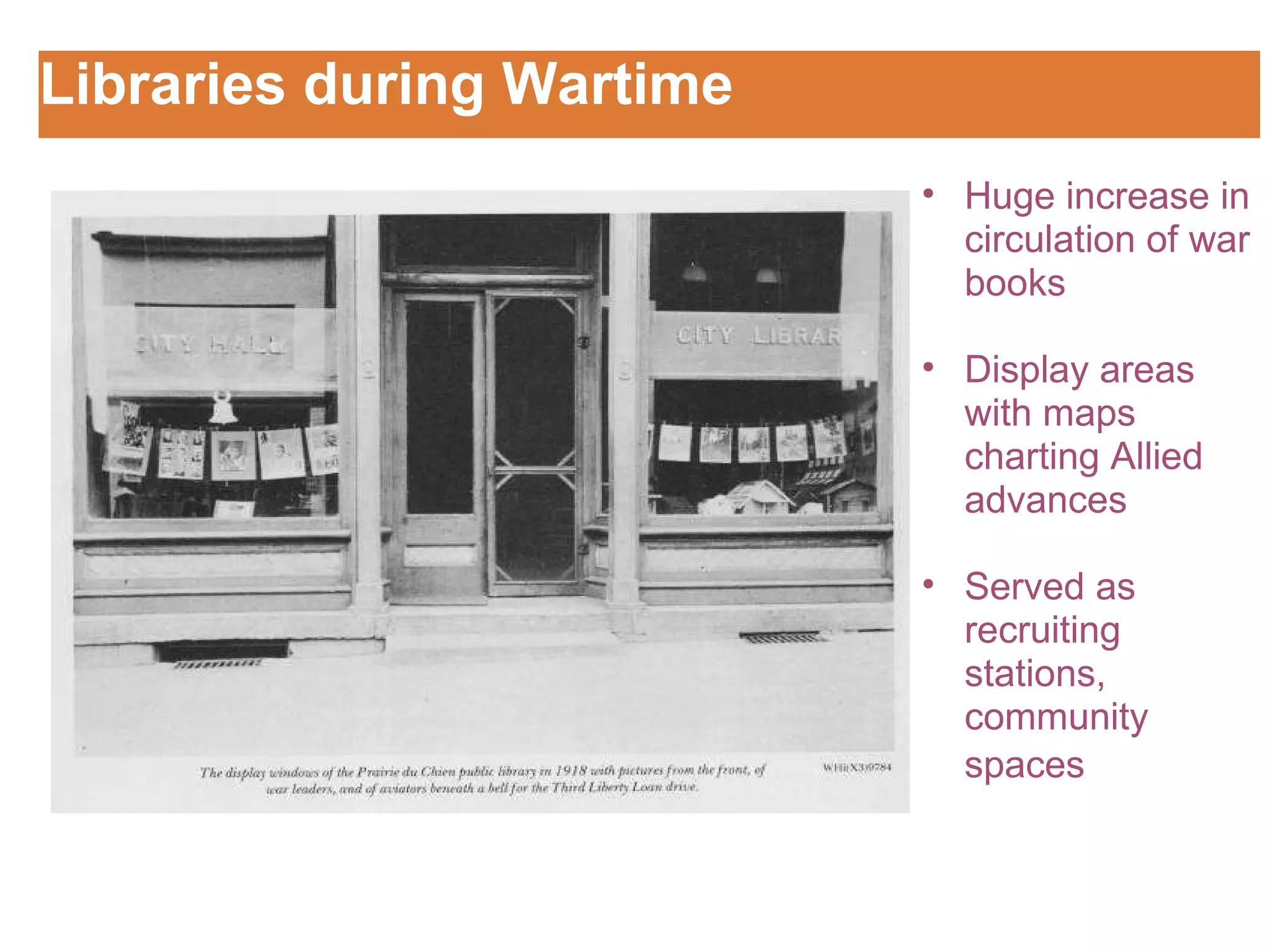
Libraries during Wartime Customizing the Logo ALA's War Service Library provided reading materials to soldiers and sailors at home and abroad Operated camp and hospital libraries  Distributed books in Europe & Siberia; books-by-mail program Book drives to solicit magazines for military hospitals This program laid the foundation for today's armed services libraries  Public libraries aided in collecting books for the War Service Library to stock training camp facilitates across the nation
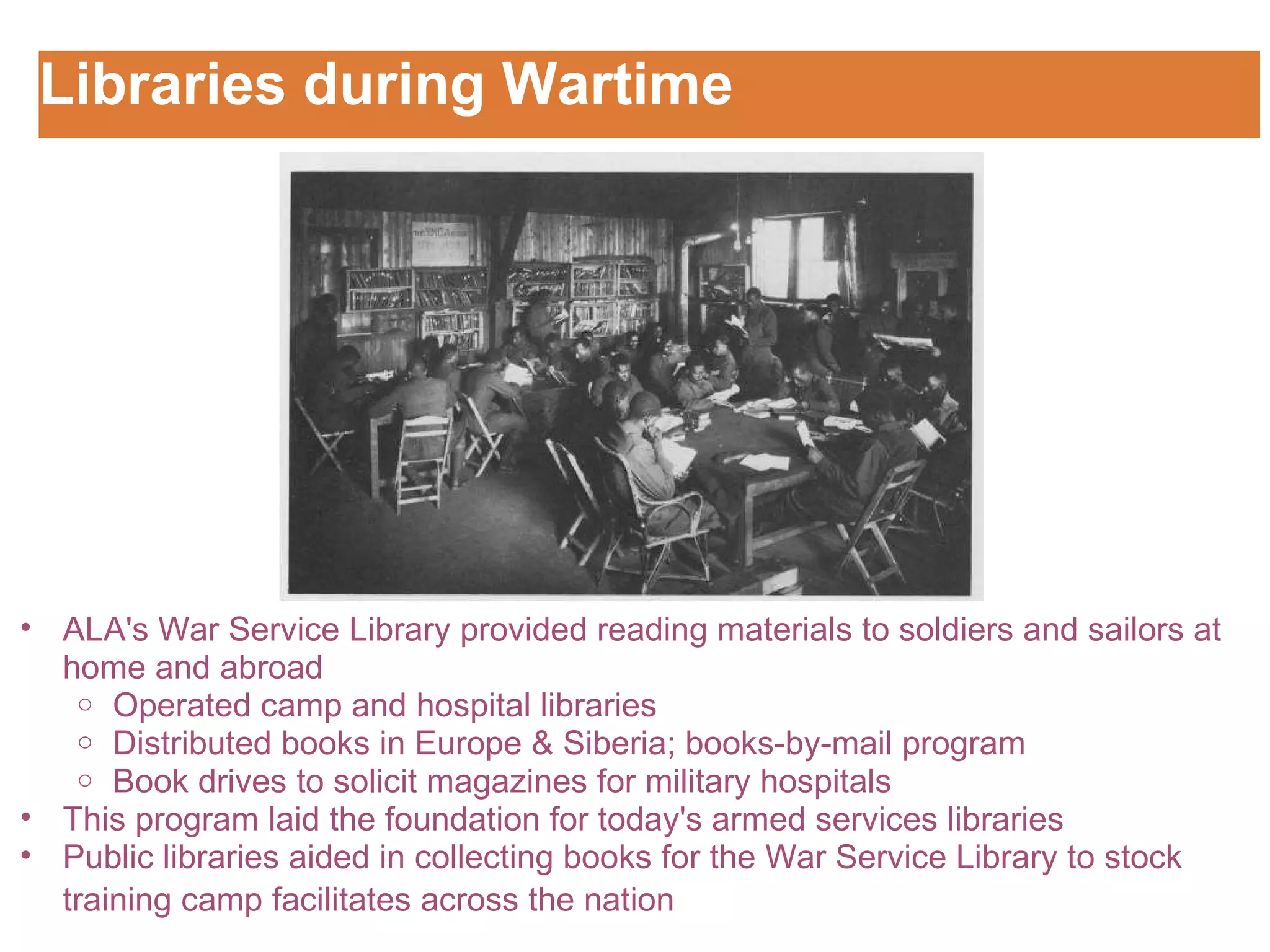
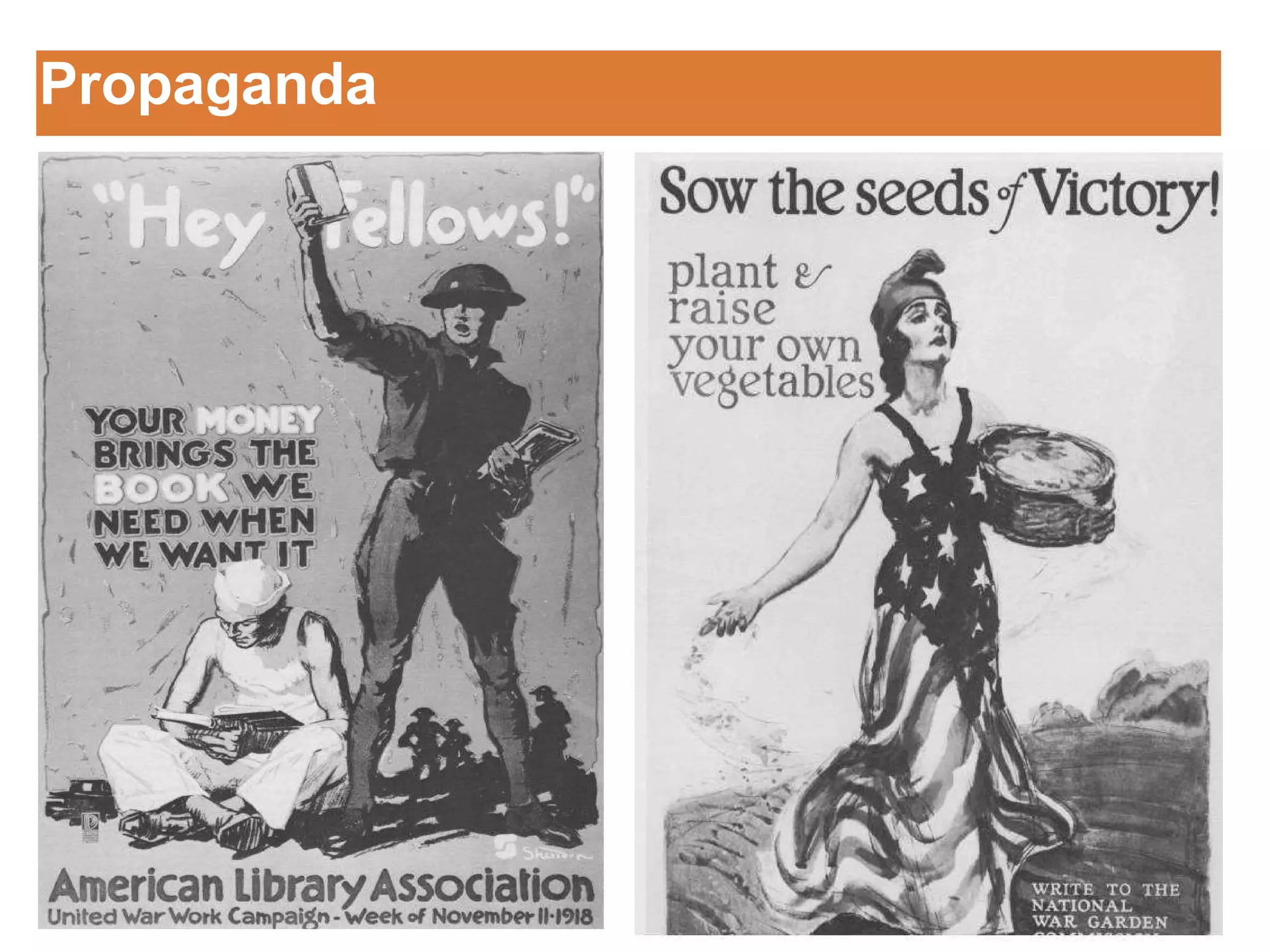
Propaganda Customizing the Logo
Libraries during Wartime Customizing the Logo Worked together with schools to indoctrinate children      Intellectual freedom issues:   Withdrawal of questionable literature Some libraries boasted about book burnings  Refusal to admit new material of a "suspicious nature" Ensured that patriotic literature be given the widest dissemination possible    American public librarians fell victim to the same wartime hysteria as many professions and institutions
Libraries during the Depression Customizing the Logo Public libraries tried to provide training in useful skills for people recently unemployed or those struggling to make ends meet   Capitalized on the growing general fear of the unemployed by positioning the library as a mechanism for social control The library, by keeping the masses busy with reading, would prevent the spread of revolutionary thought  Belief that by reading and reflecting on the right books, an educated citizenry could develop a rational solution to the depression   A poster slogan: "Turn discontent to constructive reform"
Works Progress Adminstration (WPA) Customizing the Logo Library projects covered library extension, book repair, and book cataloging and indexing   Library Extension program established thousands of new libraries Book repair projects provided jobs and saved libraries and schools money through the reconditioning of dilapidated books   Federal Writers Program authors like Studs Terkel, Nelson Algren, Saul Bellow   The WPA ’s Historical Records Survey undertook massive indexing and cataloging project
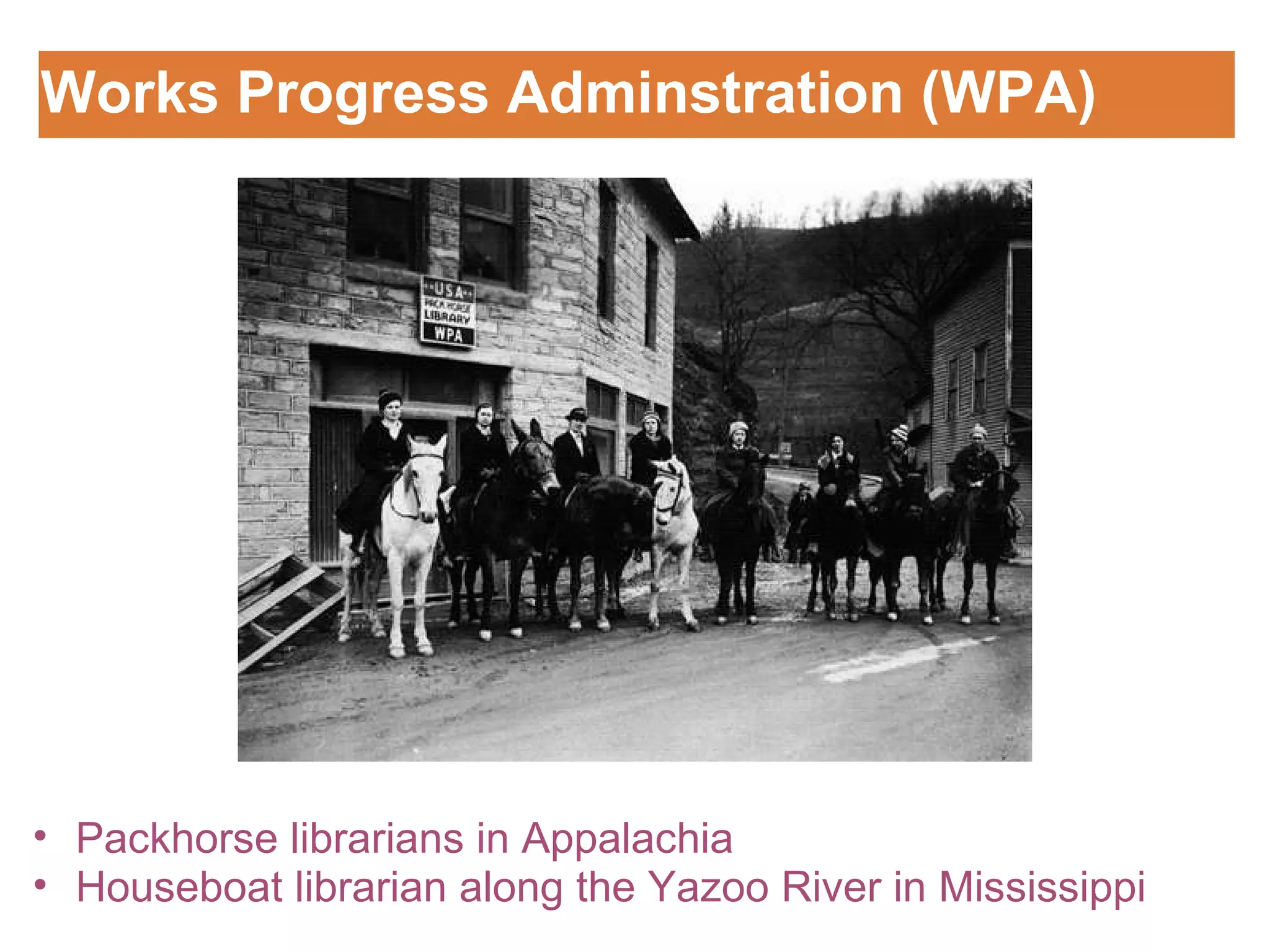
Works Progress Adminstration (WPA) Customizing the Logo Packhorse librarians in Appalachia Houseboat librarian along the Yazoo River in Mississippi
Tennessee Valley Authority (TVA) Customizing the Logo 1933 TVA created to provide navigation, flood control, electricity, and economic development in the Tennessee Valley Most rural counties in the Tennessee Valley had no public library, and some were extreme in their isolation   1934  TVA hires Mary Utopia Rothrock, the director of the Knoxville Public Library to supervise the TVA libraries Set up the first rural library in Norris, Tennessee, the model company town   Rothrock believed it was critical to make books available in remote locations Established small 4,000- to 5,000-volume libraries in stores, post offices, and filling stations “ Wherever they live or work, the library follows.”
Public Libraries during WWII Customizing the Logo Even after Pearl Harbor, librarians in Hawaii still took books to army camps Libraries around the country were shook up Moved collections, worked with police & fire departments, strengthened security, trained midwives CPL shifted emphasis from industrial training to defense issues mounted war maps   Worked with government agencies to help disseminate information  US Information Service, Office of Civilian Defense Desire for libraries to be a part of federal programs War information centers to help citizens keep up with rapid changes and new regulations (i.e. Detroit Public Library)
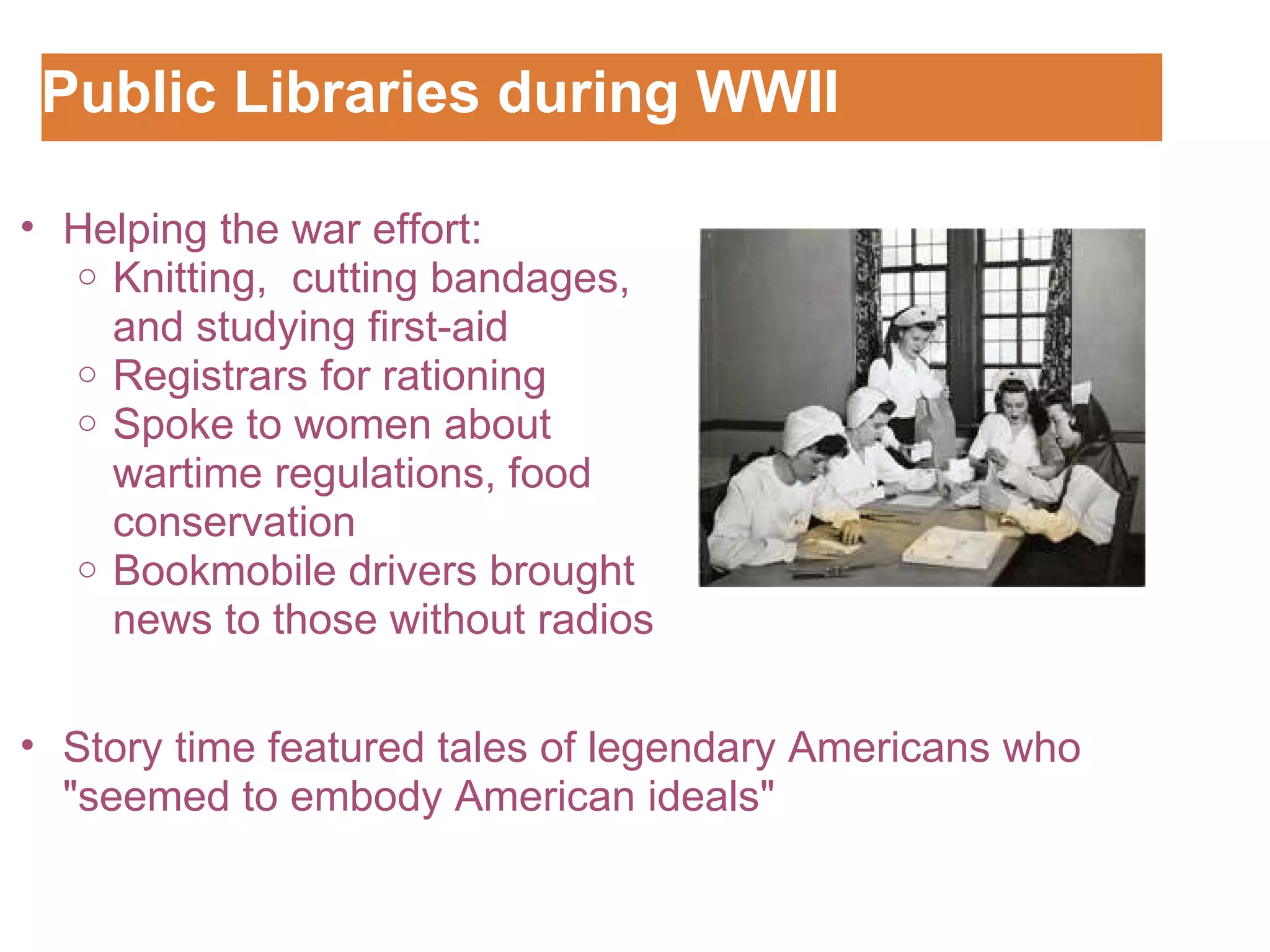
Public Libraries during WWII Customizing the Logo   Story time featured tales of legendary Americans who "seemed to embody American ideals" Helping the war effort: Knitting,  cutting bandages, and studying first-aid Registrars for rationing Spoke to women about wartime regulations, food conservation Bookmobile drivers brought news to those without radios
Public Libraries during WWII Customizing the Logo Shrinking staff Called into service Left for jobs in the war industry with lucrative salaries Some women left to marry or follow their husbands    Some libraries granted unpaid leaves and promised jobs upon their return Employed older women Hired Japanese women, but they were not allowed any contact with the public Firemen and red cross drivers took over bookmobile routes
Public Libraries during WWII Customizing the Logo 1944  ALA wants libraries to assist in military and industrial demobilization  Revival of library adult education efforts 1945  War is over! Demand for technical,war, and peace books die down Readjustment to civilian life Shifted to recreational reading Growing interest in race relations Home & design, precursor to consumer culture of 1950s     Individual libraries responded differently; some didn't change in response to war Those kept their communities' needs in mind fared better than those who did not
McCarthyism & Libraries  Customizing the Logo Those who wanted to weed out subversion in libraries focused on: library staff library services  collection Logistical challenges as well as federal laws blocked many books and periodicals from entering the United States   1952  Rep. Harold Velde proposed a bill to provide that the Library of Congress should mark all subversive matter in the collection and compile a list for the guidance of other libraries in the US. The bill never made it out of committee
McCarthyism & Libraries  Customizing the Logo Challenged books, films, and periodicals deemed overly sympathetic in their treatment of the Soviet Union Also criticized libraries for not including books that they viewed as shining examples of American patriotism  Sen. Joseph McCarthy ’s book,  McCarthyism, The Fight for America: Documented Answers to Questions Asked by Friend and Foe   Labeling: system of stamping books to indicate that the author had known Communist affiliations   Variations on labeling: Stamped books should not be circulated, only available in reference  
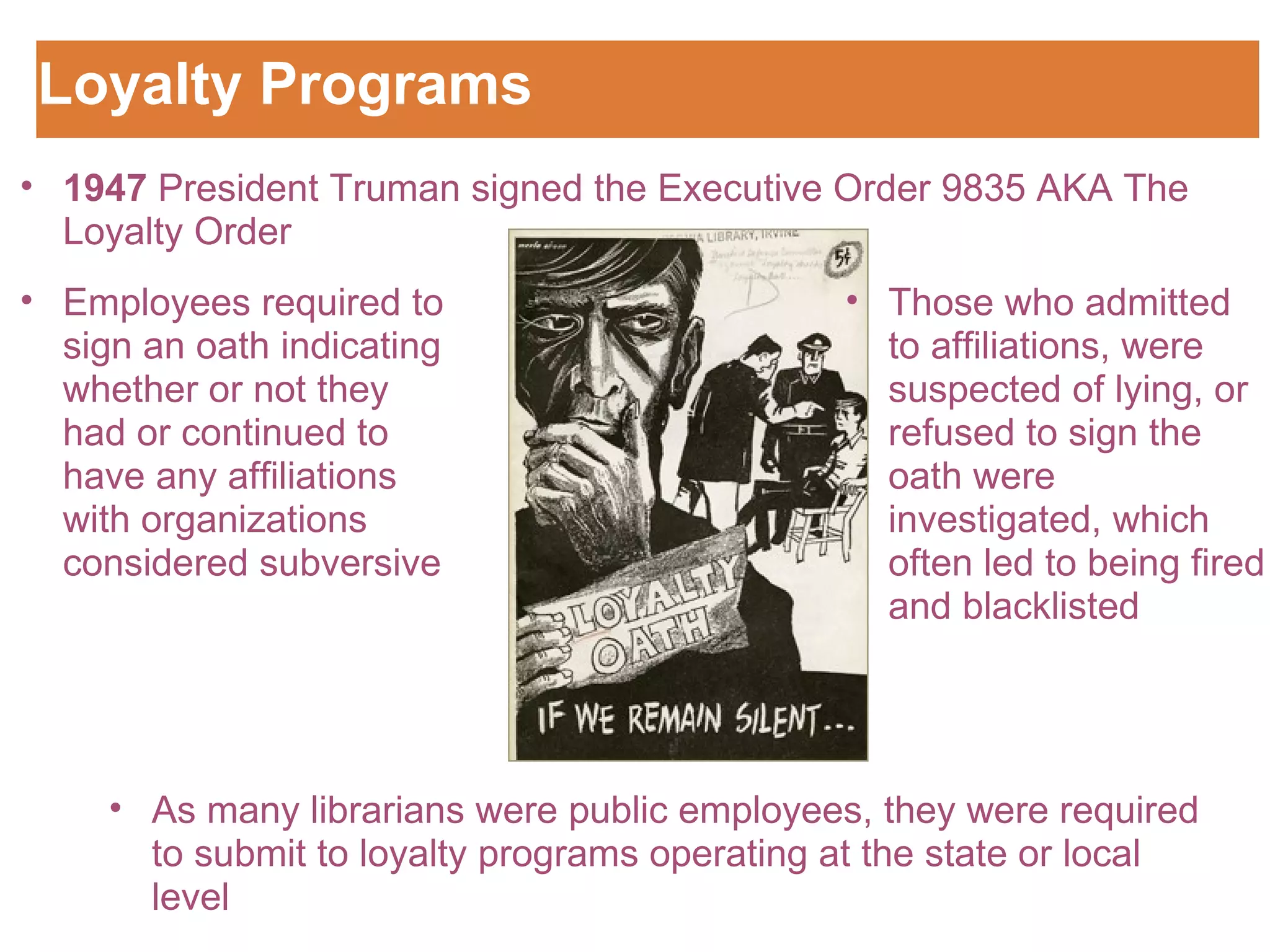
Loyalty Programs  1947  President Truman signed the Executive Order 9835 AKA The Loyalty Order Employees required to sign an oath indicating whether or not they had or continued to have any affiliations with organizations considered subversive  Those who admitted to affiliations, were suspected of lying, or refused to sign the oath were investigated, which often led to being fired and blacklisted  As many librarians were public employees, they were required to submit to loyalty programs operating at the state or local level
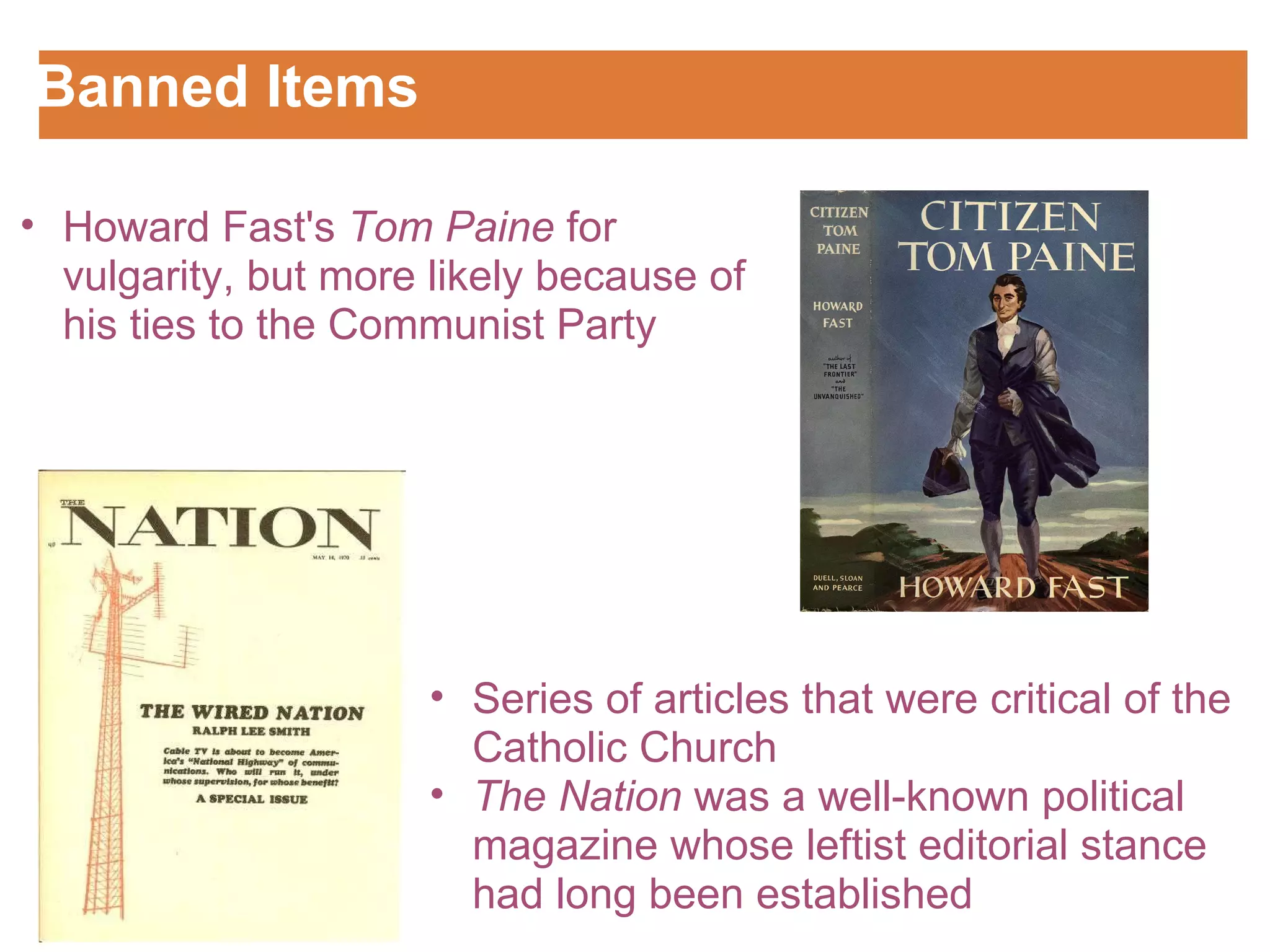
Banned Items  Customizing the Logo Howard Fast's  Tom Paine  for vulgarity, but more likely because of his ties to the Communist Party   Series of articles that were critical of the Catholic Church The Nation  was a well-known political magazine whose leftist editorial stance had long been established

History of Public Libraries

  • 1.
    THE HISTORY OFAMERICAN PUBLIC LIBRARIES
  • 2.
    Bookmobiles 1905Mary Lemist Titcomb creates the first bookmobile using a horse-drawn carriage at the Washington County Free Library in Hagerstown, Maryland Customizing the Logo 1912 The first automotive bookmobile! It was an International Harvester Autowagon with a customized body to carry books 1915 A motorized "library bus" was introduced in Hibbing, Minnesota
  • 3.
    Libraries during WartimeCustomizing the Logo   1914 WWI Begins Public libraries saw war as an opportunity to extend their services and to increase their professional authority   While the US remained neutral, libraries attempted to provide materials that offered a fair and balanced reporting of the war abroad   German and British governments vied to influence America's official neutrality through propaganda campaigns conducted through public libraries  Sent unsolicited materials Anonymous donations to be spent on German books Donated books Sent lists and bulletins recommending German books
  • 4.
    Libraries during WartimeCustomizing the Logo    1917 US enters WWI Libraries are convenient, efficient, and readily available to disseminate information about the war  Federal, state, and local government welcomed their help  Government agencies sought to tap the library as a resource for circulating information they wanted give the public
  • 5.
    Goals for Librariesduring WWI Customizing the Logo "Act as an agency of patriotic publicity" to post and distribute any government war literature President's messages and war proclamations, federal legislation, any state decrees and bulletins concerning the war, and useful information from the Red Cross and other voluntary associations If this information was not freely available, the public library had a responsibility to get it    All public libraries should furnish reading material on patriotism, the flag, military and naval training, and the "truth" about the war   Set up bulletin boards identifying the nearest recruiting station, post lists of opportunities for national service in the armed services, identify members of the national and state councils of defense
  • 6.
    Libraries during WartimeCustomizing the Logo Huge increase in circulation of war books   Display areas with maps charting Allied advances   Served as recruiting stations, community spaces 
  • 7.
    Libraries during WartimeCustomizing the Logo ALA's War Service Library provided reading materials to soldiers and sailors at home and abroad Operated camp and hospital libraries Distributed books in Europe & Siberia; books-by-mail program Book drives to solicit magazines for military hospitals This program laid the foundation for today's armed services libraries  Public libraries aided in collecting books for the War Service Library to stock training camp facilitates across the nation
  • 8.
  • 9.
    Libraries during WartimeCustomizing the Logo Worked together with schools to indoctrinate children      Intellectual freedom issues:   Withdrawal of questionable literature Some libraries boasted about book burnings Refusal to admit new material of a "suspicious nature" Ensured that patriotic literature be given the widest dissemination possible    American public librarians fell victim to the same wartime hysteria as many professions and institutions
  • 10.
    Libraries during theDepression Customizing the Logo Public libraries tried to provide training in useful skills for people recently unemployed or those struggling to make ends meet   Capitalized on the growing general fear of the unemployed by positioning the library as a mechanism for social control The library, by keeping the masses busy with reading, would prevent the spread of revolutionary thought  Belief that by reading and reflecting on the right books, an educated citizenry could develop a rational solution to the depression   A poster slogan: "Turn discontent to constructive reform"
  • 11.
    Works Progress Adminstration(WPA) Customizing the Logo Library projects covered library extension, book repair, and book cataloging and indexing   Library Extension program established thousands of new libraries Book repair projects provided jobs and saved libraries and schools money through the reconditioning of dilapidated books   Federal Writers Program authors like Studs Terkel, Nelson Algren, Saul Bellow   The WPA ’s Historical Records Survey undertook massive indexing and cataloging project
  • 12.
    Works Progress Adminstration(WPA) Customizing the Logo Packhorse librarians in Appalachia Houseboat librarian along the Yazoo River in Mississippi
  • 13.
    Tennessee Valley Authority(TVA) Customizing the Logo 1933 TVA created to provide navigation, flood control, electricity, and economic development in the Tennessee Valley Most rural counties in the Tennessee Valley had no public library, and some were extreme in their isolation   1934 TVA hires Mary Utopia Rothrock, the director of the Knoxville Public Library to supervise the TVA libraries Set up the first rural library in Norris, Tennessee, the model company town   Rothrock believed it was critical to make books available in remote locations Established small 4,000- to 5,000-volume libraries in stores, post offices, and filling stations “ Wherever they live or work, the library follows.”
  • 14.
    Public Libraries duringWWII Customizing the Logo Even after Pearl Harbor, librarians in Hawaii still took books to army camps Libraries around the country were shook up Moved collections, worked with police & fire departments, strengthened security, trained midwives CPL shifted emphasis from industrial training to defense issues mounted war maps   Worked with government agencies to help disseminate information US Information Service, Office of Civilian Defense Desire for libraries to be a part of federal programs War information centers to help citizens keep up with rapid changes and new regulations (i.e. Detroit Public Library)
  • 15.
    Public Libraries duringWWII Customizing the Logo   Story time featured tales of legendary Americans who "seemed to embody American ideals" Helping the war effort: Knitting,  cutting bandages, and studying first-aid Registrars for rationing Spoke to women about wartime regulations, food conservation Bookmobile drivers brought news to those without radios
  • 16.
    Public Libraries duringWWII Customizing the Logo Shrinking staff Called into service Left for jobs in the war industry with lucrative salaries Some women left to marry or follow their husbands   Some libraries granted unpaid leaves and promised jobs upon their return Employed older women Hired Japanese women, but they were not allowed any contact with the public Firemen and red cross drivers took over bookmobile routes
  • 17.
    Public Libraries duringWWII Customizing the Logo 1944 ALA wants libraries to assist in military and industrial demobilization  Revival of library adult education efforts 1945 War is over! Demand for technical,war, and peace books die down Readjustment to civilian life Shifted to recreational reading Growing interest in race relations Home & design, precursor to consumer culture of 1950s     Individual libraries responded differently; some didn't change in response to war Those kept their communities' needs in mind fared better than those who did not
  • 18.
    McCarthyism & Libraries Customizing the Logo Those who wanted to weed out subversion in libraries focused on: library staff library services  collection Logistical challenges as well as federal laws blocked many books and periodicals from entering the United States   1952 Rep. Harold Velde proposed a bill to provide that the Library of Congress should mark all subversive matter in the collection and compile a list for the guidance of other libraries in the US. The bill never made it out of committee
  • 19.
    McCarthyism & Libraries Customizing the Logo Challenged books, films, and periodicals deemed overly sympathetic in their treatment of the Soviet Union Also criticized libraries for not including books that they viewed as shining examples of American patriotism  Sen. Joseph McCarthy ’s book, McCarthyism, The Fight for America: Documented Answers to Questions Asked by Friend and Foe   Labeling: system of stamping books to indicate that the author had known Communist affiliations   Variations on labeling: Stamped books should not be circulated, only available in reference  
  • 20.
    Loyalty Programs 1947 President Truman signed the Executive Order 9835 AKA The Loyalty Order Employees required to sign an oath indicating whether or not they had or continued to have any affiliations with organizations considered subversive Those who admitted to affiliations, were suspected of lying, or refused to sign the oath were investigated, which often led to being fired and blacklisted As many librarians were public employees, they were required to submit to loyalty programs operating at the state or local level
  • 21.
    Banned Items Customizing the Logo Howard Fast's Tom Paine for vulgarity, but more likely because of his ties to the Communist Party   Series of articles that were critical of the Catholic Church The Nation was a well-known political magazine whose leftist editorial stance had long been established